For wildfire smoke, the best smart air purifier is not the one with the slickest app. It is the one with enough smoke CADR to clear fine particles quickly, enough real activated carbon to make smoke odor less stubborn, and smart controls that help it start before the room turns hazy. In July 2026, that distinction matters: smoke-specific purifier guides from Consumer Reports and CNET were both updated on July 16, 2026, right as shoppers were again comparing models under real seasonal pressure.[1][2]
If you need the short version: buy the Blueair Blue Pure 311i Max for the best overall balance, the Levoit Core 400S for value, or the Coway Airmega 400S if you are trying to protect a larger open zone. The Coway Airmega 250S, Winix 5510, Levoit Vital 200S, and Dyson Big+Quiet BP03 are worth considering when their specific strengths match your room, budget, or smart-home setup.
| Pick | Best For | Why It Stands Out | Main Caveat |
|---|---|---|---|
| Blueair Blue Pure 311i Max | Best overall balance | CNET measured a 1:28 T90 smoke result, low mid-fan noise, low annual energy use, auto mode, voice control, and air quality indication.[2] | Filter cost is higher than the Levoit value pick. |
| Levoit Core 400S | Best value smart purifier | 260 CFM CADR, pellet carbon, VeSync app support, Alexa and Google Home compatibility, and a typical price around $200.[3] | Pricing moves during smoke season; verify current filter pricing before buying. |
| Coway Airmega 400S | Large rooms and open-plan zones | Smoke CADR 350 and CNET Lab Award recognition for very fast particle removal, including a 21-second T90 at high fan via smart mode.[2] | Costs more, and its size makes more sense for a zone than for a small bedroom. |
| Coway Airmega 250S | Mid-size smart upgrade | Consumer Reports names it among smoke-focused recommendations and it fits buyers who want Coway performance in a smaller package.[1] | Less compelling if you can fit or afford the larger 400S. |
| Winix 5510 | Sub-$200 smart option | One of the few lower-priced models in this evidence set with app control, pellet carbon, and a 253 CFM CADR.[3] | Not as quiet at top speed as the Levoit Vital 200S in HouseFresh testing.[3] |
| Levoit Vital 200S | Quiet value alternative | HouseFresh ranks it as a top pick for most people, with 249 CFM CADR and quieter top-speed operation than the Winix 5510.[3] | The strongest support here comes from HouseFresh; CNET and Wirecutter confirmation is not in the brief. |
| Dyson Big+Quiet BP03 | Premium smart-home buyers | PCMag names it a top smart pick, and it has the design and connected feature appeal Dyson buyers expect.[4] | CNET notes that smoke-chamber testing may disadvantage Dyson’s Air Multiplier design, so comparisons need caution.[2] |
What Matters Most During Wildfire Smoke
Wildfire smoke is mostly a fine-particle problem first and an odor problem second. PM2.5 particles are small enough to stay suspended, move through cracks and gaps, and make a room feel wrong before the air visibly changes. True HEPA filtration is relevant because the standard is 99.97% capture at 0.3 microns, and common wildfire smoke particles sit within that filtration target.
That does not mean every HEPA-labeled smart purifier is a good smoke purifier. The number to look for is smoke CADR, usually expressed in CFM. CADR is not a mood score or a brand promise; it is a rate. For this guide, the useful target is roughly 230 CFM or higher for the main room you are trying to protect. Below that, a purifier may still improve air, but it has less headroom when smoke is continuously leaking in.
Room coverage claims deserve suspicion unless they say what room size and air-change rate they assume. “Covers up to” can sound generous while hiding a slow turnover rate. During smoke events, sizing up is not wasteful. It gives the purifier enough margin to keep cleaning while outdoor air keeps finding its way indoors.
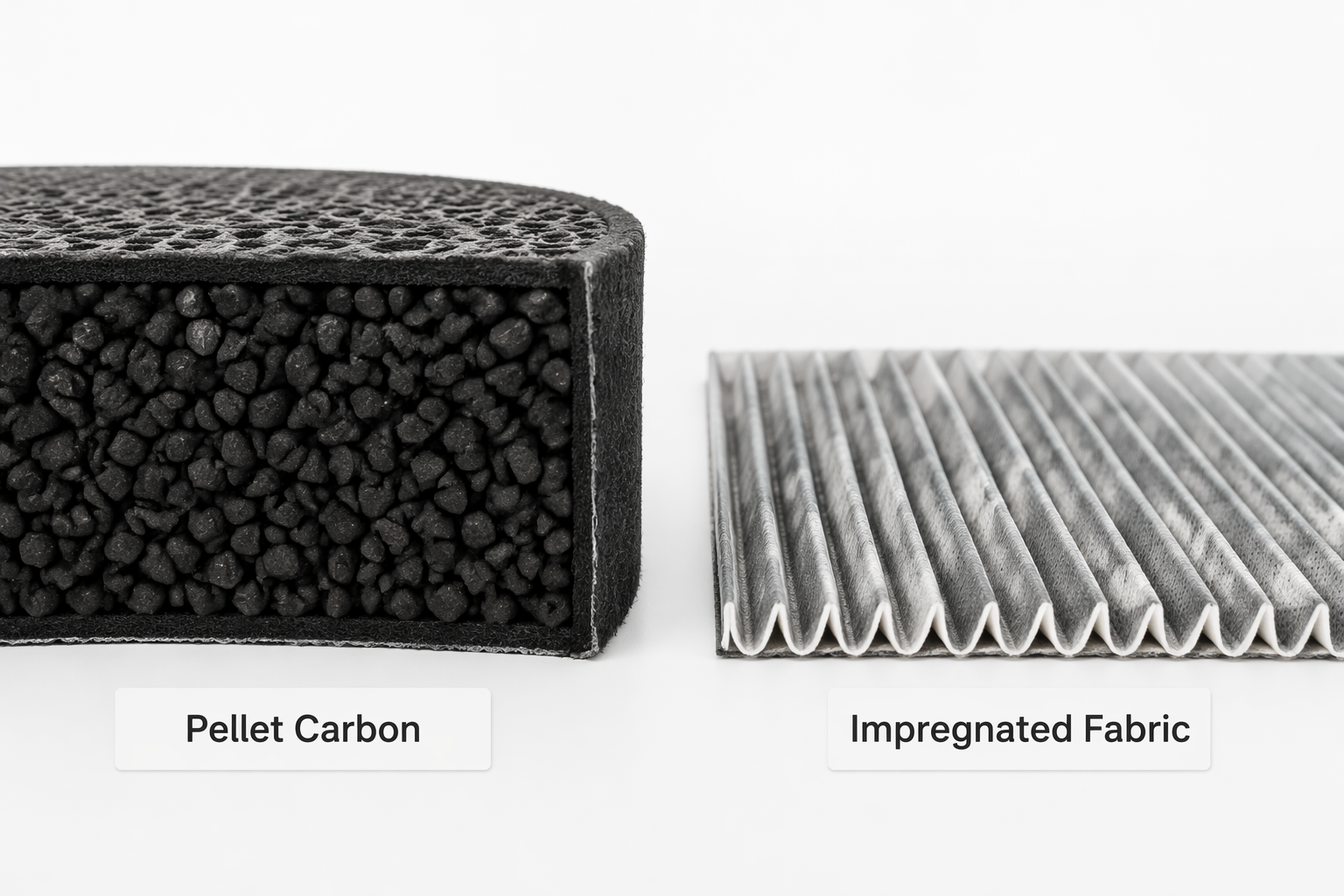
Carbon is where many smart purifiers get decorative. A thin carbon-impregnated fabric can help with light household smells, but wildfire smoke odor is harder. Pellet-based activated carbon gives gases and odor compounds more material to pass through. It will not turn a purifier into a full gas-removal system, and it will eventually saturate, but it is still the filter design to prefer when smoke smell is part of the problem.
Smart features matter after those basics are covered. A good auto mode with a real PM2.5 sensor can ramp the fan before you notice the room changing. App control lets you start the purifier from work, from a school pickup line, or before driving home through a smoky corridor. Voice support is convenient, especially if you already use Alexa or Google Home, but it should not be the reason to buy a weak smoke machine. If you are building routines around compatible devices, a broader smart-home buyer’s guide can help you decide how much ecosystem fit is actually worth.
Best Overall: Blueair Blue Pure 311i Max
The Blueair Blue Pure 311i Max is the safest broad recommendation here because it performs like a smoke purifier, not just a connected appliance. CNET names it a 2026 best overall pick and reports a T90 smoke-removal time of 1 minute 28 seconds, a 43.31 dBA mid-fan noise level, and 11.65 kWh per year energy use in its test data.[2]
That combination matters in an occupied room. A purifier that clears smoke quickly but sounds punishing often gets turned down. A purifier that is quiet but slow becomes background decor during a bad air day. The 311i Max lands in the practical middle: fast enough to take seriously, quiet and efficient enough to leave running, and smart enough to fit into a connected home.
Its smart features are also the kind that help during smoke rather than distract from it: auto mode, voice control, and an air quality indicator. The estimated filter cost is about $60 per year, so it is not the cheapest model to own, but the operating cost is reasonable for a purifier you may run hard through smoke season.[2]
Best Value: Levoit Core 400S
The Levoit Core 400S is the value pick because it checks the smoke boxes without making smart-home buyers give up app control. The available data lists a 260 CFM CADR, pellet carbon filtration, VeSync app control, Alexa and Google Home compatibility, coverage up to 403 square feet, and a typical price around $200.[3]
That 260 CFM rating is the reason it belongs near the top of a wildfire-smoke guide. The app and voice support are useful, but they are riding on top of an airflow number that makes sense for a bedroom, office, nursery, or compact living room. The pellet carbon detail also matters. Smoke smell is not solved by a glossy touchscreen.
It is also easier to recommend because the filter economics are not brutal. Estimated ongoing filter cost is around $40 per year, lower than the Blueair and Winix estimates. Air purifier prices often jump or dip around smoke events, so treat the purchase price as volatile and compare the replacement filter price at the same time.
For Google Home households, the Core 400S is also a good candidate for simple automations: turn on before a forecasted smoke window, run at a higher setting when indoor PM2.5 rises, or shut off only after air quality has stayed stable. If you want ideas beyond purifier control, see these Google Home automation recipes.
Best for Large Rooms: Coway Airmega 400S
The Coway Airmega 400S is the model to look at when the problem is not one bedroom but a larger shared space. Its smoke CADR is 350, and its listed coverage is up to 1,560 square feet. CNET also gave it a Lab Award for fastest particle removal and reports a 21-second T90 at high fan through smart mode.[2]
That does not make it a whole-house HVAC substitute. It is better to think of it as a serious purifier for a main zone: an open living room, kitchen-family room area, large primary bedroom, or the room where people and pets will spend most of a smoke day. If you are trying to make one safe room overnight, this is more machine than many people need. If you are trying to keep an open-plan zone from drifting upward all afternoon, the extra CADR is the point.
The smart premium has to be justified, because Wirecutter notes that the non-smart Blueair Blue Pure 211i Max typically sells for less than the smart Coway Airmega 400S while overlapping in coverage territory.[5] Choose the 400S when remote control, smart mode behavior, and Coway’s higher smoke CADR are worth paying for. If you only need raw non-smart coverage, that comparison gets less automatic.
Other Smart Smoke Picks Worth Considering
Coway Airmega 250S
The Coway Airmega 250S is the more compact Coway option to consider if the 400S feels oversized or overpriced. Consumer Reports includes it in its wildfire-smoke recommendations, which gives it smoke-specific credibility rather than just general purifier appeal.[1]
It fits the buyer who wants a mid-size smart purifier from a brand with strong air-cleaning reputation, but does not need to cover a large open zone. The decision mostly comes down to whether your room calls for the extra airflow of the 400S.
Winix 5510
The Winix 5510 is the budget-smart wildcard. It is the only sub-$200 model in this set with both a pellet carbon filter and a smart app, plus a 253 CFM CADR and roughly $50 per year filter cost.[3]
That makes it interesting for renters, secondary rooms, and buyers who need smoke protection now without crossing into premium pricing. The tradeoff is noise: HouseFresh data puts the Levoit Vital 200S quieter than the Winix 5510 at top speed, 57.7 dBA versus 65.7 dBA.[3]
Levoit Vital 200S
The Levoit Vital 200S has a strong case on paper: HouseFresh ranks it as its number one pick for most people, with about a $200 price, 249 CFM CADR, and quieter top-speed operation than the Winix 5510 in its testing.[3]
The reason it is not the top recommendation here is evidence breadth. CNET and Wirecutter did not test this model, so the strongest support comes from one testing source. That is not a dismissal. It is a confidence adjustment. If you trust HouseFresh’s methodology and the Vital 200S is on sale, it belongs on the shortlist.
Dyson Big+Quiet BP03
The Dyson Big+Quiet BP03 is the premium smart pick for people who care about design, polish, and connected controls as much as purification. PCMag names it a top smart air purifier in its 2026 guide.[4]
The buying caveat is unusually important. CNET notes that its smoke-chamber testing may disadvantage Dyson’s Air Multiplier design, which makes direct comparison harder than with boxier purifiers that pull and push air through the chamber in a more conventional way.[2] If you want the Dyson ecosystem and design, that caveat helps explain why lab rankings may not line up cleanly. If your only priority is smoke removal per dollar, the Blueair, Levoit, and Coway picks are easier to defend.
How to Size a Smart Purifier for Smoke
Start with the room where clean air matters most, not the largest room in the home by default. For many households, that is a bedroom. For others, it is a living room where kids, older adults, or pets spend most of the day. During a smoke event, one well-protected room is often more realistic than trying to purify every cubic foot at once.
- For bedrooms and home offices, look for a smart purifier near or above the 230 CFM smoke-CADR target when possible.
- For compact living rooms, the Levoit Core 400S and Blueair Blue Pure 311i Max class makes sense.
- For large open zones, step up to the Coway Airmega 400S class rather than trusting inflated coverage language.
- For an emergency safe room, prioritize airflow, filter availability, and noise over design.
- For multiple rooms, two smaller purifiers often beat one oversized purifier parked in the wrong place.
If the purifier will sit in a bedroom, noise matters more than spec sheets admit. You may run the fan on high before bedtime, but a machine that forces you to drop to a weak sleep mode all night may lose ground while smoke keeps entering. This is where measured sound levels and real test notes are more useful than a brand’s “whisper quiet” copy.
Smart Features That Actually Help
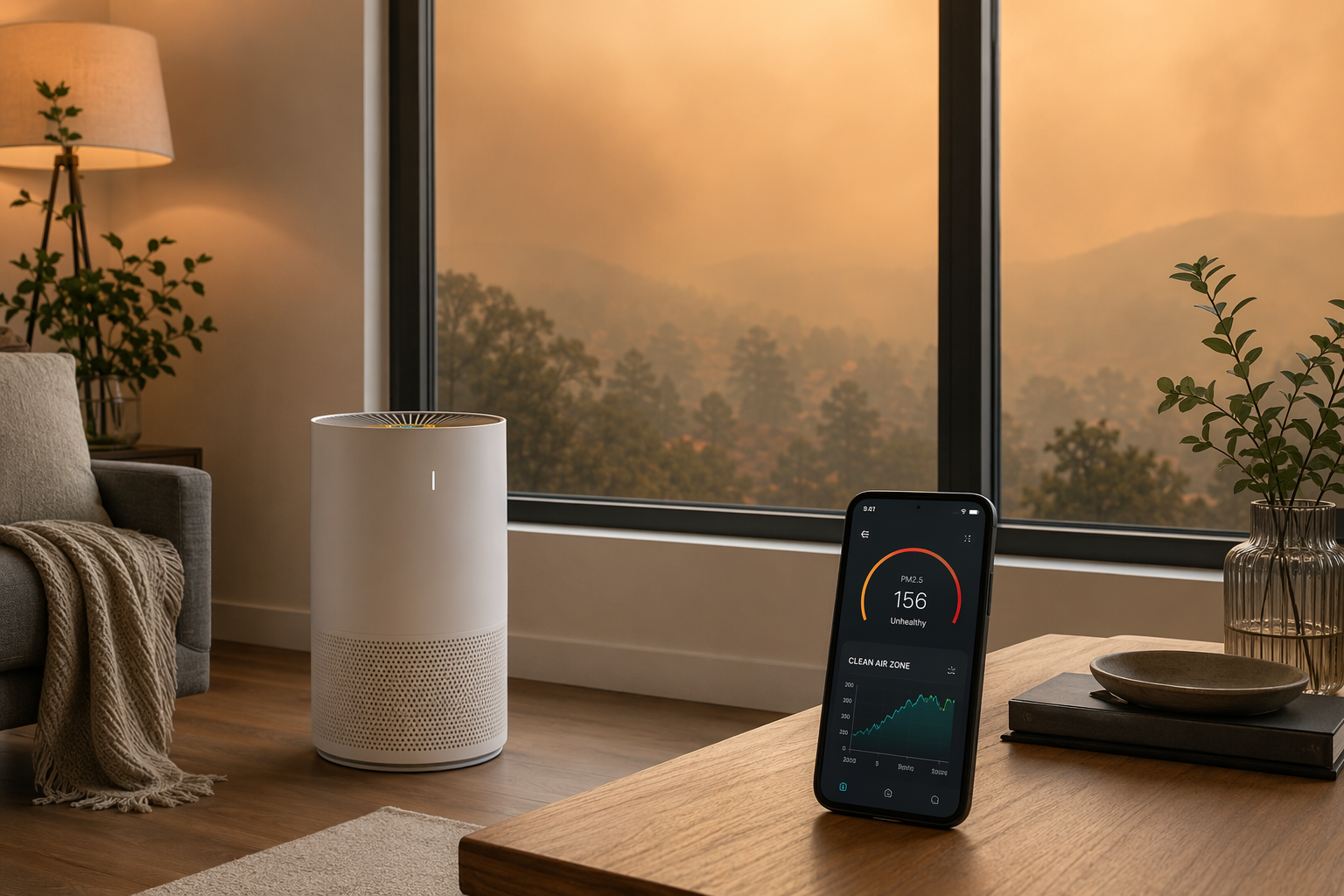
The best smart features for wildfire smoke are boring in the best way. They turn the purifier on before the room gets bad, raise the fan without waiting for a person to notice, and make it obvious when the air is improving. A PM2.5 graph falling in real time is not just satisfying; it tells you whether the machine is keeping up.
- Remote app control: useful when smoke is forecast or visible before you get home.
- Auto mode with PM2.5 sensing: useful when smoke leaks in gradually and no one is watching the app.
- Voice assistant support: useful for quick changes, less important than CADR.
- Air quality display: useful when deciding whether to keep windows closed, raise fan speed, or move activities to another room.
- Filter-life tracking: useful only if replacement filters are affordable and easy to find.
Do not overbuild the automation. A simple routine that turns the purifier on high before a smoke plume arrives is more useful than a complicated scene that depends on five cloud services. For safety planning beyond air cleaning, a smart smoke detector compatibility guide is the better place to think about alarms and household alerts.
The Buying Checklist
- Choose the room first, then size one step larger than you would for ordinary dust or pollen.
- Prioritize smoke CADR around 230 CFM or higher for the main protected room.
- Prefer pellet-based activated carbon over thin carbon-coated fabric if smoke odor matters.
- Check annual filter cost before treating a sale price as a bargain.
- Pick smart features that start, raise, or monitor filtration before and during smoke events.
- Buy the Blueair Blue Pure 311i Max for the best balance, the Levoit Core 400S for value, or the Coway Airmega 400S for larger zones.
References
- 5 Best Air Purifiers for Wildfire Smoke — Consumer Reports, updated July 16, 2026
- Best Air Purifiers for 2026: Lab-Tested Picks for Smoke — CNET, updated July 16, 2026
- The best air purifiers you can buy in 2026 — HouseFresh, June 8, 2026
- The Best Air Purifiers of 2026 — PCMag, April 3, 2026
- The 4 Best Air Purifiers of 2026 — Wirecutter, updated 2026