
Is sodium-ion really cheaper for home battery storage?
Cell-level prices put sodium-ion at near-parity with LFP, yet installed US home battery quotes still price sodium higher. Break the cost ladder down — cell, installed, cost-per-cycle — to tell which "sodium is cheaper" claim applies to your quote.
Last updated
A sodium ion vs lithium ion home battery storage cost comparison gets misleading fast if “cost” changes layers mid-sentence. At the cell layer, sodium-ion is already close to lithium iron phosphate, or LFP: Wood Mackenzie put 2025 average cell prices around $52/kWh for LFP and $59/kWh for sodium-ion, while still not expecting full price parity until around 2035.[1] At the installed US home-battery layer, the picture flips: NRG Clean Power estimates sodium-ion systems at about $1,000–1,300/kWh installed, versus $700–1,000/kWh for LFP, and puts a typical 10 kWh LFP system at $8,000–11,000 before incentives in mid-2026.[2]
Those two statements can both be true. The cell can be near parity while the homeowner’s installed quote is still worse. Between those layers sit the pack enclosure, battery management system, certification, shipping, installer margin, inverter support, usable capacity, warranty language, and the number of cycles the system is actually expected to deliver.
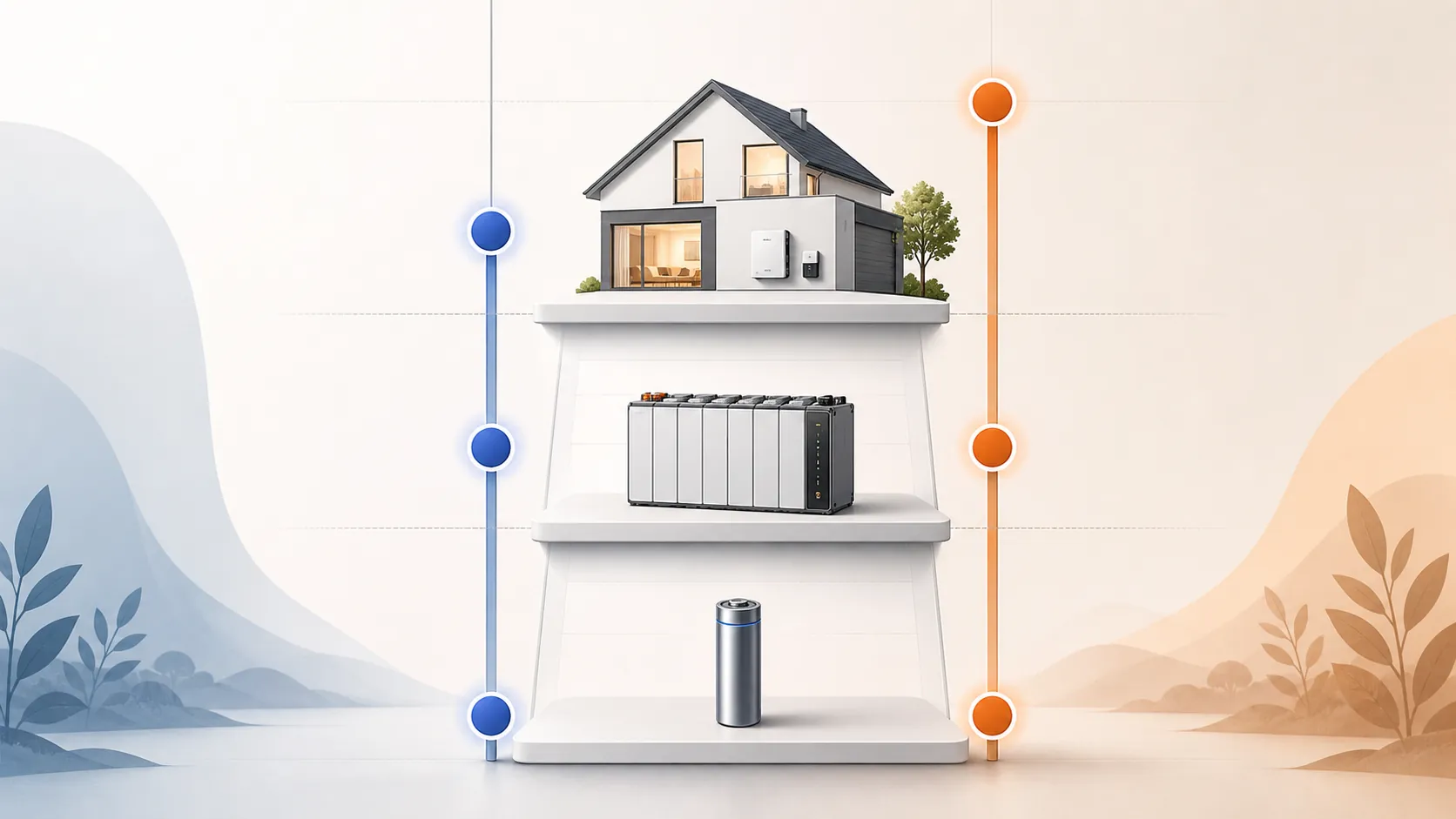
The cost ladder: cell, pack, installed system, usable kWh, warranted cycles
The cleanest way to read sodium-ion cost claims is to ask which rung of the ladder they describe. A cell-price forecast is useful, but it is not a quote. A pack price is closer, but still not an inspected home installation. An installed price still needs to be corrected for usable capacity. And even usable capacity is incomplete until the cycle life and warranty are clear.
| Cost layer | What it measures | What can go wrong in a quote |
|---|---|---|
| Cell | The battery cells before residential packaging, certification, inverter matching, and installation | A low cell price is used to imply a low installed system price |
| Pack | Cells plus enclosure, BMS, wiring, thermal and safety design, and product margin | The pack may not be certified, supported, or available through normal US installers |
| Installed system | Hardware, labor, permitting, integration, inspection, and installer margin | A chemistry advantage disappears inside certification, availability, and channel costs |
| Usable kWh | Energy the homeowner can actually discharge through the inverter under configured limits | Voltage-window mismatch or conservative settings reduce delivered capacity |
| Warranted cycles | How many usable cycles the seller is willing to stand behind | A cheap battery looks expensive if the warranted cycle count is short or vague |
For a homeowner, the useful comparison is rarely “sodium-ion versus lithium-ion” in the abstract. It is one quoted sodium-ion system against one quoted LFP system, with the same backup loads, the same inverter plan, the same permit path, and the same definition of usable capacity.
Why the cheaper-cell story is plausible
The sodium-ion cell-cost argument is not vapor. Several 2026 comparisons put sodium-ion close to LFP at the cell or large-system level, even when they disagree on when durable parity arrives.
Wood Mackenzie’s comparison is conservative: sodium-ion cells averaged about $59/kWh in 2025 versus about $52/kWh for LFP, with parity expected around 2035.[1] A Capital Dynamics analysis, summarized by ESS News, placed sodium-ion and lithium-ion BESS cost parity not before 2031 and described a 13% utility-scale differential in its comparison.[3] Zvepow, a Chinese B2B battery vendor rather than an independent forecaster, cited sodium-ion battery cells around $50–56/kWh in 2026 and projected sodium-ion below LFP in 2027, while also referencing an IRENA target of $40/kWh by 2030.[4] A LUT University and Karlsruhe Institute of Technology study, summarized by ESS News, found sodium-ion cells already near lithium-ion cost parity and expected further cost declines.[5]
Those are not interchangeable forecasts. They describe different layers, regions, methods, and lithium-price assumptions. A utility-scale BESS parity model does not become a US garage-wall quote. A China-priced cell estimate does not include US residential certification, installer channel costs, or the inverter already mounted beside a homeowner’s service panel.
The raw-material logic explains why the cell-level optimism keeps returning. The IEA notes that sodium carbonate traded around $100–500 per tonne through 2020–2024, while lithium carbonate ranged from about $6,000–83,000 per tonne; it also notes that lithium prices are roughly 70% below their 2022 peak but doubled over the past year.[6] Sodium is not automatically cheap as a finished home battery, but the input-cost contrast is large enough that dismissing the chemistry outright is sloppy.
Where the US installed-price claim breaks
The installed layer is where a homeowner has to stop giving the chemistry the benefit of the doubt. In mid-2026, public US residential sodium-ion pricing is thin. NRG’s estimate puts sodium-ion installed at $1,000–1,300/kWh, higher than LFP’s $700–1,000/kWh installed range.[2] That does not prove every sodium quote will be worse, but it does mean “sodium cells are cheaper” is not enough evidence for a buying decision.
The few concrete residential sodium-ion prices are useful, but they do not transfer cleanly to a US installed quote. Freen’s 10 kWh residential sodium-ion system was launched in Estonia at about €3,000, with stated compatibility across SMA, Sungrow, Growatt, Deye, and GoodWe systems, and a 48 V nominal battery with a 40–60 V operating window.[7]
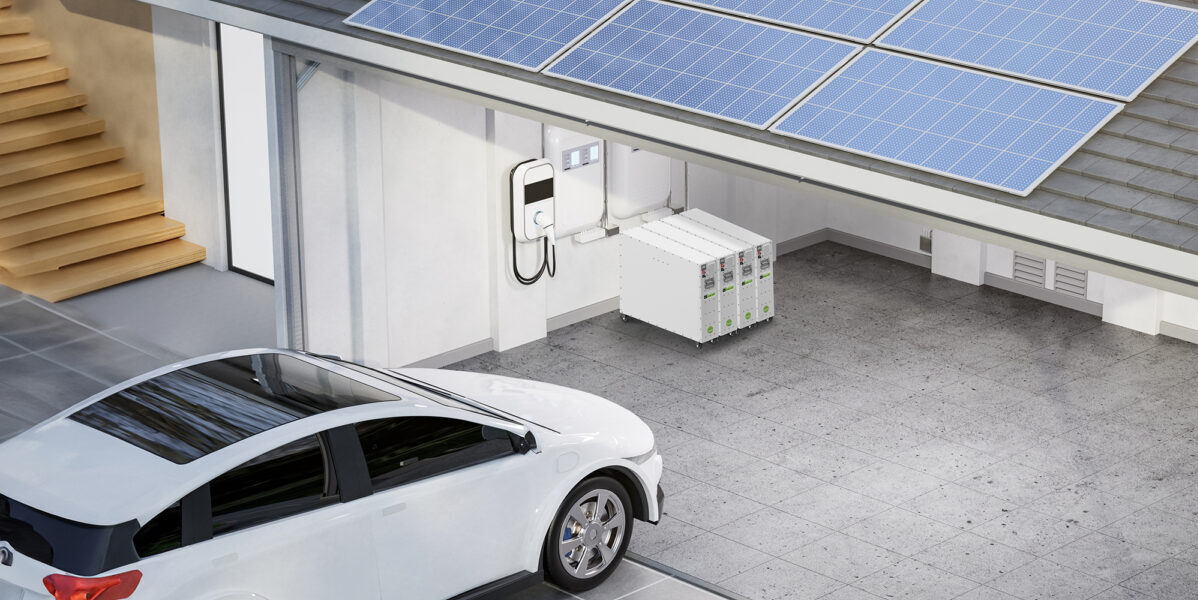
That is a real product-level data point, not just a chemistry slide. It still is not a US installed price. It does not answer US permitting, listing, local installer support, inspection practice, freight, tariff exposure, service availability, or warranty handling through a US solar contractor.
UNIGRID’s Na+Casa is the more relevant US watch item because it is explicitly aimed at residential energy storage and has a US launch planned for the end of 2026. The announced pack is 9.25 kWh, uses a NaCrO2 sodium-ion chemistry, claims 10,000 cycles at 100% depth of discharge, and is described as having a 25-year design life.[8] But the pricing language is still “competitive with lithium-ion,” not a published US list price, and Solar Power World reported that the product held UN 38.3 while UL 9540 and UL 1973 were pending.[9]
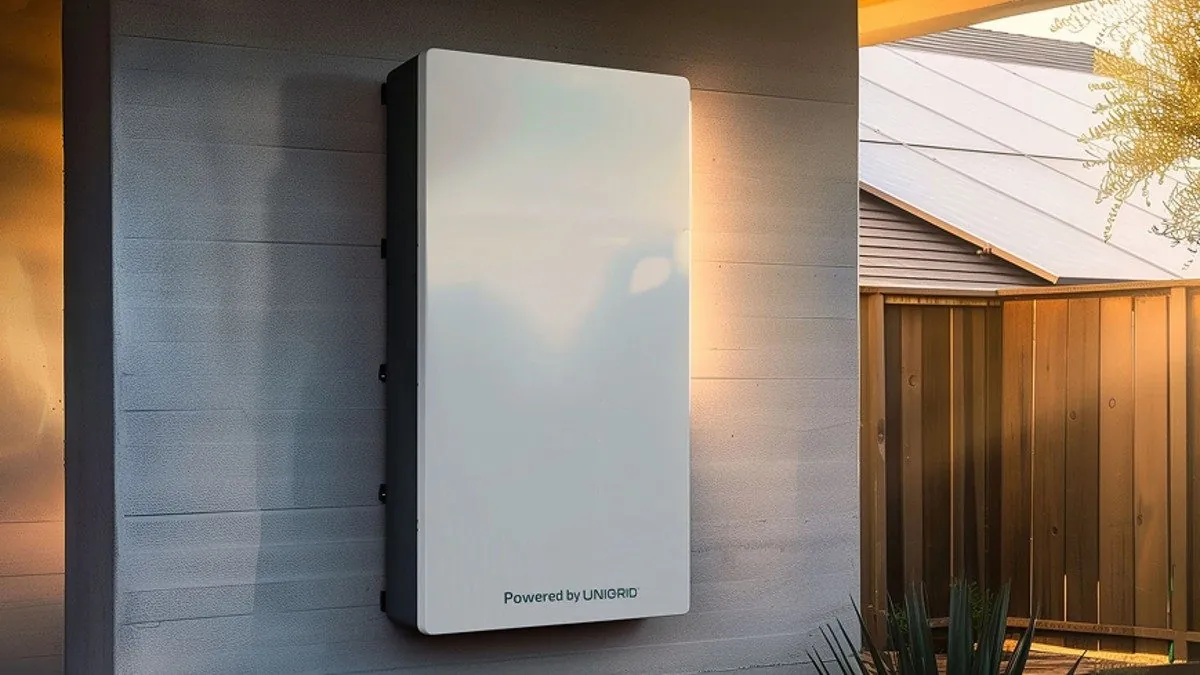
Pending certification is not a footnote for a homeowner. It can decide whether an installer will quote the product, whether an authority having jurisdiction will approve it, whether a utility program will accept it, and whether the inverter manufacturer will support the configuration. A battery that looks inexpensive in a launch story can be unavailable, non-quotable, or expensive to integrate in the actual bid.
The inverter voltage window can change the usable kWh
Compatibility is not just “does the plug fit?” Sodium-ion’s discharge curve is more sloped than LFP’s. EcoFlow and Battle Born both warn that this can cause an inverter’s low-voltage cutoff to stop discharge while the sodium-ion pack still contains energy.[10][11] If that happens, the homeowner did not buy the nameplate capacity they thought they bought; they bought whatever capacity the inverter and battery can deliver together inside the configured voltage window.
This is the same kind of verification problem that shows up in smart-home energy systems more broadly: the battery, inverter, gateway, energy-management software, utility program, and backup-load panel all have to agree. The same status-labeled thinking used for V2G smart-home compatibility belongs here too. A sodium-ion quote should identify the inverter model, operating voltage range, supported battery profile, firmware assumptions, and the usable kWh after those limits are applied.
Cost per usable cycle is the homeowner’s decision engine
Installed dollars per kWh is still incomplete because home batteries are not single-use tanks. A more useful comparison is cost per warranted usable cycle:
Installed system cost ÷ (usable kWh × warranted cycles) = cost per warranted usable kWh-cycleThis does not capture every value of backup power. A battery that keeps a medical device, refrigerator, sump pump, or communications gear running during an outage can be worth more than its arbitrage math. But for comparing two solar-battery quotes, the formula forces the right questions into the open.
If a sodium-ion system is quoted at a higher installed price but carries a clearly warranted 10,000-cycle claim at high usable depth of discharge, it can close the lifetime-cost gap. UNIGRID’s launch materials claim 10,000 cycles at 100% DoD for Na+Casa, which is exactly the sort of specification that could matter if it is backed in the final US warranty and accepted by the installer’s design.[8] If the cycle claim appears only in marketing copy, or if the warranty excludes the homeowner’s expected use pattern, the cost-per-cycle advantage may evaporate.
This is where sodium-ion TCO claims become messy. The Volta Foundation published an Alsym-contributed analysis claiming sodium-ion can deliver 18–25% lower total cost of ownership than LFP over 10 years.[12] Battle Born, an LFP seller, argues from the opposite direction and says real sodium packs can cost about double equivalent LiFePO4 today.[11] Those two claims cannot both describe the same homeowner purchase under the same assumptions.
The disagreement is not surprising. A TCO model can swing on cycle count, depth of discharge, usable voltage window, shipping weight, thermal requirements, warranty replacement terms, and whether the product is already certified and locally supported. The Volta/Alsym claim is commercially interested and model-dependent. Battle Born’s critique is also commercially interested and reflects an incumbent LFP seller’s view of current sodium-ion readiness. Neither should be pasted into a homeowner spreadsheet without the assumptions attached.
What to ask when a sodium-ion quote says it is cheaper
The quote needs to survive a layer-by-layer audit. If an installer cannot answer these items, the comparison against LFP is not mature enough to rely on.
- Installed price: Is the quoted price fully installed, permitted, commissioned, and inspected, or is it a hardware-only battery price?
- Usable capacity: What usable kWh will the system deliver after inverter voltage limits, reserve settings, backup configuration, and warranty limits?
- Inverter support: Is the exact inverter model approved for the sodium-ion pack, including firmware version and battery profile?
- Certification: Which standards are already complete for the product being installed, and which are pending?
- Warranty: How many cycles are warranted, at what depth of discharge, over what calendar term, and to what retained capacity?
- Service path: Who handles warranty replacement if the installer disappears or the sodium-ion vendor changes its US channel?
- Backup design: Which loads are on the backup panel, how long do they need to run, and does the battery have enough sustained and surge output for those loads?
The last item is where cost comparison meets outage reality. A lower-cost battery that cannot support the loads a homeowner actually wants backed up is not cheaper; it is smaller in the only way that matters during an outage. For load selection and runtime thinking, start with practical backup sizing rather than chemistry preference: NestGrid’s three-tier smart-home power backup approach and UPS or power station decision path are closer to the homeowner’s problem than another cell-price chart.
The clean comparison against LFP
Sodium-ion deserves attention because the cell-cost and raw-material case is credible. It may become a very strong home-storage chemistry as products certify, channels mature, and inverter support becomes ordinary. But in Q3 2026, a US homeowner should not treat sodium-ion cell parity as installed-system parity.
The comparison is real only when both proposals are put on the same basis: installed price, certified hardware, usable kWh through the actual inverter, backup-load fit, and warranted cycles. If the sodium proposal is cheaper only by citing cell prices, ignore the headline. If it is cheaper on installed usable kWh, certified for the home use case, compatible with the inverter voltage window, and backed by clear cycle and warranty terms, then the homeowner finally has a fair comparison against LFP.
References
- Sodium-ion batteries enter energy storage market — Wood Mackenzie
- Solar Battery Cost — NRG Clean Power
- Sodium-ion vs lithium-ion BESS cost parity not before 2031 — ESS News, May 19, 2026
- Sodium Ion Battery Cost per kWh in 2026 — Zvepow
- Sodium-ion battery cells already near lithium-ion cost parity, set to get cheaper — ESS News, January 9, 2026
- Sodium-ion battery momentum grows, but challenges remain — International Energy Agency
- Estonia’s Freen launches 10 kWh residential sodium-ion battery — ESS News, March 18, 2025
- UNIGRID unveils sodium-ion residential energy storage systems — pv magazine, July 8, 2026
- UNIGRID unveils 9.25-kWh sodium-ion battery for residential applications — Solar Power World, July 2026
- Sodium-Ion vs LFP: Which Is Better? — EcoFlow
- Sodium-Ion vs. Lithium Batteries — Battle Born Batteries
- Assessing the Promise and Potential of Sodium-Ion Batteries in 2026 — Volta Foundation
Known issues with this device / protocol
Spec-version history
For active regressions on this protocol, see Update Watch.
No linked Update Watch entries yet.