
Which V2G EVs and Chargers Work With Your Smart Home in 2026?
Not all EVs and bidirectional chargers work with your home energy management system. This status-labeled compatibility matrix (verified mid-2026) shows you exactly which combinations actually interoperate, their installed costs, and which utility V2G programs they unlock.
Last updated
A vehicle to grid smart home energy management setup is not one purchase in 2026. It is a chain: EV, bidirectional charger or home energy kit, transfer or interconnection hardware, HEMS/control software, utility approval, and sometimes a utility compensation program. If one link is only “coming soon,” the system may still be useful as an EV and charger, but it is not yet a working V2G/V2H stack for a house.
The cleanest way to shop is to stop asking whether a car is “bidirectional-ready” and ask which named combination works now. As a baseline, ZeCar’s February 2026 list counted only two EVs with official V2G/V2H certification globally: the Nissan Leaf via CHAdeMO and the Kia EV9 via CCS. The same list counted 54 models with V2L, which is useful for powering tools or appliances but is not the same thing as controlled home backup or grid export. [1]
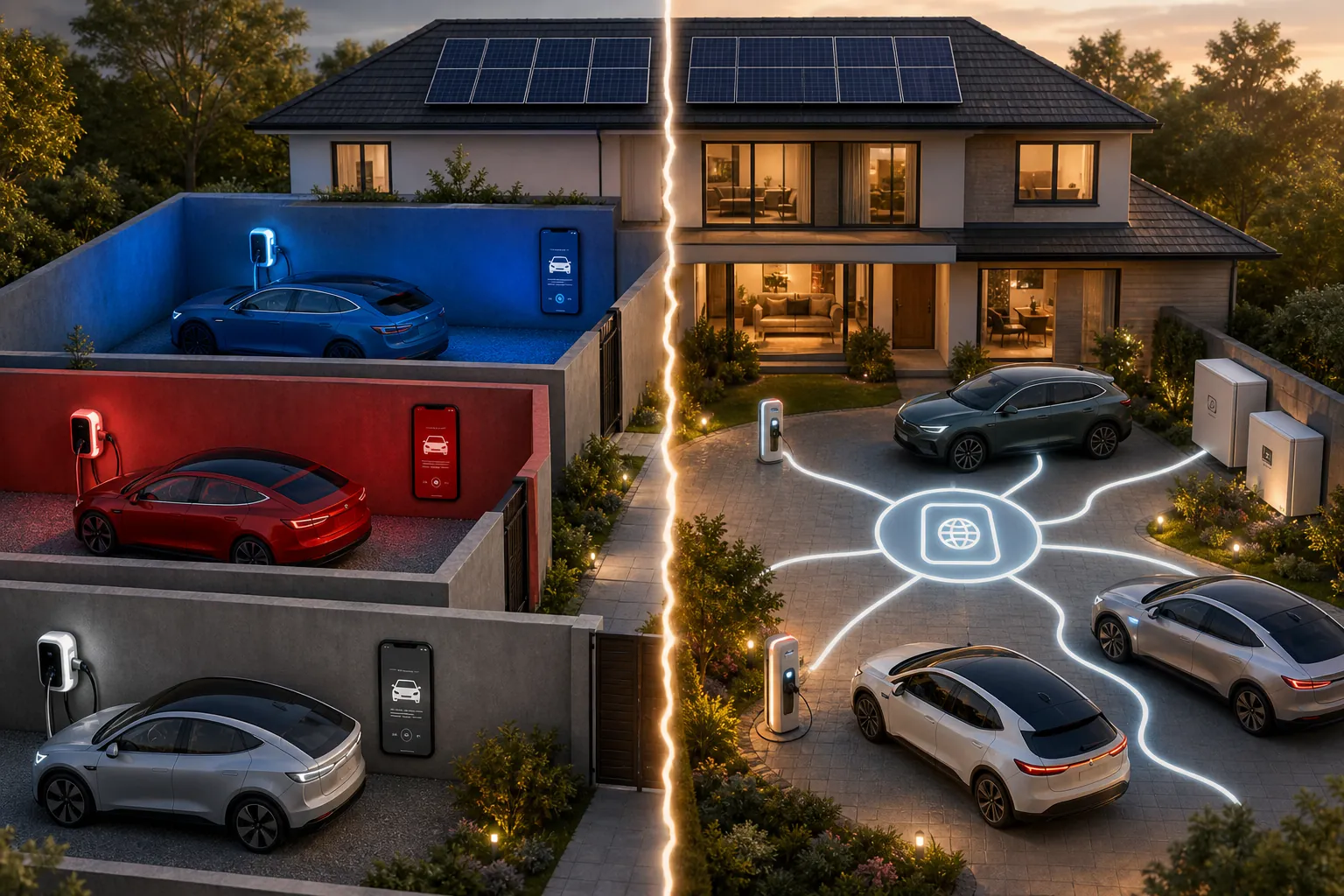
That leaves the mid-2026 market split in two. Ford, GM, and Tesla have the more concrete homeowner paths, but each path is controlled by its own vehicle, hardware, and app ecosystem. The standards-based side, built around ISO 15118-20 over CCS and NACS, is the more attractive long-term direction, but it still depends on vehicle software enablement, charger availability, local export approval, and HEMS support.
Status Labels Used In This Matrix
| Status label | What it means for a homeowner |
|---|---|
| Working proprietary V2H | A named automaker stack can provide home backup today, but it is not a broadly interchangeable V2G ecosystem. |
| Certified V2G/V2H | The EV has official bidirectional certification, but the homeowner still needs a compatible charger, HEMS path, and utility approval. |
| Standards path emerging | The charger or vehicle is built for ISO 15118-20-style interoperability, but residential availability, software, or export approval is still the gating item. |
| Hardware-ready / not enabled | The vehicle or charger may contain relevant hardware, but should be treated as not compatible until software and program access are confirmed. |
| Legacy working path | The chain can work in a narrow older ecosystem, usually CHAdeMO, but may not be a good new-install choice unless the homeowner already owns the vehicle. |
The labels are intentionally conservative. “Installed,” “available,” “certified,” “enabled,” and “eligible for export” are different claims. A quote that includes the charger and the transfer equipment still does not prove that the utility will allow export, or that the HEMS platform can schedule discharge against a tariff.
Mid-2026 Compatibility Matrix: EV, Charger, HEMS, Utility Path
| Ecosystem | EV | Bidirectional hardware | HEMS / control layer | Mid-2026 status | Cost and utility-program notes |
|---|---|---|---|---|---|
| Ford proprietary | Ford F-150 Lightning | Ford Charge Station Pro + Home Integration System | Ford-controlled home backup stack | Working proprietary V2H | Clean Energy Reviews lists the installed Ford home backup path at roughly $12,000-$15,000. Utility V2G enrollment is not a universal feature of the hardware stack. [2] |
| GM proprietary | GM Ultium EVs supported by GM Energy V2H rollout | GM PowerShift Charger + V2H Enablement Kit; optional stationary battery | GM Energy app | Working proprietary V2H where supported | The hardware bundle is reported around $7,300, or up to about $12,700 with battery. GM described its expanded V2H push in February 2026. [2][3] |
| Tesla proprietary | Tesla Cybertruck | Tesla Powershare | Tesla app / Tesla energy ecosystem | Working proprietary V2H for Cybertruck | Clean Energy Reviews lists Powershare as limited to Cybertruck at 9.6 kW. Broader Tesla vehicle support should not be assumed. [2] |
| CHAdeMO legacy | Nissan Leaf | CHAdeMO bidirectional charger, commonly associated with Quasar 1-type legacy paths | Home Assistant via V2G Liberty where the charger/vehicle combination is supported | Certified / legacy working path | Official certification exists, but this is not the same as a modern CCS/NACS standards path. Homeowner utility enrollment depends on local program rules. [1] |
| CCS certified | Kia EV9 | Compatible CCS bidirectional charger where available and approved | Depends on charger ecosystem and regional integration | Certified V2G/V2H, but homeowner chain must be verified | Certification is stronger than hardware readiness, but export approval and HEMS integration still need to be checked before purchase. [1] |
| ISO 15118-20 emerging | BMW iX3 Neue Klasse | Regional ISO 15118-20-compatible V2G hardware through supported partners | E.ON-connected path in Germany; app/EMS layer depends on the offering | First production ISO 15118-20 V2G path reported for 2026 | TMH Energy’s June 2026 list reports the iX3 Neue Klasse shipping with V2G enabled through E.ON in Germany. This should not be generalized to all countries. [4] |
| ISO 15118-20 emerging | Hardware-ready CCS/NACS vehicles, including some Volvo, VW ID., and future models depending on software | Wallbox Quasar 2, Ambibox ambiCHARGE, Sigenergy SigenStor, or other approved bidirectional hardware | Sourceful EMS, Elli app, Enphase ecosystem, or charger-specific control layers where supported | Standards path emerging / often not yet enabled | Wallbox Quasar 2 is reported around €5,500-€6,500; Sigenergy SigenStor around $4,000-$7,000. Availability and export approval vary by country and utility. [2][5] |
This is why two quotes for “bidirectional charging” can describe very different homes. A Ford or Tesla proposal may be more restrictive, but the installer can point to a known vehicle, home kit, and control app. A standards-based quote may look more future-proof, but it can still be waiting on the carmaker’s software switch, the charger’s regional rollout, or the utility’s export process.
For readers already maintaining smart-home compatibility sheets, this matrix behaves more like a solar-battery hub compatibility matrix than a charger spec comparison. The connector matters, but the control stack decides what the house can actually do.
Where The Proprietary Stacks Are Stronger
The Ford, GM, and Tesla paths are not open in the way a standards-minded buyer would prefer. They are also the least ambiguous options for a homeowner who wants a vendor-backed installation path in 2026. The vehicle, charger, enablement kit, transfer hardware, and app are sold as a system rather than assembled from separately compatible parts.
Ford’s path is the bluntest example: F-150 Lightning, Charge Station Pro, Home Integration System, and Ford’s backup controls. The cost is not small, with reported installed totals around $12,000-$15,000, but the stack is at least nameable. The buyer’s next question is not “which ISO profile does this support?” It is “does my panel, service size, permit office, and backup-load design fit this kit?” [2]
GM’s PowerShift stack is similar in structure. GM has been explicit about pushing vehicle-to-home capability across supported EVs, and the GM Energy app becomes the control center rather than a neutral HEMS layer. That is convenient if the household is comfortable buying into GM Energy. It is less attractive if the goal is to mix a vehicle, a third-party bidirectional charger, a separate HEMS, and a utility program without waiting for integrations to mature. [3]
Tesla Powershare is even narrower because the mid-2026 working path is tied to Cybertruck. The reported 9.6 kW output is meaningful for backup, but “Tesla supports Powershare” is still not the same as “any Tesla in the driveway can run my home or export to my utility.” [2]
Where ISO 15118-20 Is Promising, And Where It Still Leaves Gaps
The standards-based route is where the long-term smart-home argument lives. ISO 15118-20 is meant to support bidirectional power negotiation in a more interoperable way than older proprietary stacks. In a mature version of this market, a homeowner should be able to choose among compatible EVs, chargers, HEMS platforms, and utility programs without treating the automaker app as the only control room.
That mature version is not fully here. Sourceful’s setup guidance treats the home V2G chain as a combination of compatible vehicle, bidirectional charger, grid connection, EMS, and tariff or program access; it also notes that costs and savings depend heavily on region and approval. A charger that supports the right communication standard can still sit behind a utility process that does not yet allow export. [5]
BMW’s iX3 Neue Klasse is the strongest 2026 signal on the standards side because TMH Energy reports it as a production ISO 15118-20 V2G vehicle shipping with V2G enabled through E.ON in Germany. That is a real chain, not just a slide about readiness. But it is also geographically bounded: a German E.ON path does not automatically create a US homeowner path, a different utility enrollment path, or a generic third-party HEMS path. [4]
Wallbox Quasar 2, Ambibox ambiCHARGE, and Sigenergy SigenStor are important because they move the residential CCS bidirectional charger market away from the old CHAdeMO corner. Clean Energy Reviews describes Quasar 2 and Ambibox among the bidirectional chargers reaching the market, while Sourceful includes Sigenergy in the home setup cost range. That makes them worth watching closely, but not worth treating as universally compatible at checkout. [2][5]
Matter does not erase this problem either. Matter-based energy management can help smart-home devices expose energy data and controls more consistently, but V2G still needs the EV, charger, interconnection, and utility program to agree. The protocol context is useful if you are comparing future HEMS architectures; it is not a shortcut around vehicle enablement. See Matter EV charger energy management for that layer.
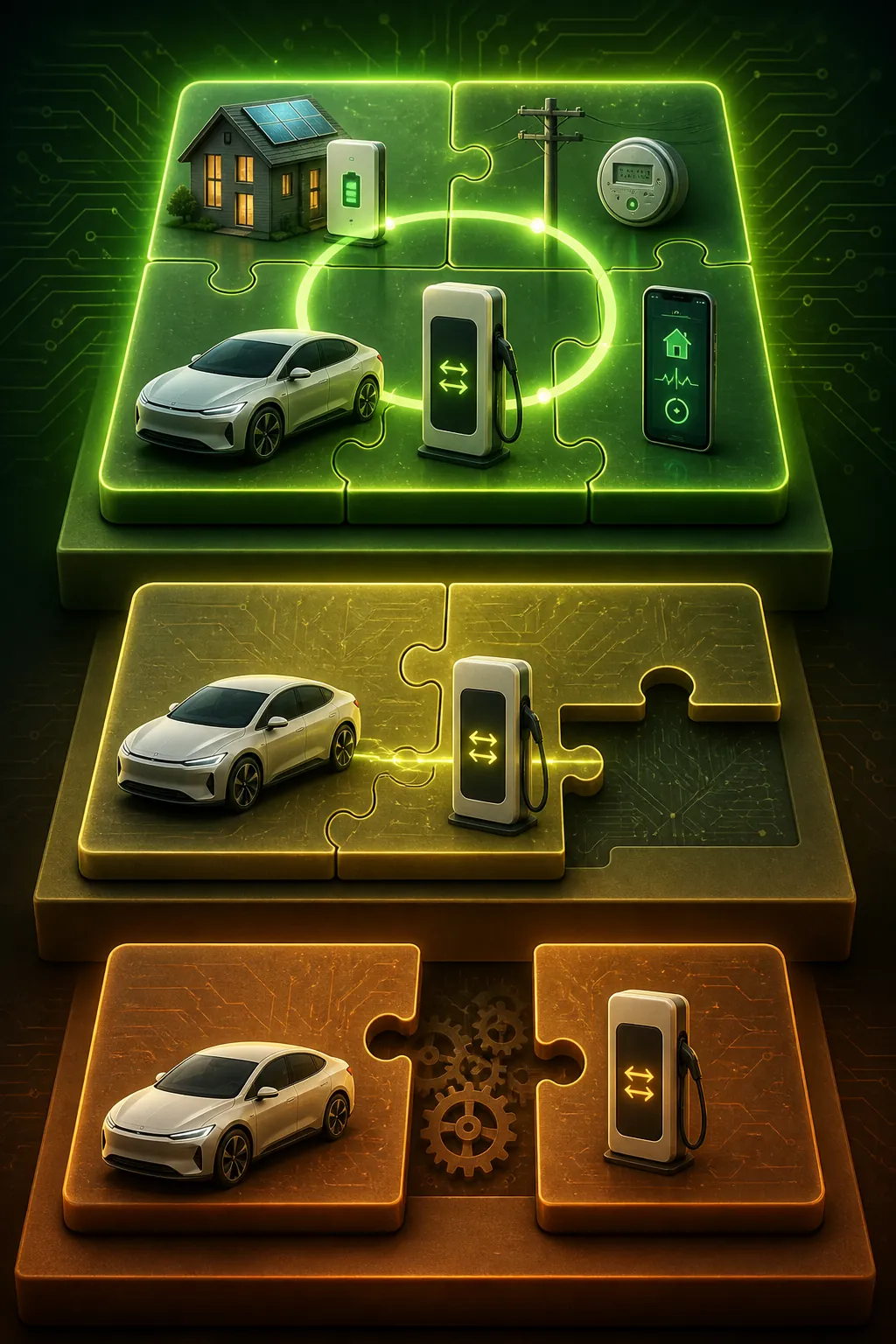
HEMS Compatibility Is Still Fragmented
The HEMS layer is where optimistic compatibility language usually gets expensive. A smart-home platform can monitor loads, schedule devices, and respond to tariffs, but that does not mean it can command a specific EV battery through a specific bidirectional charger under a utility-approved export arrangement.
| HEMS / control platform | What it can reasonably mean in 2026 | Compatibility caution |
|---|---|---|
| Home Assistant + V2G Liberty | A community/open-source route for CHAdeMO-era V2G control, especially with supported Nissan Leaf and charger combinations. | V2G Liberty is not a universal CCS/NACS bridge; its repository points to a specific supported architecture. [6] |
| GM Energy app | The control layer for GM’s own PowerShift and V2H offering. | Useful inside GM’s stack; not a neutral HEMS for every bidirectional charger. |
| Tesla app | The control layer for Powershare and Tesla home energy behavior. | Tied to Tesla’s supported vehicles and hardware. |
| Elli app | Relevant to VW-group energy services where enabled. | Treat VW ID. and related bidirectional claims as region- and software-dependent unless the exact chain is confirmed. |
| Sourceful EMS | A standards-oriented EMS path for supported V2G setups. | Still depends on local vehicle, charger, tariff, and grid-export approval. [5] |
| Enphase ecosystem | A mature home-energy ecosystem that may be part of a broader solar/battery/control design. | Do not assume EV battery dispatch unless the specific EV charger and vehicle integration is listed. |
For tariff automation, the HEMS also needs something useful to optimize against. Time-of-use rates, dynamic prices, demand-response events, export limits, and backup reserve settings all pull the EV battery in different directions. A household using dynamic pricing smart-home automation will care less about a pretty app screen and more about whether the EV can actually charge low, discharge high, and preserve enough battery for tomorrow’s driving.
Utility Programs Can Make The Math Work, But They Are Not Portable
The best V2G paybacks usually come from program participation, not from occasional outage backup. Emporia’s V2G guide cites examples including National Grid Connected Solutions in Massachusetts at up to $1,500 per year, Eversource around $3,000 per year, and the University of Delaware/PJM example around $1,200 per vehicle per year. Those numbers are attractive, but they come from specific programs and pilots, not a guaranteed national rate card. [7]
DOE’s bidirectional charging materials also frame EVs as mobile storage assets that can support buildings and the grid, but the federal explanation does not make a local interconnection agreement appear on its own. The practical question remains: does the utility recognize this charger, this inverter behavior, this metering arrangement, and this dispatch program? [8]
Before counting a rebate or dispatch payment, check the program’s device eligibility list the same way you would check a thermostat or battery enrollment list. The process is closer to demand-response device eligibility than to buying a normal Level 2 charger.
The Phrases That Need A Hard Stop In A Sales Quote
The dangerous language is not usually false. It is incomplete. “Bidirectional-capable” may describe onboard hardware. “V2G-ready” may describe a charger’s planned standards support. “Home backup available” may mean only one vehicle model, one transfer kit, and one app. “Utility program eligible” may mean eligible after approval, not automatically enrolled.
- Ask for the exact EV model year and software status, not just the vehicle platform.
- Ask whether the charger supports the required bidirectional mode now, in your country, with your connector.
- Ask which HEMS or app controls discharge, reserve level, outage mode, tariff response, and export behavior.
- Ask whether the installation quote includes transfer equipment, permits, utility interconnection, and any required meter changes.
- Ask for the utility program name and device eligibility page before counting annual compensation.
If the seller cannot name those pieces together, the system may still be a reasonable future bet, but it should be priced and judged as a future bet.
Savings And Backup: Useful, Conditional, Not Automatic
Sourceful’s home V2G guide puts typical annual V2G value around €500-€1,500 through tariff arbitrage and grid services, with a charger-investment payback window around 4-10 years. Those are plausible planning ranges for supported markets, but they should not be copied into a US project without adjusting for local installation costs, tariffs, export limits, and incentives. [5]
Backup power is the easier benefit to understand and the harder one to size honestly. Emporia notes that a typical EV battery in the 60-100 kWh range can power an average US home using about 30 kWh per day for roughly 2-4 days, and that some fully charged EVs could stretch much longer with careful management. That does not mean every installation backs up every circuit, or that the car will be full when the outage starts. [9]
For most households, the right design question is not maximum days of backup. It is which loads stay on, how much driving range must remain, whether solar can recharge the EV during an outage, and whether the HEMS can enforce those priorities without someone manually babysitting the app.
Buying Judgment For Q3 2026
Choose the equipment stack before choosing the savings story. In Q3 2026, Ford, GM, and Tesla offer the clearest named homeowner paths, but they come with lock-in. CHAdeMO has the most proven legacy V2G route through the Nissan Leaf, but it is not the direction most new CCS/NACS installations are trying to go. The ISO 15118-20 ecosystem is the better interoperability bet, yet many combinations still sit between hardware readiness and actual residential enablement.
If a vehicle is only hardware-ready, treat it as not compatible until the software is enabled, the charger is available in your region, the HEMS/control layer is named, and the utility pathway is confirmed. That rule may feel conservative, but it is cheaper than discovering after installation that the car, charger, app, and utility were each waiting for someone else to finish the handoff.
References
- Which Electric Cars Have Bidirectional Charging? — ZeCar, February 2026.
- Bidirectional EV Chargers Review — Clean Energy Reviews, June 2026.
- GM leads the charge in vehicle-to-home EVs — GM News, February 19, 2026.
- Which Cars are V2G Capable? 2026 List — TMH Energy, June 2026.
- How to Set Up V2G at Home — Sourceful Energy.
- V2G Liberty GitHub repository — GitHub.
- What is V2G? — Emporia Energy.
- Bidirectional Charging and Electric Vehicles for Mobile Storage — DOE FEMP.
- Bidirectional EV Charging: Everything You Need To Know — Emporia Energy.
Known issues with this device / protocol
Spec-version history
For active regressions on this protocol, see Update Watch.
No linked Update Watch entries yet.