
Texas Solar Battery Compatibility With Smart Home Hubs
A Texas-specific, dated-verification compatibility check comparing major solar battery systems against common smart home hubs, helping homeowners determine which combinations support automated backup during ERCOT grid events.
Last updated
The Texas solar backup question gets very plain in July: when ERCOT is tight, the lights flicker, and the house moves from normal mode to backup mode, can your battery tell your hub what is happening before the refrigerator, router, thermostat, and bedroom circuits all keep behaving as if nothing changed?
That is not a theoretical edge case in 2026. ERCOT’s planning reserve margin has been reported at 9.8% against a 13.75% target, Texas has already seen a 92,211 MW summer peak, and solar generation is forecast to exceed coal in ERCOT for the first time this year.[1][2] Texas outage planning also has to account for the difference between an average interruption and a multi-day event like Uri in 2021 or Beryl in 2024.[3]
So the useful question is not “does this battery have an app?” It is whether the battery, inverter, gateway, or smart panel exposes a local API or certified smart energy interface that your hub can use while the internet is degraded. Verified July 24, 2026, the answer is still uneven.
Compatibility Matrix, Verified July 24, 2026
| System | Home Assistant | Hubitat | Homey Pro | Apple Home | Alexa | Google Home | Local API / Matter | Cloud dependency | Circuit or load control | Outage automation judgment |
|---|---|---|---|---|---|---|---|---|---|---|
| EcoFlow DELTA Pro Ultra X + Smart Home Panel 3 | Investigating / possible through EcoFlow paths | Investigating | Investigating | Investigating through Matter claim | Investigating through Matter claim | Investigating through Matter claim | Vendor claims Matter 1.4 HEMS support; local control route still needs certification and hub exposure verification | EcoFlow app/cloud and BLE paths may matter depending on setup | 32 independently controlled circuits claimed; sub-20 ms UPS transfer claimed | Most standards-forward claim, but do not treat as certified until CSA-IOT records and target hub support are checked |
| Tesla Powerwall 3 | Workaround / integration path through Tesla Fleet API, local PW3 API where available, or community scripts | No documented native integration found | No documented native integration found | No native Matter path found | No native battery-control path found | No native battery-control path found | No native Matter; local API access is firmware-dependent | Fleet API and app functions can depend on Tesla cloud; local access varies by firmware | Backup reserve and mode control through Tesla ecosystem; circuit-level shedding usually needs other hardware | Strong battery, but smart-home automation depends on firmware and integration route tested on the actual unit |
| FranklinWH aPower + aGate | Workaround / custom Home Assistant integration | No documented native integration found | No documented native integration found | No native Matter path found | No native battery-control path found | No native battery-control path found | No native Matter found; integration depends on custom HA work | Franklin app and cloud behavior must be checked per installation | aGate manages solar, grid, generator, battery, and household loads; Smart Circuits support load control | Promising for load management, but not a plug-and-play mainstream hub battery |
| Enphase IQ Battery + IQ8 | Confirmed integration route through Enphase Envoy local API | No documented native integration found | No documented native integration found | No native Matter path found | No native battery-control path found | No native battery-control path found | Local Envoy API; no Matter support found | Local monitoring/control is the reason this remains practical for Home Assistant users | IQ System Controller handles backup/islanding; circuit control depends on system design | One of the better current routes if Home Assistant is the automation brain |
| Base Power | No documented integration found | No documented integration found | No documented integration found | No documented integration found | No documented integration found | No documented integration found | No public user-facing API or Matter path found in reviewed materials | Operates primarily as a grid-interactive service model, not a user-programmable automation platform | Backup capacity is central to the product; user-defined smart-home load automation was not documented | Potentially valuable Texas backup and VPP product, but not the choice if hub-programmable battery control is the buying criterion |
| SPAN Smart Panel | Confirmed / official integration route reported in reviewed materials | No documented native integration found | No documented native integration found | Investigating through Gen3 Matter support | Investigating through Gen3 Matter support | Investigating through Gen3 Matter support | Local gRPC API reported; Gen3 adds Matter support in reviewed materials | Best case is local panel control; app/cloud details still need installer-specific verification | Circuit-level toggling is the point of the panel | Best load-control companion to a battery when Home Assistant is allowed to coordinate circuits |
The table is deliberately stingy. “Works with an app” is not the same as “my hub can shed the upstairs HVAC, keep the router alive, and stop the EV charger before the battery drains.” Native Apple Home, Alexa, Google Home, Hubitat, and Homey Pro support remains much thinner than the battery brochures imply. Home Assistant is still where most of the serious battery-to-automation work is happening, partly because it tolerates local APIs, custom integrations, and hardware-specific workarounds that consumer hubs often do not expose cleanly.
EcoFlow: The Matter 1.4 Claim Is the One to Watch
EcoFlow deserves first attention because it is the only system in the reviewed materials explicitly claiming Matter 1.4 Home Energy Management System support. Matter 1.4 adds energy-oriented device types and HEMS capabilities, including support for solar panels, batteries, heat pumps, water heaters, OpenADR 3.0, and virtual power plant coordination.[4][5]
That is the right direction for a Texas house. If a battery and smart panel can expose state of charge, grid status, available backup power, and controllable circuits through a standard interface, the hub can move from decorative automation to useful outage behavior. A house could, in principle, enter backup mode, shut off noncritical circuits, keep the network cabinet alive, and preserve battery for the fridge, medical equipment, a bedroom, or one efficient HVAC zone.
The cautious part is certification. EcoFlow’s Matter statement is a vendor claim; it should be checked against the CSA-IOT certification database for the exact Smart Home Panel 3 or related controller SKU before anyone labels the system “Matter compatible” in a purchasing decision.[4][5] Matter support also has to be exposed by the hub you intend to use. A certified device that only shows generic power readings in one ecosystem may still fail the practical test for outage automation.
EcoFlow’s load-control story is more concrete than many portable-battery systems because the Smart Home Panel 3 is described as controlling 32 independent circuits, with a sub-20 ms UPS transfer claim.[4] That matters for homes where the automation plan depends on circuit behavior, not just whole-home backup. But until certification, firmware, and hub exposure are verified together, the safest label is “investigating,” not “confirmed.”
Tesla Powerwall 3: Strong Battery, Messy Automation Boundary
Tesla Powerwall 3 is not hard to understand as a battery purchase. It is hard to pin down as a hub-controlled automation device because the answer depends on which interface you are using, which firmware the unit runs, and how much you are willing to lean on community work.
The practical Home Assistant routes in the reviewed materials include Tesla Fleet API access, local Powerwall API access where available, and community scripts such as TeslaPy. That is enough for technically confident homeowners to build useful dashboards and automations, but it is not the same as a stable, native Matter energy device appearing in Apple Home or Google Home. Firmware changes can also change what works. For a pre-purchase decision, “Powerwall works with Home Assistant” should be followed by “through which API, on which firmware, and tested when?”
The bigger limitation is circuit-level control. Powerwall can support backup behavior inside the Tesla ecosystem, but if the goal is to drop individual loads automatically during an ERCOT event, the house usually needs another layer: a critical loads panel, a smart panel, load controllers, or carefully separated circuits. Otherwise the hub may know the battery is discharging but still have no clean way to stop the wrong loads from eating the reserve.
FranklinWH: Good Energy Hardware, Custom Hub Path
FranklinWH’s aPower plus aGate setup is built around whole-home energy orchestration. Franklin describes aGate as managing solar, grid, generator, battery, and household loads, with Smart Circuits available for load control.[6] That is exactly the kind of hardware architecture a backup-minded Texas homeowner should be looking for.
The hub story is less native. The reviewed route into Home Assistant is a custom integration, not certified Matter support and not a broad native integration across Apple Home, Alexa, Google Home, Hubitat, or Homey Pro. That does not make it bad; custom Home Assistant work can be excellent. It does mean the buyer should treat firmware updates and maintainer activity as part of the compatibility check.
Franklin is a good example of the trap in this category. The energy system may be perfectly capable of managing backup, but that does not automatically mean your existing smart home hub can command it locally during an outage. The installer can answer the electrical design question; someone still has to answer the API question.
Enphase IQ: Local Envoy Access Keeps It Practical
Enphase IQ Battery systems paired with IQ8 microinverters have one important advantage for automation-minded households: the Enphase Envoy local API gives Home Assistant a practical route into system visibility and control. The IQ System Controller handles backup and islanding behavior, while the hub can use local system data in automations.
That does not turn Enphase into a native Apple Home, Alexa, Google Home, Hubitat, or Homey Pro battery. It means Home Assistant users have a comparatively mature path. If the house is already built around Home Assistant, Enphase belongs on the shortlist. If the plan is to run everything through voice assistants alone, the battery-control expectations should be much lower.
SPAN: The Load-Control Piece Many Battery Systems Still Need
SPAN is not a battery, but it belongs in this compatibility check because circuit control is where many backup automations either become real or fall apart. A battery can report that it is in backup mode; a smart panel can decide which circuits keep eating stored energy.
The reviewed materials identify a local gRPC API, an official Home Assistant integration route, circuit-level toggling, and Matter support added with Gen3. Those are the right signals. The remaining verification is still specific: confirm the exact panel generation, firmware, Home Assistant integration behavior, and whether Matter exposes anything beyond basic status in the hub you use.
SPAN is especially relevant for Tesla, Enphase, FranklinWH, and other battery systems where battery state and load control may live in different products. In a real outage, that separation matters. Knowing state of charge is useful; being able to turn off the pool pump, EV charger, second HVAC system, or guest wing is what preserves runtime.
Base Power: Texas Value, Not User-Programmable Hub Control
Base Power should not be dismissed just because it does not fit the home-lab automation model. Its Texas pitch is different: large residential batteries deployed as part of a grid-interactive service and virtual power plant model. Texas policy and utility interest in virtual power plants is real, especially as demand grows and distributed batteries become more valuable to the grid.[9]
For this particular compatibility question, though, the reviewed materials did not show a public user-facing API, Matter interface, or Home Assistant integration for Base Power. That is an absence found during this verification, not proof that the company has made a permanent technical refusal. It simply means a buyer who wants hub-programmable backup behavior should ask directly before signing: what local or cloud API exists, what events are exposed, and can the homeowner trigger or observe battery behavior from their hub?
Base may still be a sensible Texas backup purchase for homeowners who value installed capacity, utility coordination, and a service model over personal automation control. It is not currently the cleanest answer for someone who wants Home Assistant, Hubitat, Homey Pro, Apple Home, Alexa, or Google Home to make load-shedding decisions during an outage.
The Hub Still Has to Stay Alive
The compatibility matrix only matters if the automation brain is powered. A surprising number of backup plans fail at the network shelf: the battery is working, the fridge circuit is live, but the modem, router, Home Assistant box, Thread border router, Zigbee coordinator, Z-Wave stick, or smart panel bridge is on an outlet that died with the grid.
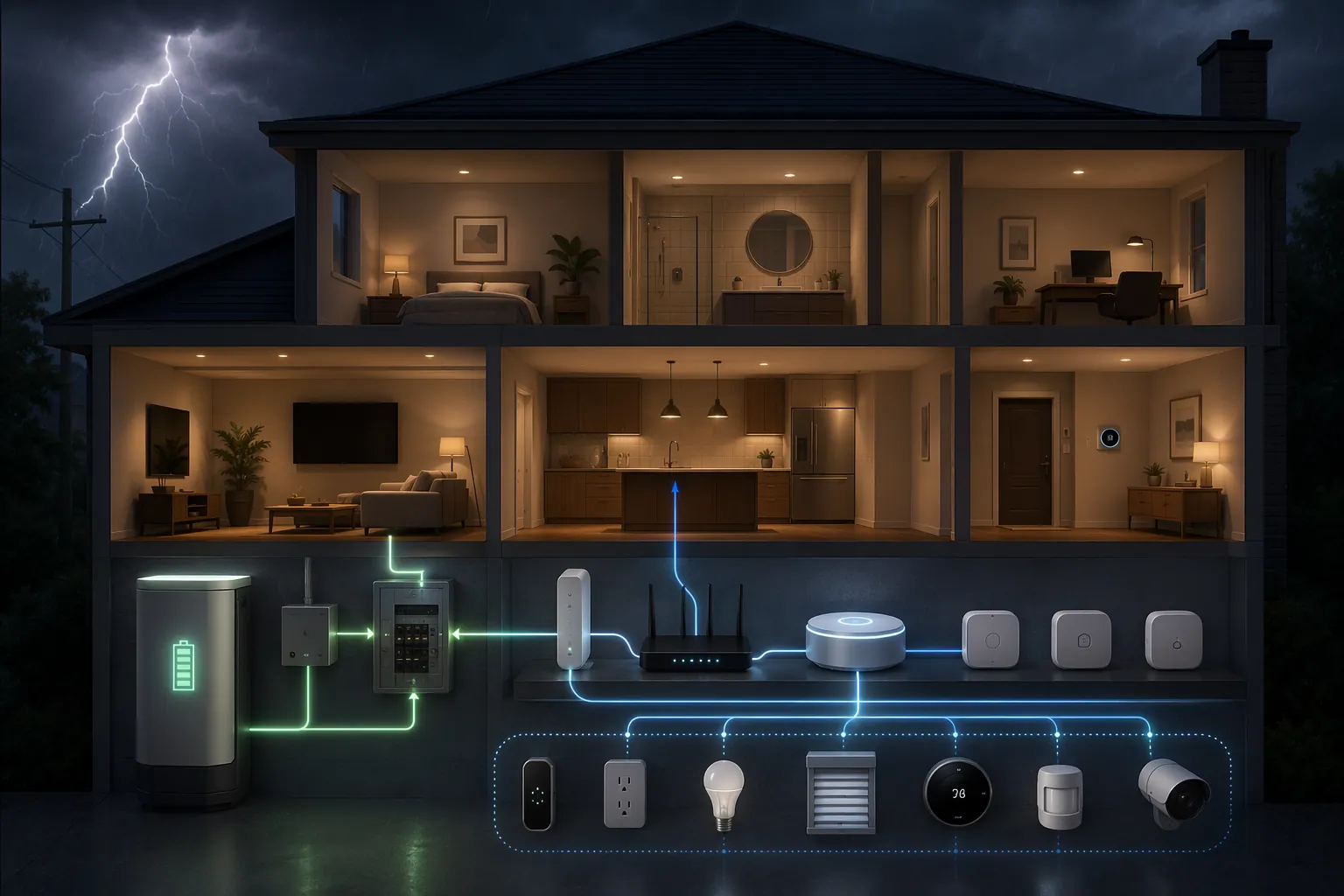
A connected-home stack does not necessarily need whole-home power. One Houston smart home backup analysis estimates a complete network and automation stack at roughly 120–250 W continuous, and estimates that a 9 kWh battery can keep that stack online for more than 43 hours.[7] The exact number changes with the router, modem, PoE switches, cameras, bridges, and hub hardware, but the planning lesson holds: the control layer is a small load with an outsized role.
That small load should usually include:
- Modem or fiber ONT, if internet service remains available during the outage
- Primary router and Wi-Fi access point
- Home Assistant server, Hubitat hub, Homey Pro, or other automation controller
- Thread border router, Zigbee coordinator, Z-Wave controller, and any required bridges
- Smart panel gateway or battery communications hardware required for local control
Cloud-dependent devices are the weak link. Ring, Nest, many Wi-Fi cameras, and app-first devices may lose major functions when the modem or router goes down, and some may still be limited if the wider internet is unavailable even though local Wi-Fi remains up.[7] Local protocols such as Zigbee, Z-Wave, Thread, Ethernet, and locally controlled Wi-Fi devices are usually better candidates for outage automations because they do not have to phone home before acting.
Homey’s backup-power guidance makes the same practical distinction: load prioritization is only useful when the devices responsible for deciding and switching loads remain powered and reachable.[8] That sounds obvious until the first outage reveals that the smart plug controlling the network rack is on the wrong side of the transfer switch.
What to Verify Before Buying
A battery quote should include an automation compatibility check, not just capacity, chemistry, warranty, and installed price. Ask for the answers in writing, because “yes, it works with smart homes” can mean anything from a certified local Matter device to an app notification you cannot automate.
- Exact hardware: battery model, inverter, gateway, smart panel, communications module, and panel generation.
- Exact software: firmware version, app version, API version, and date tested.
- Control path: local API, certified Matter interface, cloud API, BLE, installer portal, or unsupported community integration.
- Hub exposure: whether Home Assistant, Hubitat, Homey Pro, Apple Home, Alexa, or Google Home can read grid status, battery state of charge, backup mode, and circuit state.
- Action support: whether the hub can actually change reserve settings, toggle circuits, start load shedding, or only display information.
- Outage behavior: whether the control path still works with no internet, weak internet, or only local LAN access.
For Matter claims, check the CSA-IOT certification record for the specific product and firmware, then check what your hub exposes. For Home Assistant claims, check whether the integration is official, custom, locally controlled, cloud-dependent, or reverse-engineered. For Apple Home, Alexa, Google Home, Hubitat, and Homey Pro, assume less direct battery control unless the vendor can show the exact entities, devices, or capabilities that appear in that hub.
The Buyer’s Judgment for Mid-2026
If you want the most standards-forward path, watch EcoFlow’s Matter 1.4 HEMS claim closely, but verify CSA-IOT certification and your hub’s actual energy-device support before counting on it. Matter is finally pointing at the right problem; certification and implementation decide whether it helps your house this summer.
If you want the strongest current automation path, Home Assistant plus documented local APIs remains the practical center. Enphase through Envoy, SPAN through local panel control, and carefully verified Tesla or FranklinWH integrations can support real automation work, but they need dated verification because firmware and custom integrations can change the answer.
If you rely on Apple Home, Alexa, or Google Home alone, assume much less direct battery control for now. Voice-assistant compatibility may help with lights, thermostats, and plugs; it does not automatically give you island-mode triggers, reserve control, or circuit shedding.
Once the battery-and-hub pair is chosen, the implementation problem moves to critical-load design, network backup, and local automation rules. For that part, see How to Power Your Smart Home Through a Blackout. Recheck this compatibility page whenever firmware, Matter certification, or hub support changes.
References
- Is the Texas Electric Power Grid Reliable in 2026? — EnergyOgre
- Electricity generation from solar could exceed coal in ERCOT for the first time in 2026 — U.S. Energy Information Administration
- Preparing for the Next Grid Down Event in Texas: The 2026 Resilience Guide — txensolar
- Matter 1.4: The New Standard for Smart Home Energy Management — EcoFlow, January 2026
- Matter: Enabling Universal Grid-Friendly Integration — CSA-IOT
- Interoperability and Compatibility with Different Smart Home Systems — FranklinWH
- Battery Backup for Houston Smart Home: Keep Ring, Nest, and Hue Online — Eos-E, June 2026
- Keeping Your Home Running with Backup Power and Load Prioritization — Homey
- As Texas' energy demand soars, virtual power plants — The Texas Tribune, February 18, 2025
Known issues with this device / protocol
Spec-version history
For active regressions on this protocol, see Update Watch.
No linked Update Watch entries yet.