
What makes a smart air purifier best for dust storms
Most top-rated smart purifiers gate PM10 sensor data and automations inside vendor apps — a bad fit for brief, extreme dust-storm spikes. Choose by hub and protocol first (Matter, Thread/HomeKit, Zigbee, Wi-Fi), then verify the washable prefilter and room-sized CADR.
Last updated
A dust storm is a timing problem before it is a purifier-spec problem. In the Greater Phoenix Area study that should be required reading for anyone shopping for dust-storm air quality gear, researchers looked at 93 convective dust events during July and August from 2015 through 2021. The 10-minute PM10 peaks averaged about 2,174 µg/m³ — roughly 2.2 times the hourly average and 20.5 times the daily average — yet only about 15% of those events pushed the daily average above the EPA’s 150 µg/m³ daily threshold.[1]
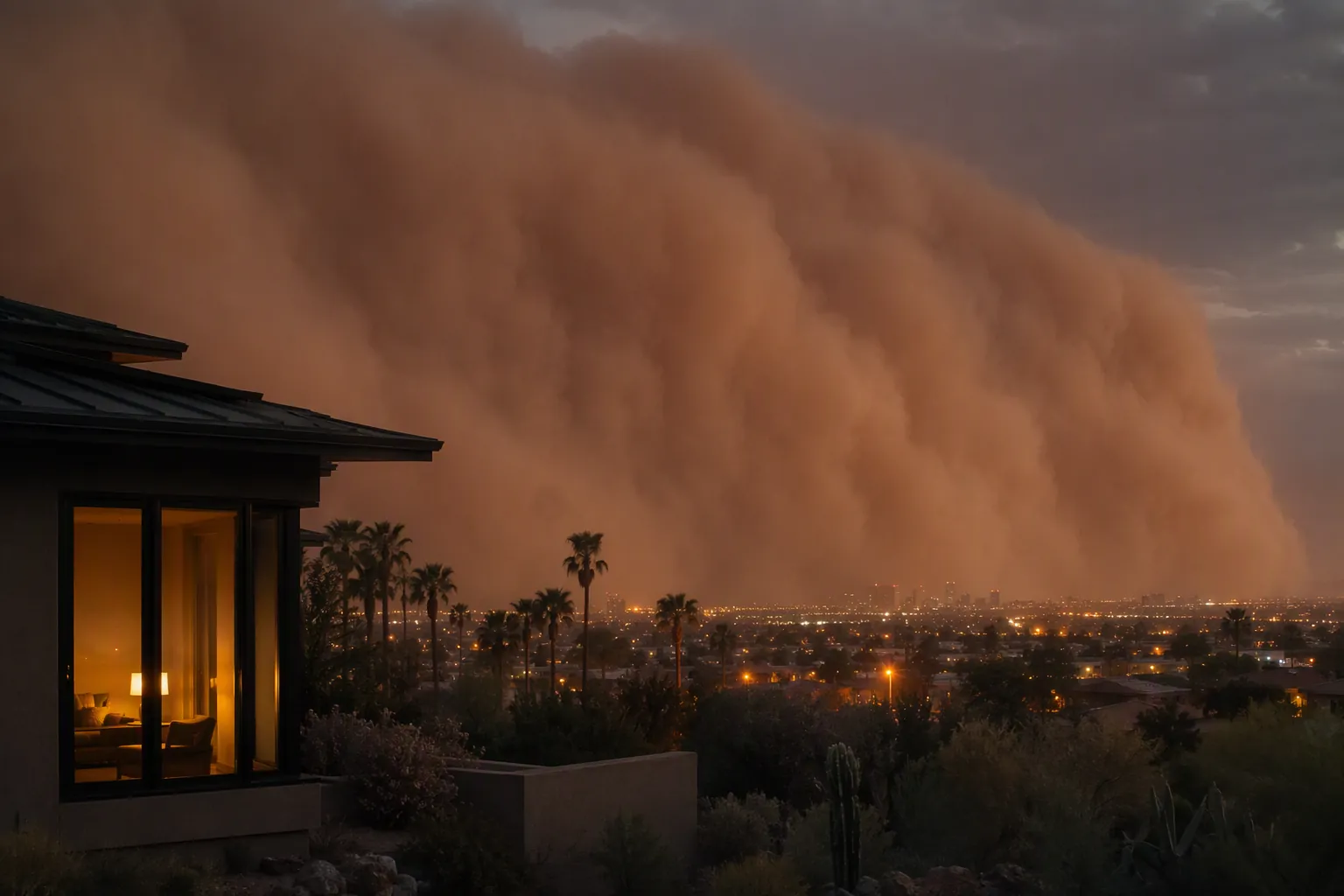
That does not mean every dust event in every Southwest city behaves exactly like Phoenix summer haboobs. The study is local and seasonal. But it explains why the normal “best air purifier” ranking can miss the thing that matters in a hub-centered home: a short, dirty PM10 spike may come and go while a daily AQI tile still looks less dramatic than the air outside your window.
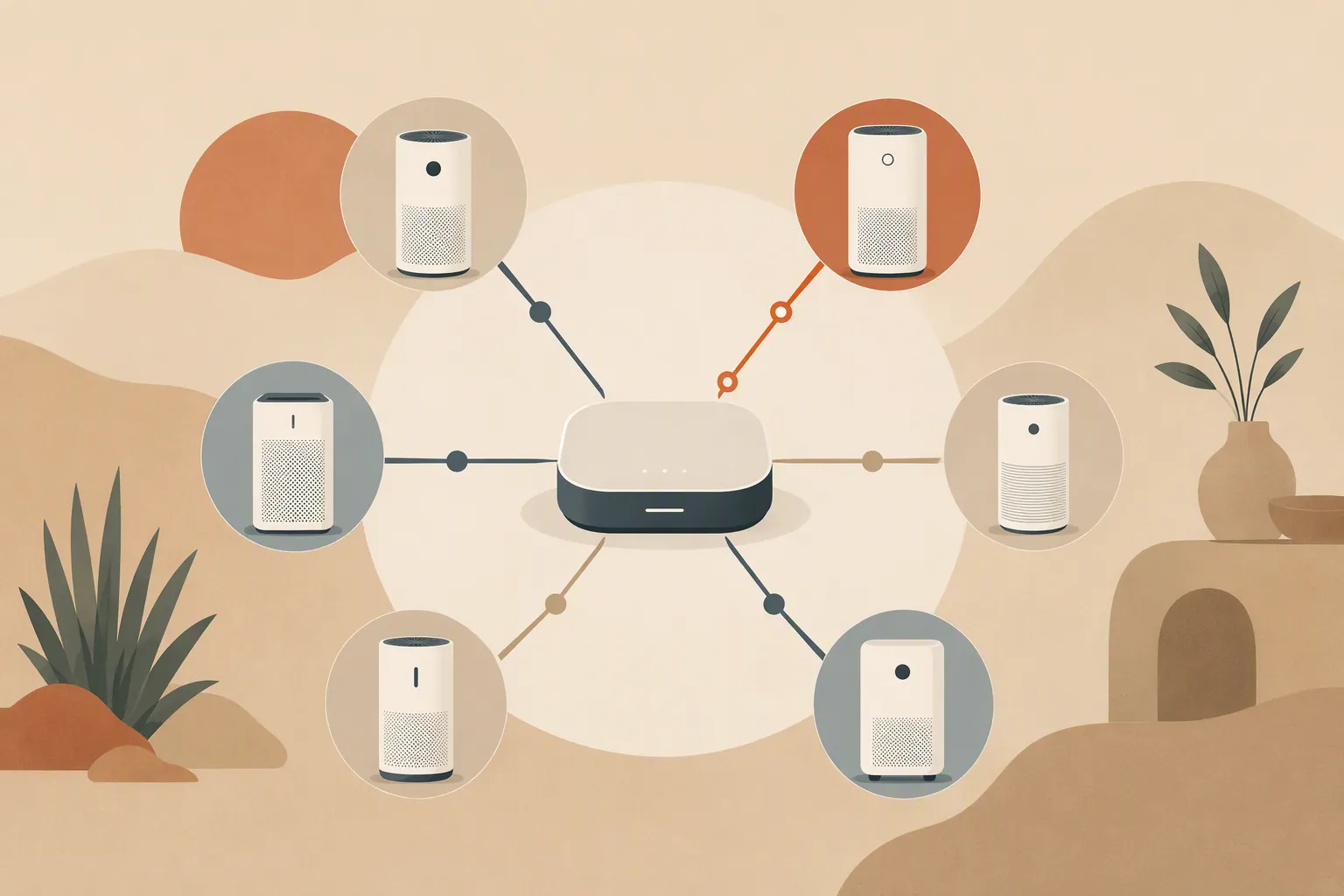
For anyone asking which smart air purifier is best for dust-storm air quality, the answer starts here: if you already run Apple Home, Google Home, Alexa, or Home Assistant, the best purifier is the one whose particulate reading and fan control actually reach that system fast enough to be useful. Filter media and CADR still matter. They just come second, because an app-only auto mode is fragile during a brief spike unless someone is watching that app.
Dust storms reward hub-visible control
Wildfire smoke buying guides usually revolve around PM2.5 and smoke CADR. Dust storms shift the emphasis toward coarse-particle load, PM10 visibility, and the first half hour of response. If the purifier’s own sensor sees a spike but reports it only inside the vendor app, your household automation has to work around a missing signal. If the hub can see the reading or a separate sensor can trigger the purifier, the response loop is simpler: sense, decide, raise fan speed, then return to normal when the indoor air recovers.
That is why dust-storm shopping should not begin with a universal winner. It should begin with the hub you already trust. The sibling guide to smart purifiers for wildfire smoke is the smoke-side version of this problem; dust storms are the PM10 counterpart, with more attention on prefilters and short-spike automation.
| Decision order | What to check | Why it matters during a dust event |
|---|---|---|
| 1 | Does the purifier expose PM10 or PM2.5 readings and fan control to your existing hub? | Brief spikes punish app-only automations. |
| 2 | Does the unit have a washable or easily cleanable prefilter? | Coarse dust loads the first filter layer quickly. |
| 3 | Is CADR sized to the room? | A smart purifier still has to move enough filtered air. |
| 4 | Can you verify the claimed protocol path? | Matter, Thread, Zigbee, and bridge behavior vary by product and firmware. |
Start with the protocol you already live in
The practical split is not “premium versus budget.” It is Thread/HomeKit-native, Zigbee, Matter, or Wi-Fi/app-only. Those paths lead to different levels of automation control, and they also carry different levels of evidence.
Thread/HomeKit-native: promising, narrow, and Apple-centered
The most interesting Thread/HomeKit-native niche is the Airversa Purelle AP2. Airversa lists the AP2 at about $140, with a CADR of 130 CFM for the HEPA version and 107 CFM for the Pro version, a PM2.5 sensor, and a requirement for a Thread-capable Apple hub such as a HomePod mini, HomePod 2nd generation, or Apple TV 4K 2nd/3rd generation.[2]
Status: Investigating. The AP2 is interesting because it is not merely “works with Siri” copy; it is framed around Thread and Apple Home. But the evidence here is vendor-supplied, and the sensor listed is PM2.5, not PM10. For an Apple Home household, it may still be cleaner than a Wi-Fi purifier whose intelligence never leaves its app, especially if a separate air-quality monitor handles the trigger. For a dust-storm buyer who specifically wants PM10 inside Apple Home, this is not a complete answer by itself.
Zigbee: STARKVIND is the real candidate, with dated evidence
IKEA’s STARKVIND is the purifier that keeps coming up when the conversation moves from voice skills to actual hub behavior. A 2023 Home Assistant ZHA write-up reported fan speed exposure in 10% steps, filter status, later particle sensor data, and Zigbee router behavior; the same report also noted that early ZHA behavior did not initially expose auto mode or the sensor cleanly.[3]
Status: Workaround. STARKVIND is a credible Zigbee/Home Assistant or DIRIGERA-adjacent candidate, not a blanket recommendation. The strongest case is for a household already comfortable with Home Assistant, Zigbee pairing, entities that may change across firmware, and verification after setup. If you want a sealed retail promise that every sensor and mode will appear exactly as expected in your hub, this dated single-tester evidence is not enough.
The appeal is still obvious: a purifier that can expose fan control and filter status to a local hub is much easier to fold into a dust response than a purifier that only accepts cloud voice commands. For readers building a similar loop, the indoor air quality response loop is the more general automation pattern.
Matter: the catalog exists, but certification is not a dust guarantee
Matter is where the buying language can get slippery. Matter 1.2 added an Air Quality Sensor device type and standardized reporting for pollutants including PM1, PM2.5, PM10, CO2, NO2, VOC, CO, ozone, radon, and formaldehyde.[4] That is a standards milestone, not proof that a given purifier exposes the exact data and controls you need in your chosen hub.
Matter Alpha’s purifier catalog lists the AiDot Welov P200 Pro as a Wi-Fi Matter purifier that does not require a hub, the SwitchBot Air Purifier as requiring a SwitchBot hub, and IKEA STARKVIND as reaching Matter through DIRIGERA.[5] Treat that as a lead list, not a final verdict. Before buying for dust storms, check the CSA product listing, the current firmware notes, and whether your actual hub exposes the attributes you care about: particulate level, fan speed, mode, and filter status.
Status: Investigating. Matter’s long-term promise is exactly what a dust-storm home needs: less brand-specific glue and more readable device capability. In Q3 2026, “Matter-compatible purifier” is still too thin a phrase to trust without model-level confirmation.
Wi-Fi/app-only: often excellent purifiers, weaker hub citizens
Levoit, Coway, Dyson, and Blueair make serious purifiers. The compatibility problem is that their smart features often stop at app control, cloud routines, or voice assistant support. PCMag’s 2026 smart purifier roundup describes the Dyson Purifier Big+Quiet Formaldehyde BP03 as tracking PM1, PM2.5, PM10, VOC, NO2, and formaldehyde, with Alexa, Google Assistant, and Siri support; it also lists Blueair with Alexa and Google but no HomeKit, and Coway and Levoit with Alexa and Google support.[6]
That is useful, but voice support is not the same as hub-visible particulate data. “Alexa, set the purifier to high” is better than walking across the room. It is not the same as a local rule that sees indoor PM rise and raises fan speed while everyone is away or asleep.
PCMag also notes that budget units may expose only PM2.5, and it points to the Amazon Smart Air Quality Monitor as a $69.99 device that can trigger Alexa routines.[6] That kind of external-sensor workaround can be acceptable in an Alexa home, but it changes the buying question: you are no longer buying a purifier whose own dust event intelligence reaches the hub; you are building a separate sensor-to-purifier automation path.
The filter still has to survive the storm
Protocol-first does not mean physics-optional. HEPA filtration is still the baseline. Wirecutter summarizes the core mechanics plainly: coarse particles are captured by impaction, 0.3-micron particles are the hardest size to capture, and true HEPA filters remove at least 99.97% of 0.3-micron particles.[7]
For dust storms, the prefilter deserves more attention than it usually gets. A washable or easily cleanable prefilter is the part that takes the first beating from hair, lint, and larger dust before the HEPA media does. Wirecutter recommends monthly prefilter cleaning in its purifier coverage and notes that Coway’s Mighty2 includes a “PRE” notice for prefilter maintenance.[7] After a storm, monthly may be too relaxed; the point is that the prefilter should be accessible enough that the person cleaning it will actually do it.
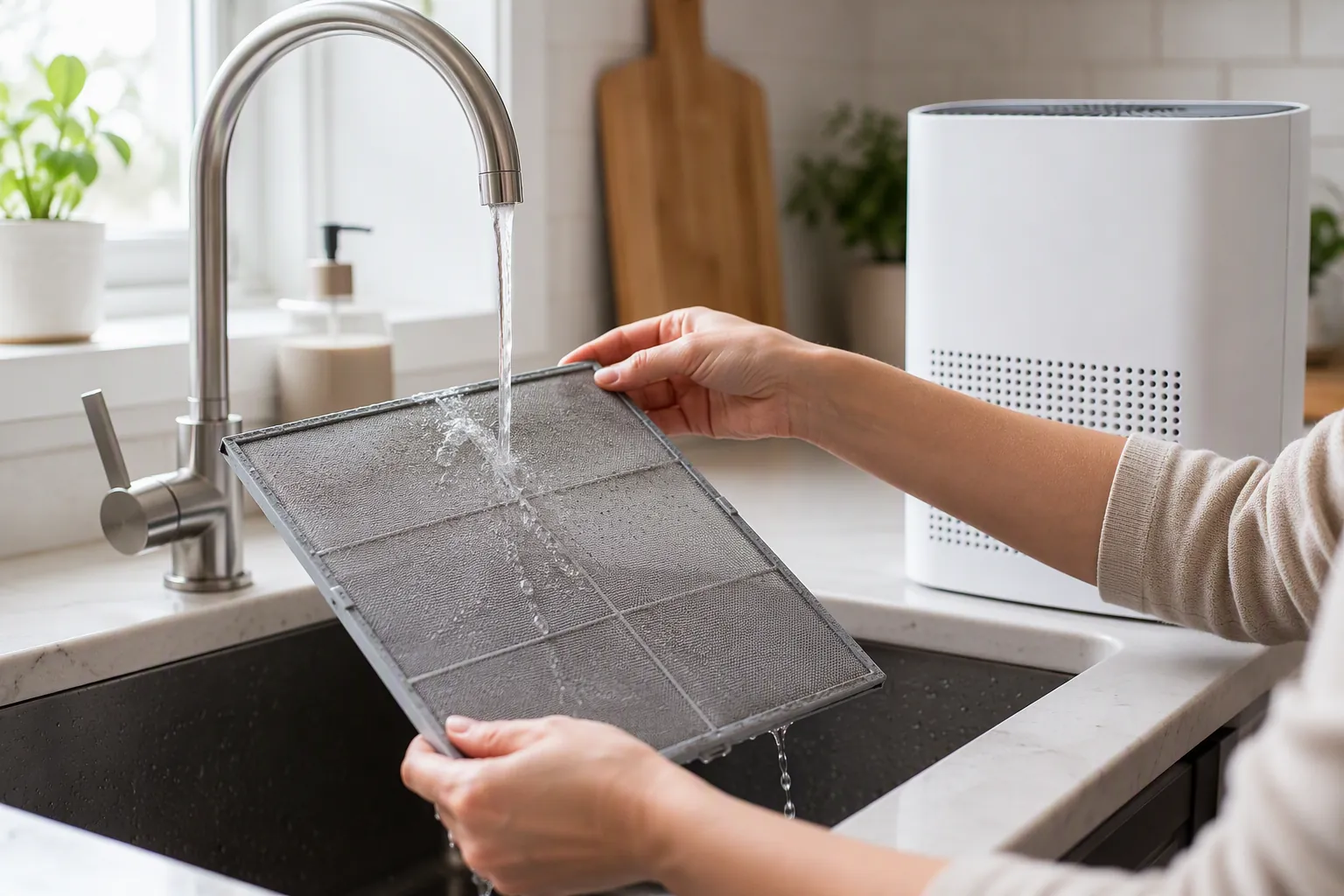
This is where some otherwise strong smart purifiers become less attractive for dust-prone rooms. If the prefilter is awkward, non-washable, hidden behind a brittle cover, or bundled into an expensive replacement stack, the household pays for every dirty event in maintenance friction. The best dust-storm purifier is not only the one that ramps up quickly; it is the one someone can restore afterward without turning filter care into a project.
CADR is the second hard cutoff
Once the hub path and prefilter pass inspection, size the machine like an air cleaner, not a gadget. AHAM Verifide explains that CADR is reported separately for smoke, pollen, and dust, and its general 2/3 rule says the CADR should be at least two-thirds of the room area in square feet.[8] A 300-square-foot room, for example, needs a CADR of at least 200 CFM under that rule.
That 2/3 rule is a baseline, not a magic shield. Many purifier testers and buyer guides also aim around 4 to 5 air changes per hour for effective cleaning, especially when conditions are severe.[7] If a purifier barely fits the room on paper, a dust storm is not the moment to discover that its quiet auto mode is too timid or that high speed is too loud to run when people are home.
For dust, look at the dust CADR when it is available, not only smoke CADR. Smoke CADR remains useful for PM2.5-heavy events, but a Southwest dust wall is not just a smoke problem wearing a different color.
How the named models sort out
This is not a normal ranked list because the same purifier can be sensible in one ecosystem and frustrating in another. A Home Assistant household with Zigbee patience should evaluate STARKVIND differently from an Apple Home household trying to stay inside Thread, and both should evaluate app-first Coway or Levoit models differently from someone who just wants a good purifier with a phone notification.
| Category | Models to examine | Compatibility status | Dust-storm caution |
|---|---|---|---|
| Thread/HomeKit-native | Airversa Purelle AP2 | Investigating: vendor-framed Thread/HomeKit path | PM2.5 sensor listed; verify hub exposure and room sizing before treating it as a dust-storm pick. |
| Zigbee / Home Assistant / DIRIGERA-adjacent | IKEA STARKVIND | Workaround: dated single-tester ZHA evidence supports useful entities | Verify current firmware, auto mode, sensor exposure, and whether your hub path is Zigbee direct or DIRIGERA bridge. |
| Matter catalog | AiDot Welov P200 Pro, SwitchBot Air Purifier, STARKVIND via DIRIGERA | Investigating: catalog-reported paths require certification and hub checks | Matter support does not automatically mean PM10, fan speed, mode, and filter state are visible in your hub. |
| Wi-Fi/app-first premium and mainstream | Levoit Core 400S/Vital 200S, Coway Airmega 250S/400S/Mighty2, Dyson BP03, Blueair Blue Signature | Confirmed as strong app/voice ecosystems where documented, but not confirmed as full hub-exposed dust automations | Good purification hardware may still leave the key automation inside the vendor app. |
Coway is the clearest example of why “best purifier” and “best smart-home purifier for dust storms” can split. Wirecutter names the Coway Mighty2 as a 2026 top pick and also reports app complaints around the AP-1512HHS, including bugginess and permission concerns.[7] That does not make Coway a bad purifier brand. It does mean the smart layer needs to be judged separately from the filtration layer.
Dyson’s BP03 goes the other direction: rich onboard sensing, including PM10, VOC, NO2, and formaldehyde, according to PCMag.[6] For someone who is happy living in Dyson’s app plus voice assistants, that may be enough. For a hub-centered dust response, the missing question is whether those readings and controls are usable by your automation platform in the way you expect.
Levoit and Blueair sit in the same general caution zone. They can be good air purifiers and still be poor first choices for a protocol-first dust-storm setup if the hub only gets voice commands or shallow routines. Before buying, check the current integration page, not just the badge on the box.
A practical shortlist by ecosystem
If you run Apple Home and want the cleanest native path, start by investigating Thread/HomeKit units such as the Purelle AP2, then verify what the Home app actually exposes. If PM10 is the trigger you care about, assume you may need a separate verified air-quality sensor unless the purifier itself proves otherwise.
If you run Home Assistant with Zigbee, STARKVIND is the model worth testing first, provided you are comfortable with a Workaround status. Confirm current ZHA or Zigbee2MQTT behavior, check whether fan speed and filter status appear, and do not count on old screenshots as proof of today’s firmware behavior.
If you are waiting for Matter to solve this cleanly, use the AiDot, SwitchBot, and DIRIGERA/STARKVIND paths as candidates, not conclusions. Matter 1.2 gives the air-quality data model room to grow, but the buyer still has to verify certification, hub support, and the exact attributes surfaced for that product.
If you run Alexa or Google Home and prefer a mainstream Wi-Fi purifier from Levoit, Coway, Dyson, or Blueair, separate two decisions. First, buy enough purifier for the room. Second, decide whether voice control, app auto mode, or an external monitor-triggered routine is good enough for your dust-event setup. If the routine depends on a separate sensor, the air-quality monitor verification guide is the next place to check assumptions about sensor readings.
The final rule is simple enough to use in a store aisle: choose the purifier category that your hub can actually read and command, reject anything without a cleanable prefilter, then reject anything under-sized by CADR. The prettiest app in the category does not help much when the dust spike lasts minutes and the useful controls never leave the app.
References
- Times Matter, the Impact of Convective Dust Events on Air Quality in the Greater Phoenix Area, Arizona — GeoHealth, 2025
- Purelle Smart Air Purifier (AP2) — Airversa
- A breath of fresh air — the Starkvind Zigbee air purifier from IKEA tested with Home Assistant — The smarthome journey, 2023
- Matter 1.2 Arrives with Nine New Device Types — CSA-IOT
- The Best Matter-Compatible Air Purifiers — Matter Alpha
- The Best Smart Air Purifiers for 2026 — PCMag
- The 4 Best Air Purifiers of 2026 — Wirecutter
- Air Filtration Standards (CADR and the 2/3 Rule) — AHAM Verifide
Known issues with this device / protocol
Spec-version history
For active regressions on this protocol, see Update Watch.
No linked Update Watch entries yet.