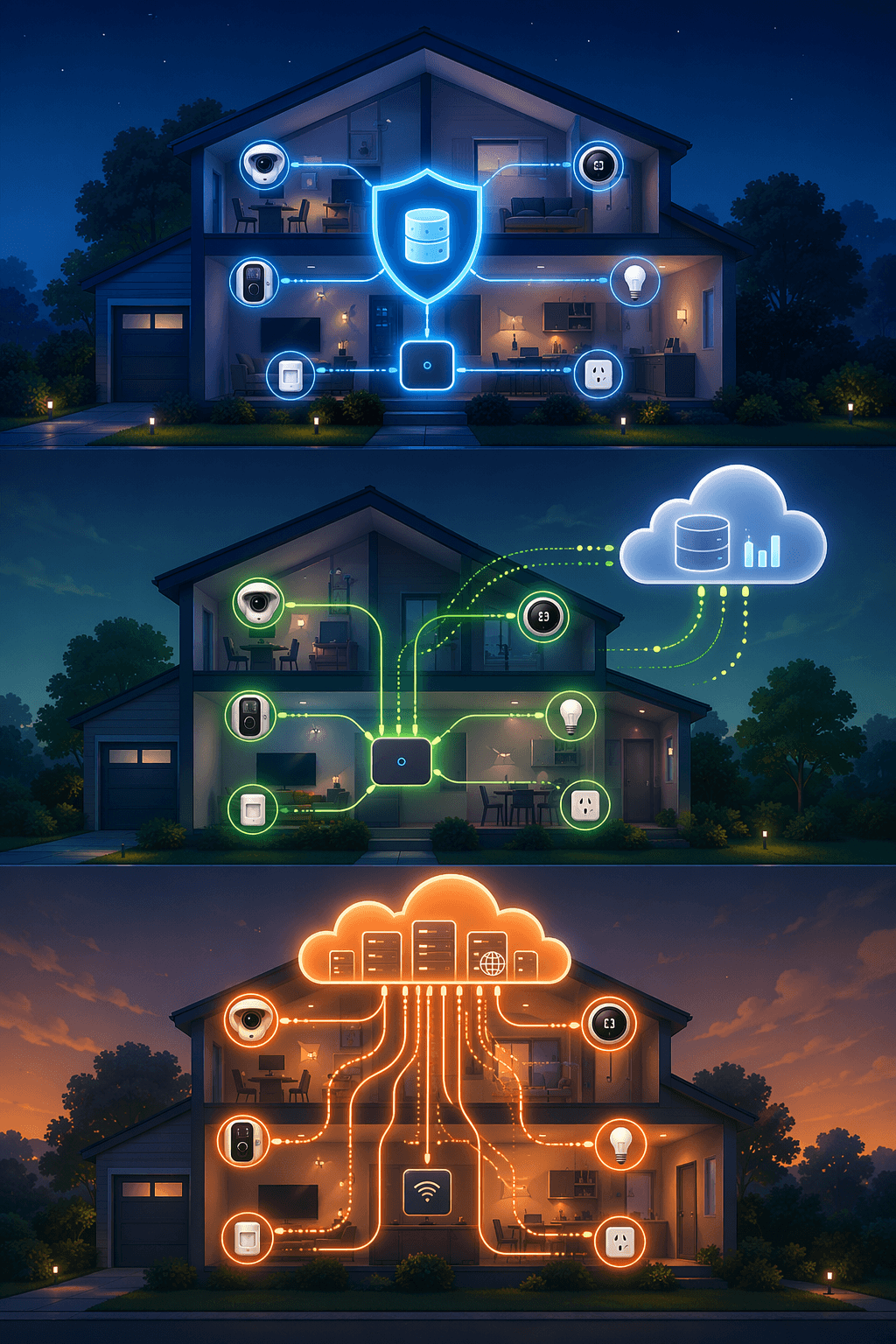
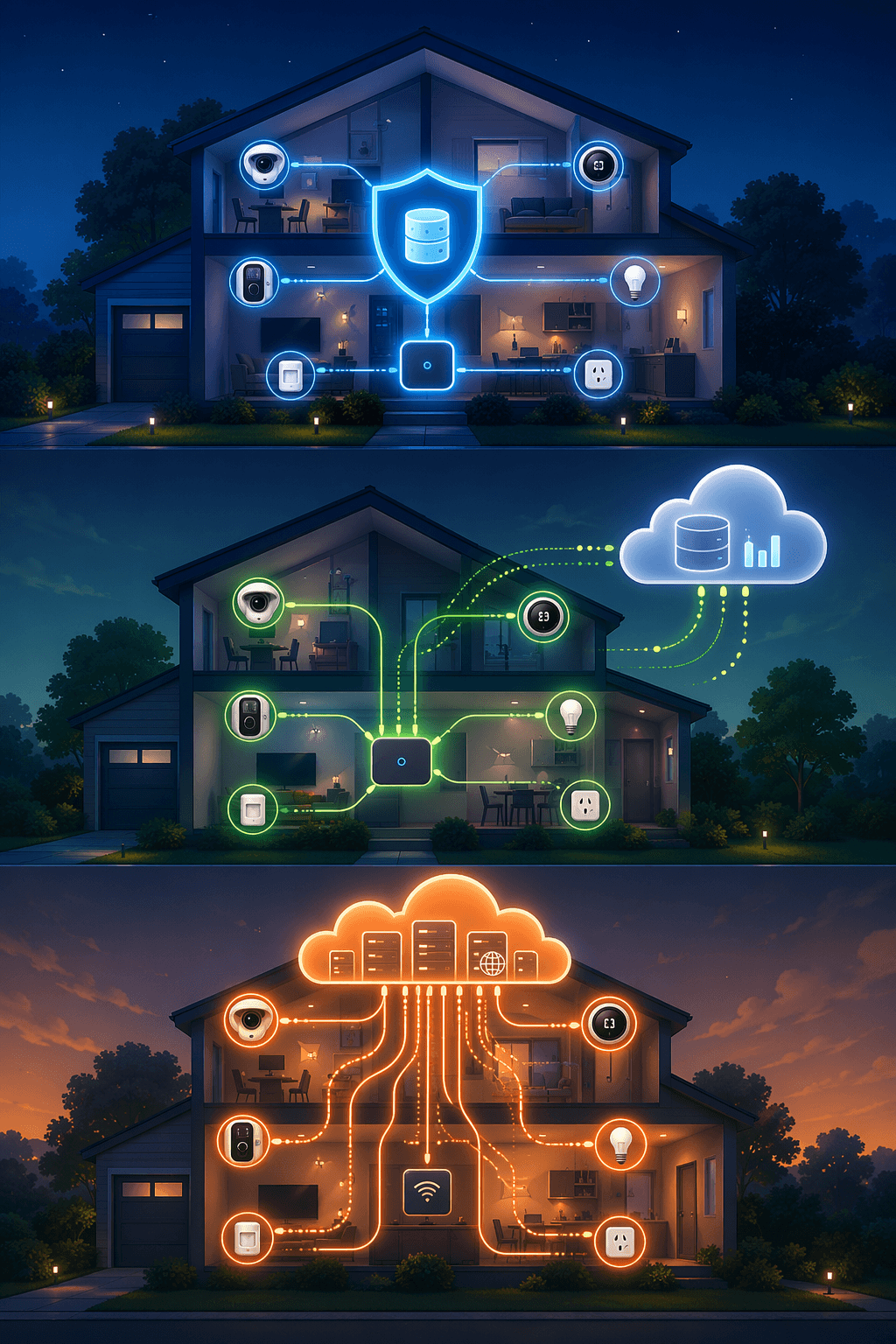
Choosing among smart home platforms in 2026 is also choosing where your household data travels. A light switch command, a camera alert, a voice request, a presence routine, and a vacation-mode automation do not all follow the same path. Some stay mostly inside the home. Some pass through a company cloud because that is how the platform was built. Some start locally, then become cloud-dependent the moment you want remote access, richer video history, or an AI assistant that understands context.
The privacy tiers are clearer than the marketing pages make them sound: Apple HomeKit and Home Assistant are the strongest choices for minimizing exposure; Samsung SmartThings is the useful middle ground; Amazon Alexa and Google Home remain cloud-dependent by default. That does not mean HomeKit and Home Assistant are effortless, or that Alexa and Google are useless. It means the privacy bargain is different before you even buy the first plug.
| Privacy tier | Platforms | What it means in practice |
|---|---|---|
| Strongest privacy | Apple HomeKit, Home Assistant | Local-first control, strong encryption or self-hosting, fewer routine data flows to platform clouds |
| Compromise tier | Samsung SmartThings | Local hub automations for supported devices, but cloud services still matter for remote access and some advanced routines |
| Cloud-dependent tier | Amazon Alexa, Google Home | Voice, assistant intelligence, account services, and many automations depend heavily on cloud processing |
The privacy audit criteria that actually matter
A platform’s privacy posture is not captured by one app toggle. The better audit starts with a few plain questions: what data is collected, where commands are processed, whether device communication is encrypted, what changes when you turn on remote access, whether subscriptions create new incentives to retain or analyze data, and what compatibility you give up if you choose the more private route.
That last question matters more than privacy purists like to admit. A household with old Echo speakers, a Nest doorbell, a Samsung hub, and a few half-migrated HomeKit accessories is not starting from a blank diagram. Privacy has a switching cost, and the cost can be money, time, broken automations, missing camera features, or a spouse who just wants the kitchen lights to work.
For the architecture side of this problem, see Local vs. Cloud Home Automation. This guide stays narrower: how the major consumer platforms handle your data in real homes.
Apple HomeKit: strong encryption, narrower device choice
HomeKit is the mainstream privacy pick because Apple made privacy part of the platform architecture rather than an optional cleanup step. Security.org describes HomeKit as using end-to-end encryption for device communication, with most commands processed locally, and says HomeKit Secure Video analyzes footage on the user’s Home Hub rather than sending raw analysis to the cloud by default.[1]
That design changes the feel of the system. A HomeKit light automation does not need to become a behavioral profile just to be useful. A compatible camera using HomeKit Secure Video can identify motion events through the Apple home hub before encrypted video is stored. The privacy advantage is not that nothing ever touches Apple’s infrastructure; it is that the default design reduces what has to leave the home and protects communication when it does.
Remote access still changes the model. To control HomeKit devices away from home, you generally need an Apple home hub such as an Apple TV or HomePod. Siri can also involve cloud processing depending on the request and device. Firmware updates, account services, and some integrations are not magically local just because the Home app looks quiet. HomeKit’s privacy case is strong, but it should not be sold as air-gapped home automation.
The practical trade-off is compatibility. Security.org cites roughly 1,000-plus HomeKit-compatible devices, far below the largest Alexa compatibility claims.[1] Matter has helped, but anyone moving from Alexa or Google to HomeKit should expect to check every camera, thermostat, lock, sensor, and bridge before assuming it can come along.
Home Assistant: maximum local control, maximum responsibility
Home Assistant is the clearest answer for people who want their smart home to run on their own hardware. Security.org describes it as fully self-hosted, with data staying on the user’s home network, and notes support for more than 2,500 integrations.[1] That combination is rare: deep compatibility without making a major platform cloud the center of the home.
The privacy gain is concrete. Automations can run locally. Dashboards can live locally. Zigbee, Z-Wave, Thread, Wi-Fi, and Matter devices can be pulled into one system through the right radios, bridges, and integrations. For households trying to salvage a mixed collection of devices without surrendering everything to one vendor account, Home Assistant is often the least wasteful privacy upgrade.
The catch is that self-hosted means someone is now the administrator. Backups, updates, add-ons, certificates, remote access, dashboards, broken integrations, and network changes become household infrastructure. That is fine for a tinkerer and miserable for someone who only wanted a more private version of a voice assistant.
Remote access is where Home Assistant’s privacy story is refreshingly explicit. Nabu Casa’s optional cloud service is listed at $6.50 per month and provides remote access without a data-mining or telemetry business model, according to Security.org.[1] You can also build your own remote-access setup, but then you own the security work. Either route is better understood as a responsibility choice, not a free privacy upgrade.
Samsung SmartThings: the middle tier is real
SmartThings earns its compromise position because it solves a practical problem that HomeKit sometimes dodges and Home Assistant sometimes overcomplicates: mixed-device homes. Security.org notes that SmartThings supports Z-Wave alongside Zigbee, Thread, and Matter, and that core automations can run locally through a SmartThings Station or Aeotec hub.[1]
That local hub support matters. A motion sensor turning on a hallway light should not need a round trip to a distant server when both devices are already in the house. For supported automations, SmartThings can keep that routine closer to home and more resilient than a purely cloud-orchestrated setup.
But SmartThings is not in the same privacy tier as HomeKit or Home Assistant. Remote access and some advanced routines still depend on Samsung cloud services, according to the research summarized by Security.org.[1] If your household relies on checking locks from the office, managing automations while traveling, or chaining devices through cloud-linked services, the privacy model expands beyond the hub.
For many people, that is an acceptable bargain. SmartThings is especially attractive when ripping out Z-Wave or Zigbee devices would be expensive. It is not the cleanest privacy platform, but it can reduce exposure while preserving more of an existing smart home than a strict HomeKit migration would.
Amazon Alexa: unmatched reach, cloud-first privacy trade-offs
Alexa’s privacy problem is not that it fails at convenience. It is that its convenience depends on a cloud-centered assistant and a retail ecosystem that has every reason to understand household intent. Security.org describes Alexa as cloud-dependent and notes that voice recordings are retained for service improvement.[1]
Its reach is the reason people tolerate that model. Security.org cites Alexa support for more than 140,000 devices, while Amazon has claimed more than 400,000 compatible devices in other contexts; those figures should not be treated as interchangeable because publishers count compatibility differently.[1] Security.org also reports an ExpressVPN survey finding that 66% of consumers were most likely to buy smart home products from Amazon.[1]
A privacy reader should not treat that scale as a defense. Scale explains why Alexa is hard to leave: the cheap plug works, the random garage controller has a skill, the holiday lights already respond to an Echo in the kitchen. It does not make retained voice interactions or cloud processing less sensitive.
The subscription shift makes the bargain sharper. Security.org reports that Alexa+ launched at $20 per month, or $0 for Prime subscribers, while some free Alexa features were scaled back.[1] Once advanced assistant behavior is tied to a paid tier, the platform has an even stronger reason to turn household interaction into a recurring service rather than a local utility.
Ring integration adds history that should not be hand-waved away. Security.org cites a 2023 FTC settlement over Ring security practices and a 2025 Electronic Frontier Foundation criticism of an Axon partnership enabling law-enforcement footage requests without user consent.[1] Those cases do not prove every Alexa device is unsafe. They do show why Amazon’s broader smart-home ecosystem deserves stricter privacy scrutiny than a feature checklist would suggest.
Google Home: smarter assistant, familiar cloud bargain
Google Home sits in the same cloud-dependent tier as Alexa, but the user bargain is slightly different. Google’s assistant strength is real. THTheater cites Loup Ventures testing in which Google Assistant scored 93% on question accuracy, and notes that Google’s assistant experience is now tied to Gemini for contextual understanding.[2]
That competence explains why people accept the privacy cost. A system that understands natural language better, handles context more gracefully, and integrates with Google services can feel less like a gadget hub and more like household infrastructure. But Security.org characterizes Google Home as cloud-dependent for most features and says usage patterns are analyzed for service improvement.[1]
The paid-tier issue is also moving in the wrong direction for privacy-sensitive buyers. Security.org reports that Google Home Premium costs $10 to $20 per month and places advanced features behind a subscription, including some capabilities that had previously been free.[1] The more the platform’s best behavior lives inside a recurring service, the more users should ask what data is needed to power, personalize, retain, and improve that service.
Google is not Amazon with a different logo. Its strength is assistant intelligence and contextual services, not the same purchase-intent machine that makes Alexa so sticky. But for smart home privacy, the operational question remains blunt: if the platform needs the cloud for most of the experience, your household behavior is part of a larger data system.
Matter helps, but it does not erase the platform
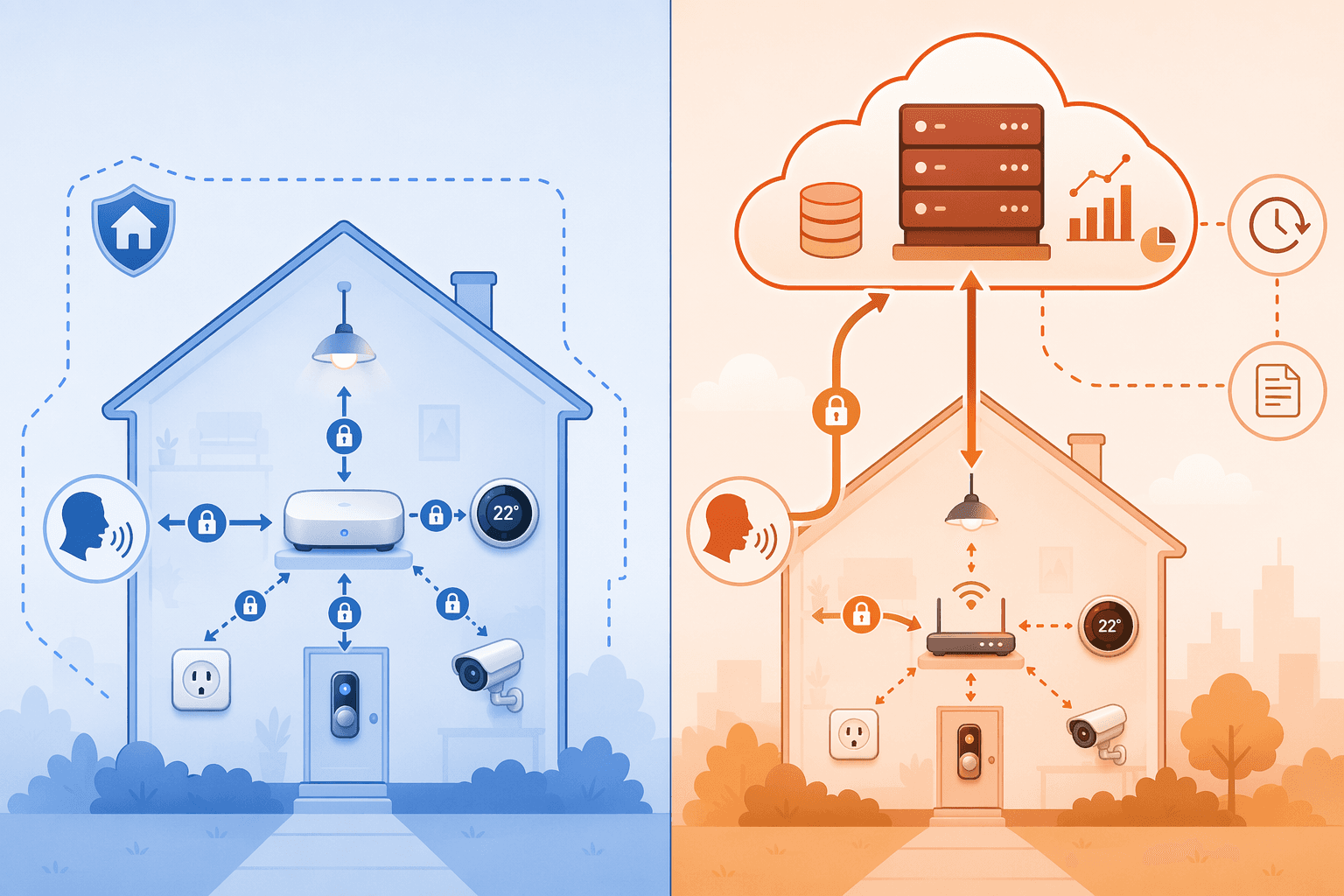
Matter is useful because it changes the path of many routine commands. The Matter standard is designed around local-first control over Thread or Wi-Fi, which can route commands locally instead of sending every action through cloud servers, reducing third-party data exposure.[3]
That is a real privacy improvement, especially for basic switches, sensors, plugs, lights, and some thermostats. It also makes hybrid homes less painful. A Matter device can often be paired into more than one ecosystem, which gives households a way to move gradually instead of replacing everything in one expensive weekend.
Matter is not a privacy force field. It does not eliminate platform accounts, voice assistant processing, cloud video subscriptions, manufacturer apps, firmware-update dependencies, or analytics attached to optional features. A Matter light bulb controlled locally is one thing; a camera subscription with person detection and cloud history is another.
Even Matter adoption numbers need care. Security.org cites 850-plus Matter products, while matter-smarthome.de cites 750-plus, partly because sources may count regional variants, certification database listings, and pre-certification entries differently.[1][3] The exact count matters less than the direction: Matter is now practical enough to reduce lock-in, but not mature enough to make ecosystem privacy irrelevant.
Why overall rankings can mislead privacy buyers
A general smart-home ranking is not the same as a privacy ranking. Security.org ranks Google Nest Hub Max highly overall while also giving Apple HomeKit a higher SecurityScore than Google’s platform, because the overall ranking weighs factors beyond privacy.[1] That is a reasonable editorial choice for a broad buyer’s guide, but it is the wrong shortcut if the question is data exposure.
Compatibility numbers create a similar trap. Alexa’s large device catalog is valuable if you already own scattered accessories. SmartThings’ protocol breadth is valuable if you have Z-Wave and Zigbee hardware. Home Assistant’s integration count is valuable if you are willing to maintain the system. HomeKit’s smaller catalog may still be the better privacy choice if the devices you need are supported.
The broader market still leans cloud-heavy. Mordor Intelligence reports that cloud-based deployment accounts for 81% of the smart home platform market, while on-premises and edge solutions are growing at a 19.1% CAGR.[4] That split says something useful: privacy demand is rising, but most of the market is still built around cloud services.
The real cost of choosing the more private platform
Privacy costs show up in ordinary places. HomeKit may require replacing unsupported devices. Home Assistant may require buying a small server, radios, or a ready-made hub, then maintaining it. SmartThings may preserve more old hardware but leave remote control and advanced routines tied to cloud services. Alexa and Google may let almost everything work immediately, then ask you to accept retained interactions, cloud intelligence, and subscription tiers as the price of convenience.
A household with five smart bulbs can switch platforms casually. A household with cameras, locks, thermostats, leak sensors, garage control, voice speakers, and family routines cannot. Before moving, make an inventory by device type, not by brand loyalty:
- Which devices control safety or access, such as locks, garage doors, smoke alarms, and leak sensors?
- Which devices depend on cloud video, cloud AI detection, or a manufacturer subscription?
- Which routines must work when the internet is down?
- Which voice assistant features does the household actually use every day?
- Which devices already support Matter, Thread, Zigbee, or Z-Wave through a hub you can keep?
That inventory often produces a less dramatic answer than a platform ranking. You might move cameras to HomeKit Secure Video, keep Z-Wave sensors on SmartThings, and stop using Alexa for sensitive rooms. You might run Home Assistant as the private backbone while leaving a Google speaker for music and casual questions. Hybrid setups are not ideologically pure, but they can cut exposure without turning the house into a weekend repair project.
Which platform should you choose?
Choose Home Assistant if maximum local control matters more than polish. It is the strongest option for people who want to self-host, combine many device types, and reduce reliance on platform clouds. It is also the option most likely to punish neglect.
Choose Apple HomeKit if you want strong privacy with mainstream usability. It is the best fit for households already comfortable with Apple devices and willing to buy compatible accessories. The trade-off is a narrower device universe and some dependence on Apple hubs and services for remote access and voice features.
Choose SmartThings if device flexibility matters and some cloud dependence is acceptable. It is especially useful for homes with Z-Wave, Zigbee, Thread, and Matter devices that would be expensive to replace. Its privacy ceiling is lower than HomeKit or Home Assistant because remote access and some advanced behavior still rely on Samsung’s cloud.
Choose Alexa or Google Home only with clear expectations. Alexa offers enormous device breadth and easy buying paths; Google offers a strong assistant and contextual intelligence. Both are cloud-dependent by default, and both are moving more value into paid tiers. If you choose them, use privacy controls, delete old recordings where available, limit cameras and microphones in sensitive spaces, and avoid treating subscription convenience as privacy-neutral.
In 2026, smart home privacy is less about finding one hidden setting and more about choosing a business model, a processing architecture, and a level of switching cost you can live with.
References
- Best Smart Home Platforms of 2026, Security.org
- Apple HomeKit vs Google Home vs Alexa vs SmartThings 2026, THTheater
- Matter Standard in 2026, matter-smarthome.de
- Smart Home Platforms Market Report 2031, Mordor Intelligence
Discussion
Share your experience with the compared products, flag outdated pricing or specs, or ask clarifying questions about the comparison verdict.
Comments
Join the discussion with an anonymous comment.