
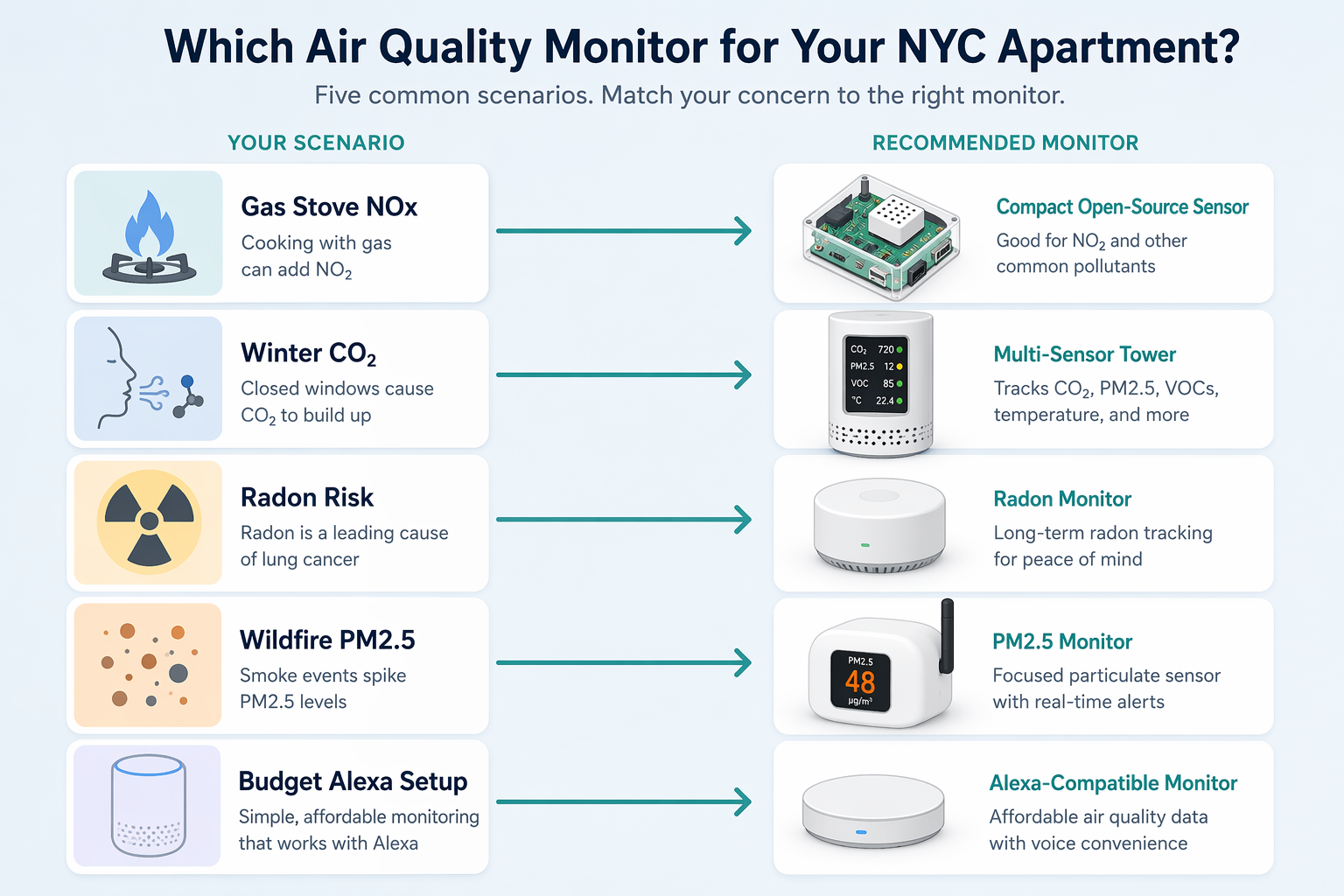
The best smart home air quality monitor for an NYC apartment is not the one with the longest spec sheet. It is the one that catches the pollutant your apartment is most likely to hide from you. For a gas-stove kitchen, that points first to AirGradient ONE because it measures NOx, the category many cheaper monitors skip, and Wirecutter named it the top pick in its September 2025 review largely because of that sensor coverage.[1] For a garden-level or basement unit, the answer changes: Airthings View Plus is the special-case pick because continuous radon monitoring matters more than another PM2.5 or VOC reading. For an Alexa household trying to spend as little as possible, Amazon Smart Air Quality Monitor is the practical answer, even though it is not the most complete one.
| If this is your NYC apartment problem | Start with this monitor | Why it fits | Main caveat |
|---|---|---|---|
| Gas stove, sealed winter kitchen, concern about NOx | AirGradient ONE | Measures NOx, along with PM, CO2, temperature, and humidity; Wirecutter's top pick | Home Assistant native, not native Alexa or Google Home convenience as of the September 2025 review |
| Garden-level, basement, or ground-contact unit | Airthings View Plus | Adds continuous radon monitoring to the usual indoor air readings | Costs more, around $330 as of July 2026 |
| Alexa routines on a tight budget | Amazon Smart Air Quality Monitor | Low-cost way to trigger Alexa routines from PM2.5, VOCs, CO, temperature, and humidity | No NOx, no CO2, no radon |
| Stale bedroom air in winter | Qingping Air Monitor Pro Gen 2 | Focused mid-range CO2 monitoring with PM and TVOC readings | Best fit if you are comfortable with Xiaomi Home rather than Alexa-first control |
| Wildfire smoke and neighborhood-level PM2.5 | PurpleAir Zen | Strong PM focus and contributes to PurpleAir's local map network | Less useful if your main risk is gas-stove NOx or radon |
That table is the shortcut. The longer version is that NYC apartments compress several air-quality problems into small rooms: gas burners beside living space, bedrooms that get stale when windows stay shut, outdoor smoke that makes ventilation a bad idea, and ground-floor units where radon deserves its own category. A monitor can be smart, accurate, and nicely designed, and still be the wrong purchase if it never measures the thing you actually need to catch.
Start With The Pollutant You Cannot Afford To Miss
In a small apartment, the first buying question is not whether a monitor works with Alexa, Google Home, or HomeKit. It is whether the monitor covers the pollutant that would change your next action. If the answer is “turn on the range hood, open the window, or run the purifier after cooking,” NOx matters. If the answer is “crack a window before sleep gets heavy and the room feels sour,” CO2 matters. If the answer is “do not open the window because the outdoor air is worse,” PM2.5 matters. If the answer is “I live at or below grade,” radon may outrank all of them.
Smart-home integration comes after that. A routine that turns on a purifier from a weak or incomplete reading is not much comfort. A less polished monitor that catches the right pollutant can be the better apartment tool.
Gas Stove Apartments: AirGradient ONE Is The First Place To Look
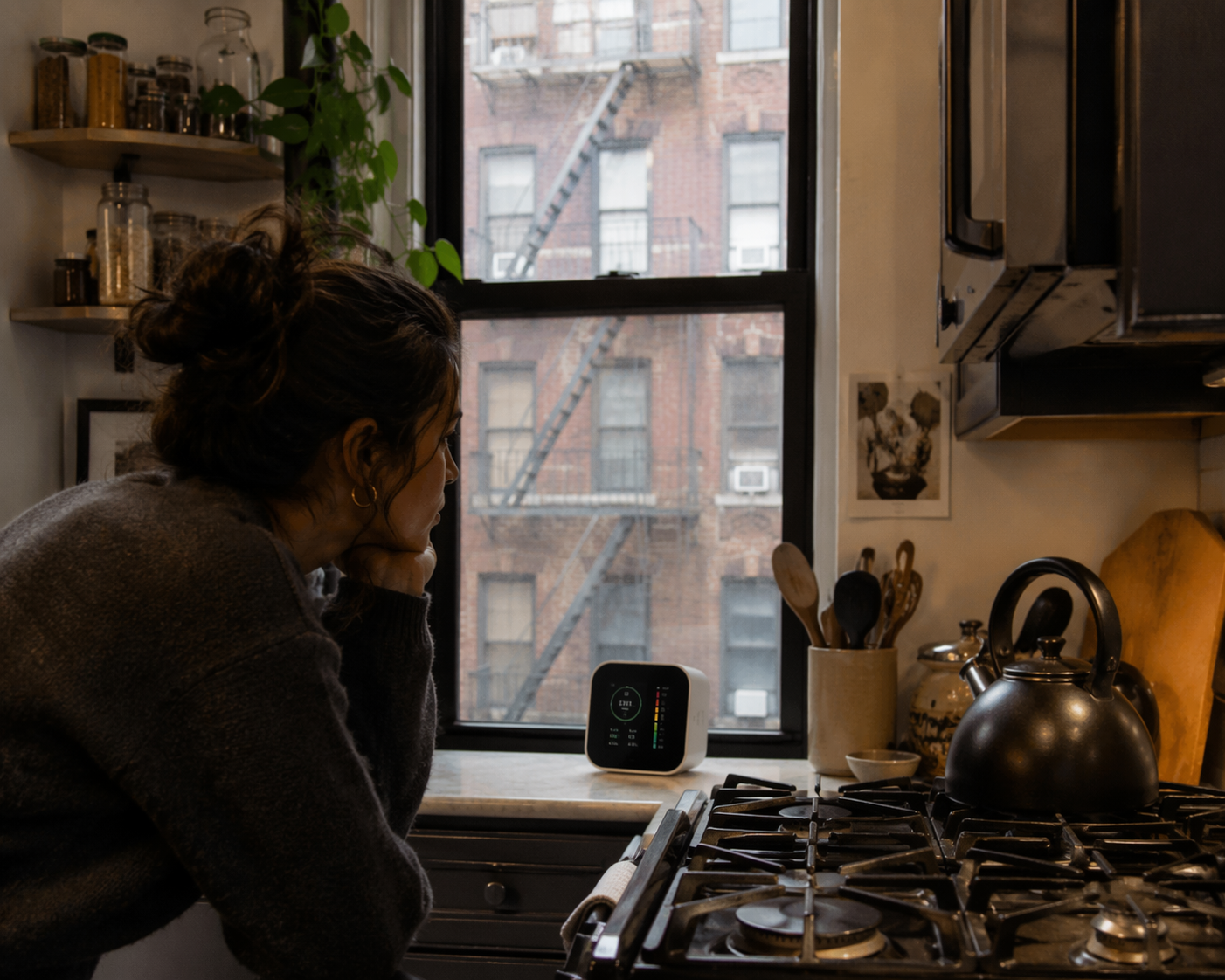
Gas-stove households are where the usual “PM2.5, VOC, humidity” monitor starts to feel incomplete. Cooking with gas can raise nitrogen dioxide and related nitrogen oxides near the source, and that is exactly the class of pollutant many consumer monitors do not measure. AirGradient ONE stands out because it includes NOx, making it unusually well matched to an NYC kitchen where the stove may be a few steps from the sofa and ventilation may be whatever the lease, window, and weather allow.[1]
That does not mean every gas-stove apartment needs to panic-buy the most technical device. It means that if your biggest concern is what happens during and after cooking, a monitor without NOx can give false reassurance. It may show PM2.5, VOCs, or humidity behaving normally while missing the pollutant class that made you buy a monitor in the first place.
There is NYC-specific reason to take that seriously. A Columbia University/Lamont-Doherty project examining gas stove impacts in NYC public housing focused on indoor air quality effects from gas cooking in a local apartment context, which is more relevant than a generic smart-home demo in a detached house.[2] The estimate that more than 70% of NYC apartments have gas ranges should be treated cautiously unless checked against the current NYC Housing and Vacancy Survey; the safer point is narrower but still useful: gas cooking is common enough in NYC apartments that NOx coverage should be a front-page buying criterion, not a footnote.
The catch is integration. AirGradient ONE is Home Assistant native, which is excellent if your apartment already runs through Home Assistant or you are willing to build around it. It is not the same as native Alexa or Google Home support, and Wirecutter's September 2025 review should not be stretched into a promise about mid-2026 firmware or ecosystem changes.[1] If your real requirement is “when this crosses a threshold, Alexa turns on a plug-in purifier,” AirGradient may still be the better sensor, but it is not the lowest-friction automation box.
What I would actually do with the reading
- Place the monitor near the breathing zone outside the immediate cooking plume, not directly over the burner.
- Watch what happens during normal cooking, not only during a deliberate test.
- Use the reading to compare habits: back burner versus front burner, range hood on versus off, window cracked versus closed.
- If outdoor smoke is present, do not assume opening the window is the right response; switch to filtration and source control instead.
Garden-Level And Basement Units: Radon Changes The Category
A garden-level apartment has a different problem from a tenth-floor apartment with a gas stove. Radon is a radioactive gas that can enter buildings from the ground, and the EPA estimates that about 1 in 15 U.S. homes has radon at or above its 4 pCi/L action level.[3] That statistic is national, not an NYC-apartment-specific prevalence number, but it is enough to justify treating ground-contact homes differently.
This is where Airthings View Plus earns its price. At around $330 as of July 2026, it is not the casual budget pick, but it measures seven parameters including continuous radon, and it works with Alexa, Google, and IFTTT. If you live in a basement, garden-level unit, or a house-like apartment with ground contact, buying a cheaper monitor with PM2.5 and VOCs but no radon can create exactly the wrong kind of confidence.
Radon also does not behave like a cooking spike. You are not looking for a ten-minute alert that tells you to open a window while dinner is on. You are looking for a longer-running pattern that tells you whether mitigation or further testing belongs on the home-maintenance list. That slower rhythm is why continuous radon monitoring belongs in its own decision lane.
Winter CO2: The Bedroom Reading That Explains A Lot
CO2 is not usually the most dramatic pollutant in an apartment, but in winter it is one of the most useful readings. When windows stay shut and a bedroom door is closed overnight, CO2 can climb past 1,000 ppm, a commonly used ventilation benchmark in standards discussions, and the practical consequence is easy to recognize: stale air, worse sleep, and a room that feels used up by morning.
If CO2 is your main concern, Qingping Air Monitor Pro Gen 2 is the focused mid-range mention. Around $150 as of July 2026, it covers CO2 plus particulate matter and TVOC, which is the right cluster for someone trying to understand a sealed bedroom or work-from-home corner. Its smart-home fit is less universal because it leans toward Xiaomi Home, so it is not my first recommendation for an Alexa-first renter who wants simple routines.
CO2 readings are most useful when they lead to a boring change: a cracked door, a short ventilation window when outdoor air is acceptable, or a fan strategy that moves air between rooms. NYC Health's indoor air guidance recommends improving ventilation when possible, including opening windows when outdoor air quality allows, which is the important condition in this city.[4] On wildfire-smoke days, the same habit can backfire.
Wildfire PM2.5: Accuracy And The Map Matter
For wildfire smoke, the key pollutant is PM2.5, and the monitor's response speed matters because conditions can change quickly. Consumer Reports' 2026 testing found that top indoor air quality monitors detected PM2.5 drops in under 30 seconds, while the IKEA Vindstyrka failed to report unhealthy air in smoke testing.[5] That does not mean every IKEA unit in every revision should be written off forever, but it is a strong warning against treating cheap PM2.5 displays as interchangeable.
PurpleAir Zen is the wildfire-smoke pick when PM accuracy and neighborhood context matter most. It is not just telling one apartment what one sensor sees; PurpleAir sensors contribute to a community air-quality map, and PurpleAir describes its NYC network as part of hyper-local monitoring.[6] The EPA's Fire and Smoke Map also incorporates PurpleAir sensor data, which is one reason these devices have become more useful during smoke events than a standalone countertop number.[6]
The apartment-level decision is still simple. If the outdoor map is bad and your indoor PM2.5 starts rising, close the window, run filtration, and reduce indoor particle sources. If outdoor air improves and indoor CO2 is high, ventilation can come back into the conversation. A good monitor does not make one rule for every day; it tells you which rule applies right now.
Alexa On A Budget: Amazon's Monitor Is Limited, But Useful
There is no shame in buying the Amazon Smart Air Quality Monitor if your real constraints are price and Alexa routines. Around $50 as of July 2026, it gives an Alexa household a cheap trigger for PM2.5, VOCs, carbon monoxide, temperature, and humidity. For a renter with an Echo speaker and a plug-in purifier, that may be the difference between having a routine and never setting one up.
The limitation is not subtle: it does not measure NOx, CO2, or radon. That makes it a poor single monitor for a gas-stove household worried specifically about combustion pollutants, a stale bedroom where CO2 is the mystery, or a garden-level unit where radon is the question. It is best understood as a low-cost automation sensor, not as the most complete NYC apartment monitor.
For some apartments, that is enough. If the main goal is “turn on the purifier when indoor particles rise” and the household already lives in Alexa, buying a technically superior monitor that never gets connected may be the worse outcome.
VOCs And Humidity Are Secondary, Not Disposable
VOCs are easy to overstate because consumer TVOC readings are broad and not always specific enough to identify a source. Still, in compact apartments, off-gassing from furniture, cleaning products, paint, fragrances, and hobby materials has less space to dilute. A TVOC reading is most useful when it helps compare before and after: after cleaning, after building furniture, after painting, after bringing in a new rug.
Humidity is more straightforward. NYC Health advises keeping indoor humidity between 30% and 50% to help prevent mold.[4] That makes humidity a worthwhile baseline reading in bathrooms, window-wall bedrooms, and apartments with condensation problems. It just should not distract from the more decisive purchase questions: NOx for gas cooking, CO2 for ventilation, PM2.5 for smoke, and radon for ground-contact units.
Where Smart-Home Ecosystems Actually Fit
Alexa, Google Home, HomeKit, Home Assistant, Xiaomi Home, and IFTTT are tie-breakers after pollutant coverage. That sounds backward only until a monitor misses the pollutant you bought it to catch. Native Alexa support is wonderful when the device's sensor set matches your problem. It is less impressive when it automates from the wrong measurement.
| Ecosystem priority | Better fit | Tradeoff |
|---|---|---|
| Alexa-first, lowest cost | Amazon Smart Air Quality Monitor | Easy routines, but no NOx, CO2, or radon |
| Home Assistant household | AirGradient ONE | Strong sensor coverage for gas-stove homes, but less plug-and-play for Alexa or Google |
| Alexa/Google plus radon | Airthings View Plus | Broader integration and radon coverage, with a higher price |
| Xiaomi Home user focused on CO2 | Qingping Air Monitor Pro Gen 2 | Good CO2 fit, less universal smart-home appeal |
| Wildfire-smoke watcher | PurpleAir Zen | Excellent PM/community-map value, not the right answer for NOx or radon |
HomeKit remains the awkward case. Some households want a clean Apple-native path, but the strongest pollutant fit for an NYC apartment may not be the easiest HomeKit device. In that situation, I would rather solve the air problem first and the automation path second, especially for NOx or radon.
The Short Buyer Verdict
- Buy AirGradient ONE if you cook with gas and want the monitor most directly matched to NOx risk.
- Buy Airthings View Plus if your apartment is basement, garden-level, or otherwise ground-contact and radon belongs in the decision.
- Buy Amazon Smart Air Quality Monitor if you want the cheapest useful Alexa routine trigger and accept its missing pollutants.
- Consider Qingping Air Monitor Pro Gen 2 if winter bedroom CO2 is the main thing you want to understand.
- Consider PurpleAir Zen if wildfire PM2.5 accuracy and neighborhood mapping matter more than gas-stove or radon coverage.
If you still need the broader device-selection process, start with How to Choose a Smart Home Air Quality Monitor in 2026. If someone in the apartment is more vulnerable to smoke, asthma triggers, or poor ventilation, read How to Choose a Smart Air Quality Monitor for Sensitive Groups. For smoke season, the next step is not another display; it is a plan, which is where Automate Your Smart Home Air Quality Monitor for Wildfire Smoke, Build a Smoke-Ready Smart Home with a Four-Layer Defense, and Your Smart Air Quality Monitor Detected Smoke: Now What? become more useful than one more product comparison.
References
- The Best Home Air Quality Monitor, Wirecutter, September 2025
- Indoor Air Quality Impacts of Gas Stoves in NYC Public Housing, Columbia University / Lamont-Doherty
- Indoor Air Quality, U.S. Environmental Protection Agency
- Indoor Air Quality, NYC Health Department
- Best Indoor Air Quality Monitors of the Year, Consumer Reports, 2026
- Case Study: How PurpleAir Helps Monitor New York Air Quality, PurpleAir
Reader Feedback
Share your purchase experience, flag outdated picks, or ask clarifying questions about the checklist items.
Comments
Join the discussion with an anonymous comment.