
The simplest version of a smart outdoor fan fly-repellent setup is almost annoyingly plain: put a real fan where the bugs are flying, power it through an outdoor-rated smart plug, and let the automation turn it on before people start swatting.
For a patio or deck, that usually means a standard 20-inch box fan or similar outdoor-safe fan, a weather-resistant smart plug, a GFCI-protected outdoor outlet, and a sunset or temperature-based schedule. Aim the fan low across the seating area, not up into the trees. The goal is not a theatrical wind tunnel; it is a steady 3-6 ft zone of messy, moving air around ankles, chair legs, and the edge of the table.
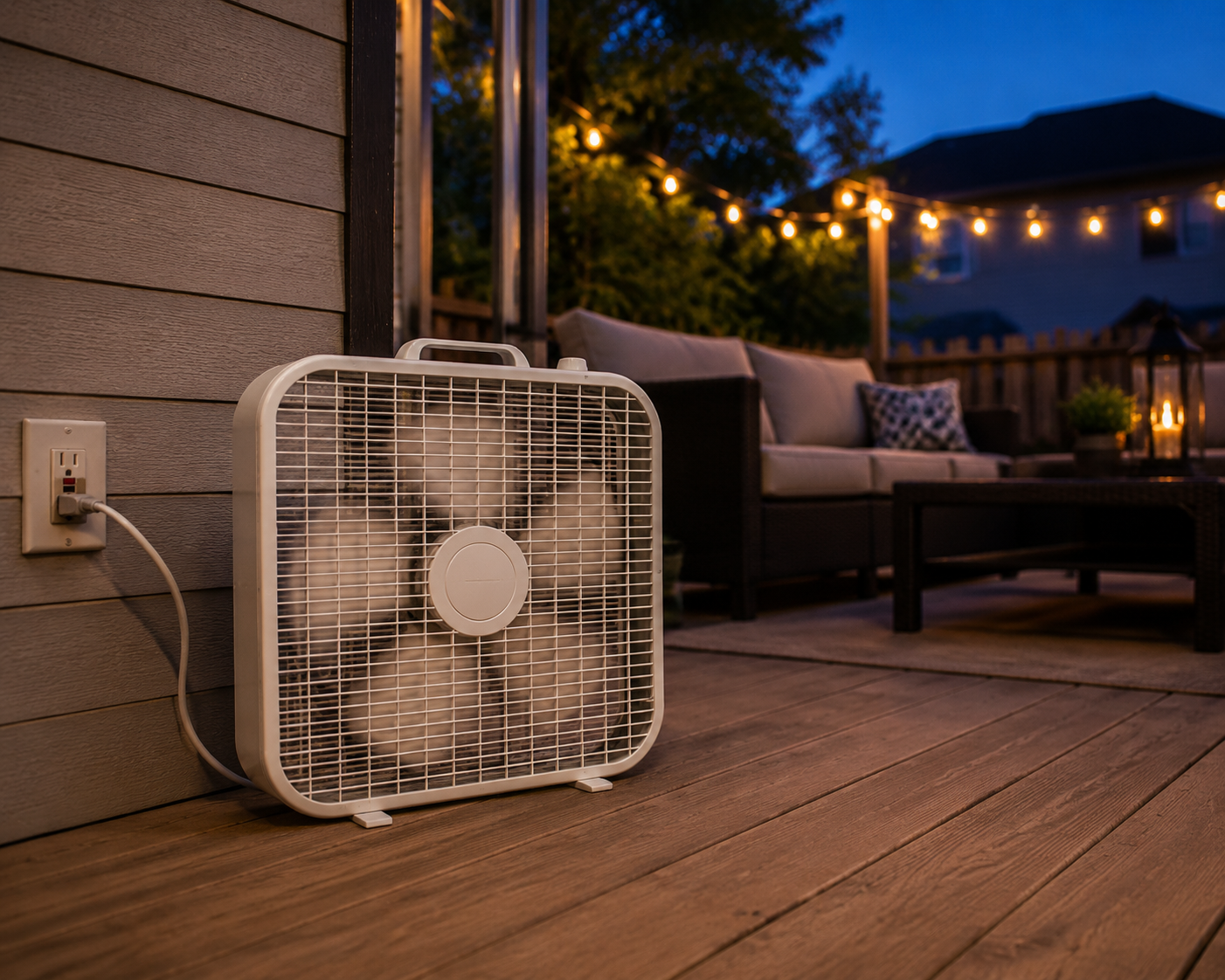
The Recipe
| Part | What to use | Why it matters |
|---|---|---|
| Fan | A 20-inch box fan, pedestal fan, or existing fan that is appropriate for the location | Moves enough air to disturb the space where mosquitoes approach |
| Smart plug | Outdoor-rated plug matched to the fan's load | Lets the fan run automatically without leaving it on all day |
| Power | GFCI-protected outdoor outlet with weather-safe placement | Keeps the hack from becoming an electrical hazard |
| Placement | Low, aimed across legs and under-table space | Targets the area mosquitoes often use rather than just cooling faces |
| Automation | Sunset schedule, voice routine, temperature trigger, or Home Assistant rule | Turns pest control into a background habit instead of another patio chore |
That is the whole system. The useful work is in the placement and the safety details, not in buying a purpose-built pest gadget.
Why Airflow Works Better Than It Looks
Mosquitoes are not strong fliers. Joe Conlon, technical adviser for the American Mosquito Control Association, told Wirecutter that mosquitoes cannot fly in winds above 15 mph, and that even a gentle 4 mph breeze can push them away. He also recommends placing fans low, below table level, because Aedes aegypti mosquitoes tend to target lower extremities and shelter under furniture. [1]
That is the part that makes the hack more than backyard folklore. A fan changes access. It breaks up the calm pocket of air around people, makes it harder for mosquitoes to land, and interferes with the low, sheltered path they often take around chair legs and ankles. A fan on a table may cool your face; a fan on the deck floor is more likely to protect the parts of you mosquitoes are trying to reach.
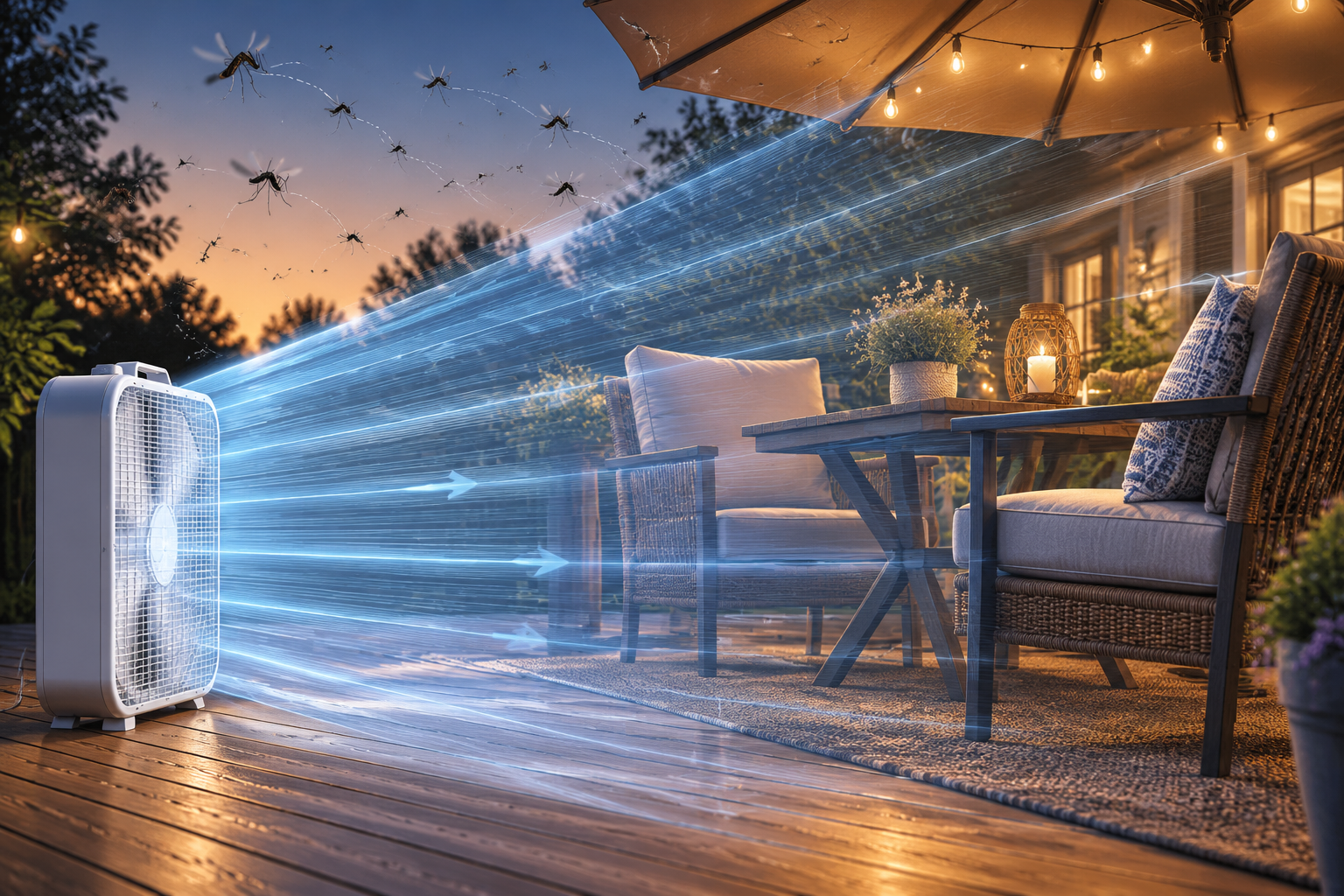
Wirecutter's mosquito-control testing also treated a real fan as a credible deterrent method, including a Vornado fan among its recommended ways to reduce mosquito annoyance outdoors. [1] Its separate review of small tabletop Fly Away fans measured an effective radius of only 8-9 inches from the blade edge. [2] That comparison is the practical hinge: a little spinner may protect a plate; a real fan can shape the air around seats.
Flies deserve a little more caution. Moving air can make a table less inviting for them, and plenty of homeowners use fans that way, but the strongest sourced evidence here is about mosquitoes. If your main problem is houseflies landing on food, the fan still helps most when it blows across the serving zone, but it should not be sold as a guaranteed fly shield for every yard.
Set the Fan Where Bugs Actually Approach
Start with the seating area, not the outlet. Put the fan low enough that the airflow crosses ankles, chair legs, and the shaded space under the table. Angle it across the patio rather than straight at one person. If the first chair gets blasted and the last chair gets nothing, the fan is in the wrong place.
- For a dining table: place the fan on the deck or patio floor and aim it diagonally under the table.
- For lounge chairs: blow across the front of the chairs where legs and feet rest.
- For a serving table: use a lower fan angle if insects are landing near plates, but do not point dust or leaves into food.
- For a larger patio: use two ordinary fans at opposite edges before assuming you need a specialized repellent system.
A calm evening is where this setup feels most useful. On a naturally breezy day, the fan may add less. That is a reason to automate it intelligently, not a reason to abandon the idea.
Use an Outdoor Smart Plug, Not an Indoor Plug Near a Door
The smart plug is the cheap trick that makes the fan behave like installed patio equipment. It also has to be the right kind of cheap trick. Use an outdoor-rated smart plug, keep the plug and cord connection protected from direct water exposure, and plug it only into a GFCI-protected outdoor outlet.
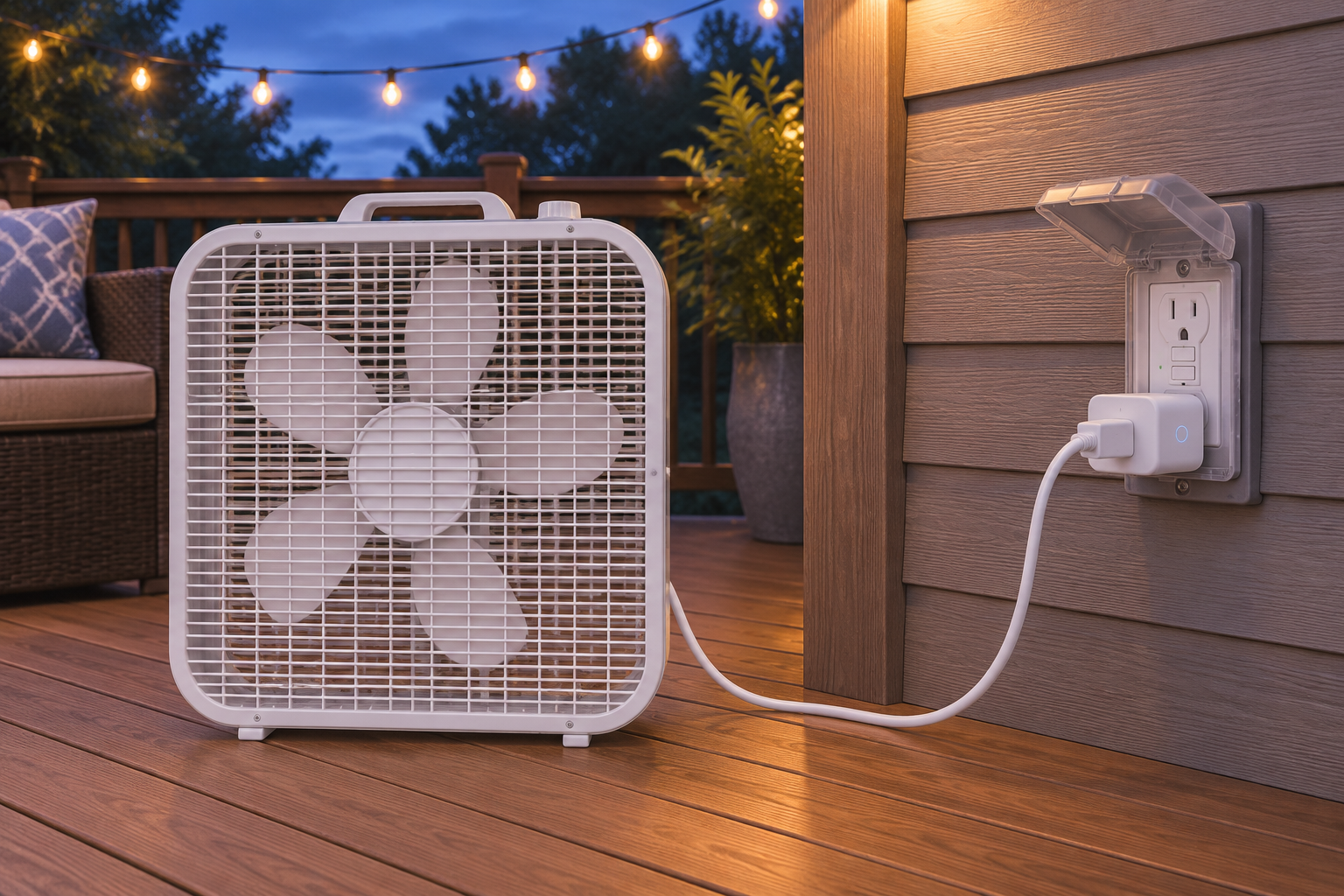
When choosing the plug, the short version is simple: check the outdoor rating, amperage and load compatibility, platform support, operating temperature range, and whether you want independent control of two outlets. If you want the spec-by-spec version, use the site's outdoor smart plug profile or the practical outdoor smart plug chooser rather than turning the fan project into a full plug-shopping guide.
One more unglamorous check matters: make sure the fan returns to its previous state when power is restored. Most simple box fans with physical dials do this well. Some electronic fans do not; if they require a button press after being plugged in, a smart plug cannot reliably start them.
Automate the Annoying Part
The point of adding smart control is not to make the fan futuristic. It is to stop remembering the fan. Most patio use falls into a few reliable patterns: turn it on around sunset, turn it off later in the evening, or run it only when the weather is warm enough that people are likely to sit outside.
| Automation pattern | Use it when | Example rule |
|---|---|---|
| Sunset schedule | Mosquitoes show up most predictably near dusk | Turn patio fan on at sunset and off at 10:30 p.m. |
| Temperature trigger | The patio is only used on warm evenings | Turn fan on at sunset only if outdoor temperature is above your comfort threshold |
| Voice scene | You host irregularly | Say “patio mode” to turn on lights and fan together |
| Manual smart button | Guests or family members should be able to start it without an app | Press an outdoor or nearby indoor button to run the fan for a set period |
Alexa, Google Home, Apple Home, and Home Assistant can all handle the basic version: if it is near sunset, turn on the outdoor plug; later, turn it off. A voice assistant routine is enough for most people. Home Assistant becomes useful when you want conditions: patio fan on after sunset, only above a chosen temperature, only if the back door has opened recently, and off automatically before bed.
Reddit examples from r/homeautomation and r/homeassistant show homeowners using exactly this kind of smart plug plus fan setup, with schedules and platform-specific routines rather than dedicated pest-control hardware. [3][4] Those threads are useful as recipe inspiration, not proof that one schedule works in every climate.
If you already build Home Assistant automations, the same structure used for other smart plug recipes applies here: define the plug, choose a trigger, add conditions, and set a safe shutoff. The site's Home Assistant smart plug recipe patterns are a better place to adapt YAML than turning this fan setup into a full Home Assistant tutorial.
A Ceiling Fan Can Help, But It Is Not the Same Hack
If your patio already has a ceiling fan, it may be worth automating before buying anything else. Wirecutter has covered ways to smarten existing ceiling fans, which can be useful when the fan is already wired in the right place. [5]
The catch is direction. Ceiling fans often move air above the exact zone mosquitoes like: lower legs, chair bases, and the sheltered underside of furniture. A ceiling fan may make the patio feel better, but a low box fan aimed across the seating area is the more direct pest barrier.
Cost Is Where the Plain Hardware Wins
A standard fan plus outdoor smart plug is usually a one-time purchase, and many people already own the fan. There are no repellent mats, cartridges, batteries, scent bottles, or seasonal subscriptions hiding behind the first pleasant dinner outside.
That matters because the competing products tend to solve a narrower problem at a higher ongoing cost. Small tabletop fly fans protect only a tiny radius around the blades in Wirecutter's testing. [2] Refill-based repellent systems may be convenient, but they turn every patio season into another consumables cycle. The fan is boring in exactly the right way: clean it, store it, plug it back in.
What This Hack Does Not Solve
A fan will not remove standing water, reduce a mosquito population, or protect a whole yard. It creates a usable comfort zone in the place people are sitting. If the patio is full of clutter, if the fan is pointed too high, or if the outlet setup is sketchy, the automation layer does not rescue it.
It also works best as a local barrier, not a property-wide pest strategy. Keep the airflow where bodies and food are. Keep the plug dry and GFCI-protected. Give the fan an automatic shutoff so it does not run until morning because someone forgot it after dessert.
For patios and decks, that is enough to make the setup worth trying before buying a specialized repellent gadget: a real fan, automated through an outdoor smart plug, gives broader coverage than tabletop fly fans and avoids refill-based maintenance, provided the power is safe and the placement is realistic.
References
- The Best Mosquito Control Gear for Your Patio or Yard, Wirecutter.
- Do Fly Away Fans Really Keep Flies Away?, Wirecutter.
- r/homeautomation smart plug and fan mosquito repellent discussion, Reddit.
- r/homeassistant smart plug and fan mosquito repellent discussion, Reddit.
- How to Smarten Up Your Ceiling Fans, Wirecutter.
Implementation Notes
Share platform-specific tips, report that a recipe no longer works after a platform update, or contribute variations for different device combinations.
Comments
Join the discussion with an anonymous comment.