What Matter Is — and What It Is Not
Matter is an application-layer standard. It defines the language smart home devices use to describe themselves, receive commands, and report state. What it does not define is the radio or wire those messages travel over. Matter runs on top of Wi-Fi, Thread, or Ethernet — the transport is separate from the standard itself.
This distinction matters more than it might seem. When someone says a device "supports Matter," they mean it speaks a common application language that any Matter-compatible controller can understand. They are not describing a new radio chip or a new wireless frequency.
Matter was launched as version 1.0 in October 2022 by the Connectivity Standards Alliance (CSA), the organization formerly known as the Zigbee Alliance. Apple, Google, Amazon, and Samsung were founding backers — which is why Matter-certified devices work, at least at a baseline level, across all four ecosystems from day one.
At the technical level, Matter describes device capabilities through standardized clusters. The On/Off Cluster, the Level Control Cluster, the Lock Cluster, and the Thermostat Cluster are examples. A dimmer switch from one manufacturer can control a bulb from another because both implement the same cluster definitions. This cluster model is what makes cross-brand interoperability possible — and also what creates the "feature stripping" problem covered later in this article.
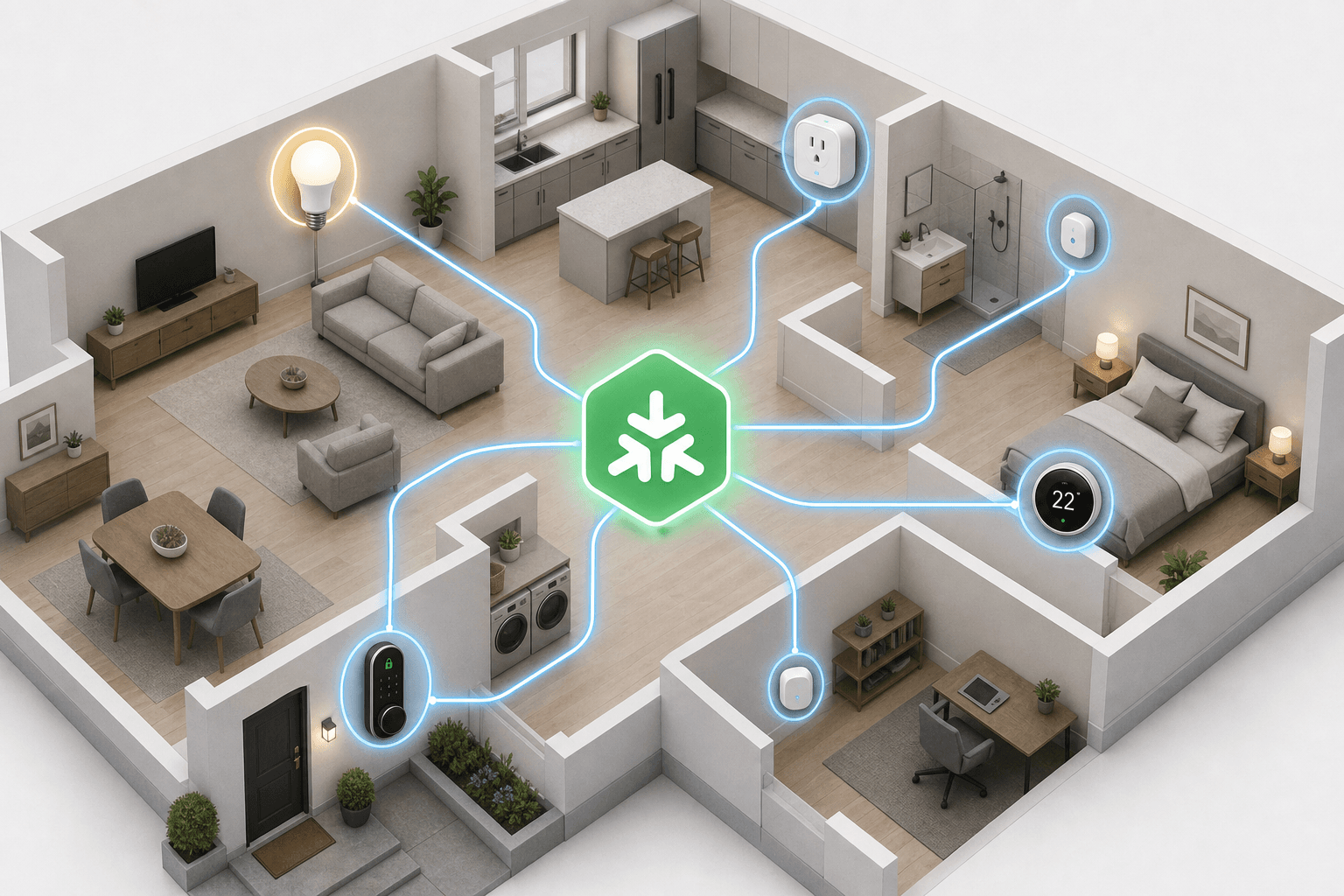
Matter also prioritizes local network communication. Basic device control — lights, locks, sensors — works within the home network without requiring an internet connection. Voice assistants and remote access still depend on cloud connectivity, but the core device relationship is local.
Matter Version History: 1.0 Through 1.5
Matter has released six major versions since its launch. Understanding the version timeline is essential for buyers because a device certified under a newer version may not work correctly on a platform that only implements an older version. This is not a theoretical concern — it is the most common real-world frustration with Matter in 2026.
| Version | Release Date | Key Device Types Added | Notable Spec Changes |
|---|---|---|---|
| 1.0 | October 2022 | Lights, plugs, locks, thermostats, contact/motion sensors, bridges | Initial release; foundational cluster model; commissioning via QR code/NFC |
| 1.1 | May 2023 | No new device types | Bug fixes, improved commissioning reliability, minor spec clarifications |
| 1.2 | October 2023 | Appliances (refrigerators, dishwashers, etc.), robot vacuums, smoke/CO detectors, air quality sensors | Expanded device type library; first major post-launch additions |
| 1.3 | May 2024 | EV chargers, water management devices, energy meters, media devices (TVs, set-top boxes) | Scenes Management Cluster added (provisional); energy and media domains introduced |
| 1.4 | November 2024 | Solar panels, battery storage systems, heat pumps, water heaters, in-wall switches/dimmers (mounted load control), Home Routers and Access Points (HRAP) | Enhanced Multi-Admin (EMA); Long Idle Time (LIT) for battery-powered ICDs; HRAP certification for unified Thread mesh |
| 1.4.1 | May 2025 | No new device types | NFC onboarding improvements; multi-device setup flows |
| 1.4.2 | August 2025 | No new device types | Certificate Revocation Lists (CRLs); Vendor ID Verification; Access Restriction Lists (ARLs); Scenes cluster now certifiable; Quieter Reporting; Thread 1.4 required for border router certification; Wi-Fi Aware commissioning |
| 1.5 | November 2025 | Cameras, video doorbells, closures (shades, gates, awnings), soil sensors | Current specification as of publication; camera and video doorbell support is the headline addition |
The practical implication of this table: if you purchase a Matter 1.5 camera today, it will only work on ecosystems that have implemented Matter 1.5 camera support. As of mid-2026, that means SmartThings — and only SmartThings. Apple Home, Google Home, Alexa, and Home Assistant users will need to wait for their respective platforms to catch up.
What Thread Is and How It Relates to Matter
Thread is a low-power IPv6 mesh networking protocol. It uses the IEEE 802.15.4 radio standard at 2.4 GHz — the same physical radio layer as Zigbee — but it is a completely different protocol stack above that layer. Thread is designed specifically for battery-powered IoT devices: it forms a self-healing mesh, consumes very little power, and routes IP packets directly rather than requiring a proprietary gateway.
Thread is the preferred transport for battery-powered Matter devices. A Matter door sensor or occupancy sensor will typically use Thread rather than Wi-Fi because Thread's power consumption is dramatically lower. Mains-powered Thread devices — a plug-in outlet, for example — also act as router nodes, automatically strengthening the Thread mesh for battery-powered devices nearby.
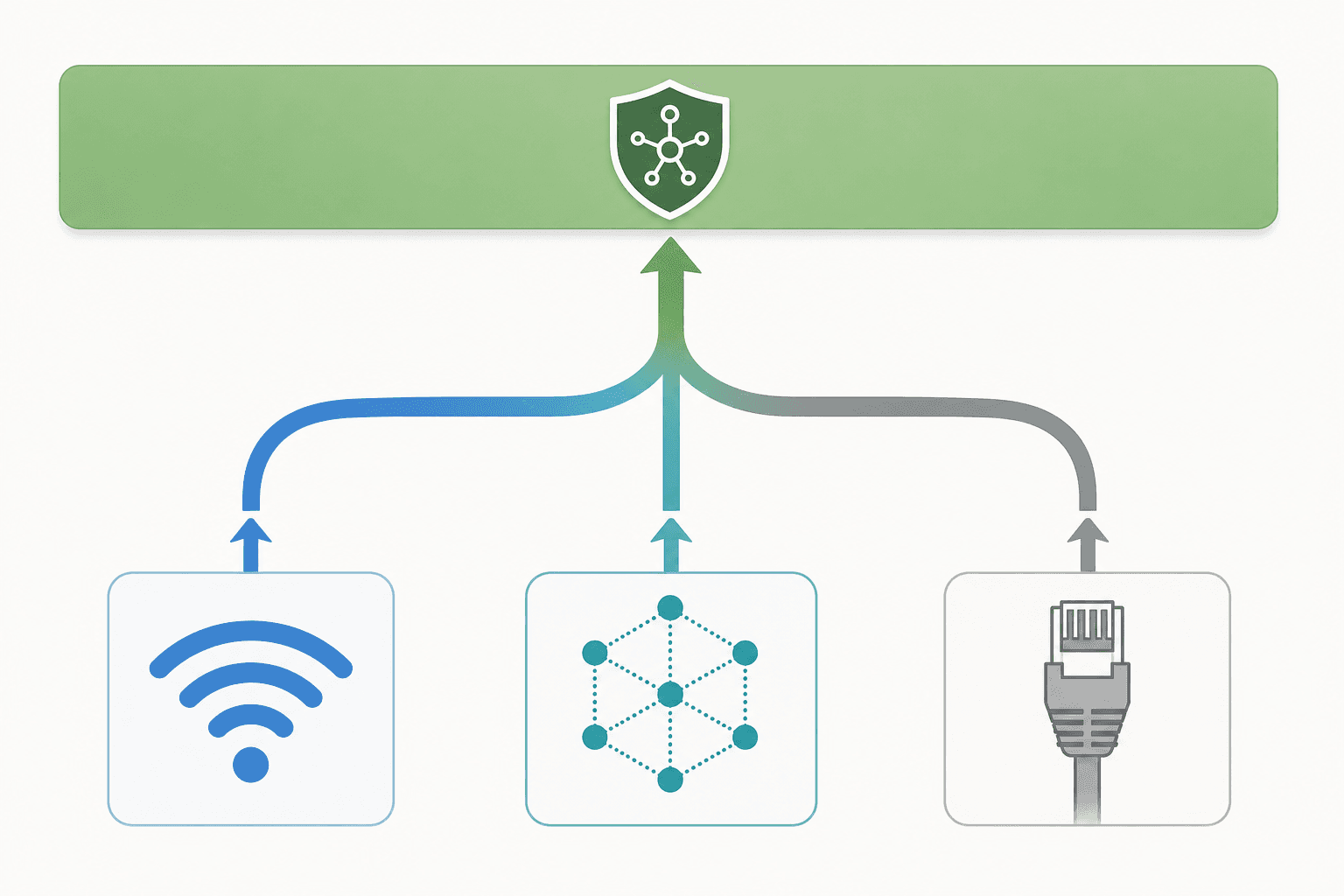
Thread is not required for all Matter devices. Always-on devices — a smart plug, a light switch with a neutral wire, a wired thermostat — commonly use Matter over Wi-Fi instead. Wi-Fi Matter devices connect directly to your router and do not need Thread infrastructure at all.
Thread Border Routers: Which Devices Include One in 2026
A Thread border router bridges the Thread mesh network to your home's IP network (your Wi-Fi router and internet connection). Without a Thread border router, Thread-based Matter devices cannot communicate with Matter controllers or reach the internet for remote access. If you plan to use any battery-powered Matter sensors, locks, or similar devices, you need at least one Thread border router on your network.
Many smart home hubs and speakers already include a Thread border router. The version of Thread the border router supports matters significantly, which is why the table below lists Thread versions alongside each device.
| Device | Thread Version | Notes |
|---|---|---|
| Apple HomePod mini | Thread 1.3 | Thread 1.4 expected via tvOS 26 — not yet confirmed shipped as of June 2026 |
| Apple HomePod (2nd gen) | Thread 1.3 | Thread 1.4 expected via tvOS 26 — not yet confirmed shipped as of June 2026 |
| Apple TV 4K (3rd gen) | Thread 1.3 | Thread 1.4 expected via tvOS 26 — not yet confirmed shipped as of June 2026 |
| Google Nest Hub (2nd gen) | Thread 1.3 | Border router cannot be disabled by user |
| Google Nest Hub Max | Thread 1.3 | Border router cannot be disabled by user |
| Google TV Streamer | Thread 1.3 | Border router cannot be disabled by user |
| Amazon Echo (4th gen) | Thread 1.3 | Border router cannot be disabled by user |
| Amazon Echo Hub | Thread 1.3 | Border router cannot be disabled by user |
| Amazon eero 7 | Thread 1.4 | First widely available Thread 1.4 device from Amazon; mesh router |
| IKEA Dirigera | Thread 1.4 | Hub required for IKEA ecosystem; Thread 1.4 credential sharing supported |
| Samsung SmartThings Station | Thread 1.3 | SmartThings hub with built-in border router |
The Thread version distinction is more than a spec number. Prior to Thread 1.4, each brand's border routers created separate, isolated Thread mesh islands. A Google border router and an Apple border router on the same network would each maintain their own mesh — devices could not roam between them. Thread 1.4 standardizes credential sharing, so a new Thread 1.4 border router joins the existing mesh network rather than creating a competing one.
As of January 1, 2026, Thread 1.3 certifications for new border router hardware are no longer accepted by the Thread Group. New border router products must now certify under Thread 1.4 or later. Matter 1.4.2 goes further, requiring that border routers certified under that spec version support Thread 1.4 and be capable of addressing at least 150 devices.
Matter vs. Zigbee vs. Z-Wave: Protocol Comparison
Neither Zigbee nor Z-Wave is obsolete. Both protocols have real advantages over current Matter implementations in specific areas, and both can coexist with Matter in the same home through bridges. If you already have a working Zigbee or Z-Wave setup, you do not need to replace it to start using Matter.
| Dimension | Matter (over Thread) | Matter (over Wi-Fi) | Zigbee | Z-Wave |
|---|---|---|---|---|
| Radio band | 2.4 GHz (IEEE 802.15.4) | 2.4 / 5 GHz | 2.4 GHz (IEEE 802.15.4) | ~900 MHz (sub-GHz) |
| Hub / border router required | Yes — Thread border router required | No — connects directly to Wi-Fi router | Yes — Zigbee hub/coordinator required | Yes — Z-Wave controller required |
| Network topology | IPv6 mesh (self-healing) | Star (device to router) | Mesh (coordinator + routers) | Mesh (controller + repeaters) |
| Battery life | Good; improving with LIT (1.4) | Poor — Wi-Fi radios draw significant power | Excellent — often 2–5 years on coin cells | Excellent — similar to Zigbee |
| 2.4 GHz congestion risk | Yes — shares band with Wi-Fi and Bluetooth | Yes | Yes — shares band with Wi-Fi and Bluetooth | No — 900 MHz avoids congestion |
| Device ecosystem size | 750+ certified devices (growing rapidly) | Included in above | Thousands of devices across many brands | Hundreds of devices, more curated |
| Cross-brand interoperability | Native — core purpose of Matter | Native | Limited — hub-dependent | Limited — controller-dependent |
| Coexistence with Matter | Native | Native | Via Zigbee-to-Matter bridges (e.g., Hue Bridge, IKEA Dirigera) | Via Z-Wave-to-Matter bridges (limited availability) |
| Privacy / local control | Strong local control by design | Depends on platform cloud dependency | Hub-dependent; local control common | Hub-dependent; local control common |
One concrete battery life data point: the Aqara FP300 presence sensor lasts approximately three years on a battery in Zigbee mode and roughly two years in Thread mode. The Thread radio draws more power than Zigbee's radio at equivalent polling intervals. This gap will likely narrow as Thread hardware matures, but it is real in 2026 and worth factoring into sensor purchasing decisions.
Ecosystem Platform Support in 2026: Where Each Platform Stands
No ecosystem fully implements the complete Matter specification. This is not a criticism — the spec evolves faster than any single platform team can track. But it means that which ecosystem you use determines which Matter device types and features are actually available to you, regardless of what the device's box says.
| Ecosystem | Matter Version Level | Thread Border Router | Notable Gaps / Strengths |
|---|---|---|---|
| Apple Home | 1.3–1.4 (partial) | Thread 1.3 (1.4 expected via tvOS 26 — not yet confirmed) | Strong consumer UX; multi-admin reliable; robot vacuum room targeting added in iOS 18.4; missing some 1.4 energy device types; Matter 1.5 cameras not yet supported |
| Google Home | 1.2–1.3 (partial) | Thread 1.3 (cannot be disabled) | Slowest spec adoption of major platforms; generic switches — a Matter 1.0 feature — still not available to users as of mid-2026; Matter 1.5 cameras not yet supported |
| Amazon Alexa | Claims 1.4 SDK (subset only) | Thread 1.3 (Echo 4th gen, Echo Hub); Thread 1.4 (eero 7) | Implements a subset of 1.4 features; leak sensors not supported as of mid-2026; eero 7 provides Thread 1.4 for users who own it; Matter 1.5 cameras not yet supported |
| Samsung SmartThings | 1.5 (fastest adoption) | Thread 1.3 (SmartThings Station) | Announced Matter 1.5 support within weeks of spec release; only major platform currently supporting Matter 1.5 cameras; Thread border router still at 1.3 |
| Home Assistant | 1.3–1.5 (community-driven) | Requires separate Thread radio dongle (e.g., SkyConnect / ZBT-1) | Open-source; strongest local control; no cloud dependency for core functions; best choice for privacy-first users; requires more technical setup than consumer platforms |
The honest summary: SmartThings is the fastest to adopt new spec versions. Apple Home offers the most polished consumer experience for the device types it supports. Google Home lags on certain device categories in ways that are difficult to explain given the company's resources. Amazon works reliably for the device types it supports but has meaningful gaps. Home Assistant is the right choice if local control and privacy are your primary criteria and you are comfortable with a more hands-on setup.
Real-World Limitations in 2026: Version Mismatch, Feature Stripping, and Thread Fragmentation
Matter's promise is real. The interoperability it delivers — a lock that works in Apple Home and Google Home simultaneously, a sensor that shows up in Home Assistant without any custom integration — is a genuine improvement over the pre-Matter landscape. But three specific issues affect buyers in 2026, and understanding them before purchasing prevents the most common frustrations.
Version Mismatch
When a device is certified under a Matter version that your ecosystem has not yet implemented, the result ranges from degraded functionality to a blank, uncontrollable device icon. A real example: a user purchased an air purifier certified under a Matter version Apple Home did not yet support. The device connected — it appeared in the Home app — but showed a blank box with no controls. It became usable only after Apple released a firmware update months later.
A current live example as of mid-2026: the Aqara Matter camera, certified under Matter 1.5, is supported only by SmartThings. Users on Apple Home, Google Home, Alexa, and Home Assistant cannot use it as a Matter camera yet — they either wait for their platform to implement Matter 1.5 camera support or use the manufacturer's proprietary app instead.
Feature Stripping
Matter's cluster model defines a standardized baseline for each device type. Manufacturers can implement additional features beyond that baseline — effects, scenes, fingerprint readers, custom modes — but those features are not accessible through Matter. They require the manufacturer's own app.
Two concrete examples illustrate this well. Govee smart lights added to Apple Home via Matter expose only On/Off, brightness dimming, and a single solid color. All lighting effects, color scenes, and music sync features require the Govee app. The Aqara U400 UWB smart lock via Matter in Apple Home exposes approach direction detection, Home Key, and passcode management — but fingerprint enrollment still requires the Aqara app. Matter gives you the baseline; the manufacturer's app gives you everything else.
This is not a bug — it is an inherent consequence of standardization. The Matter cluster for lights defines On/Off and Level Control. It does not define proprietary lighting effects because those cannot be standardized across brands. Buyers who want full device functionality should expect to keep the manufacturer's app installed alongside their primary ecosystem.
Thread Fragmentation and the Popcorn Effect
In homes with multiple Thread border routers from different brands, competing Thread meshes can form. Because Google and Amazon hubs do not allow users to disable their built-in border routers, a home with both a Google Nest Hub and an Amazon Echo may have two separate Thread meshes — and devices may join the less optimal one. This creates connectivity inconsistencies that are difficult to diagnose.
A separate but related issue affects Matter lighting: the "popcorn effect." When a group of Matter lights receives a command to turn on simultaneously, they sometimes activate sequentially rather than at the same moment. This happens because Matter's standardized cluster model does not include multicast scene execution — each device receives and processes the command individually. For users who previously used Zigbee group commands with near-simultaneous activation, this is a noticeable regression.
Multi-Admin: One Device, Multiple Ecosystems
One of Matter's most practically useful features is multi-admin: a single Matter device can be added to multiple ecosystems simultaneously. Each ecosystem receives its own cryptographic binding, called a fabric. The device maintains independent state relationships with each fabric — up to five simultaneous ecosystems.
In practice, this means a Matter smart lock can appear in both Apple Home and Google Home at the same time. Locking it from the Apple Home app locks it — and that state is reflected in Google Home as well, because both ecosystems are receiving live state updates from the same device.
Matter 1.4 introduced Enhanced Multi-Admin (EMA), which simplifies the process of adding a device to additional ecosystems. With EMA, an existing device can join a new ecosystem with a single user consent step, rather than requiring the device to be physically reset or re-commissioned. This is particularly useful when adding Home Assistant alongside an existing voice assistant ecosystem.
Practical Guidance: Is Matter Ready for You, and What to Buy First
The answer to "is Matter ready?" depends entirely on which device categories you are buying and which ecosystem you use. Matter is genuinely reliable for some device types. For others, you are better off waiting or buying a non-Matter alternative with better current ecosystem support.
For First-Time Smart Home Buyers
- Start with a Thread 1.4 border router hub. The eero 7 and IKEA Dirigera are the most widely available Thread 1.4 devices. If you are already in the Apple ecosystem, the HomePod mini is a reasonable starting point even at Thread 1.3, with 1.4 expected via tvOS 26. If you use Google or Amazon primarily, an eero 7 adds Thread 1.4 infrastructure to your network.
- Add one or two devices in a mature category before scaling. Smart plugs and contact/motion sensors are the most reliable Matter categories. A single Matter plug or a two-pack of sensors lets you verify that your ecosystem and border router work correctly before committing to a larger purchase.
- Verify ecosystem support before buying any device in a category newer than Matter 1.2. Check your ecosystem's official Matter compatibility documentation, not just the device's box.
For Existing Zigbee or Z-Wave Owners
- Do not replace your existing hub. If your Zigbee or Z-Wave devices are working, keep them. Many Zigbee hubs (Philips Hue Bridge, IKEA Dirigera, Aqara Hub M3) now support Matter bridging, which makes your existing devices visible in Matter ecosystems without replacing anything.
- Evaluate new device purchases on a case-by-case basis. When buying a new sensor or lock, check whether the Matter version offers meaningful advantages over the Zigbee equivalent in your specific ecosystem. For battery-powered devices, the Zigbee version may still offer longer battery life.
- Use Matter for new device categories your current hub does not support. If your Zigbee hub does not support EV chargers or energy meters, Matter 1.3+ devices in those categories can add that capability without disrupting your existing setup.
Device Category Readiness Assessment
| Device Category | Matter Readiness | Notes |
|---|---|---|
| Smart plugs / outlets | Mature — buy now | Matter 1.0; works reliably across all major ecosystems |
| Smart lights / bulbs | Mature — buy now | Matter 1.0; minor popcorn effect in group scenes; check if full effects require manufacturer app |
| Smart locks | Solid — buy with ecosystem check | Matter 1.0; verify your ecosystem supports the specific lock's cluster features before purchasing |
| Contact / motion sensors | Solid — buy now | Matter 1.0; excellent cross-ecosystem reliability |
| Thermostats | Solid — buy with ecosystem check | Matter 1.0; energy management features vary by ecosystem |
| Robot vacuums | Solid, check ecosystem | Matter 1.2; room targeting added in iOS 18.4 for Apple Home; verify support on your platform |
| Smoke / CO detectors | Solid — buy with ecosystem check | Matter 1.2; check ecosystem support for your specific detector model |
| Air quality sensors | Solid — buy with ecosystem check | Matter 1.2; widely supported |
| EV chargers | Evolving — verify before buying | Matter 1.3; limited certified devices; ecosystem support varies |
| Energy meters / solar / batteries | Evolving — platform-limited | Matter 1.3–1.4; limited ecosystem implementation; SmartThings most advanced |
| Cameras / video doorbells | Early — SmartThings only | Matter 1.5; only SmartThings supports Matter 1.5 cameras as of mid-2026 |
| Motorized shades / blinds | Early — verify per ecosystem | Matter 1.5; limited certified products and ecosystem support as of mid-2026 |
Frequently Asked Questions
- Do I need Thread to use Matter? No. Matter works over Wi-Fi and Ethernet as well. Always-on devices like smart plugs and wired light switches commonly use Matter over Wi-Fi and require no Thread infrastructure. Thread is the preferred transport for battery-powered devices because of its lower power draw, but it is not required for all Matter setups.
- Can one Matter device work in both Apple Home and Google Home simultaneously? Yes. This is Matter's multi-admin feature. A single device can join up to five ecosystems at the same time, each with its own cryptographic fabric. State changes made in one ecosystem are reflected in the others.
- How many ecosystems (fabrics) can a Matter device join? Up to five simultaneous fabrics. In practice, most households will use one or two.
- Is my existing hub Matter-compatible? It depends on the hub. Many smart speakers and hubs received Matter controller support via firmware updates (Amazon Echo, Google Nest Hub, Apple HomePod). Zigbee-specific hubs like the Philips Hue Bridge and IKEA Dirigera received Matter bridge support, making their connected Zigbee devices visible in Matter ecosystems. Check your hub manufacturer's release notes for Matter support status.
- What happens if I buy a Matter 1.5 device and my ecosystem only supports 1.3? The device may connect but operate with degraded functionality — or it may appear as an unrecognized device type with no controls. The specific outcome depends on the device category and how the platform handles unknown device types. For device categories introduced in 1.4 or 1.5 (cameras, energy devices, closures), a platform running 1.3 will typically not support them at all.
- Do I need to replace my Zigbee hub to use Matter? No. Do not replace a working Zigbee hub. Many Zigbee hubs now support Matter bridging, which exposes your existing Zigbee devices to Matter controllers. If your hub does not yet support Matter bridging, you can still add Matter devices to your network independently — the two protocols coexist without conflict.
- Is Matter 1.5 the latest version? As of this article's publication date (June 2026), Matter 1.5 (released November 2025) is the current specification. Further development is ongoing — additional versions are expected — but no confirmed specification beyond 1.5 has been formally announced by the CSA as of publication.
Updates & Corrections
Protocol specifications and platform features change rapidly — especially with Matter version evolution. Report version changes, certification count updates, or platform policy changes that have occurred since the last editorial review.
Comments
Join the discussion with an anonymous comment.