Platform Snapshot: Classic Alexa vs. Alexa+
Alexa in mid-2026 operates as a two-tier platform. Classic Alexa — the voice assistant that has shipped on Echo devices since 2014 — handles device control, routines, timers, shopping lists, and third-party skill integrations. It remains free and functional on every Echo device Amazon has sold.
Alexa+ is the generative AI layer built on top of classic Alexa. It adds agentic task completion (booking a ride, placing a food order, navigating streaming content by scene), ambient intelligence driven by the Omnisense sensor platform on newer Echo hardware, and orchestration across tens of thousands of third-party services. According to Amazon's launch announcement, Alexa+ is free for all Amazon Prime members and costs $19.99 per month as a standalone subscription.
Every Echo device released in the fall 2025 refresh ships with Alexa+ Early Access enabled out of the box. Older Echo generations may have partial or no Alexa+ support depending on chip capability — buyers should verify current support status at amazon.com/alexaplus before assuming full AI feature availability on legacy hardware.
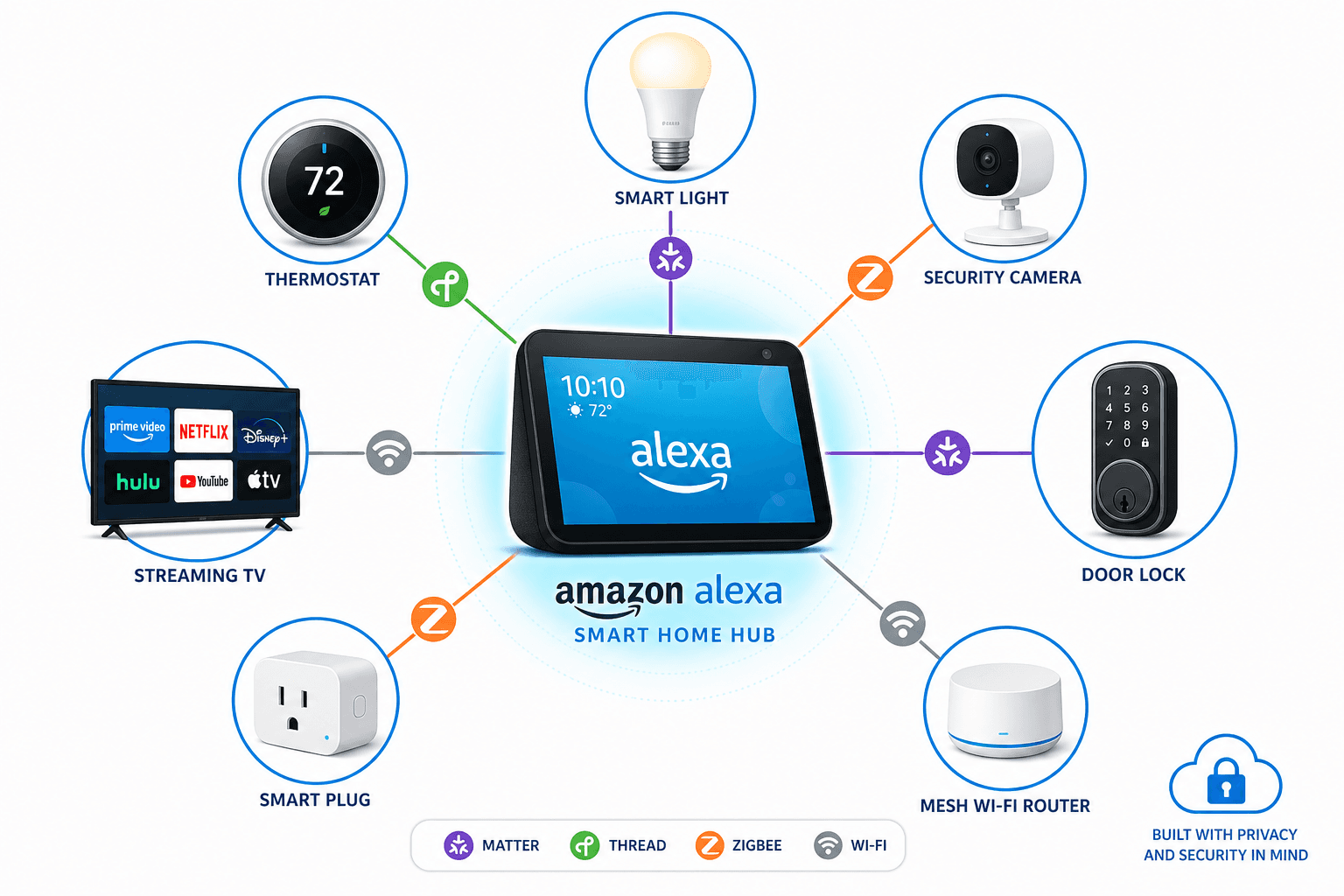
For smart home buyers, the practical distinction is this: classic Alexa is the compatibility and control layer — it is what makes 140,000+ third-party devices work with Echo. Alexa+ is the intelligence layer — it is what makes Alexa capable of multi-step autonomous tasks and contextual awareness. Both layers coexist; Alexa+ does not replace the device control functionality of classic Alexa.
Protocol Support: Matter 1.5, Thread, Zigbee, and Wi-Fi
Alexa's protocol stack as of mid-2026 is the broadest of any major smart home platform. The March 2026 developer documentation update confirmed Matter 1.5 support across Matter-compatible Echo devices — putting Alexa ahead of several competitors still running Matter 1.3 or 1.4. The same update added OTA firmware update support for Matter devices, meaning Echo can push firmware to compatible Matter products directly from the Alexa platform without requiring a manufacturer app.
| Protocol | Alexa Support Status | Hub Required? | Notes |
|---|---|---|---|
| Matter 1.5 | Confirmed (March 2026) | No — built into qualifying Echo/eero devices | Covers Matter over Wi-Fi and Matter over Thread; OTA device firmware updates added March 2026 |
| Thread 1.3 (border router) | Yes — select Echo and eero devices | No separate hub needed on supported devices | Echo Dot Max, Echo Hub, Echo Show 8/11 (2025), Echo Show 10/15/21, Echo Studio, eero 6/6+/7/Pro/Max 7/Outdoor 7/PoE |
| Thread 1.1 (border router) | Yes — older Echo hardware | No separate hub needed | Echo (4th Gen) |
| Zigbee | Yes — select Echo devices | No separate hub — built into Echo Show 8, Echo Show 11, Echo Hub, Echo (4th Gen) | Required for Zigbee-only devices; not all Echo models include Zigbee |
| Wi-Fi (2.4 GHz / 5 GHz) | Yes — all Echo devices | No | Standard for most Wi-Fi smart home devices; BLE used for Matter commissioning |
| Bluetooth LE | Yes | No | Used for Matter device commissioning and some direct device control |
The practical implication for buyers: if you own an Echo Show 8 (2025), Echo Show 11, Echo Hub, Echo Dot Max, or any eero 6 or newer mesh router, you already have a Thread 1.3 border router in your home. You do not need a separate hub to run Matter over Thread devices. Zigbee support is more limited — it is built into specific Echo models (Echo 4th Gen, Echo Show 8, Echo Show 11, Echo Hub) but not universal across the lineup.
Current Echo and Amazon Hardware Lineup
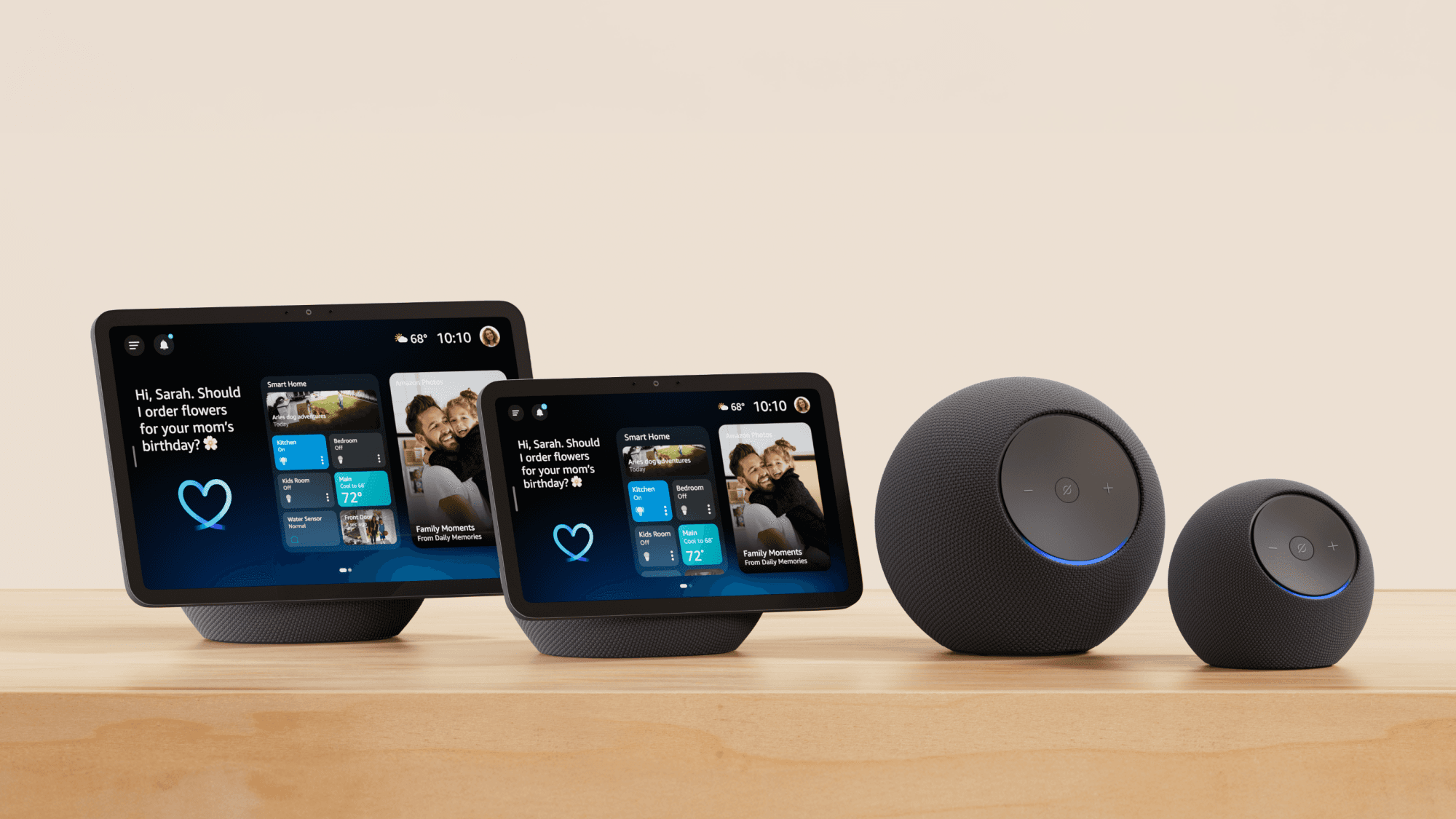
The fall 2025 Echo refresh introduced four new devices built around Amazon's custom AZ3 and AZ3 Pro silicon. All four ship with Alexa+ Early Access and are purpose-built for the AI-layer capabilities Alexa+ requires.
| Device | Price (USD) | Chip | Thread Border Router | Built-in Hub Protocols | Alexa+ Early Access |
|---|---|---|---|---|---|
| Echo Dot Max (2025) | $99.99 | AZ3 | Thread 1.3 | None | Yes |
| Echo Studio (2025) | $219.99 | AZ3 Pro | Thread 1.3 | None | Yes |
| Echo Show 8 (2025, 3rd Gen) | $179.99 | AZ3 Pro | Thread 1.3 | Zigbee, Matter, Thread | Yes |
| Echo Show 11 (2025) | $219.99 | AZ3 Pro | Thread 1.3 | Zigbee, Matter, Thread | Yes |
| Echo Spot (2024) | N/A | AZ2 Pro | No | None | Limited |
| Echo Hub | Varies | AZ2 Pro | Thread 1.3 | Zigbee, Matter, Thread | Yes |
| Echo (4th Gen) | Varies | AZ2 | Thread 1.1 | Zigbee, Matter | Partial |
| eero 6 / 6+ / 7 / Pro / Max 7 | Varies | — | Thread 1.3 | Wi-Fi mesh + Thread border router | N/A — router, not Echo |
The Echo Show 8 and Echo Show 11 are the most capable smart home hubs in the lineup — each includes built-in Zigbee, Matter, and Thread support alongside the AZ3 Pro chip and the Omnisense sensor platform (13MP camera, ultrasound, Wi-Fi radar, accelerometer, and Wi-Fi CSI). The Echo Hub is a dedicated smart home dashboard device without speaker or display-first use cases, optimized for device management.
Fire TV devices extend the Alexa surface to living room displays — the redesigned Fire TV interface (CES 2026) delivers 20–30% speed improvements and Alexa+ scene-level navigation in Prime Video. For buyers already in the Amazon ecosystem, Fire TV acts as a secondary Alexa control surface without requiring an additional Echo.
Works with Alexa: Device Categories and Certification Standards
The Works with Alexa (WWA) program is the certification layer that defines which third-party devices officially integrate with the Alexa platform. As of mid-2026, the certified device category list covers the full breadth of a smart home buildout:
- Lighting and smart plugs (the largest category by device count)
- Generic buttons and remote controls
- Sensors (motion, contact, temperature, air quality)
- Door locks and window coverings (closure devices)
- Thermostats and HVAC controls
- Fans, air purifiers, and room air conditioners
- Dishwashers and major appliances
- Robotic vacuums
- Smoke and CO alarms
The November 2024 developer update added air purifiers, air quality sensors, dishwashers, generic buttons, and smoke/CO alarms as supported Matter device categories. All of these are now covered under the Matter 1.5 SDK Alexa supports.
The practical value of WWA breadth is that buyers are unlikely to encounter a mainstream smart home device category that Alexa cannot control. The risk is that within any given category, device quality varies significantly. A thermostat from a major brand with a recent WWA certification will behave differently than a budget plug certified under older standards.
First-Party Ecosystem Depth: Ring, Blink, eero, and Fire TV
Alexa's compatibility breadth is matched by a first-party ecosystem depth that no competing platform can replicate through third-party integrations alone. Amazon owns Ring, Blink, and eero outright, which means these brands share infrastructure, data pathways, and update cycles with the Alexa platform rather than depending on API agreements.
- Ring: The Ring Alarm and camera lineup integrates with Alexa at a depth third-party security brands cannot match — including AI Unusual Event Alerts, Active Warnings, and Fire Watch with Watch Duty integration announced at CES 2026. Ring Sensors announced at CES 2026 operate over Amazon Sidewalk, requiring no Wi-Fi, hub, or Ring base station — a meaningful installation simplification. Note that Ring Alarm arming and disarming through Alexa requires an active Ring subscription.
- Blink: Amazon-owned Blink cameras (including the Outdoor 2K+ with 1-year+ battery life) integrate natively with Alexa without requiring a separate bridge or skill setup. A new AI subscription tier adds intelligent event detection. For buyers who want long-battery outdoor cameras without Ring's subscription model, Blink is a lower-cost first-party option.
- eero: Every eero 6, 6+, 7, Pro, Max 7, Outdoor 7, and PoE model includes a Thread 1.3 border router. For buyers who already use eero for mesh Wi-Fi, the Thread infrastructure for Matter devices is already in place. eero devices also receive OTA firmware management through Amazon's infrastructure.
- Fire TV: Fire TV functions as a living room Alexa surface — the redesigned interface and Alexa+ scene navigation in Prime Video extend smart home control to the TV screen. For households already using Fire TV, this is a zero-cost additional Alexa control point.
The integration advantage here is not just convenience — it is update cadence and feature parity. When Amazon adds a new Alexa capability, Ring, Blink, and eero devices receive it through the same infrastructure. Third-party brands must wait for API updates and re-certification cycles.
Extended Alexa+ Integrations: Beyond Amazon Hardware
CES 2026 marked a significant expansion of Alexa+ to non-Amazon surfaces. The announcements signal that Amazon is positioning Alexa+ as a platform layer that can run on other manufacturers' hardware, not just Echo devices.
- Samsung TVs: Samsung is the first non-Amazon hardware manufacturer to embed Alexa+ directly. Early access is available for select 2021–2025 Samsung TV models with existing Alexa built-in. This is the first time Alexa+ has shipped outside Amazon's own hardware.
- BMW vehicles: BMW's new iX3 features the BMW Intelligent Personal Assistant powered by Alexa+ via Amazon's Alexa Custom Assistant (ACA) framework, enabling natural language vehicle control, connected services, and AI-powered in-vehicle navigation through HERE Technologies and TomTom mapping integrations.
- Bosch 800 Series espresso machines: Alexa+ capabilities are being added to Bosch's fully automatic espresso line — an example of Alexa+ moving into major kitchen appliances beyond the smart home device categories already covered by WWA.
- Oura health rings: Oura ring integration (sleep and recovery data) is in early access, with Withings and Wyze announced as upcoming additions. This extends Alexa+ into health and wellness data beyond the home.
- Third-party agentic services: At the Alexa+ launch, Amazon announced integrations with Uber, Grubhub, Ticketmaster, OpenTable, Spotify, and tens of thousands of other services through the 'experts' framework — groups of APIs and capabilities Alexa+ can orchestrate to complete multi-step tasks.
For smart home buyers, the practical relevance of these expansions is ecosystem durability. An Alexa investment is not limited to Echo hardware — the platform is expanding to TVs, vehicles, appliances, and health devices, which reduces the risk that Alexa becomes a niche voice assistant as computing surfaces diversify.
Privacy Posture: What Changed in March 2025 and What Controls Remain
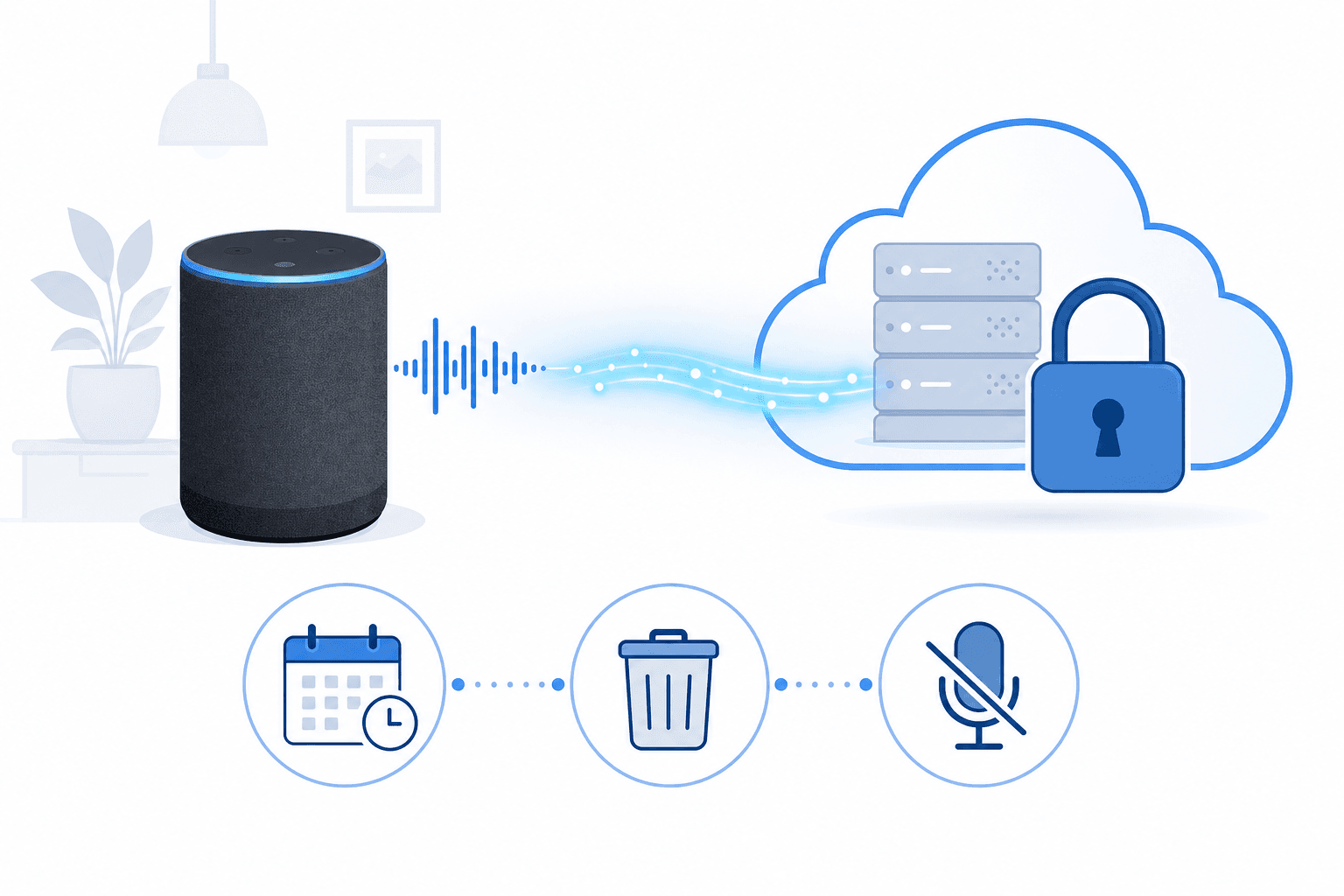
The most significant change to the Alexa platform in the past 18 months was not a feature addition — it was a removal. On March 28, 2025, Amazon eliminated the 'Do Not Send Voice Recordings' setting, which had previously allowed local processing of Alexa requests on three devices: Echo (4th Gen), Echo Show 15, and Echo Show 10.
Amazon informed affected users by email on March 14, 2025. The company's stated reason: generative AI features in Alexa+ require cloud processing power that cannot be replicated locally. As a consequence, all Alexa voice commands — across all Echo devices — are now processed in Amazon's cloud. Users who had the 'Don't save recordings' setting enabled also lost Voice ID functionality as a result of the change.
Amazon states that voice recordings are encrypted in transit and deleted by default after processing. The following controls remain available to users:
- Auto-delete schedules: Users can configure recordings to be automatically deleted after each session, after 3 months, or after 18 months. This setting is accessible via Alexa app > More > Alexa Privacy.
- Manual recording deletion: The Alexa Privacy Dashboard allows users to review and manually delete individual voice recordings or all recordings in a date range.
- Hardware mic and camera shutoffs: Echo Show devices retain physical hardware buttons to disable the microphone and camera. These are hardware-level controls — not software toggles — and are independent of the cloud processing change.
This is a real trade-off, not a minor policy footnote. Amazon's privacy history — including a $25M FTC penalty over children's voice recordings in 2023 and a Ring FTC settlement over employee access to camera footage — provides context for how seriously buyers should weigh this change. At the same time, Amazon's stated data handling (encryption in transit, default deletion) is consistent with major cloud platform practices. Buyers should assess their own privacy tolerance rather than treating this as a categorical disqualifier or dismissing it entirely.
Competitive Positioning: Alexa vs. Google Home, Apple HomeKit, and SmartThings
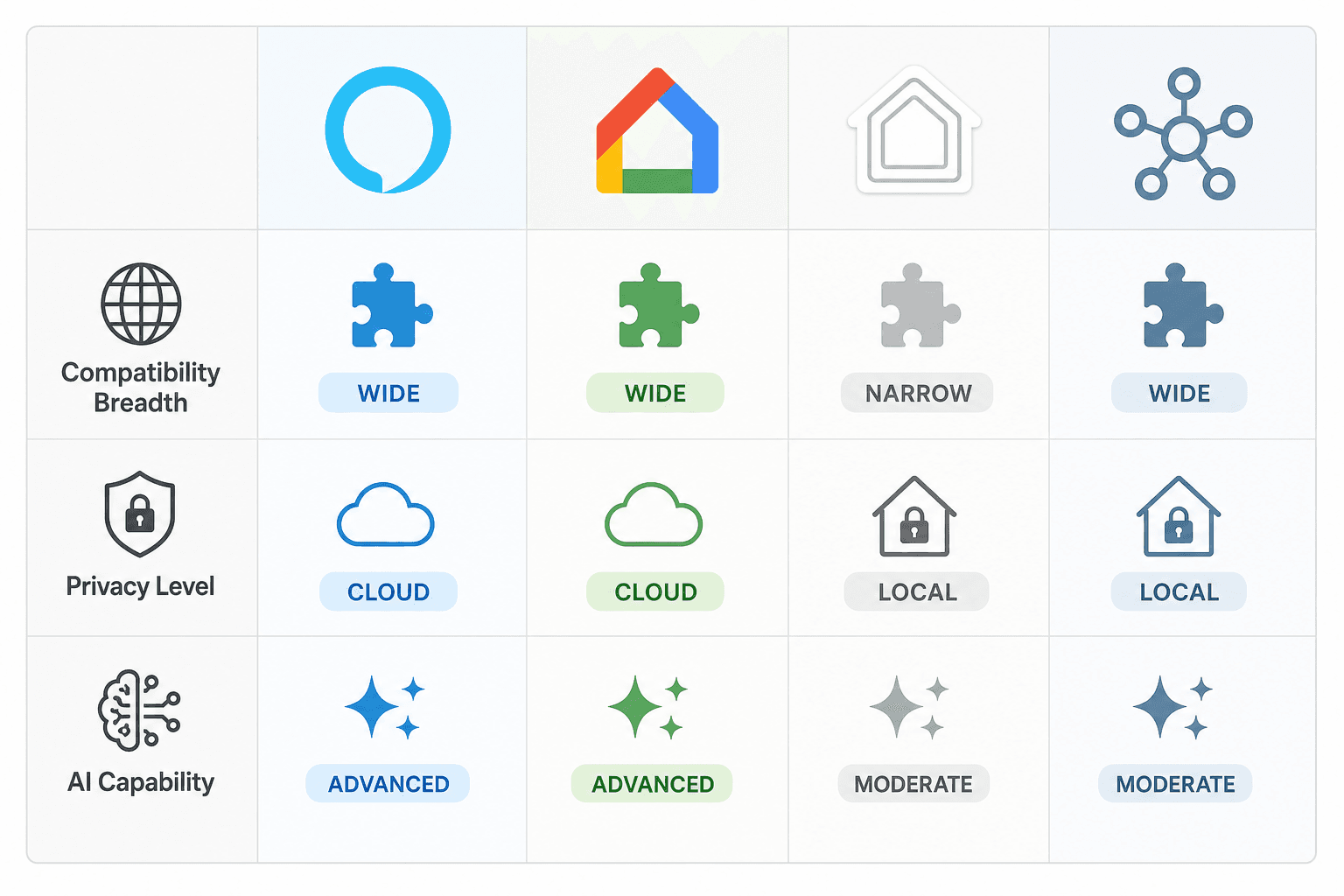
| Dimension | Amazon Alexa | Google Home | Apple HomeKit | Samsung SmartThings |
|---|---|---|---|---|
| Compatibility breadth | Very High — largest third-party device network; 140,000+ WWA-certified devices | High — broad via Matter and Android/Nest integration | Moderate — Apple-certified devices only; partial Matter integration | Very High — multi-protocol, universal hub support |
| Voice processing model | Cloud (mandatory as of March 2025) | Cloud with local assist for some features | Local processing primary; cloud for Siri requests | Hybrid — local automation + cloud services |
| Privacy posture | Fair — encrypted in transit, user-configurable deletion schedules; no local processing option | Moderate — cloud-dependent with some local processing for routines | Excellent — local processing default, end-to-end encryption | Good — hybrid model with local automation capability |
| AI / automation capability | Advanced — ambient/sensor-driven via Omnisense; Alexa+ agentic tasks | Advanced — predictive and context-aware via Gemini integration | Moderate — adaptive automations; privacy-constrained AI scope | High — hybrid energy-efficient automation; SmartThings AI features |
| Matter support | Matter 1.5 (March 2026) | Matter 1.x (check current version) | Matter (via Home app) | Matter (via SmartThings hub) |
| Hub required? | No — Thread/Zigbee built into select Echo and eero devices | No — Thread built into Nest Hub Max and newer | No — Thread built into HomePod mini and HomePod (2nd Gen) | Yes — SmartThings Hub required for Zigbee/Z-Wave |
| First-party hardware depth | Very High — Ring, Blink, eero, Fire TV | High — Nest cameras, thermostats, displays | High — HomePod, Apple TV, iPhone as hub | Moderate — Samsung appliances and SmartThings devices |
The clearest trade-off in this comparison is between Alexa and HomeKit. Alexa offers the widest device compatibility and the most capable AI layer, but at the cost of mandatory cloud voice processing. HomeKit offers the strongest privacy posture through local processing and end-to-end encryption, but with a narrower certified device ecosystem. Google Home sits between the two — broader than HomeKit, with some local processing capability, but cloud-dependent for most AI features.
SmartThings competes with Alexa on compatibility breadth and multi-protocol support but requires a SmartThings Hub for Zigbee and Z-Wave devices, which adds cost and a dependency that Alexa avoids for buyers who already own an Echo Show or eero router.
Buyer Verdict: Who Alexa Is Right For — and Who Should Look Elsewhere
Alexa is the strongest choice in the following scenarios:
- You want maximum third-party device choice and do not want to be constrained by a narrow certified device ecosystem. No platform has a wider WWA-certified device range than Alexa.
- You are already an Amazon Prime subscriber. Alexa+ is included at no additional cost with Prime — the AI layer is effectively free for the majority of US Amazon shoppers.
- You are building a security camera and alarm system and want Ring or Blink as your camera platform. The native integration depth between Ring/Blink and Alexa is unmatched by any third-party camera brand on any platform.
- You use eero for mesh Wi-Fi. Your Thread border router infrastructure is already in place — you can add Matter over Thread devices without purchasing any additional hub hardware.
- You want agentic AI capabilities — booking services, multi-step task completion, ambient intelligence — as part of your smart home platform, not just device control.
Alexa is a less ideal choice in the following scenarios:
- Privacy is a primary requirement. If local voice processing is non-negotiable, Apple HomeKit with HomePod is the only major platform that maintains local processing as its default model. Alexa's mandatory cloud processing is a fundamental architectural choice, not a configurable setting.
- Your household is Apple-only. HomeKit integrates natively with iPhone, iPad, Apple Watch, and Apple TV in ways that Alexa cannot replicate. For Apple-centric households, HomeKit's ecosystem coherence outweighs Alexa's device breadth.
- You need Z-Wave device support. Alexa does not include a native Z-Wave radio. Z-Wave devices require a separate hub (SmartThings, Hubitat, or similar) that then integrates with Alexa — adding cost and complexity that SmartThings avoids by including Z-Wave natively.
Updates & Corrections
Protocol specifications and platform features change rapidly — especially with Matter version evolution. Report version changes, certification count updates, or platform policy changes that have occurred since the last editorial review.
Comments
Join the discussion with an anonymous comment.