
Why '10–26% Savings' Is Not a Purchase Decision
Every smart thermostat review eventually quotes the same range: save 8% to 26% on heating and cooling. That figure comes from real data — ENERGY STAR certification requires a minimum 8% heating run-time reduction, and engaged users of leading models have reported savings approaching the upper bound. But a percentage is not a timeline. It does not tell you when your specific purchase pays for itself.
A household spending $800 per year on HVAC and a household spending $2,400 per year can both achieve 12% savings — but one recoups $96 annually and the other recoups $288. Those two households have very different break-even dates, even if they buy the same device at the same price.
This article is not a buyer guide and not a savings explainer. It is a calculation tool. It delivers the payback formula with labeled inputs, two fully worked numerical examples, a 12-scenario matrix covering common household profiles, and 10-year net savings projections — so you can determine your own break-even date before you buy.
The Four Variables That Determine Your Payback Period
Four inputs drive every payback calculation. Get these right and the formula takes care of itself.
- Device cost. Budget-tier smart thermostats (e.g., Honeywell Home T6 Pro, Amazon Smart Thermostat) typically run $80–$150. Premium models (e.g., Ecobee Premium, Nest Learning Thermostat 4th Gen) run $200–$280. Use the actual retail price, not a promotional price that may not apply to you.
- Installation cost. DIY installation costs $0 in labor. Professional installation typically adds $100–$150, though costs vary by market and by wiring complexity — homes without a C-wire may require additional work. If you are unsure whether your wiring supports DIY installation, check the device's compatibility tool before assuming $0.
- Utility rebate. Utility rebates average $75–$100 nationally, though the range is wide. Some programs offer $50; others offer $130 or more. Roughly half of available rebate programs allow DIY installation; the other half require professional installation to qualify. No federal tax credit applies to smart thermostat purchases in 2026 — rebates are the only available subsidy.
- Annual HVAC spend × savings rate. This is the single most powerful ROI driver. Your annual HVAC spend is what you actually pay for heating and cooling each year — pull it from last year's utility bills. Your savings rate is the percentage reduction a smart thermostat is likely to achieve given your climate zone and occupancy pattern. The range runs from roughly 8% in mild, always-occupied homes to 26% in extreme-climate households with variable occupancy.
Of these four inputs, annual HVAC spend has the highest leverage. Doubling your HVAC spend doubles your annual savings in dollar terms — which cuts your payback period in half, independent of device cost. A household spending $2,400 per year on HVAC recoups $288 annually at a 12% savings rate. A household spending $800 per year recoups only $96 at the same rate. The device cost is identical; the payback timeline is three times longer for the lower-spend household.
The Payback Formula: Plain-Language Explanation
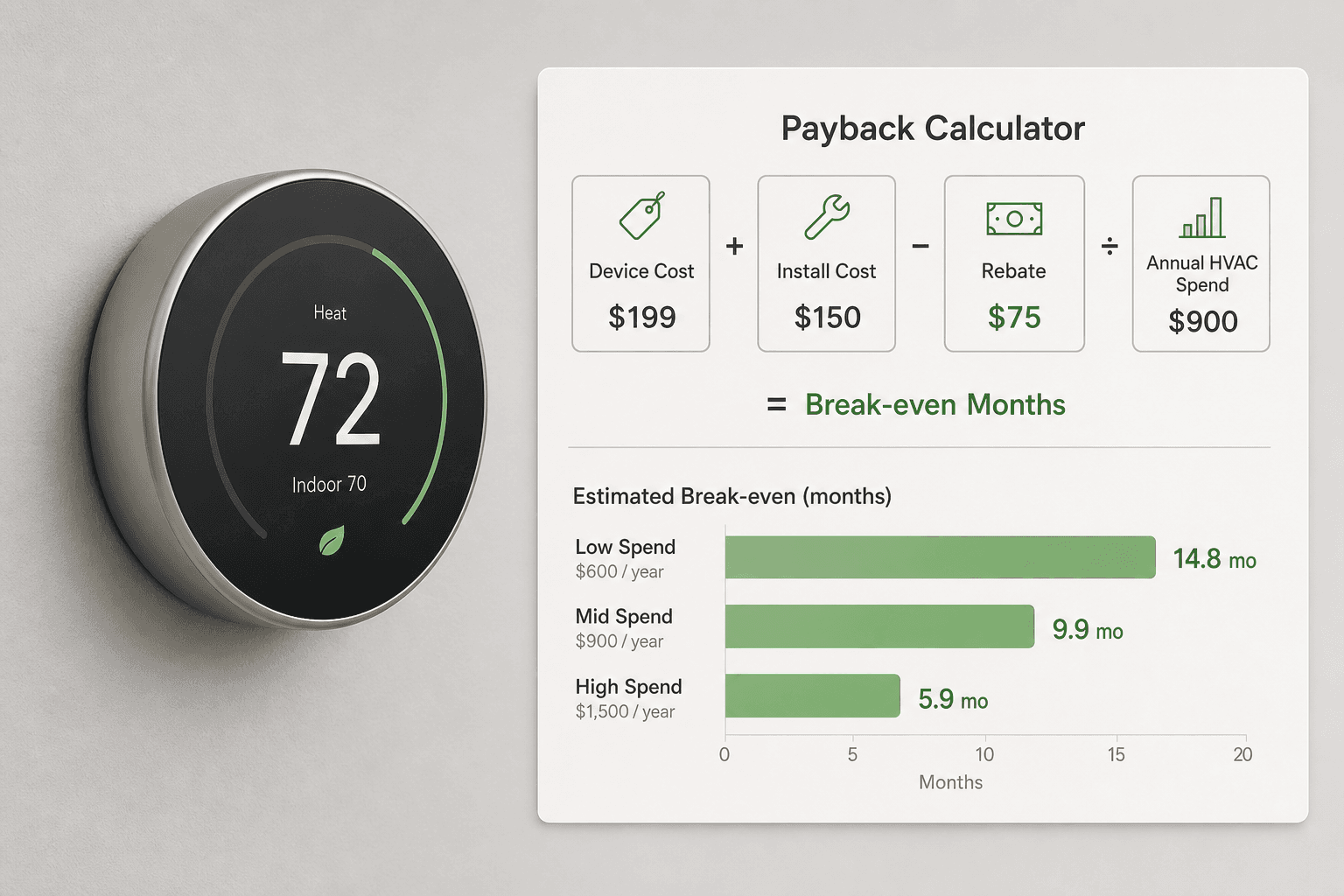
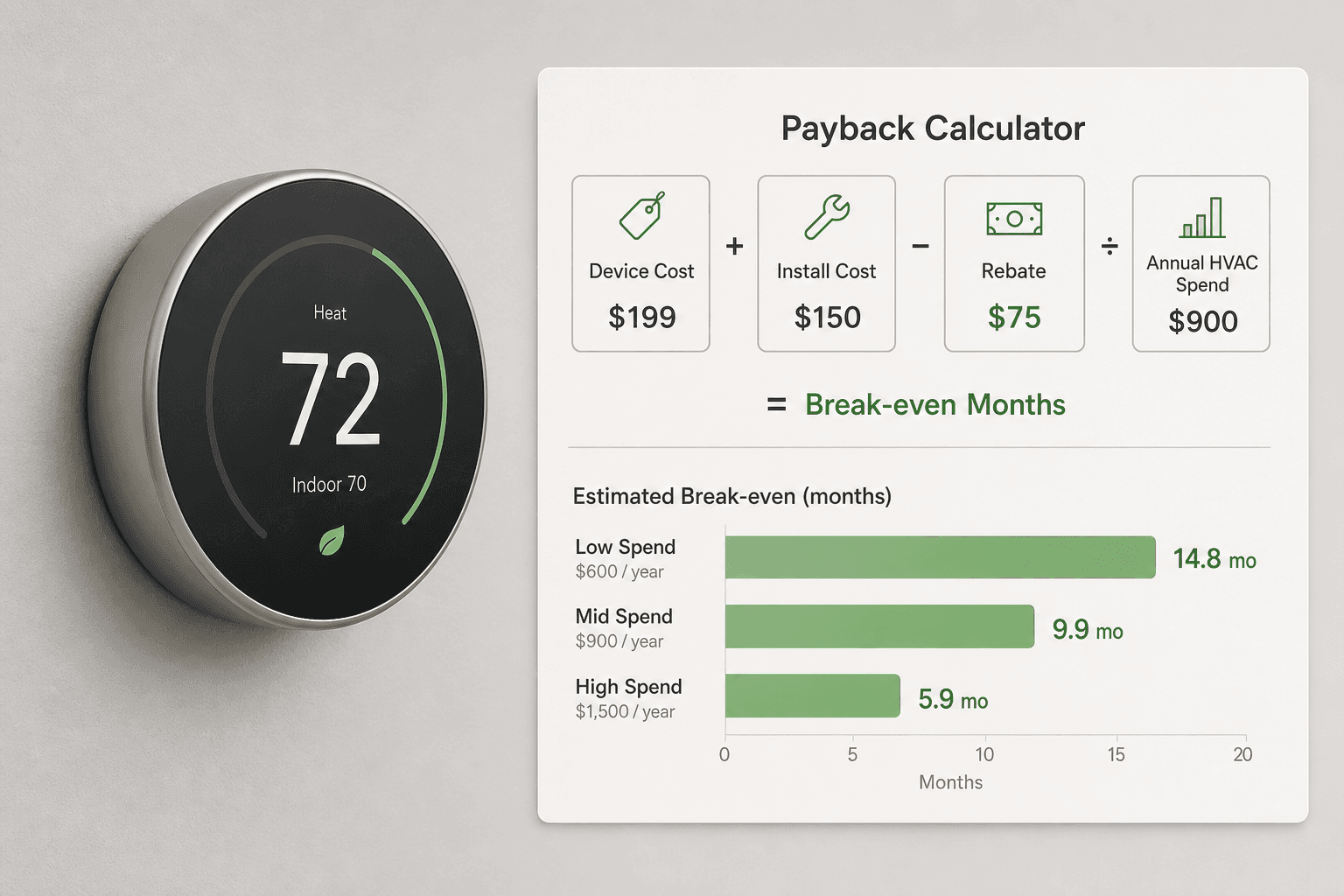
The payback period formula has one rule: net investment divided by annual savings equals years to break even.
The numerator is your net total investment: the price you paid for the device, plus any professional installation fee, minus any utility rebate you receive. The denominator is your projected annual dollar savings: your total annual HVAC spend multiplied by the savings rate you expect to achieve. Divide the numerator by the denominator and you have the number of years until cumulative savings equal your upfront cost. After that point, every dollar of savings is net positive return.
A quick illustration: $200 net investment ÷ $150 annual savings = 1.33 years, or about 16 months. The sections below work through this formula with real numbers at two device tiers.
Worked Example A: Budget Thermostat, DIY Install, Rebate Applied
This example represents the most favorable common scenario: a budget-tier device, no installation labor cost, and a utility rebate applied.
| Input | Value |
|---|---|
| Device cost | $130 |
| Installation cost (DIY) | $0 |
| Utility rebate | −$75 |
| Net total investment | $55 |
| Annual HVAC spend | $1,200 |
| Savings rate | 12% |
| Annual dollar savings | $144 |
| Payback period | ~4.6 months |
The arithmetic: ($130 + $0 − $75) ÷ ($1,200 × 0.12) = $55 ÷ $144 = 0.38 years, or approximately 4.6 months.
This outcome is consistent with real-world data. A Texas case study documented in HVAC industry sources shows a $250 smart thermostat installed via DIY producing a 12% drop in cooling bills — roughly $180 per year in savings — yielding a payback period of about 1.4 years at full device cost and no rebate. At the lower $130 device cost with a $75 rebate reducing net cost to $55, the payback compresses dramatically.
The 12% savings rate used here is realistic for a household in a moderate climate (DOE Zones 4–5) with variable occupancy. If your climate is milder, use 8–10%. If you are in an extreme-climate zone, 15–18% is a defensible estimate. The climate zone section below explains how to select your rate.
Worked Example B: Premium Thermostat, Professional Install, No Rebate
This example represents the least favorable common scenario for a mid-to-high-end buyer: a premium device, professional installation, and no utility rebate.
| Input | Value |
|---|---|
| Device cost | $250 |
| Installation cost (professional) | $150 |
| Utility rebate | $0 |
| Net total investment | $400 |
| Annual HVAC spend | $1,200 |
| Savings rate (moderate climate, 10%) | $120/yr → 3.3-year payback |
| Savings rate (mild climate, 8%) | $96/yr → 4.2-year payback |
The arithmetic at 10%: ($250 + $150 − $0) ÷ ($1,200 × 0.10) = $400 ÷ $120 = 3.3 years. At 8%: $400 ÷ $96 = 4.2 years.
The professional installation fee is the largest single variable here. At $150, it represents 60% of the total net investment — more than the device itself after a typical rebate would have been applied. Eliminating that fee (by qualifying for DIY and claiming a $75 rebate) would reduce net cost from $400 to $175, cutting the payback period from 3.3 years to 1.5 years at the same 10% savings rate.
12-Scenario Payback Matrix: Find Your Row
The matrix below covers three annual HVAC-spend tiers, two device tiers, and two rebate conditions — 12 scenarios in total. Each cell shows the calculated payback period in months at a 12% savings rate (moderate climate baseline). Adjust for your climate zone using the savings rate guidance in the next section.
| Annual HVAC Spend | Device Tier | Net Cost (with $85 rebate) | Net Cost (no rebate) | Payback with Rebate | Payback No Rebate |
|---|---|---|---|---|---|
| $800/yr | Budget (~$130, DIY) | $45 | $130 | ~8 months | ~20 months |
| $800/yr | Premium (~$250 + $150 install) | $315 | $400 | ~47 months (3.9 yrs) | ~60 months (5.0 yrs) |
| $1,500/yr | Budget (~$130, DIY) | $45 | $130 | ~4 months | ~10 months |
| $1,500/yr | Premium (~$250 + $150 install) | $315 | $400 | ~25 months (2.1 yrs) | ~32 months (2.7 yrs) |
| $2,400/yr | Budget (~$130, DIY) | $45 | $130 | ~2 months | ~7 months |
| $2,400/yr | Premium (~$250 + $150 install) | $315 | $400 | ~16 months (1.3 yrs) | ~20 months (1.7 yrs) |
How Your Climate Zone Shifts the Savings Rate
The savings rate you plug into the formula is not a fixed national number. It is a function of how hard your HVAC system works — and that depends directly on your climate.
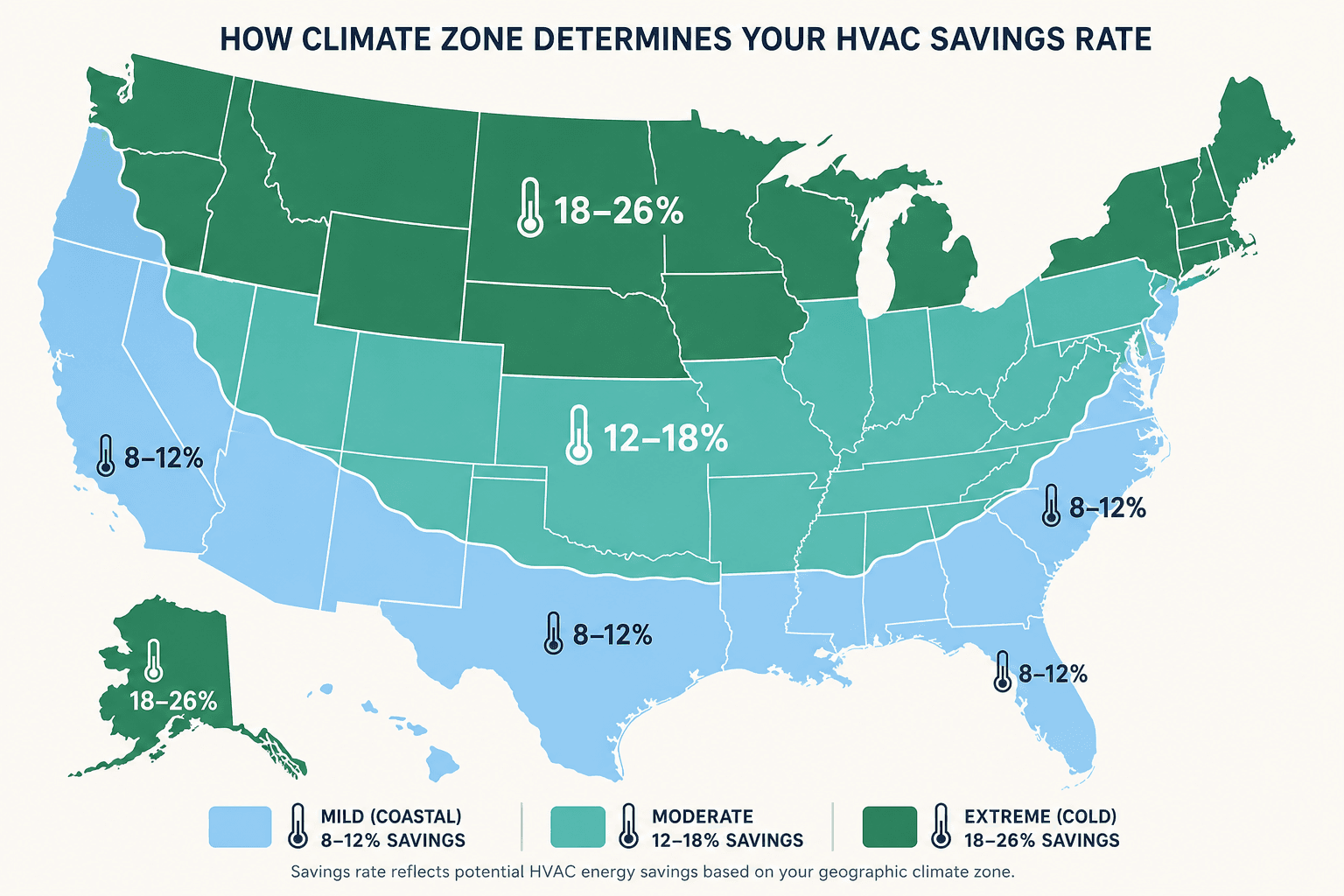
The U.S. Department of Energy divides the country into eight climate zones based on Heating Degree-Days (HDD) and Cooling Degree-Days (CDD). Higher cumulative HDD or CDD means more annual HVAC runtime. More runtime means a smart thermostat's scheduling and setback behavior produces larger absolute dollar savings — even at the same percentage reduction. This is why a household in Minnesota achieves a faster payback than a household in San Diego at the same device cost and savings rate percentage.
| DOE Zone Band | Climate Description | Example States/Regions | Realistic Savings Rate Range |
|---|---|---|---|
| Zones 1–3 | Hot to Very Hot (cooling-dominated) | Florida, Gulf Coast, Arizona, inland California | 8–12% |
| Zones 4–5 | Mixed to Cool (balanced or heating-dominated) | Mid-Atlantic, lower Midwest, Pacific Northwest, Great Lakes | 12–18% |
| Zones 6–8 | Cold to Subarctic (heating-dominated) | New England, upper Midwest, mountain West, northern plains | 18–26% |
To use this table: identify your DOE climate zone using your state and region, then select a savings rate from the corresponding range. For planning purposes, use the midpoint (e.g., 15% for Zones 4–5). For a conservative estimate — particularly if your home is always occupied — use the lower bound of your zone's range.
Always-occupied homes see smaller savings because smart thermostat setback programming has less opportunity to reduce runtime. If someone is home 24 hours a day, the thermostat cannot safely set back temperatures as aggressively during daytime hours. This applies regardless of climate zone.
Utility Rebates: How to Find Yours and Apply It to the Formula
Utility rebates reduce your net investment — the numerator in the payback formula — and therefore shorten your payback period directly. At the national average rebate of $75–$100, the reduction in payback ranges from 3 to 18 months depending on your annual savings rate.
ENERGY STAR data indicates that rebate programs allowing DIY installation and those requiring professional installation are split approximately 50/50 across the country. Before assuming you qualify, confirm whether your utility's program requires a licensed HVAC technician to install the device. If it does and you planned to DIY, you face a choice: pay for professional installation to unlock the rebate, or install yourself and forgo it. The worked examples above show the math either way.
5-Year and 10-Year Cumulative Net Savings Projections
Payback period tells you when you break even. Cumulative net savings tell you what you actually gain over the device's lifespan. Smart thermostats typically last 8–12 years. The table below shows cumulative net savings at years 5 and 10 across the scenario bands, using the same inputs as the payback matrix.
| Scenario | Annual Savings | Net Investment | 5-Year Net Savings | 10-Year Net Savings |
|---|---|---|---|---|
| Low spend ($800/yr), mild climate (8%), budget + rebate | $64/yr | $45 | $275 | $595 |
| Low spend ($800/yr), mild climate (8%), premium, no rebate | $64/yr | $400 | −$80 (still paying back) | $240 |
| Mid spend ($1,500/yr), moderate climate (12%), budget + rebate | $180/yr | $45 | $855 | $1,755 |
| Mid spend ($1,500/yr), moderate climate (12%), premium + rebate | $180/yr | $315 | $585 | $1,485 |
| High spend ($2,400/yr), extreme climate (18%), budget + rebate | $432/yr | $45 | $2,115 | $4,275 |
| High spend ($2,400/yr), extreme climate (18%), premium + rebate | $432/yr | $315 | $1,845 | $4,005 |
The spread is substantial. A low-spend household in a mild climate clears roughly $600 in net savings over 10 years with a budget thermostat — a meaningful return, but modest. A high-spend household in an extreme climate clears $4,000+ over the same period. The device cost is nearly irrelevant at that scale; the HVAC spend and climate zone are doing the work.
The one scenario where 10-year returns remain limited: a low-spend household buying a premium model without a rebate. At $64 per year in savings against a $400 net investment, the device does not break even until year 6.3, leaving only 3–4 years of net-positive return within a 10-year lifespan.
When the ROI Is Marginal: Situations Where the Math Is Harder to Justify
The formula works for every household, but the result is not always favorable. Three conditions consistently produce weak payback timelines:
- Annual HVAC spend under $800. At this spending level, even a 15% savings rate generates only $120 per year in savings. A premium thermostat with professional installation and no rebate ($400 net cost) takes over 3 years to break even — and that assumes a moderate-to-aggressive savings rate. Budget thermostat with rebate ($45 net cost) still makes sense, but the premium tier is difficult to justify on savings alone.
- Always-occupied home in a mild climate. Smart thermostats achieve their best savings through scheduled setbacks — reducing temperature when the home is unoccupied or during sleep hours. If someone is always home, setback opportunities are limited. Combined with a mild climate (low HDD/CDD), the effective savings rate may fall to 6–8% — below ENERGY STAR's national average. In this scenario, payback extends and long-term returns shrink.
- Premium model without a rebate in a Zone 1–3 climate. A $400 net investment (premium device + professional install, no rebate) recovering only $80–$100 per year in a mild climate yields a 4–5 year payback. Over a 10-year lifespan, net savings are positive but limited. If a rebate is unavailable and professional installation is required, a budget-tier device with DIY installation is almost always the better financial decision in this scenario.
Calculate Your Payback in 5 Minutes: Action Checklist
Run your own calculation using these five steps. You need last year's utility bills and a few minutes.
- Find your annual HVAC spend. Add up 12 months of utility bills and estimate what portion goes to heating and cooling. If your bills do not break this out, use your total annual energy cost and apply 40–60% as a rough HVAC share (the actual percentage varies by climate and home type). Alternatively, check whether your utility provider offers a usage breakdown in your online account.
- Choose your device tier and installation method. Decide whether you will DIY or hire a professional. Confirm your wiring supports DIY (C-wire present, or a compatible adapter available). Set your device cost and installation cost accordingly.
- Look up your utility rebate. Use the ENERGY STAR Rebate Finder with your ZIP code to find available programs. Note whether the rebate requires professional installation. If it does and you planned to DIY, calculate both scenarios to see which net cost is lower.
- Identify your climate zone savings rate. Use the zone table above to select a savings rate range. If your home is always occupied, use the lower bound of your zone's range. If occupancy is variable (regular away periods during work or travel), use the midpoint or higher.
- Plug your numbers into the formula. Payback Period (years) = (Device Cost + Install Cost − Rebate) ÷ (Annual HVAC Spend × Savings Rate). Multiply by 12 for months. Compare the result to the scenario matrix to sense-check your output.
Data Updates
Know about updated rebate programs, changed subscription prices, or new ENERGY STAR certifications? Submit a note below to help keep this content current. For formal data corrections, use the contact page.
Comments
Join the discussion with an anonymous comment.