
Which Roborock 2026 flagship specs are actually verified?
Roborock's 2026 flagship Saros 20 and Saros 20 Sonic come with impressive spec sheets, but most headline numbers — including suction, listed as both 35,000 and 36,000 Pa across Roborock's own announcement channels — are manufacturer claims, not confirmed figures. This dated breakdown separates what independent testing confirms or contradicts from what remains manufacturer-claimed, so buyers know what to verify before spending $1,600+.
Roborock’s 2026 flagship spec sheet has a problem right at the number most buyers will remember. In the Jan. 6 CES announcement, Roborock described the Saros 20 flagship suction figure as 35,000 Pa; in the Mar. 23 North America launch release and on the official U.S. Saros 20 product page, the figure appears as 36,000 Pa.[1][2][3] Mashable’s CES coverage also used 35,000 Pa.[4]
That does not automatically mean the Saros 20 is weak, mislabeled, or not worth buying. It means the cleanest version of the claim is currently unavailable. As of Aug. 4, 2026, the suction headline should be treated as manufacturer-claimed and internally inconsistent, not as a verified benchmark a buyer can confidently repeat.
This matters because the Saros 20 and Saros 20 Sonic sit in flagship-price territory. Roborock’s U.S. launch price for the Saros 20 is $1,599.99, with a Mar. 23–29 introductory price of $1,389.99; Vacuum Wars listed the Saros 20 Sonic at $1,699.99.[2][6] At that price, the useful question is not whether Roborock has ambitious hardware. It clearly does. The useful question is which parts of the Roborock 2026 flagship robot vacuum announcement specs are verified, which are still manufacturer claims, and which have already been challenged by independent testing.
A quick claim-status map before the details
| Spec or claim | Current status as of Aug. 4, 2026 | What that means for a buyer |
|---|---|---|
| Flagship suction | Contradicted across official and launch-adjacent sources: 35,000 Pa in Roborock’s CES release and Mashable’s CES coverage; 36,000 Pa in Roborock’s North America release and U.S. product page | Treat the number as manufacturer-claimed and unresolved, not independently confirmed |
| Threshold handling | Manufacturer-claimed in launch footnotes; independently tested by Vacuum Wars at 57mm | Promising and independently supported in one purchased-unit test, but still not a universal home guarantee |
| Low-clearance body | 3.13 inches, listed as based on internal manufacturer testing | Useful sizing claim, but measure your own furniture clearance |
| Dock hot-water washing | 212°F / 100°C water claim tied to TÜV Rheinland verification in the North America launch release | The cleanest named third-party verification in the current materials |
| Embedded-sand pickup | Vacuum Wars reported 89% embedded-sand removal | Strong independent evidence from a purchased-unit test, not a permanent industry benchmark |
| Hair tangle handling | Vacuum Wars reported a perfect 7-inch hair-tangle score | Good sign for long-hair homes, within that test setup |
| Dustbin capacity | Vacuum Wars measured 259ml | A practical weakness to consider if the home sheds a lot of debris between dock visits |
| Battery life | Roborock lists up to 200 minutes; Vacuum Wars found below-average tested battery results | Do not assume the official maximum maps to your actual cleaned area |
| Matter support | Matter over Wi-Fi for basic control, with mapping and scheduling still in Roborock’s app | Helpful, but not full Apple Home replacement for the Roborock app |
The pattern is already visible: the most polished launch numbers are not all the same kind of evidence. Some are official claims. One dock-water detail names a verifier. Some performance results come from purchased-unit testing. Those should not be flattened into the same confidence level.
The suction figure is still not clean enough
Suction is the lead exhibit because it is both marketable and muddled. Roborock’s CES 2026 announcement used 35,000 Pa for the flagship platform, while the North America launch release later used 36,000 Pa for Saros 20; the U.S. product page also lists 36,000 Pa.[1][2][3] Mashable’s CES write-up matched the earlier 35,000 Pa number.[4]
The difference between 35,000 and 36,000 Pa is probably not what will decide whether pet hair comes out of a rug. The problem is traceability. If a buyer, reviewer, or retailer cannot cite the headline suction number without first choosing between Roborock’s own public materials, the safest label is not “verified.” It is “manufacturer-claimed, conflicting official values.”
There is also no independent suction measurement in the provided materials that resolves the discrepancy. Vacuum Wars’ purchased-unit testing is valuable elsewhere in this article, but the available sources do not turn either 35,000 Pa or 36,000 Pa into an independently measured suction result.
The attractive launch specs mostly remain manufacturer claims
The North America launch release is full of details that sound usefully specific, and several of them are exactly the kind of details that matter in real homes: raised thresholds, thick carpet, low furniture, and obstacle recognition. The same release also footnotes several of those figures as based on internal manufacturer testing.[2]
- Threshold handling: the launch materials cite 1.77 inches plus 1.69 inches, with the claim based on internal manufacturer testing.[2]
- Pile-height handling: the release lists 1.18 inches, also based on internal manufacturer testing.[2]
- Object recognition: Roborock claims recognition of 300+ objects, with the figure tied to internal testing.[2]
- Low clearance: the 3.13-inch body height is likewise presented with internal manufacturer testing language.[2]
None of those claims is useless. Internal testing can be a reasonable starting point, especially for mechanical features that are hard to compress into a retail listing. But the label matters. A threshold number based on Roborock’s test setup is not the same as a broadly reproduced field result across uneven old transitions, soft rug edges, and mixed flooring.
The 3.13-inch clearance claim is a good example of a claim that can be helpful even before independent confirmation. If your sofa clearance is below that, the number is enough to warn you off. If your bed frame is just above it, the claim is still not a substitute for measuring the real gap, including sagging fabric, floor protectors, and any lip under the frame.
The cleanest third-party verification is the dock-water claim
One Saros 20 claim has a different evidentiary shape: the dock’s hot-water washing. Roborock’s North America launch release says the 212°F / 100°C water figure was verified by TÜV Rheinland, specifically for water heated at the base’s clean-water dispenser under standard atmospheric pressure.[2]
That is unusually specific, and specificity helps. It names the third party, names the measured thing, and gives the test condition. It does not verify every cleaning outcome the dock might imply — stain removal, odor control, long-term mop hygiene, or maintenance burden — but it does verify more than a generic “hot wash” line would.
Vacuum Wars gives the strongest purchased-unit reality check
Independent testing becomes most useful where it touches things buyers actually live with. Vacuum Wars reported testing purchased Saros 20 units and found a 57mm threshold result, calling it an all-time best in their testing.[5] That is not the same as saying every Saros 20 will cross every household threshold. It is still a stronger reference point than launch copy because the test was run outside Roborock’s own materials.
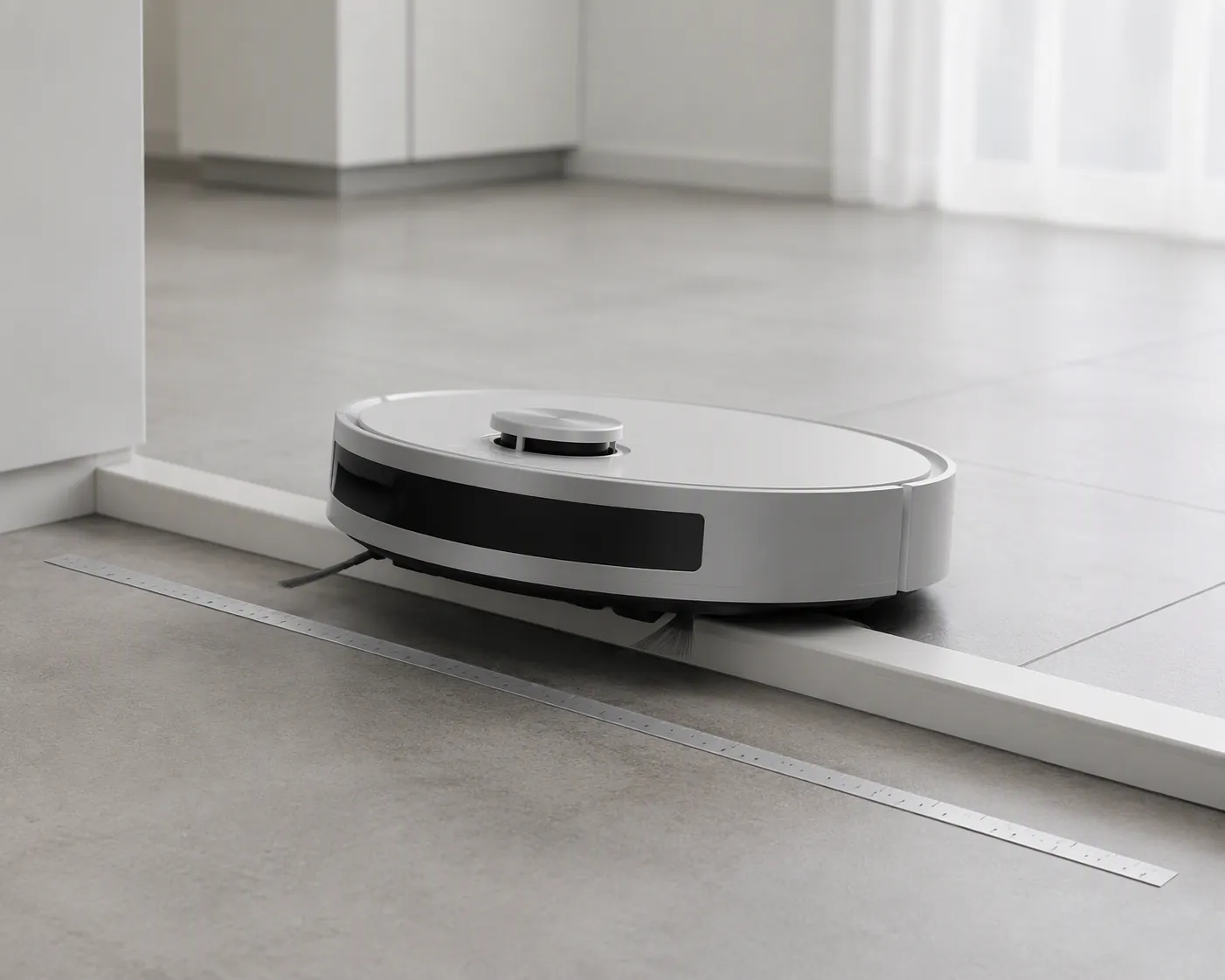
Vacuum Wars also reported 89% embedded-sand removal and a perfect 7-inch hair-tangle score for the Saros 20.[5] Those are the kinds of results that make the platform look serious beyond the spec sheet. Embedded sand is a better proxy for difficult carpet pickup than loose surface debris, and long hair is one of the recurring failure points for robot vacuums that look impressive in tidy demos.
The same independent pass also found less flattering practical limits. Vacuum Wars measured the dustbin at 259ml and described the battery result as below average, which sits awkwardly next to Roborock’s official up-to-200-minute battery claim on the U.S. product page.[5][3] This is not a contradiction in the same way the suction number is; “up to” battery claims are usually best-case figures. It is still the difference between a lab ceiling and the run time a buyer may feel in a real cleaning cycle.
A small dustbin is easier to forgive if the dock empties reliably and the home does not generate heavy debris. A below-average tested battery result is easier to accept if the robot can recharge and resume without making the owner babysit it. But those are buyer-specific tolerances, not reasons to pretend the official 200-minute figure answers the whole question.
Saros 20 Sonic: priced separately, not automatically identical
The Saros 20 Sonic should not be folded casually into the Saros 20 just because the names are close. Vacuum Wars covered the Sonic launch separately and listed it at $1,699.99.[6] Where a claim is specific to the Saros 20 launch release, the safe reading is that it applies to that model unless the Sonic source or Roborock’s own Sonic materials say the same thing.
That boundary also applies to regional pricing. Malaysia and Germany prices may be useful for local buyers in those markets, but they should not be converted into unofficial U.S. pricing. For this U.S.-focused check, the supported figures are $1,599.99 for Saros 20, including the stated Mar. 23–29 intro price, and $1,699.99 for Saros 20 Sonic.[2][6]
Matter support is useful, but it is not full smart-home control
Matter over Wi-Fi is one of the more interesting smart-home claims around the Saros 20 because robot vacuums have historically been awkward citizens in Apple Home and other cross-platform systems. The supported reading here is modest: basic control through Matter over Wi-Fi in Apple Home, with mapping and scheduling still handled in the Roborock app.[7]
For a buyer, that means Matter may cover start, stop, dock, and status-style control, but it should not be treated as a replacement for Roborock’s app experience. If Matter compatibility is part of the purchase decision, check the broader model-by-model issue in NestGrid’s Matter device readiness guide and Matter-compatible devices buyer’s guide before assuming the robot will behave like a fully native Apple Home appliance.
Why these claims deserve this much scrutiny
Roborock is not a marginal brand making noise from the edge of the market. In March 2026, Roborock’s newsroom cited IDC in saying Roborock was the world’s No. 1 smart cleaning robot brand of 2025, with 5.8 million shipments and 17.7% share; the same item cited 32.72 million global household cleaning robot shipments in 2025, up 20.1% year over year.[8]
Those market-share numbers do not prove the Saros 20 suction figure, the obstacle-recognition database, or the battery result. They explain why the wording matters. When a leading brand puts a $1,600-class flagship into a fast-growing category, the difference between an internal claim, a named third-party verification, and an independent purchased-unit result is not pedantry. It is part of the product.
There are also forward-looking U.S. market variables around robot vacuums and the FCC Covered List, but that is a separate availability and policy question, not evidence for or against Saros 20 performance. NestGrid’s FCC robot vacuum ban explainer and security-versus-reshoring analysis are better places for that thread.
What to verify before paying flagship money
The purchase check is short because the evidence split is clear. Before buying, confirm the exact model, region, and seller listing; do not assume a Saros 20 claim automatically applies to Saros 20 Sonic, or that a non-U.S. launch price maps to the U.S. store.
- For suction, look for whether Roborock has reconciled 35,000 Pa and 36,000 Pa in the specific listing you are buying from. Until then, cite it as a conflicted manufacturer claim.
- For thresholds, compare Roborock’s internal-test claim with your actual floor transitions. Vacuum Wars’ 57mm result is encouraging, but your doorway geometry may be less test-friendly.
- For furniture clearance, measure the real opening, not the advertised furniture category. The 3.13-inch claim is only useful if your clearance is comfortably above it.
- For battery life, treat the 200-minute official figure as a maximum claim and look for tested cleaning-area behavior if you have a large floor plan.
- For smart-home control, assume Matter handles basic commands and status unless Roborock documents deeper support for your platform.
- For dock performance, separate the TÜV-verified 212°F / 100°C water-heating detail from broader claims about cleaning results or long-term maintenance.
The Saros Rover belongs in a different box for now: pending. The available materials do not support treating it as a confirmed 2026 U.S. launch with settled specs, price, mopping system, or date. If you are tracking launch state rather than spec verification, use NestGrid’s Roborock 2026 flagship announcement status board.
Verified, claimed, and challenged as of Aug. 4, 2026
| Bucket | Specs or evidence |
|---|---|
| Named third-party verified | Dock water heated to 212°F / 100°C at the base’s clean-water dispenser under standard atmospheric pressure, with TÜV Rheinland named in Roborock’s North America launch release |
| Manufacturer-claimed / internal testing | Suction at either 35,000 Pa or 36,000 Pa, threshold claims, 1.18-inch pile-height handling, 300+ object recognition, and 3.13-inch low clearance |
| Independently supported by purchased-unit testing | Vacuum Wars’ 57mm threshold result, 89% embedded-sand removal, and perfect 7-inch hair-tangle score |
| Challenged or practically limited by independent testing | Vacuum Wars’ 259ml dustbin measurement and below-average tested battery result compared with Roborock’s official up-to-200-minute claim |
| Still unresolved | The official suction discrepancy between 35,000 Pa and 36,000 Pa |
Roborock may well have a serious 2026 flagship platform here. The threshold result is interesting, the dock-water verification is unusually clean, and the purchased-unit cleaning results give the Saros 20 more credibility than a launch sheet alone would. But large numbers repeated across product pages are not the same as confirmed numbers, especially when the largest headline number changes depending on which official announcement you read.
References
- CES 2026: Roborock Releases the World’s First Robotic Vacuum with Wheel-Leg Architecture as It Joins Hands with Real Madrid Football Club — Roborock Newsroom
- Roborock Launches Saros 20 in North America — PR Newswire
- Roborock Saros 20 — Roborock US
- CES 2026: So far, the best new robot vacuums are from Roborock, Dreame, and Narwal — Mashable
- Roborock Saros 20 Now Available — Vacuum Wars
- Roborock Launches Saros 20 Sonic Robot Vacuum — Vacuum Wars
- Roborock Saros 20 robovac launches with 36,000Pa, Matter support — HomeKit News
- Roborock Becomes the World’s No. 1 Smart Cleaning Robot Brand, According to IDC — Roborock Newsroom
Resolution
Investigating — no confirmed fix yet.
Protocol background
For general spec/firmware mechanics, see Compatibility & Protocols.
No linked protocol reference for this update yet.