
Is Your Robot Vacuum Banned? The FCC Rule, Explained
Your robot vacuum isn't banned: the FCC's July 28, 2026 Covered List update blocks authorization for new foreign-produced models only, while already-authorized vacuums stay legal to use, sell, and update through at least January 1, 2029. This dated explainer tells owners and pre-purchase shoppers what actually changes for new models, retailer stock, and firmware support — verified and marked Confirmed on July 31, 2026.
Confirmed status — verified July 31, 2026
No: your existing robot vacuum is not banned, recalled, or illegal to use. The short version is this: the July 2026 FCC change affects authorization for new foreign-produced advanced robotic devices. It does not turn a vacuum already in your home into contraband, and it does not announce that your specific device is unsafe. The FCC FAQ says the Covered List status does not prohibit the import, sale, or use of previously authorized covered equipment, and consumers may continue using lawfully purchased devices.[1]
| Status | What it means on July 31, 2026 |
|---|---|
| Owned robot vacuum | Confirmed: not banned, not recalled, not illegal to keep using if lawfully purchased.[1] |
| Already-authorized model in retail channels | Confirmed: the rule does not prohibit import, sale, or use of previously authorized models.[1] |
| New future foreign-produced model | Confirmed: a covered foreign-produced advanced robotic device faces a new FCC equipment-authorization block unless it fits the available approval path.[1] |
| App, firmware, and security updates | Confirmed: DA-26-789 allows software and firmware permissive changes that maintain usability or fix vulnerabilities through at least January 1, 2029.[4] |
The dated chain matters because a lot of the panic comes from compressing several legal steps into one sloppy word: “ban.” The National Security Determination is dated July 27, 2026.[2] The FCC then announced on July 28, 2026 that it had added foreign-produced power inverters and advanced robotic devices to the Covered List.[3] That is a future authorization restriction, not a consumer possession ban.
What changes for owners, shoppers, and future models
If the robot vacuum is already running in your kitchen, the practical answer is boring in the best possible way: keep using it. The FCC material does not require you to unplug it, return it, remove the app, or stop installing patches. There is no product-by-product security verdict in the rule that says a particular vacuum in your home has failed a safety review.
If you are looking at a discounted model on a retailer shelf, the useful question is not “Was it made outside the U.S.?” in isolation. The useful question is whether that model has already been authorized for the U.S. market. Previously authorized models can still be imported, sold, and used under the FCC’s stated FAQ position.[1] A retailer listing is not a promise of future product-line continuity, but the FCC update does not erase lawful existing authorization.
If the model is new, foreign-produced, and seeking FCC authorization after the Covered List update, that is where the restriction bites. The FCC mechanism is equipment authorization: without authorization, a radio-frequency device cannot move through the normal U.S. approval path. For robot vacuums, that can matter because the vacuum is not just a motor and a battery; it is also a connected wireless device.
For updates, the waiver is the part owners should not miss. DA-26-789 allows software and firmware permissive changes that maintain device usability or fix vulnerabilities through at least January 1, 2029.[4] That means the rule is not, as of this verification date, a command for manufacturers to stop shipping security patches to already-authorized vacuums.
Why robot vacuums fall inside the FCC robot definition
The FCC FAQ defines the covered category as “advanced robotic devices,” and the definition is technical rather than brand-based. A device must be a mobile ground robot; the combined device-plus-dock weight must exceed 4.4 pounds; it must include a sensor that perceives its environment; it must have network connectivity of at least 200 kbps; and local or remote software must control its navigation.[1]
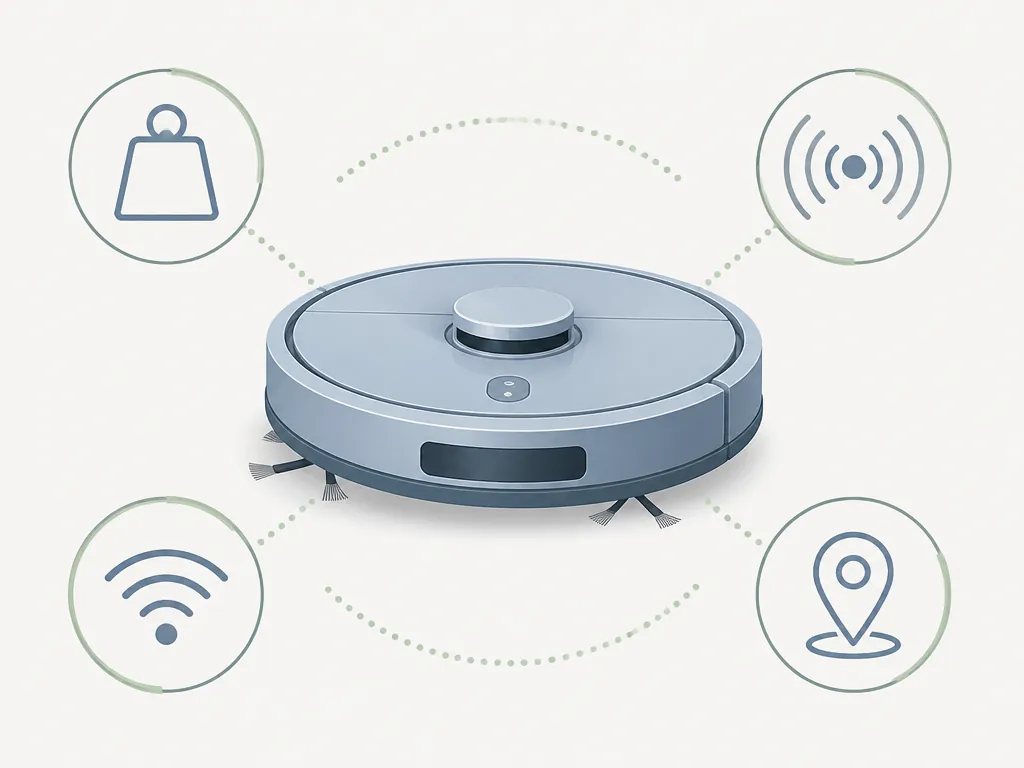
That is why robot vacuums are not a stretch case. A self-emptying vacuum can easily combine a mobile base, a charging or debris dock, mapping sensors, Wi-Fi, and software-directed navigation. The FCC also confirmed the point directly: FCC media relations director Katie Gorscak told The Verge that robot vacuums are covered, and deputy communications director Will Wiquist gave USA Today the same confirmation.[5][6]
That confirmation settles one common misunderstanding but not the louder one. “Robot vacuums are covered” does not mean “all robot vacuums are banned.” It means robot vacuums can fall within the covered category when they meet the definition and are foreign-produced models seeking the relevant authorization.
The rule is about production origin and authorization, not a finding about your vacuum
The FCC wording is country-neutral on its face. The category is “foreign-produced,” with the FCC FAQ pointing to the federal procurement definition in 48 CFR 25.101(a).[1] That is different from a brand blacklist and different from an FCC teardown of every model currently sold at retail.
This distinction is not a technicality for owners. A security finding would tell you something about the device you own. An equipment-authorization restriction tells manufacturers what they can get approved for the U.S. market going forward. The first might change whether you trust a device already under your couch; the second changes which future models can be introduced, where they may need to be produced, and what paperwork or approvals manufacturers must obtain.
The FCC FAQ also lists categories outside this robot definition, including connected vehicles, rail vehicles, drones, underwater vehicles, FDA-regulated devices, and fixed industrial robotic arms.[1] Those exclusions are useful mainly because they show the agency is drawing boundaries around a particular class of connected mobile ground robots rather than declaring every automated machine a covered robot.
What manufacturers can still try to do
The FAQ describes a path for covered robots through Conditional Approval from the Department of War, with FCC-published guidance.[1] Some coverage uses Defense Department or Department of Defense language for the same government lane; for this article, the agency’s own FAQ wording is the reference point.
For consumers, that path mostly matters in a delayed way. It may determine whether a foreign-produced successor model appears in the U.S., whether a manufacturer shifts production, or whether a planned launch changes timing. It does not create a new chore for the person who already bought a robot vacuum last month.
Retail stock, returns, and support: the practical read
Do not return a working vacuum solely because a headline said “ban” unless the seller or manufacturer gives you a separate reason that matters to your purchase: no warranty, no app support, no replacement parts, or a model-specific discontinuation notice. Those are purchase-risk questions. They are not the same thing as an FCC recall.
- Already own it: keep using it if it was lawfully purchased. The Covered List update does not prohibit use.[1]
- Buying existing stock: check normal buying signals — FCC ID, warranty terms, return window, app support history, and seller legitimacy. The rule does not automatically make already-authorized retail stock illegal.[1]
- Waiting for a future model: expect more uncertainty, especially for foreign-produced models that would need new FCC authorization.
- Security patches: the current waiver permits qualifying firmware and software changes through at least January 1, 2029.[4]
There is one shopper trap here: a product can be “on sale” in the ordinary retail sense while its future replacement line becomes uncertain. A discounted 2025 or early-2026 model may remain a perfectly ordinary purchase if it is already authorized and supported. A not-yet-authorized future model from the same brand may face a different path.
Why the examples keep pointing to Chinese brands
The legal wording is not limited to China, but the market context makes China hard to avoid. USA Today and The Verge both reported that the Roomba brand is now owned by Shenzhen Picea Robotics after iRobot’s bankruptcy.[5][6] That makes even the most familiar U.S. robot-vacuum name part of the practical discussion about production origin and future authorization.
The broader market is also heavily weighted toward Chinese brands globally. IDC reported Q1 2025 global robot-vacuum shares of Roborock at 19.3%, Ecovacs at 13.6%, Dreame at 11.3%, Xiaomi at 9.9%, and iRobot at 9.3%; TechNode, citing IDC figures, put the top four Chinese brands at 54.1% global share.[8][9] Those are global figures, not U.S.-specific sales shares, so they should not be read as a direct map of the American shelf.
China also warned of “resolute retaliation” if the U.S. sticks with the robot ban, according to Reuters on July 30, 2026.[7] That warning belongs in the context file, not in the owner panic file. It may affect negotiations, supply chains, or future product availability; it does not change the status of a vacuum already docked in your home as of July 31.
Brand-by-brand origin is still not always cleanly resolved from public reporting. Shark is the caution example: available reporting reviewed for this article conflicted, including USA Today placing production in China and Vietnam.[6] Treat that as unresolved rather than as a solved exception or a solved violation.
Matter, HomeKit, and smart-home ecosystem fallout
For smart-home buyers, the downstream risk is availability, not immediate compatibility. If a future foreign-produced robot vacuum cannot obtain U.S. authorization, then it may never reach the U.S. market with whatever Matter, HomeKit, Alexa, or Google Home integrations the manufacturer planned. That is a reasonable ecosystem inference from the authorization rule; it is not an FCC statement that existing Matter-capable or app-connected vacuums must stop working.
The same dated-reading habit applies here as it does in other smart-home policy scares: separate the agency action from the headline paraphrase, then separate future model availability from the device already paired to your home network. If you are comparing this with broader device-policy questions, the regulatory layer is similar in shape to other smart-home rules covered in Is UK AI Regulation Protecting Your Smart Home Devices? — but the July 2026 FCC robot update has its own narrow mechanism.
The bottom line on July 31, 2026
The FCC’s July 2026 action may reshape future robot-vacuum supply, especially for new foreign-produced models that need U.S. equipment authorization. It may also push manufacturers to explain production origin and approval status more clearly than they have in ordinary retail copy.
It does not ban the robot vacuum you already own. It does not recall retailer stock that was already authorized. It does not, by itself, prove that a vacuum is unsafe. And under the current waiver reporting, qualifying software and firmware changes remain allowed through at least January 1, 2029.[4]
References
- Covered List FAQs: Robots and Inverters — FCC.
- National Security Determination — FCC, July 27, 2026.
- FCC Adds Foreign-Produced Power Inverters and Robots to Covered List — FCC, July 28, 2026.
- FCC Ban on Foreign-Made Robots Includes Robot Vacuums — PCMag.
- US robot ban could sweep up Chinese vacuums — The Verge.
- Foreign robot ban rules: Roombas, vacuums — USA Today, July 30, 2026.
- China warns of retaliation if US sticks with robot ban — Reuters, July 30, 2026.
- Worldwide Smart Home Device Tracker — IDC.
- Chinese robotic vacuum brands capture 54.1% global market share — TechNode, June 21, 2026.
Resolution
Investigating — no confirmed fix yet.
Protocol background
For general spec/firmware mechanics, see Compatibility & Protocols.
No linked protocol reference for this update yet.