
Is UK AI Regulation Protecting Your Smart Home Devices?
The UK has no single AI Act, but three regulatory regimes already protect smart home owners. This article explains what the PSTI Act, ICO guidance, and the Data (Use and Access) Act mean for your devices—and where AI features like predictive heating and facial recognition still fall through regulatory gaps.
Last updated
If you searched for “uk ai regulation smart home devices,” the first thing to clear up is the assumption inside the phrase. In Q3 2026, the UK does not have one AI Act that sits over your smart speaker, camera, thermostat, doorbell, TV, and robot vacuum. You are not unprotected, but the protection is split across different regimes that do different jobs.
For a smart-home owner, the useful map starts with three protections. The Product Security and Telecommunications Infrastructure Act gives connected products mandatory security baselines and a fine ceiling of up to £10 million or 4% of qualifying worldwide revenue.[1] The ICO’s June 2025 smart-device privacy guidance pushes manufacturers on consent, transparency, user control, and deletion tools, and it was aimed at everyday devices including air fryers, smart speakers, fertility trackers, and smart TVs.[2] The Data (Use and Access) Act 2025 gives a right to human review for a narrow class of solely automated decisions, but only where the decision has legal or similarly significant effects.[3]
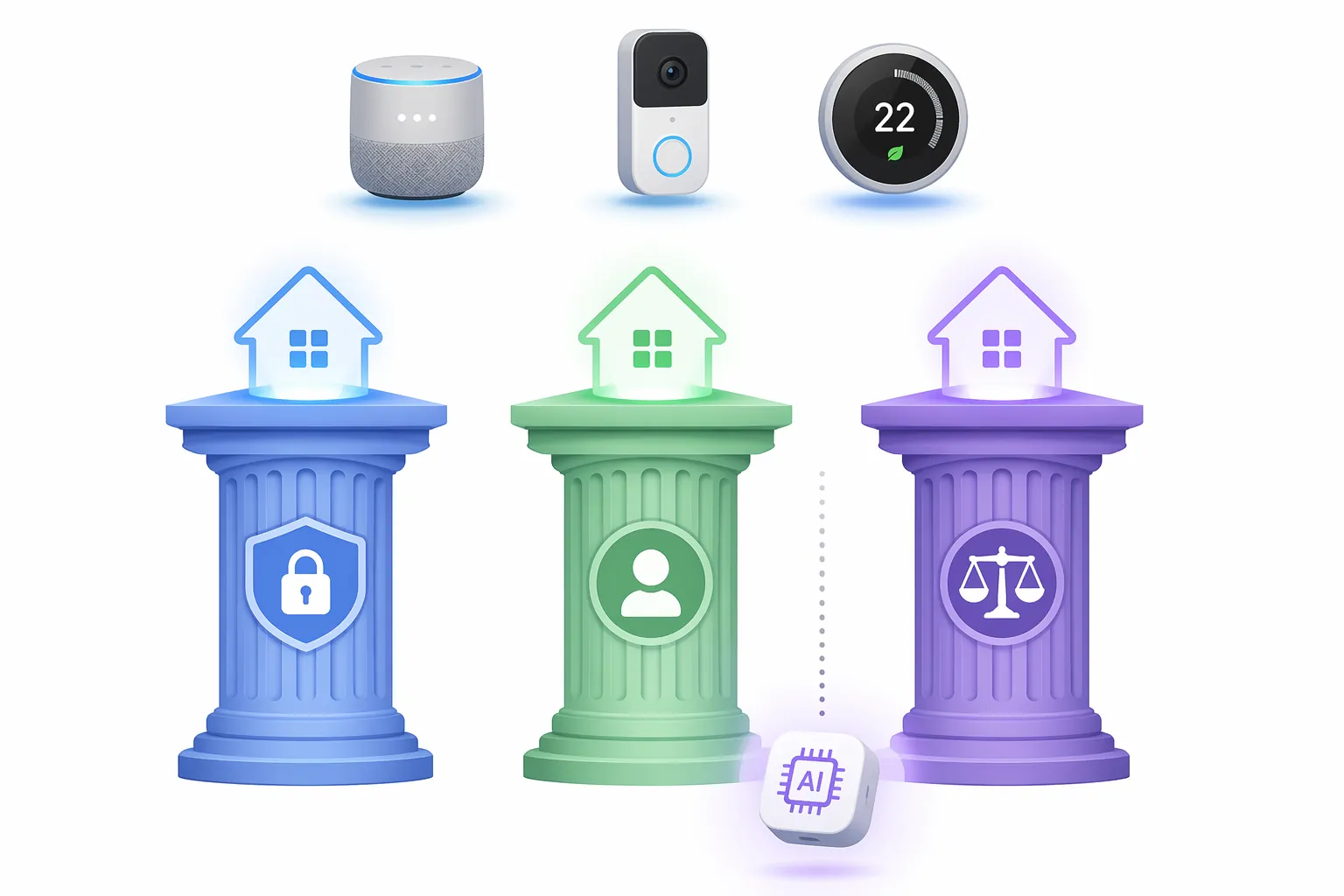
That distinction matters because “AI” is not the thing most UK smart-home law directly regulates. Security law asks whether the device can be sold with basic protections and a stated support period. Data protection law asks what personal information is collected, shared, explained, and controlled. Automated-decision rules ask whether a person is being subjected to a qualifying decision without meaningful human involvement. A face-recognition doorbell, a predictive heating routine, or a voice assistant that starts buying things can touch all three areas, but none of those labels automatically puts the feature under one clean AI-specific consumer right.
The UK Smart-Home Protection Map
| Regime | What it is useful for at home | Who it points you toward | Where it stops |
|---|---|---|---|
| PSTI Act | Baseline security for connected products, including update-support information | Product security enforcement route | It does not judge whether an AI feature is fair, appropriate, or privacy-friendly |
| ICO smart-device privacy guidance | Personal-data collection, consent, transparency, user control, and deletion tools | Information Commissioner’s Office | Guidance is not the same thing as a tested enforcement outcome in every product category |
| Data (Use and Access) Act 2025 | Human review for certain solely automated decisions with legal or similarly significant effects | Data protection complaint route | Routine heating, lighting, or convenience automation may not qualify |
| CMA AI-agent guidance | AI assistants or agentic systems that interact with consumers or make purchases | Competition and Markets Authority | Guidance is softer than a direct device-security rule and enforcement is still developing |
A practical complaint starts by naming the failure correctly. A doorbell sold without a clear security update period is not the same problem as a doorbell that uploads facial images in ways the buyer did not understand. A thermostat that changes its schedule after a cloud-side model update is not the same problem as a supplier making a solely automated decision that affects someone’s access to a service. The same object can create all of these headaches, but the route to challenge each one is different.
PSTI Gives Security Some Teeth, Not an AI Fairness Test
The PSTI regime is the easiest part of the UK picture to respect because it is not just a polite reminder to be careful. The NCSC described the new smart-device law as helping citizens choose secure products, and the fine ceiling is high enough to make weak baseline security a board-level issue rather than a footnote in a product launch.[1]
For a buyer, the most visible benefit is the support-period statement. If a connected camera, hub, baby monitor, smart plug, speaker, or thermostat has to tell you how long it will receive security updates, that becomes a compatibility fact, not just a cybersecurity fact. A device that loses updates early can become a bad neighbor on the network, a weak point for the household, and eventually a product that no longer deserves access to the same accounts, hubs, and automations.
This is where the wording matters. “Receives updates” is not as useful as a dated minimum support period. “Security updates” is not the same promise as new Matter features, new Thread border-router behavior, new Home Assistant integrations, or continued support for every cloud automation. PSTI helps with the baseline question: will the seller stand behind the connected product’s security for a stated period? It does not make a manufacturer keep adding features.
It also does not answer the AI questions people increasingly care about. PSTI does not decide whether a predictive thermostat’s learning model is reasonable, whether a camera should be classifying familiar faces, or whether a speaker’s voice model should infer more than the user intended to give away. A product can be better secured and still make poor privacy choices. It can have a defensible update statement and still hide an AI behavior behind a bland phrase like “personalized experience.”
Privacy Is Where Everyday Smart Devices Start To Feel Personal
The ICO’s June 2025 intervention landed closer to ordinary smart-home life than most AI policy announcements. It did not begin with frontier models or national strategy. It named air fryers, smart speakers, fertility trackers, and smart TVs: the kind of devices that sit in kitchens, bedrooms, living rooms, and routines where people stop noticing them until something feels off.[2]
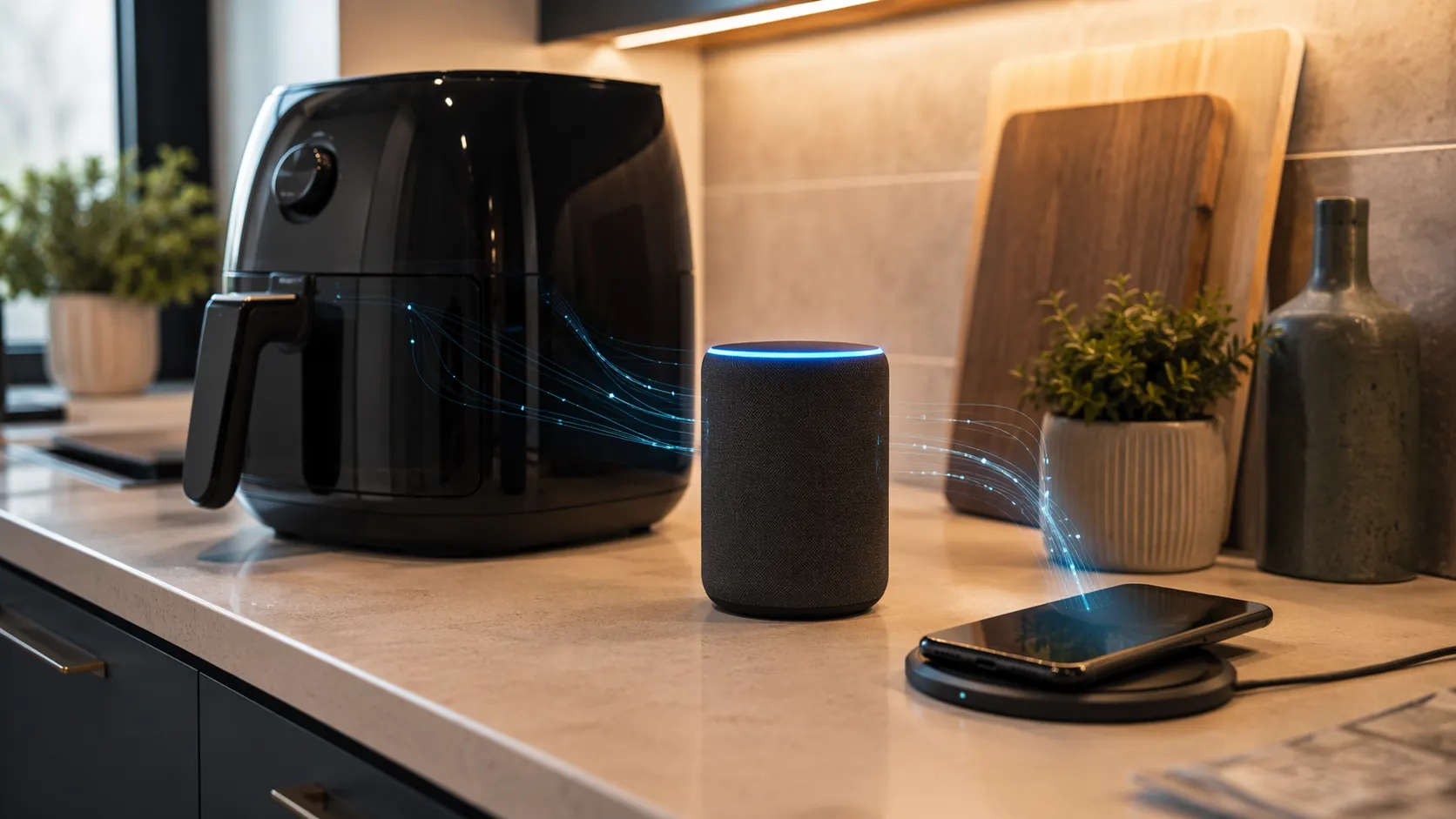
That guidance matters because smart-home privacy is rarely one dramatic disclosure. It is usually a pile-up of small permissions: app account creation, location access, diagnostics, voice processing, viewing history, advertising settings, household profiles, third-party integrations, and cloud backups. By the time the owner realizes the product is collecting more than expected, the device may already be physically installed, paired to the household, and folded into daily habits.
The citizen-jury language reported around the ICO work is worth taking seriously. Participants felt “powerless to control how their personal information is used and shared.”[2] That word, powerless, is a better description of many smart-device experiences than the usual industry language about choice. A privacy toggle buried three menus deep inside a companion app is not meaningful control if the user cannot tell what turning it off actually changes.
For smart-home buyers, the ICO lens turns vague privacy promises into concrete checks. Does the device explain what data it collects before account creation? Does it separate necessary processing from optional analytics or advertising? Can voice recordings, camera clips, household profiles, or usage histories be deleted without closing the whole account? Does the product still perform its core function if optional data sharing is refused?
The limitation is also plain. The June 2025 guidance was about what device makers should do, and the ICO warning that it was ready to take action has not yet become a long, settled line of smart-device enforcement cases. That does not make the guidance meaningless. It means a consumer should treat it as a real complaint framework, not as proof that every intrusive product behavior will be quickly corrected.
The Human-Review Right Is Narrower Than It Sounds
The Data (Use and Access) Act 2025 is the part most likely to be overread by anyone hoping for a general “challenge the AI” button. Section 80, brought into force on 5 February 2026, changed the default approach to solely automated decisions from “not permitted unless” to “permitted provided,” while preserving protections where the decision has legal or similarly significant effects.[3]
In a smart home, that means the hard question is not simply whether software made a decision. Software makes decisions constantly: preheating a room, dimming a light, turning on a camera mode, prioritizing a speaker group, or flagging motion as a person rather than a branch. The DUAA right becomes relevant only when the automated decision reaches the legal or similarly significant threshold.
A routine heating adjustment is unlikely to be the clean test case. Annoying, expensive, or badly explained does not automatically mean legally or similarly significant. A smart-home feature tied to access, insurance, credit, employment, housing, or another consequential service would be a more serious candidate, but the household automation itself still has to be connected to a qualifying decision.
This is where AI marketing can get ahead of the remedy. A product page may advertise learning, prediction, recognition, or autonomy. None of those words alone tells you whether the DUAA human-review safeguard applies. The relevant wording is about the effect on the person, the absence of meaningful human involvement, and whether the decision crosses the legal or similarly significant line.
As of July 2026, final ICO guidance on automated decision-making under the new regime is still expected rather than available. That leaves a grey area for edge cases. The sensible reading for a household buyer is narrow: the DUAA may matter a lot when a smart-device ecosystem feeds a consequential decision, but it is not a general consumer warranty for every strange AI choice made by a thermostat, camera, or speaker.
Voice Assistants and AI Agents Add a Consumer-Law Edge
AI-agent guidance becomes relevant once the smart home stops merely responding and starts acting in the market. A voice assistant that compares subscriptions, renews a service, books a repair, or orders household goods is no longer just an interface. It is participating in a consumer transaction.
The CMA’s 2026 guidance says businesses remain liable for what their AI agents do, even where a third party designed or supplied the agent. The same material points to potential fines of up to 10% of worldwide turnover for breaches of consumer law.[4] That is useful if an agent misleads, omits important information, applies unfair pressure, or makes it hard for the consumer to understand the deal being entered.
Still, this sits at the softer edge of the smart-home picture. It is guidance, not a single product rule stamped onto every voice assistant or hub. It is most useful when the AI system is selling, recommending, ranking, renewing, or purchasing. It is less useful when the complaint is simply that an assistant’s household automation is opaque or that a device’s “AI mode” behaves differently after an update.
What the UK Does Not Give Smart-Home Owners
The UK’s approach is deliberately not a direct copy of the EU AI Act. UK materials on AI regulation describe a sector-led framework rather than one comprehensive AI statute, and commentary on the UK position notes the absence of an AI-specific right to explanation.[5][6] Smart-home owners therefore fall back on UK GDPR transparency rights, ICO guidance on explaining AI decisions, product security law, and consumer-law routes depending on the facts.
That creates three practical gaps. First, there is no single regulator to call when an AI-enabled camera is secure, data-hungry, commercially manipulative, and hard to challenge all at once. Security, privacy, automated-decision rights, and consumer protection point in different directions.
Second, there is no broad AI-specific explanation right that makes every smart-home model intelligible to the owner. A company may have to be transparent about personal-data processing. It may have to explain a qualifying automated decision. It may have to avoid misleading consumers. But a vague “AI optimized” feature is not automatically subject to a complete technical explanation just because it affects comfort, convenience, or trust.
Third, some meaningful household consequences do not fit neatly into legal thresholds. A camera that mislabels visitors, a thermostat that persistently learns the wrong pattern, or a speaker that pushes users toward one service may matter a great deal to the people living with it. The available remedy depends on whether the problem can be framed as weak security, unlawful data handling, misleading consumer practice, or a qualifying automated decision. If it cannot, the complaint may be real but legally awkward.
Ofcom’s April 2026 open letter on frontier AI cyber risk belongs in the background rather than the center of this home-device map. It placed frontier AI cyber risk inside the Telecoms Security Act 2021 perimeter, which matters for connected infrastructure and networks that smart homes rely on.[7] It is not, by itself, the rule that tells a household what to do about a doorbell recognition feature or a thermostat prediction model.
What To Check Before You Buy
Regulation-aware buying is not about reading legislation before buying a plug. It is about using the rules as a filter for product claims. If a seller cannot state basic support and privacy facts clearly, the device is asking for a level of trust it has not earned.
- Look for a dated security update support period, not a vague promise that updates are provided.
- Check whether the privacy notice explains the data collected by the device itself, the companion app, cloud services, and third-party integrations.
- Find the deletion route before purchase if the device records voice, video, location, health, household, or behavior data.
- Treat “AI,” “learning,” “personalized,” and “predictive” as signals to ask what changes automatically and whether the user can override it.
- For voice assistants or agentic features that can buy, renew, recommend, or rank offers, check who the contracting business is and how consent is confirmed.
- Do not confuse ecosystem compatibility with long-term suitability: Matter, Thread, Alexa, Google Home, Apple Home, or Home Assistant support does not answer privacy, update, or AI-control questions.
The best smart-home product pages increasingly need to read like compatibility pages and trust pages at the same time. Protocol support tells you whether the device can join the system. Update support tells you how long it can remain a responsible network citizen. Privacy controls tell you whether the device respects the household after pairing. AI descriptions tell you whether the maker is explaining behavior or hiding behind convenience language.
So, is UK AI regulation protecting your smart home devices? Partly, but not in the way the phrase suggests. UK smart-home owners have enforceable protection against weak connected-product security and some data misuse, plus narrow safeguards for certain solely automated decisions. They should not assume that every AI-powered feature is explainable, challengeable, or watched by one coordinated regulator. A device that works with your hub still has to work with your rights, your data expectations, and the number of years you expect it to stay in the hallway, kitchen, or living room.
References
- Smart devices: new law helps citizens to choose secure products, NCSC
- Makers of air fryers and smart speakers told to respect users’ right to privacy, The Guardian, 16 June 2025
- Is There a UK AI Act? UK AI Regulation in 2026, Bratby Law
- Complying with consumer law when using AI agents, GOV.UK
- AI regulation in the UK, House of Commons Library
- AI Watch: Global regulatory tracker - United Kingdom, White & Case
- UK AI Regulation: UK government announces plans to set standards for how AI is deployed, Bird & Bird
Known issues with this device / protocol
Spec-version history
For active regressions on this protocol, see Update Watch.
No linked Update Watch entries yet.