The 2026 Perseids are worth a little fussy lighting work. The shower peaks on the night of Aug. 12 into the morning of Aug. 13, and this time the peak lines up with a new moon, giving observers a moonless sky rather than a washed-out one.[1] Under truly dark conditions, Perseid forecasts commonly describe ideal rates around 100 to 150 meteors per hour, though that is a zenithal hourly rate, not a promise that every suburban patio will see that many.[2]
That distinction matters because the sky is doing its part in 2026. The controllable variable is the house: porch lights, patio strings, garage sconces, motion floods, phone screens, and the path light that is helpful at 9 p.m. but brutal at 1 a.m. If you want the best backyard result, the smart home setup for Perseid meteor shower 2026 is not a decorative scene. It is a temporary lighting plan that protects night vision while keeping people from tripping over a chair leg in the dark.
For timing, plan your meteor-watch mode around the late-night and pre-dawn window, roughly midnight to 5:30 a.m. on Aug. 13 for most backyard viewers following the peak night. If you want a companion reminder flow for the observing window itself, use 2026 Perseid meteor shower: best viewing time and smart home reminders. This article stays with the lights attached to the house.
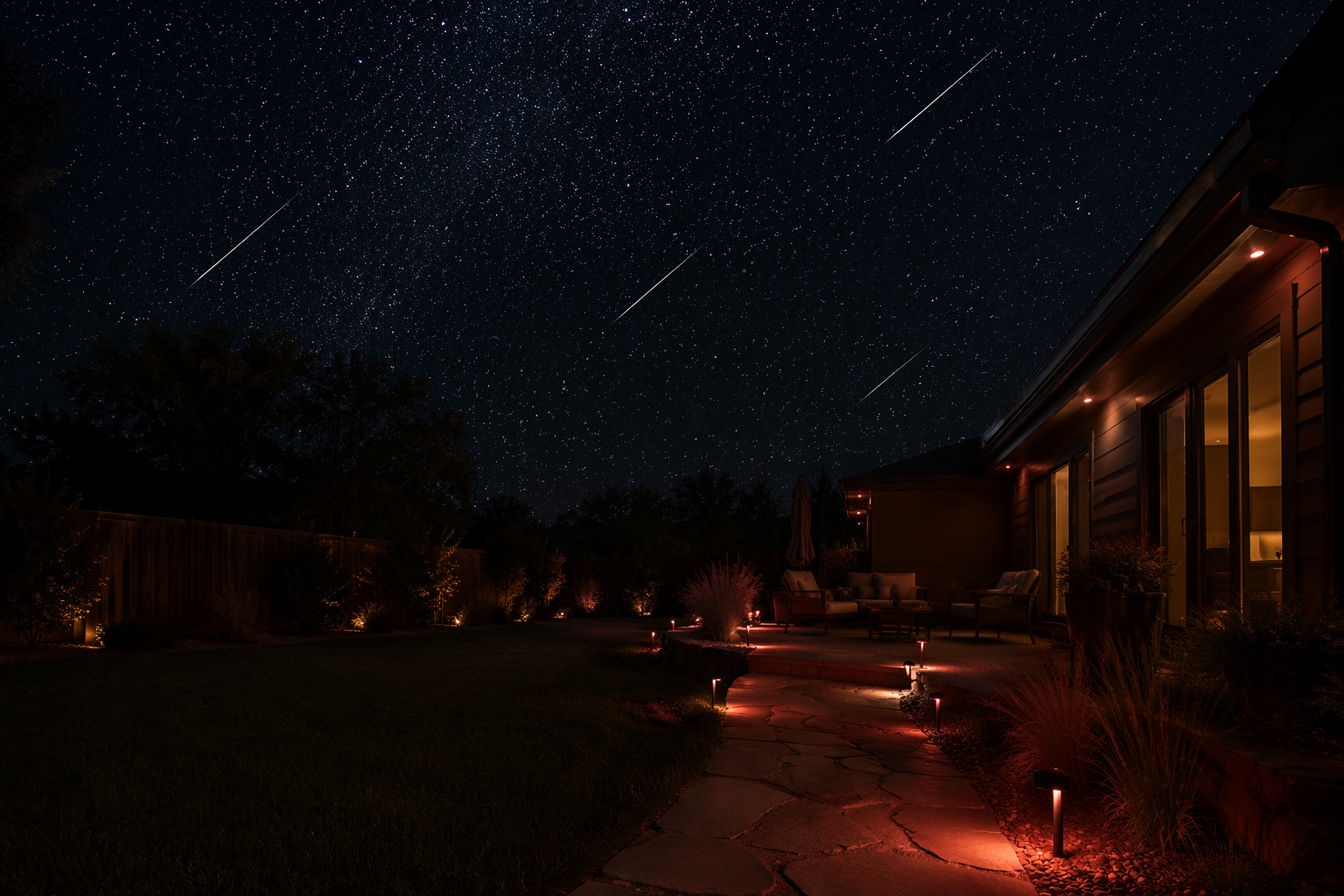
Start by sorting every outdoor light
Do this before the peak night, ideally while standing outside after dark. Walk the route people will actually use: back door to patio, patio to lawn chair, lawn chair to bathroom, driveway to gate, and wherever someone might carry a blanket, mug, tripod, or sleepy child. Then put each fixture into one of three groups.
| Light group | Examples | Perseid-night behavior |
|---|---|---|
| Safety layer | Step lights, low path lights, one shielded patio light | Keep on, but dim heavily and shift to red if possible |
| Nuisance glare | Porch lanterns, upward-facing landscape lights, bright string lights, wall sconces aimed at faces | Turn off before serious viewing begins |
| Security and recovery | Motion floods, driveway lights, normal dawn lighting | Control during viewing, then restore automatically after dawn |
The useful mistake to catch here is a light that feels harmless from the switch but is awful from a chair. A 1% bulb in a clear sconce pointed at eye level can still wreck the session. A warmer, slightly brighter step light aimed down at the ground may be less damaging because no one is staring into it. Angle, shielding, and line of sight matter as much as the number in the app; astronomy lighting guidance consistently favors low, shielded, warm, downward-facing light over bare bright fixtures.[3]
Why red light is not just ambiance
The reason to obsess over one forgotten porch light is dark adaptation. The National Park Service article on dark adaptation, based on Tucson Amateur Astronomy Association guidance, explains that rhodopsin in the eye can take 20 to 40 minutes to regenerate fully after white-light exposure. It also notes that red light at wavelengths of 620 nm or longer does not bleach rhodopsin in the same way, which is why red flashlights are standard practice among night-sky observers.[4]
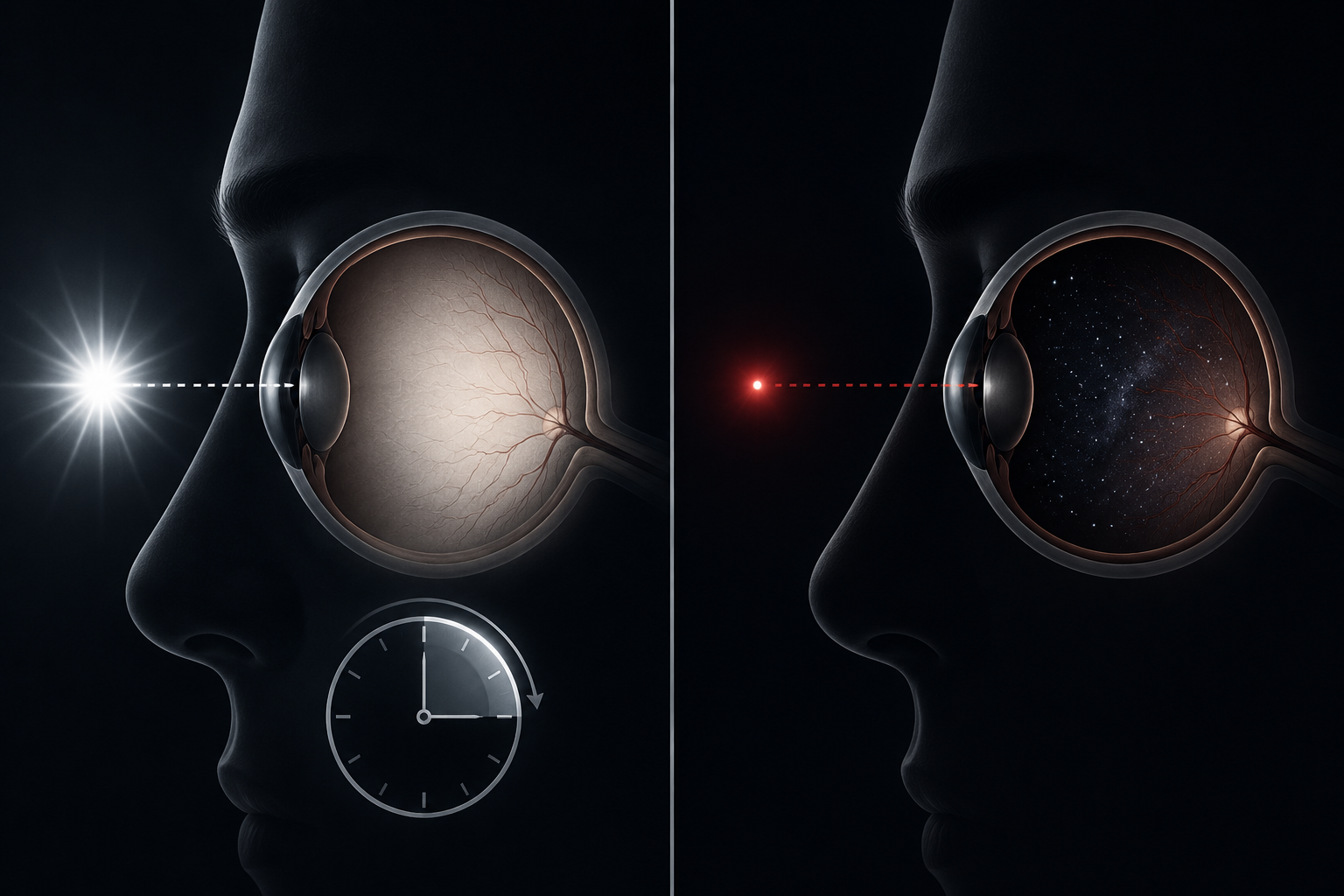
That is the hinge of the setup. A meteor shower is not like watching fireworks, where a bright flash arrives whether your eyes are ready or not. Many Perseids are faint. After your eyes settle, the sky gains texture: dimmer stars appear, your peripheral vision starts doing more work, and small streaks that would have disappeared into glare become visible. Then someone opens a door into a white kitchen glow, checks a phone at full brightness, or triggers a motion floodlight, and the next stretch of sky is poorer.
Deep red is the best smart-bulb target when you have true RGB outdoor bulbs or strips. Warm white at 2200K or 2700K is the fallback when the hardware cannot make red. It is better than cool white because it reduces blue-heavy glare, but it is not the same thing as astronomy red. And brightness still counts: set the minimum you can safely use, then test it from seated viewing positions, not just from the app.
Build the night around three lighting states
A clean Perseid setup has three states, not one dramatic blackout. The house should ease down before people go outside, stay disciplined during peak viewing, and restore itself after dawn so no one wakes up to a strangely disabled exterior.
- Pre-watch mode: before midnight, dim outdoor lights, shift color-capable bulbs warmer, and turn off purely decorative glare.
- Meteor mode: from about midnight to 5:30 a.m., keep only the safety layer on at very low red or warm light, with non-essential lights off.
- Dawn restore: after the viewing window, return porch, path, and security lighting to normal schedules automatically.
The restore is not optional. If you disable a motion flood, cut power to a patio circuit, or change a porch bulb to dim red at midnight, schedule the return while you are still awake and thinking clearly. Meteor nights have a way of ending with someone carrying chairs inside at 5 a.m., not calmly auditing automations.
Philips Hue: best when you have outdoor RGB bulbs
Hue is the most flexible of the common setups if your outdoor fixtures use Hue White and Color Ambiance bulbs or other Hue color-capable outdoor products. Hue White-only bulbs can dim and warm, but they cannot become red. That is the dividing line to check before building the scene.
- Create a room or zone for the relevant outdoor lights, such as Patio, Back Path, or Yard.
- For the safety layer, set color-capable bulbs to red and brightness to the lowest usable level, starting at 1%.
- For white-only Hue bulbs, set a warm white scene at the lowest practical brightness instead of pretending it is equivalent to red.
- Use Hue Routines or automations to start the warm-down scene before midnight, switch to the darker meteor scene at midnight, and restore normal outdoor lighting after the viewing window.
- Test the scene from the chair or blanket location; if a fixture is visible in your direct line of sight, dim it further, shield it, or remove it from the active safety layer.
Hue’s strength is that one scene can keep a path barely readable while shutting down the decorative layer. The weak point is assuming every Hue-labeled outdoor light has the same color ability. For red Perseid mode, the bulb or fixture has to support color, not merely tunable white.
Wyze: use Rules for a timed warm-to-red sequence
Wyze color bulbs are useful for this job because they support RGB color and can be driven by Rules. The clean sequence is a two-step descent: warm the yard before serious viewing begins, then switch the remaining safety lights to red at midnight.
- At 11:45 p.m., set the relevant Wyze bulbs to 2700K and low brightness so people are not walking from full white light straight into darkness.
- At midnight, set only the safety bulbs to red at 1% or the lowest setting that still shows steps and edges.
- Turn off bulbs that shine toward seating areas, windows, reflective siding, or the sky.
- Create a morning Rule that restores the usual color temperature, brightness, and on/off schedule after the meteor window.
If you already use evening color-temperature automations indoors, the logic is similar, only stricter outdoors. For a deeper primer on scheduled warm shifts, see Circadian Rhythm Lighting Automation. The Perseid version is less about comfort and more about keeping white light from repeatedly resetting people who have already adapted.
Govee: tame the string lights before they become the problem
Govee RGBIC outdoor string lights can create red scenes, which is helpful if the bulbs are mounted low, shielded, or far enough from faces. If they are overhead patio strings, they are more likely to be nuisance glare than safety lighting. Red glare is still glare when it is hanging above your eyes.
- Create a simple red scene rather than an animated effect; movement pulls attention away from the sky.
- Set the brightness as low as the app and hardware allow, then judge it from the viewing location.
- If the string lights sit above the seating area, schedule them off at midnight and use lower path lighting instead.
- Use a timer to restore the usual patio scene after dawn, not during the peak window.
This is where restraint helps. Govee can make a backyard look like an event, but the Perseids do not need the patio to perform. The useful scene is the one nobody notices after their eyes settle.
Lutron Caseta Outdoor Plug: cut power to the offenders
A Lutron Caseta Outdoor Smart Plug does not give a dumb fixture red light or warmer color. It is a relay. That makes it excellent for a different job: shutting off fixtures that should not be part of the observing environment at all.
- Put non-essential plug-in patio lights, landscape transformers, or decorative strings on the outdoor plug.
- Schedule them off before midnight, or earlier if people are already settling outside.
- Leave a separate low-level safety layer on another circuit if people still need to move through the yard.
- Schedule the plug to restore power after dawn or at your normal exterior-lighting start time.
Relay control is blunt, which is sometimes exactly right. A fixture that cannot dim, cannot turn red, and throws light across the lawn does not need a nuanced Perseid mode. It needs to be off for a few hours.
Kasa, Matter bulbs, and the buying check that prevents disappointment
TP-Link Kasa and other smart bulbs can fit the same pattern if the specific model supports the function you need. The model matters more than the brand name. A white-only smart bulb can schedule on and off, and some can shift warm, but it cannot create the deep red mode that preserves night vision best. A color bulb can. A plug can only cut or restore power.
Before buying anything for August, check three specifications: outdoor rating, RGB color support, and minimum brightness behavior. Some bulbs technically dim to 1% but still look bright in an exposed fixture. If you are comparing newer Matter options, Which Matter Smart Bulb Should You Buy? is the better place to sort protocol and ecosystem questions before you pick hardware.
Handle motion lights like they are part of the scene
Motion lights are often the worst surprise on a meteor night. They are designed to be attention-grabbing, and they usually fire at face height with cool white light. If a dog, raccoon, delivery, or late-arriving neighbor can trigger one near the viewing area, plan for it before the first meteor.
- If the fixture has smart controls, create a temporary schedule that disables motion activation during the peak viewing window.
- If the fixture supports dimming or warm color, use the lowest safe setting instead of the normal security blast.
- If you cannot change the motion behavior, aim seating away from it or choose a different viewing spot.
- If the light is important for real security, do not disable it without a manual fallback and a morning restore.
This is also where a single-command scene can help, as long as it is not the only control. After you know which lights should dim, redden, or shut off, you can package the settings into a “Perseid Night” scene; Create a Stargazing Smart Home Scene for the Perseid Meteor Shower covers that broader scene-building approach. Keep a manual button, app favorite, or labeled switch available for anyone who needs normal lighting quickly.
A practical schedule for Aug. 12–13
| Time | Lighting action | Reason |
|---|---|---|
| Before sunset | Confirm automations, charge devices, and test red or warm scenes outdoors | Fix problems before people are waiting in the yard |
| 11:45 p.m. | Dim exterior lights and shift safety bulbs to warm white if they are not already red | Give eyes and habits time to settle before the best window |
| Midnight | Switch safety lights to very low red where supported; turn off nuisance glare | Protect dark adaptation during serious meteor watching |
| Midnight–5:30 a.m. | Keep only necessary path lighting active; suppress or control motion floods | Balance safe movement with a darker observing environment |
| After dawn | Restore normal exterior lighting and security schedules | Avoid leaving the house in a temporary meteor-night state |
Do one full rehearsal on an ordinary night. Sit where you plan to watch. Let your eyes adjust. Then have someone walk the path with the planned lighting. If they hesitate at steps, add a little low, shielded light. If you can see bulb filaments, bright globes, or reflections in windows from the chair, subtract light. The goal is not heroic darkness; it is safe darkness with fewer interruptions.
If you are replacing fixtures before August
Most people should start by configuring what they already own. If you are replacing outdoor fixtures anyway, look at DarkSky International’s Approved program. It identifies luminaires designed to reduce upward light and limit blue-wavelength emission, the two qualities that matter most when a fixture becomes part of the night environment.[5]
The gold-standard fixture is not necessarily the one with the most app features. It is shielded, aimed down, warm or red-capable where appropriate, bright enough for the task, and no brighter. Smart control then becomes the layer that changes timing and intensity instead of compensating for bad optics.
The finished Perseid-night setup
By midnight on Aug. 13, the yard should be quiet from a lighting standpoint. The safe walking route has just enough low red or warm light to show edges. The patio strings, porch lanterns, uplights, and decorative brightness are off unless they serve a real safety purpose. Motion and security lights are either controlled, softened, or deliberately kept out of the viewing area. Phones are dimmed and preferably red-filtered before anyone’s eyes adjust.
Then the automation gives the house back to itself after dawn. Normal security lighting returns. Path lights resume their ordinary schedule. Nobody has to remember which plug was disabled or why the porch is still glowing red at breakfast. In 2026, the new moon removes the usual lunar excuse. The smart home’s job is simply not to replace it with porch glare.
References
- Perseid meteor shower 2026 — When, where and how to see it, Space.com
- Perseid meteor shower 2026: All you need to know, EarthSky
- Best outdoor lighting to minimise light pollution, BBC Sky at Night Magazine
- Dark Adaptation of the Human Eye and the Value of Red Flashlights, National Park Service
- DarkSky Approved, DarkSky International
Community Tips
Share platform-specific variations, steps that have changed after app updates, or tips that helped your installation succeed.
Comments
Join the discussion with an anonymous comment.