
Smart Home Gifts That Make Cold Weather Cozy and Automated
Find smart home gifts that solve real cold-weather problems like cold rooms, high heating bills, and dark mornings. Each recommendation comes with a copyable automation recipe and protocol/hub compatibility facts so you know exactly what works together.
Cold weather exposes the weak spots in a smart home fast. The spare room is always five degrees behind the rest of the house. The kitchen lights feel like an interrogation at 6:30 a.m. Someone plugs in a space heater, walks away, and now the “smart” part of the house is mostly you remembering to check on it.
A better way to shop for the best smart home gifts for men in cold weather is to start with the winter annoyance, then choose the smallest reliable device that removes it. A gift does not need to look dramatic on day one. It needs to be the thing he quietly keeps using in February.
| Winter problem | Gift that fits | Copyable automation | Compatibility facts to check |
|---|---|---|---|
| Cold guest room or home office | TP-Link Kasa EP25 smart plug, or a Govee smart space heater | Pre-warm the room on a schedule, then shut it off automatically | Kasa EP25 is a low-cost smart plug option around $17; Govee’s heater works with Alexa and Google Assistant and is rated for 160–270 sq ft rooms [1][2] |
| Heating bills creeping up | ENERGY STAR-certified smart thermostat, such as an Ecobee-style upgrade | Lower the set point when everyone leaves or sleeps; recover before the house is occupied | ENERGY STAR reports average savings of 8% on heating and cooling, or roughly $50 per year, but not a guaranteed payback [3] |
| Dark winter mornings | Philips Hue starter kit or similar smart lighting | Gradually brighten warm light before the alarm | Hue starter kits are commonly priced around $68–$143 and support wake-up routines with gradual brightness and warm color temperature [1] |
| Coffee goes cold during long calls | Ember Mug 2 | Keep the drink at a chosen temperature instead of reheating it | Maintains 120–145°F; runs up to 1.5 hours for 10 oz or 80 minutes for 14 oz untethered, and all day on the charging coaster [4] |
| Small room needs heat, fan, and filtration | Dyson Purifier Hot+Cool | Use one premium appliance instead of separate heater, fan, and purifier | Combines heater, fan, and HEPA purification; reported coverage is 290 sq ft with 99.97% particle capture [5][6] |
| Holiday lights are a daily plug-unplug chore | TP-Link Kasa EP25 smart plug | Turn lights on at sunset and off at bedtime | A cheap plug is usually enough if the load is appropriate and the outlet location is safe [1] |
For the cold room: smart plug plus heater, with the safety rule built in
The cheapest useful cold-weather smart-home gift is often not a heater at all. It is a smart plug that makes an existing heater easier to control. PCMag lists the TP-Link Kasa EP25 at about $17, which is exactly the kind of price where a gift can be boring in the box and excellent in daily use [1].
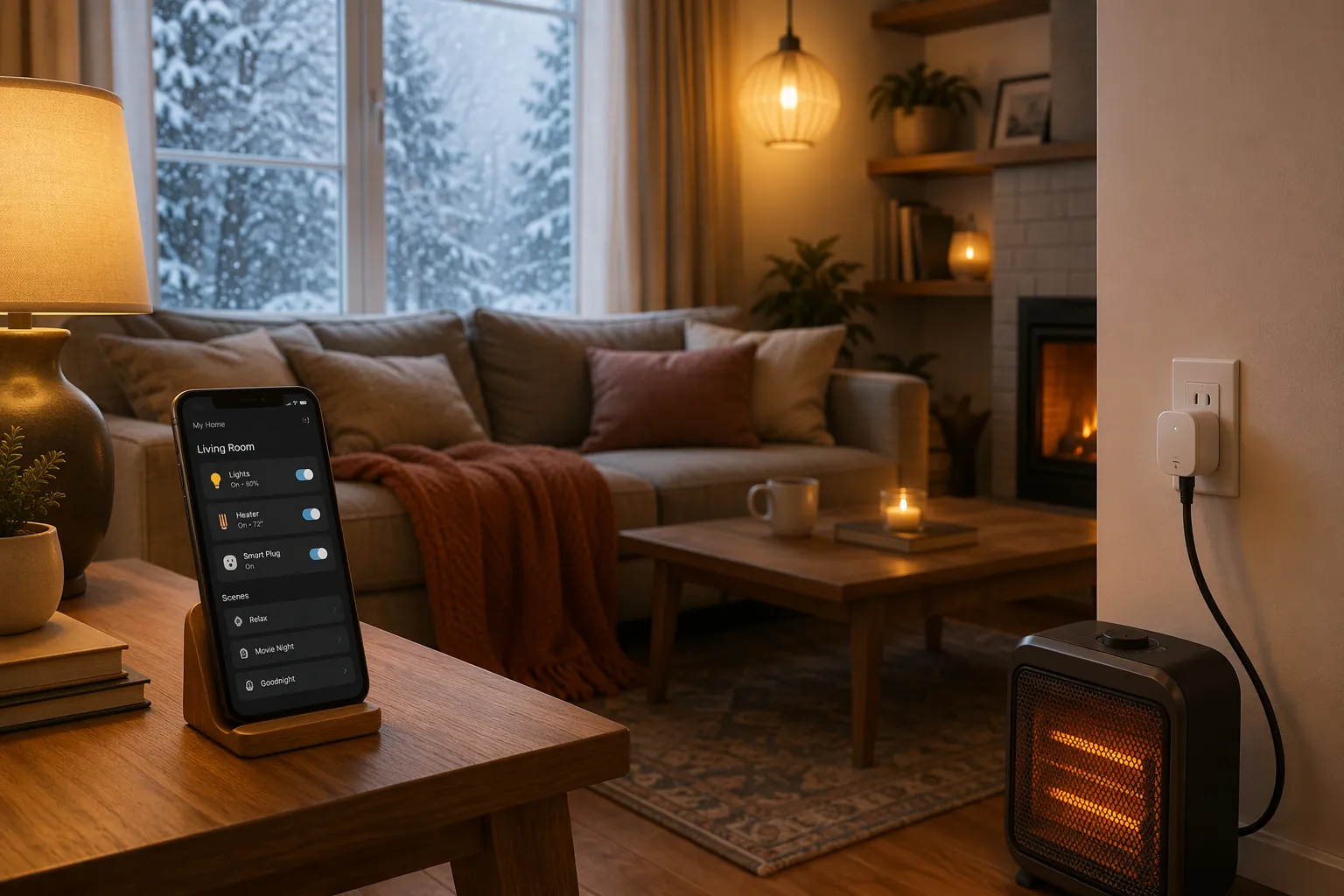
The recipe is simple: plug in a compatible space heater, set the heater itself to a safe operating mode, and use the smart plug only to control when power is available. For a home office, that might mean “turn on at 7:45 a.m. on weekdays, turn off at 9:00 a.m.” For a guest room, it might mean “turn on 30 minutes before guests arrive, then turn off automatically after two hours.”
This is not a set-and-forget HVAC replacement. A smart plug does not make a space heater safe to run unattended. The operating rule stays the same whether the heater is dumb or smart: do not leave it running unattended, do not run it while sleeping, and keep at least 3 feet of clearance from flammable materials [2][7]. If that makes the automation less magical, good. Winter comfort is not worth pretending a plug can supervise a heating element.
A purpose-built smart space heater is the cleaner gift when the recipient does not already have a decent heater or when app control matters more than bargain pricing. ZDNET’s 2026 space-heater coverage lists a Govee smart heater at around $70, with Alexa and Google Assistant support, about a 2-second heat-up claim, 45 dB operation, and room coverage of 160–270 sq ft [2]. Those details make it better suited to a small office, bedroom while occupied, or chilly den than to a large open living area.
- Pick the smart plug if he already owns a safe heater with physical controls and mostly needs scheduling or voice control.
- Pick the smart heater if the room is small, the existing heater is questionable, and Alexa or Google Assistant control is useful.
- Skip both if the gift would encourage sleeping with a space heater on or leaving it to run in an empty room.
The buying check before wrapping it is load and behavior. The plug has to be rated for the heater’s electrical draw, the heater should resume safely after power is restored, and the recipient needs to be comfortable setting a schedule in the plug’s app. If any of that sounds like a future troubleshooting call, the smart heater is the less fiddly gift.
For heating bills: a smart thermostat is useful, not magic
A smart thermostat is the gift for the person who is already adjusting the heat manually, arguing about the set point, or heating an empty house out of habit. It is also the gift where overpromising is easiest, because the savings are real on average but personal in practice.
ENERGY STAR says certified smart thermostats save users an average of 8% on heating and cooling, or roughly $50 per year, based on field data [3]. That is a useful anchor, not a guarantee. The actual number depends on climate, utility rates, insulation, occupancy patterns, existing thermostat habits, and the HVAC equipment in the home.
The automation recipe is less flashy than “AI comfort” copy, but it is what matters: reduce heating when the house is empty, reduce it again overnight if the household tolerates that, and warm the house before the first occupied period. The thermostat earns its keep by making those changes consistent without requiring someone to remember them every day.
Consumer Reports frames the value question around whether smart thermostats are worth the investment, which is the right way to think about this gift [8]. If the thermostat costs several times the average annual savings, the payback may take years. That can still be a good gift if it also solves comfort complaints, adds remote control for travel, or replaces a thermostat nobody likes using.
- Check HVAC compatibility before buying; thermostat wiring and system type matter more than brand loyalty.
- Favor ENERGY STAR-certified models if heating and cooling savings are part of the reason for the gift.
- Make sure the recipient actually wants automatic setbacks; some households value a steady temperature more than marginal savings.
- Do not treat the 8% average as a personal forecast; use it as a rough reasonableness check.
For dark mornings: smart lights that wake the room before the alarm does

Smart lighting is easy to dismiss as ambience until winter makes every morning feel like waking up underground. A warm bulb that starts dim and gradually brightens before the alarm is not just decorative; it changes the first five minutes of the day.
Philips Hue is the obvious gift here because the ecosystem is mature and the wake-up routine is easy to understand. PCMag’s smart-home device coverage places Hue starter kits around $68–$143 and notes gradual brightness and warm color-temperature routines, which is the feature that matters for cold, dark mornings [1].
The recipe: set the bedside lamp or bedroom ceiling light to begin warming up before the alarm, keep the color temperature warm at first, then let it brighten enough that the room feels occupied by the time the alarm sounds. In a kitchen, a second routine can bring lights up slowly instead of blasting full brightness while coffee is still brewing.
This is one place where ecosystem commitment can be worth it. A single bargain bulb can work, but a reliable lighting ecosystem makes routines easier to copy across rooms and less likely to break after an app update. If he already uses Alexa, Google Assistant, Apple Home, or another home platform, buy lighting that fits that system rather than forcing a new island of control.
For cold coffee: the Ember Mug 2 is not automation, but it is honest comfort
The Ember Mug 2 is the exception in this list because it does not make the house smarter in any meaningful way. It makes one small habit better. For the person who pours coffee, joins a call, and returns to a lukewarm mug, that may be enough.
Ember says the Mug 2 maintains drinks between 120°F and 145°F. The 10 oz version runs up to 1.5 hours untethered, the 14 oz version up to 80 minutes, and either can keep a drink warm all day on the charging coaster [4]. That last clause is the real ownership detail: it is best for a desk, not for wandering around the house all morning.
Buy it for the slow coffee drinker, tea drinker, or desk worker. Do not buy it for someone who finishes a mug in ten minutes or mostly drinks from travel cups. It is expensive for a mug, but the benefit is unusually direct when the habit matches.
For heat plus air quality: Dyson is the premium consolidation gift
The Dyson Purifier Hot+Cool belongs in a different category from the smart plug and Govee heater. It is not the frugal way to warm a room. It is the gift for someone who wants one polished appliance to handle supplemental heat, fan duty, and air purification.
CNET includes Dyson’s purifier-heater-fan style products in its smart-home gift coverage, and The Verge describes the Hot+Cool as combining heat, fan, and HEPA purification, with 99.97% particle capture and 290 sq ft coverage [5][6]. Those are useful reasons to consider it for a bedroom, office, or apartment where device clutter matters.
The practical test is whether consolidation is worth the premium. If he already owns a good purifier and only needs a chilly office warmed for an hour, a cheaper heater setup makes more sense. If the room needs seasonal heat, summer airflow, and year-round filtration from one appliance, the Dyson pitch becomes easier to defend.
For holiday lights: the $17 smart plug may be the most satisfying gift
Holiday-light automation does not need a flagship device. A smart plug can remove the exact nightly chore that makes seasonal lights annoying: walking around to plug them in, then remembering to turn them off before bed.
The recipe is almost too simple: plug the lights into the Kasa EP25, set an evening schedule, and add an off time. If the lights are visible from the street, a sunset routine feels better than a fixed 4:30 p.m. schedule as daylight shifts. If the outlet is outdoors or in a damp area, choose hardware rated for that location rather than improvising with an indoor plug.
This is the kind of gift that looks small and then gets used every winter. It also avoids the trap of buying an expensive smart-home object with no job. The job is obvious: the lights turn on when they should and stop wasting power when everyone forgets about them.
What to check before buying any of these gifts
The device is only half the gift. The other half is whether it fits the home after the wrapping paper is gone. A smart-home gift that requires a new hub, new app, new account, and a Saturday of troubleshooting is not really a gift unless the recipient enjoys that part.
- Voice assistant: confirm whether the home already uses Alexa, Google Assistant, Apple Home, or none of them.
- Protocol and hub: check whether the device is Wi-Fi, Zigbee, Thread, Matter, or tied to a proprietary bridge.
- Room size: match heaters, purifiers, and lighting kits to the actual room instead of assuming one device covers the house.
- Electrical safety: smart plugs must be rated for the load, and heaters need safe placement and supervised use.
- Routine fit: a device is worth more when it removes a repeated annoyance than when it adds another dashboard to check.
If there is one buying rule, it is this: choose the gift by the winter problem and the ecosystem already in the house. The smallest reliable automation that fixes a cold room, a dark morning, a high heating bill, or a forgotten string of lights usually beats the premium gadget that has no obvious place to live.
References
- Best Smart Home Devices 2026, PCMag
- Best space heaters of 2026, ZDNET
- ENERGY STAR Smart Thermostats FAQ, ENERGY STAR
- Ember Mug 2, Ember
- Best Smart-Home Gifts for 2026, CNET
- 26 practical smart home gifts, The Verge
- 3 ways I'm using smart home gadgets to stay cozy this winter, Tom's Guide
- Are Smart Thermostats Worth It?, Consumer Reports