
The Matter logo is finally common enough to influence a normal smart home purchase. That is progress. It is also where the confusion starts, because “Matter-supported devices” now includes both the boringly reliable plug you can buy tonight and the video doorbell category that may exist in the standard before it feels safe in your actual home app.
For Q3 2026, the practical answer is this: buy lights, plugs, outlets, switches, basic sensors, door locks, and thermostats with reasonable confidence. Slow down for robot vacuums, appliances, air purifiers, cameras, and video doorbells. Treat solar, batteries, heat pumps, water heaters, and EV chargers as early-stage Matter categories unless you have verified the exact product and platform path.
| Buying tier in 2026 | Device categories | What this means in practice |
|---|---|---|
| Proven buys | Lights, plugs, outlets, switches, sensors, door locks, thermostats | Good candidates for cross-platform Matter buying, assuming you have the right Matter controller and Thread Border Router where required. |
| Verify before buying | Robot vacuums, appliances, air purifiers, cameras, video doorbells | The category may be in Matter, but platform support, firmware status, and exposed controls can differ. |
| Early-stage | Solar, batteries, heat pumps, water heaters, EV chargers | Important for Matter’s direction, but not yet normal shelf-safe purchases for most buyers. |
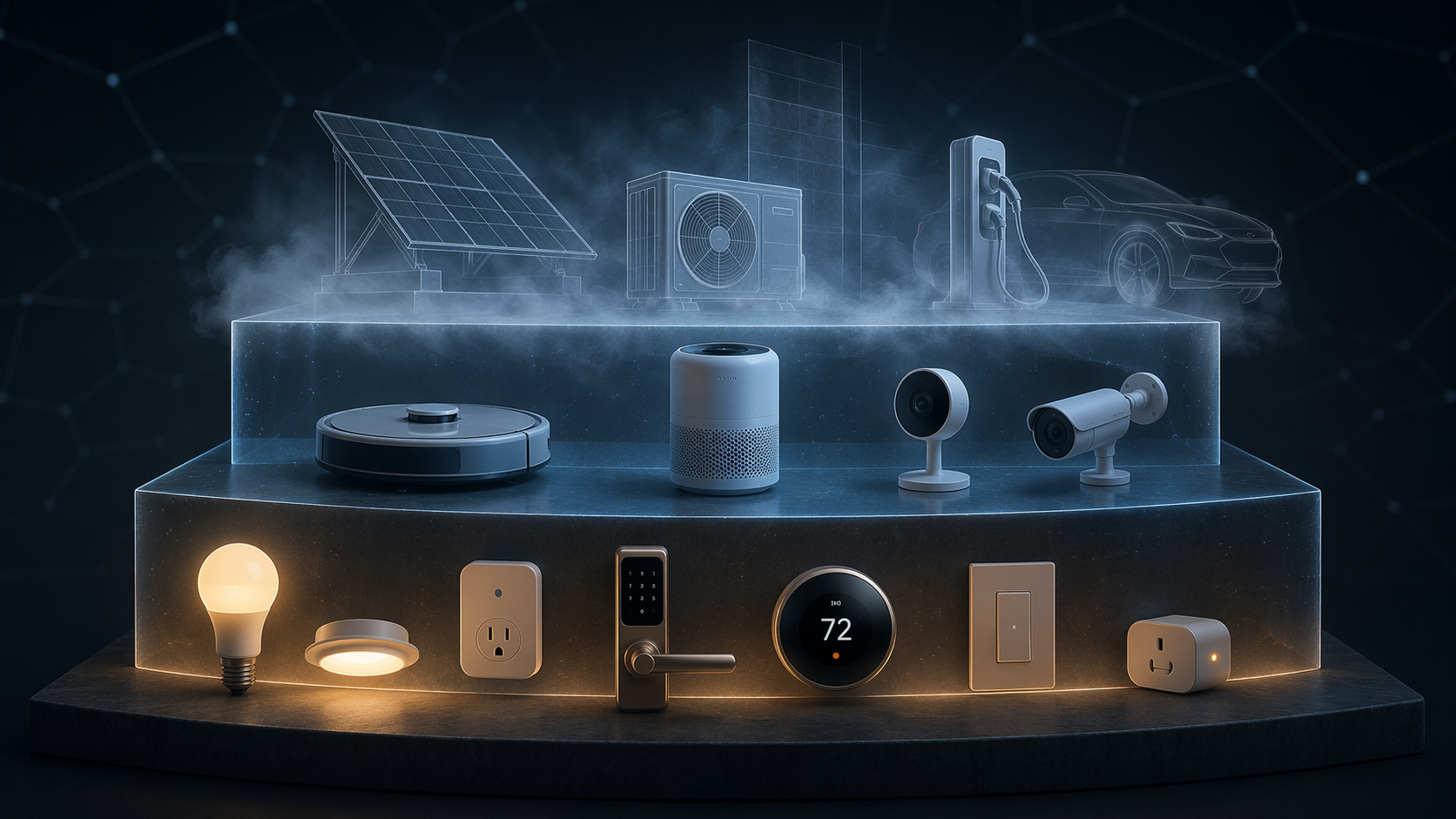
The Matter Device List Is Big Now, But It Is Not Flat
A mid-2026 Matter shopper is not imagining the momentum. matter-smarthome.de listed more than 750 Matter products across more than 60 device types as of June 30, 2026, excluding country variants and devices reachable through bridges; the maintainer says the broader addressable count is in the thousands when those are included.[1] That is enough scale to make ecosystem-agnostic buying real instead of aspirational.
The catch is that the count mixes very different kinds of readiness. A Matter smart plug and a Matter camera do not represent the same buying risk. One is usually a simple on/off endpoint. The other touches live video, events, storage expectations, app permissions, and platform-specific features. They may both sit under the Matter umbrella, but they do not deserve the same level of trust in a shopping cart.
That is why the better question is not “Does Matter support this?” It is “Can I buy this category now, pair it through my real Matter controller, and expect the controls I care about to appear in Apple Home, Google Home, Alexa, SmartThings, or Home Assistant without hunting for the one firmware build that makes it work?”
Proven Buys: Lights, Plugs, Switches, Sensors, Locks, And Thermostats
The safest Matter-supported devices in 2026 are still the categories that look least dramatic on a spec sheet: lights, plugs, outlets, switches, basic sensors, door locks, and thermostats. These are the categories with the broadest presence in current Matter device lists and the strongest practical support across major platforms.[2][3]
For lights, plugs, outlets, and switches, the core promise is straightforward. A lamp turns on. A plug turns off. A wall switch reports its state. Dimming and color controls still depend on the specific device and platform, but the basic interaction has had enough time to become routine. If someone is replacing a few ecosystem-locked bulbs or trying to make a guest room lamp work in both Apple Home and Alexa, this is the part of Matter that now feels closest to the original pitch.
Sensors are also in the dependable group when expectations stay realistic. Contact, motion, occupancy, temperature, and similar sensor types are well suited to Matter because they mostly report states rather than expose a complicated control surface. The usual caveat is automation behavior: the sensor may pair cleanly, but the app you use for automations still decides which triggers and conditions it exposes.
Door locks are mature enough to consider, but they deserve a little more care than plugs. Locking and unlocking is one thing; user codes, logs, auto-lock behavior, and keypad management can be another. Matter makes the lock less trapped in one ecosystem, but the manufacturer app may still handle advanced administration. That is not a failure if you know it before buying. It is maddening if you discover it while standing at the door with a half-configured lock.
Thermostats belong in the proven tier too, especially for normal temperature control. They are also a good reminder that “supported” can mean different levels of depth. Matter 1.6, released in June 2026, added Thermostat Suggestions along with NFC commissioning and Joint Fabric, but those additions are recent standard progress rather than a guarantee that a retail thermostat already exposes the same new behavior everywhere.[4]
The equipment requirement is not optional. Every Matter device needs a Matter controller in the ecosystem you want to use, such as Apple HomePod or Apple TV, Google Nest Hub, Amazon Echo, SmartThings Station or Aeotec hub, or Home Assistant with the Matter add-on. If the device uses Thread rather than Wi-Fi, you also need a Thread Border Router within radio range.[5] If you are still sorting out the distinction, the site’s guide to Google Nest Matter controllers vs devices is a useful sanity check before buying hardware.
Thread Is Less Annoying Than It Was
One of the better 2026 changes is not a flashy device category at all. Thread 1.4 border routers became mandatory for Matter certification in January 2026, addressing the multi-network fragmentation problem that caught early adopters when different border routers formed separate Thread networks instead of cooperating.[5] That does not make every Thread setup perfect, but it does remove one of the more ridiculous sources of “why is this bulb on a different island?” troubleshooting.
For buyers, the rule is simple: if you buy a Thread Matter device, do not assume the Matter controller and Thread Border Router are always the same box. Some devices can do both. Some cannot. Check your ecosystem hardware first, and if your home has weak Thread coverage, solve that before blaming the bulb. For platform-specific hardware choices, see the Thread border router guide.
Verify Before Buying: Robot Vacuums, Appliances, Air Purifiers, Cameras, And Doorbells
The middle tier is where the Matter logo can get expensive. Robot vacuums, appliances, air purifiers, cameras, and video doorbells are not vaporware categories, but they are not as safe as lights and plugs. The standard may define the device type, and a product may advertise Matter, while your preferred platform exposes only a subset of the controls you expected.
Robot vacuums are the easiest example. Basic start, stop, pause, and status controls are very different from full room mapping, no-go zones, mop settings, camera navigation features, and maintenance tools. A Matter path may reduce ecosystem lock-in for core commands, but it does not turn Apple Home, Google Home, Alexa, SmartThings, and Home Assistant into identical robot vacuum apps.
Air purifiers sit in a more promising place, but they still need device-by-device checking. The controls a buyer probably cares about are power, fan mode, air quality state, filter status, and possibly automation triggers. If a platform only exposes power and a simple mode selector, the product can be technically Matter-supported while still falling short of what the manufacturer app shows.
Appliances are broader and therefore messier. A dishwasher, refrigerator, washer, dryer, oven, and cooktop do not create the same control and safety questions. Some appliance support is closer to monitoring than remote operation. Some functions may remain in the brand app for safety, liability, or just because the platform has not caught up. Treat every appliance listing as a starting point, not proof that your favorite dashboard will become the full control panel.
Cameras and video doorbells deserve the most caution. Camera and video doorbell support arrived with Matter 1.5 in November 2025, and retail support is still ramping rather than settled.[4] A doorbell is not just a button and a stream. Buyers expect motion alerts, package detection, two-way audio, event history, local or cloud recording choices, chime behavior, and household sharing. The Matter category matters, but platform implementation will decide whether the product feels integrated or merely connected.
This is also where multi-admin needs a caveat. Matter multi-admin can let a single device bind to up to five ecosystems simultaneously, but features may differ by fabric.[1][3] Pairing the same device to Apple Home and Google Home does not guarantee the same controls, automations, notifications, or settings in both. Multi-admin is valuable because it lowers the wall between ecosystems. It is not a feature equalizer.
- For robot vacuums, verify which cleaning commands appear in your platform, not just whether the vacuum pairs.
- For air purifiers, check fan modes, sensor readings, and filter status exposure.
- For appliances, separate monitoring support from remote control support.
- For cameras and doorbells, wait for current platform-specific confirmation unless you are comfortable being an early adopter.
The same caution applies to smaller newly added categories. If you are looking at garden or closure devices, the useful question is still what can be bought and controlled now. The site’s pieces on Matter 1.5 soil sensors and Matter closure support for smart blinds are good examples of why a defined device type still needs a retail reality check.
Early-Stage: Energy Management Devices
Energy management is one of the most important directions for Matter, but it is not yet a casual purchase category. Solar, batteries, heat pumps, water heaters, and EV chargers exist in the Matter 1.3 and 1.4 era of the standard, with Matter 1.4 specifically expanding energy management and related device support.[6] That is meaningful for where the smart home is going. It is not the same as walking into a store and safely assuming your preferred ecosystem can manage a new EV charger through Matter.
The reason to be conservative is simple: these devices are expensive, infrastructure-adjacent, and often tied to installer workflows, utility programs, safety rules, or manufacturer cloud services. A smart plug can disappoint you for an evening. A misjudged heat pump or charger purchase can become a much larger support problem.
If you are buying in this tier, start from the installer or manufacturer documentation, then verify Matter certification and platform support. Do not reverse the order because a product page used the Matter logo. For most households in Q3 2026, energy management is a category to watch closely, not a category to buy on Matter compatibility alone.
Matter Version Numbers Are Useful, But They Are Not A Buying Verdict
Matter versions matter when they explain why a device category is newly possible. They are less helpful when used as retail shorthand. Matter 1.6, released in June 2026, added NFC commissioning, Joint Fabric, and Thermostat Suggestions.[4] NFC commissioning could make setup less painful. Joint Fabric could improve how ecosystems participate together. Thermostat Suggestions could make climate devices smarter. All of that is worth caring about.
But a June 2026 standard update does not instantly rewrite every product box, controller firmware, and app interface. A device can support an older Matter version and still be a better purchase than a category newly introduced in a later version. For buyers, maturity beats novelty.
This is the part retail pages often blur. “Matter 1.4,” “Matter 1.5,” or “Matter 1.6” can tell you something about the technical context. It does not tell you whether Apple Home exposes the specific feature you want, whether Alexa supports that device type fully, whether SmartThings has updated its handling, or whether Home Assistant users need a particular integration path.
How To Verify A Matter-Supported Device Before You Buy
Do not rely on the front of the box if the purchase matters. The Connectivity Standards Alliance maintains the Device Certification List, and buyers can use it to verify whether a product is actually certified rather than merely described in Matter-adjacent language.[3] Third-party device lists are useful for discovery, especially when they are actively maintained, but certification is the anchor.
- Identify the category tier first: proven, verify-before-buying, or early-stage.
- Check the exact model, not just the brand, in the CSA Device Certification List or a reliable current Matter device list.
- Confirm that your ecosystem supports that Matter device type today.
- Check whether the device uses Wi-Fi, Ethernet, or Thread.
- Make sure you have a Matter controller for the ecosystem you plan to use.
- For Thread devices, confirm you have a Thread Border Router close enough to be useful.
- Look for current owner reports or manufacturer notes about which features appear in your specific platform.
For category-level product direction, the companion Matter smart home devices buyer’s guide can help narrow the field. Use that kind of guide to shortlist, then use certification and platform checks to avoid buying the one model that looks right until setup night.
The 2026 Buying Line
Matter is not dead, and it is not magic. In 2026, it is mature enough that lights, plugs, outlets, switches, sensors, locks, and thermostats are sensible Matter-first purchases for most smart homes. It is also uneven enough that robot vacuums, air purifiers, appliances, cameras, and doorbells need platform-specific verification before money changes hands.
Energy devices are the clearest place to wait unless you know exactly what you are buying and who supports it. The standard is moving in the right direction, but a device category appearing in Matter is only the first checkpoint. The purchase is ready when the exact product, your controller, your Thread network if needed, and your preferred ecosystem all line up.
References
- Matter-compatible devices overview, matter-smarthome.de, June 30, 2026
- Device Types Available in the Matter Standard, matter-smarthome.de
- Every smart home device that works with Matter, The Verge
- The Matter Standard in 2026 – A Status Review, matter-smarthome.de
- Matter and Thread Explained: What Works in 2026, Data Wire Solutions
- Matter 1.4 Enables More Capable Smart Homes, Connectivity Standards Alliance
Updates & Corrections
Protocol specifications and platform features change rapidly — especially with Matter version evolution. Report version changes, certification count updates, or platform policy changes that have occurred since the last editorial review.
Comments
Join the discussion with an anonymous comment.