The safest way to shop for Matter smart home devices in Q3 2026 is not to ask whether the box says “Matter.” Ask which tier the device belongs in for your house.
| Readiness tier | Buy these categories this way | What to check before paying |
|---|---|---|
| Buy Now | Lights, smart plugs, simple switches, basic sensors, thermostats, and locks | Your platform supports the device type; your hub or controller is current; Thread devices have a reliable border router |
| Proceed with Caution | Robot vacuums, appliances, energy-monitoring plugs, presence sensors with platform-specific extras | The exact feature you want appears in Apple Home, Google Home, Alexa, SmartThings, or Home Assistant—not just in the manufacturer app |
| Wire and Wait | Cameras, video doorbells, and advanced energy controls | Run power or plan locations if you want, but do not rebuild your setup around Matter support yet |
That sounds conservative until you look at what “compatible” can hide. Matter has real momentum: one mid-2026 status review counted more than 750 certified products, a huge change from the handful available around the standard’s late-2022 launch, but certification lists include items that may not be easy to buy, fully updated, or tested in the exact platform mix sitting in your home.[1][2]
Buy Now: the boring categories are the trustworthy ones
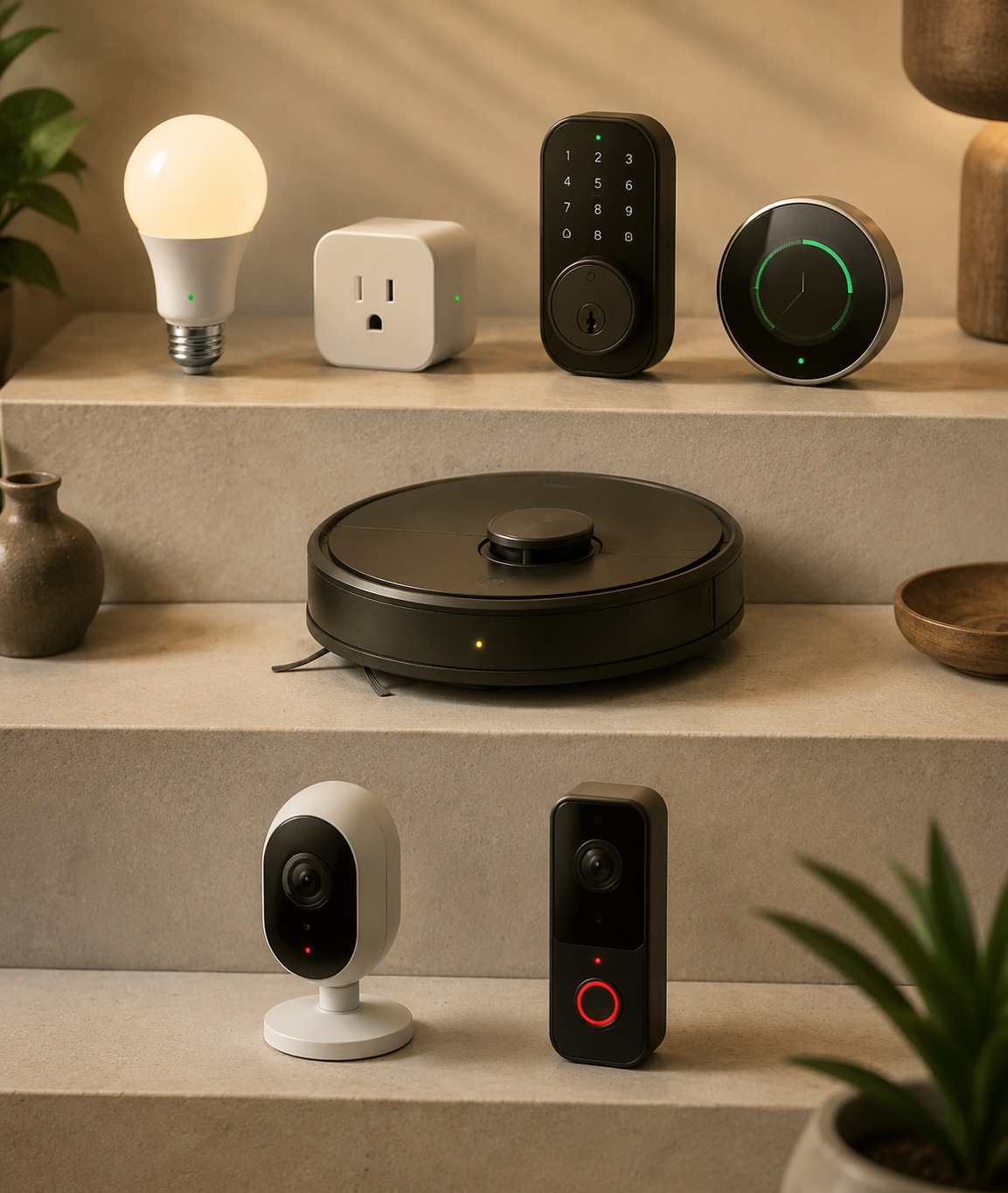
Lights, plugs, switches, sensors, thermostats, and locks are where Matter is most useful today. These are the categories where the standard’s basic promise matters most: turn on, turn off, dim, sense, read temperature, lock, unlock, and let more than one platform control the same device without forcing the household into one app forever.
The strongest buys are not exciting because they are futuristic. They are strong because the fallback behavior is still acceptable. If a Matter bulb loses a fancy scene, it can still turn on. If a lock’s deeper settings stay in the manufacturer app, Apple Home or SmartThings can still show lock state and operate the bolt. If a contact sensor reports open and closed reliably, the rest of the automation can be simple.
Third-party device roundups and hands-on coverage have repeatedly pointed to the same kinds of mature products: Eve Energy smart plugs, Nanoleaf Essentials bulbs, Aqara’s FP300 presence sensor, Yale Assure Lock SL with the Matter module, and ThirdReality’s Switch MT1 are the sort of concrete shopping examples that make Matter useful rather than theoretical.[3][4]
| Category | Current buying judgment | Examples to compare |
|---|---|---|
| Smart bulbs and light strips | Good buy when you already have the right controller and accept that advanced effects may remain app-specific | Nanoleaf Essentials bulbs |
| Smart plugs | Good buy for on/off control; energy data needs extra checking | Eve Energy |
| Switches and button-style controls | Good buy in supported platforms, but Google Home’s generic switch gap matters | ThirdReality Switch MT1 |
| Sensors | Good buy for simple open/close, motion, temperature, and presence use cases | Aqara FP300 |
| Thermostats | Good buy when the supported controls match how your household actually adjusts heating and cooling | Matter-compatible thermostat models from established HVAC brands |
| Locks | Good buy when the Matter module, hub requirements, and fallback key or keypad behavior are confirmed | Yale Assure Lock SL with Matter module |
A smart plug is the cleanest example of why the Buy Now tier still needs conditions. If the job is to turn a lamp, fan, or holiday display on and off from several platforms, Matter is doing something valuable. If the job is to monitor power use in Apple Home, Google Home, or Alexa, the same purchase can disappoint you, because Matter energy monitoring is exposed in SmartThings and Home Assistant but not in those three mainstream platforms according to current compatibility guidance.[5]
That does not make the plug bad. It changes the buying advice. For a mixed Apple-and-Alexa household that only wants voice control and schedules, Eve Energy can be a sensible buy. For someone trying to track freezer power draw or washer runtime from a dashboard, the platform matters more than the Matter logo.
The compatibility matrix is the purchase decision
Device category gets you only halfway. The actual question is what your chosen platform exposes after pairing. SmartThings’ faster Matter 1.5 adoption is useful context; Apple Home and Google Home have been slower on Matter version uptake, with mid-2026 reporting placing them closer to Matter 1.2 or 1.3 support, and that can affect which newer device types or features appear.[1]
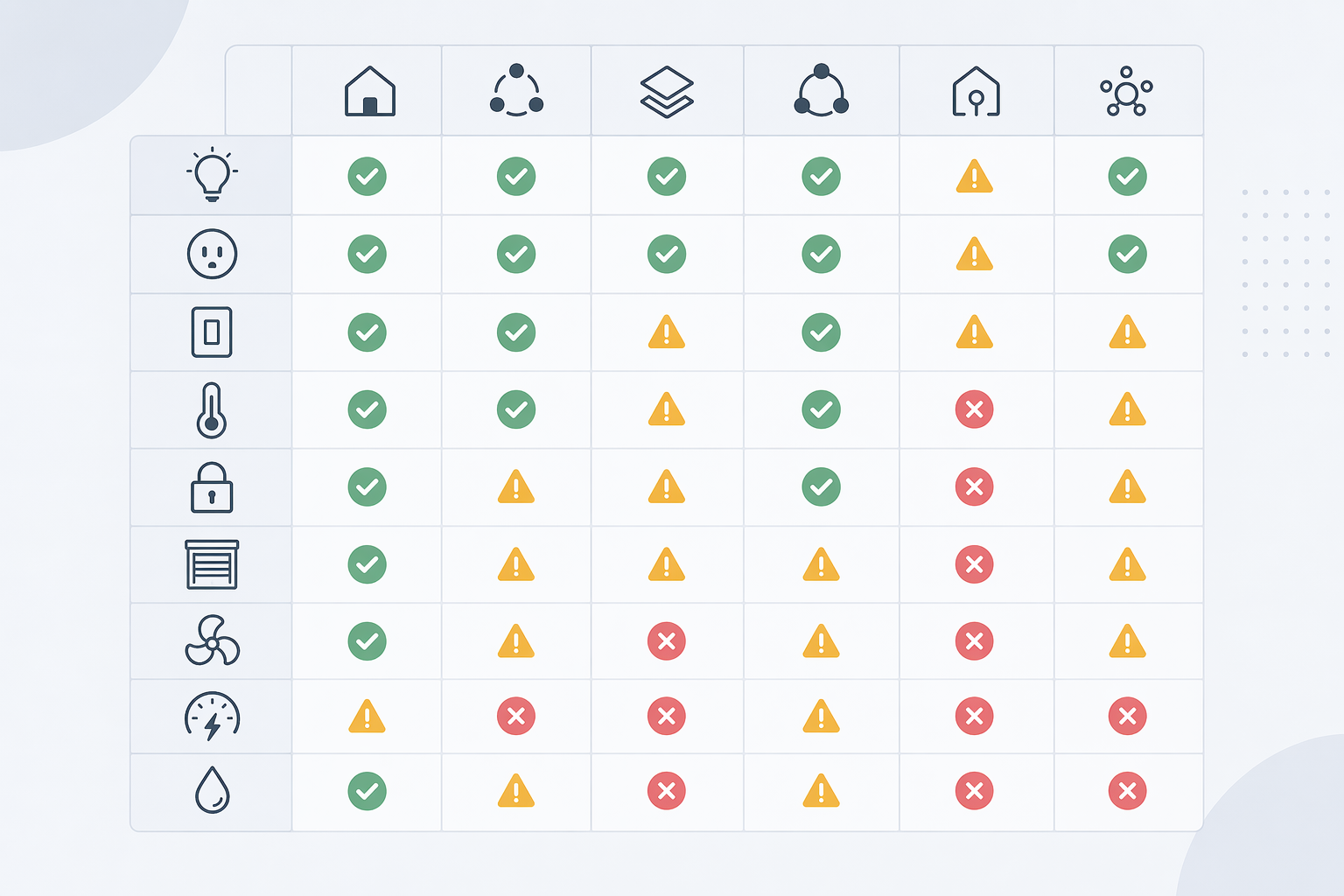
| Feature or category | Apple Home | Google Home | Alexa | SmartThings | Home Assistant |
|---|---|---|---|---|---|
| Basic lights and plugs | Generally suitable | Generally suitable | Generally suitable | Generally suitable | Generally suitable |
| Matter energy monitoring | Not exposed in current guidance | Not exposed in current guidance | Not exposed in current guidance | Exposed | Exposed |
| Generic switches | Check device behavior | Notably unsupported | Check device behavior | Better current fit | Better current fit |
| Locks | Suitable when the lock/module is confirmed | Suitable when the lock/module is confirmed | Suitable when the lock/module is confirmed | Suitable when the lock/module is confirmed | Suitable when the lock/module is confirmed |
| Matter 1.5-era cameras and doorbells | Too early for mainstream buying | Too early for mainstream buying | Too early for mainstream buying | More current on spec adoption, but still early | Powerful for tinkerers, not a mainstream shortcut |
Google Home’s generic switch gap deserves to be treated as a real shopping constraint, not a footnote. A wall button, relay, or switch-like accessory can be perfectly reasonable hardware and still be the wrong buy if the platform you use every day cannot represent it the way you expect.[6]
SmartThings currently looks better for buyers who want faster Matter feature uptake, especially around newer spec support, but that is not the same as a permanent platform victory. Matter support changes through app updates, hub firmware, device firmware, and manufacturer decisions. A matrix like this is a pre-purchase check, not a tattoo.
Thread makes the good tier better, if your border routers are current
For battery sensors, bulbs, and small accessories, Thread is often the cleaner path than Wi-Fi because it is built for low-power mesh devices. The important mid-2026 improvement is Thread 1.4: border routers have been mandatory since January 2026, and that requirement was meant to reduce the multi-mesh fragmentation that made mixed-brand Thread homes feel less universal than the branding suggested.[5]
Still, the word “mandatory” does not update the hardware already plugged into your walls. Before buying a Thread Matter device, check which device in your home is the Thread border router, whether its firmware is current, and whether your setup includes older gear that might keep creating separate Thread networks. Newer infrastructure is reassuring; stale infrastructure is how a Saturday project turns into a family complaint ticket.
Proceed with Caution: working is not the same as complete
Robot vacuums and appliances do not belong in the avoid pile. They belong in the “show me the exact control screen” pile. Matter can give a platform enough vocabulary to start, stop, or report basic state, while the features people actually bought the product for—maps, cleaning zones, cycle options, maintenance alerts, energy views—may stay in the vendor app or appear unevenly across ecosystems.
Energy monitoring is the simplest cautionary feature because the split is so visible. A Matter plug with energy data can be the right device for a SmartThings or Home Assistant user and the wrong device for an Apple Home, Google Home, or Alexa user who expected those charts to appear in the main household app.[5]
Presence sensors need the same treatment. Aqara’s FP300 is interesting because it sits in a useful category—presence can make lighting and HVAC automations feel much less clumsy—but planning around battery life should stay cautious. The reported battery expectations of roughly three years on Zigbee versus roughly two years on Thread are manufacturer-sourced figures, not independent guarantees, and real homes vary with network quality, polling behavior, and how many systems are attached.[3]
The IKEA Matter-over-Thread rollout is the case worth remembering here, carefully. A March 2026 report described widespread connectivity problems tied to platform-level incompatibilities rather than simply bad IKEA devices, which is exactly the kind of failure a shopper cannot see from a certification mark on a box.[7]
That report should not be used as a permanent verdict on IKEA or on Matter. Firmware updates may have improved the situation since then. Its value is narrower and more useful: certified devices can still stumble in specific combinations of platform, hub, Thread network, and firmware.
Wire and Wait: cameras, doorbells, and advanced energy controls
Cameras and video doorbells are the tempting part of the roadmap because they are among the devices people most want to work across platforms. Matter 1.5, released in November 2025, added camera and video doorbell device types to the specification, but mid-2026 retail availability and platform integration are still too sparse for a mainstream buyer to treat them like plugs or bulbs.[2][1]
This is where wiring ahead can make sense. If you are renovating a porch, adding power for a future doorbell or camera is reasonable. If you are planning a panel, conduit, or outlet location for later energy controls, that is sensible infrastructure work. What does not make sense is replacing a stable camera setup just because Matter 1.5 defines a device type.
Video is also where buyers should be least impressed by broad compatibility language. A camera is not just an on/off device. It involves live view, recording, event detection, notifications, privacy modes, storage, household permissions, and often subscriptions. Until those behaviors are visible in the platform you use, Matter support is a roadmap signal rather than a buying guarantee.
A practical buying rule for Q3 2026
Buy Matter now when the device is simple, the category is mature, and the platform matrix matches your home. That usually means bulbs, plugs used for basic control, straightforward switches, common sensors, thermostats with confirmed controls, and locks with the right module and hub requirements.
Proceed only when the needed feature is confirmed in your ecosystem. If the purchase depends on energy monitoring, generic switch behavior, advanced appliance controls, robot vacuum maps, or presence-sensor extras, find a current screenshot, support page, or user report for Apple Home, Google Home, Alexa, SmartThings, or Home Assistant before you buy.
Wire or plan for cameras, doorbells, and advanced controls, but do not make them the reason you rebuild the house yet.
References
- The Matter Standard in 2026: A Status Review, Matter-smarthome.de
- Matter (standard), Wikipedia
- The best Matter devices we saw in 2025, Matter Alpha
- Best Matter smart home devices and controllers, The Ambient
- Matter and Thread Explained 2026, Data Wire Solutions
- I’m starting to doubt Matter is truly the future of smart homes, XDA
- IKEA smart home failings point to a major problem with Matter, 9to5Mac, March 18, 2026
Updates & Corrections
Protocol specifications and platform features change rapidly — especially with Matter version evolution. Report version changes, certification count updates, or platform policy changes that have occurred since the last editorial review.
Comments
Join the discussion with an anonymous comment.