
The most useful answer to “Matter protocol vs Zigbee vs Thread” starts by refusing the matchup. Matter is not the new Zigbee. Thread is not Matter with a different logo. Zigbee and Thread are low-power mesh radio networks; Matter is the application layer that lets devices describe themselves and talk to ecosystems in a common way. Matter can run over Thread, Wi-Fi, or Ethernet, while Zigbee and Thread both sit in the same 2.4 GHz IEEE 802.15.4 family at the radio level.[1]
That layer mistake is where a lot of bad shopping decisions begin. A working Zigbee motion sensor does not become obsolete because a thermostat box says Matter. A Thread sensor does not help much if the home has no reliable Thread border router. A Matter badge may solve app compatibility, but it does not tell you whether the device uses Thread, Wi-Fi, or Ethernet underneath.
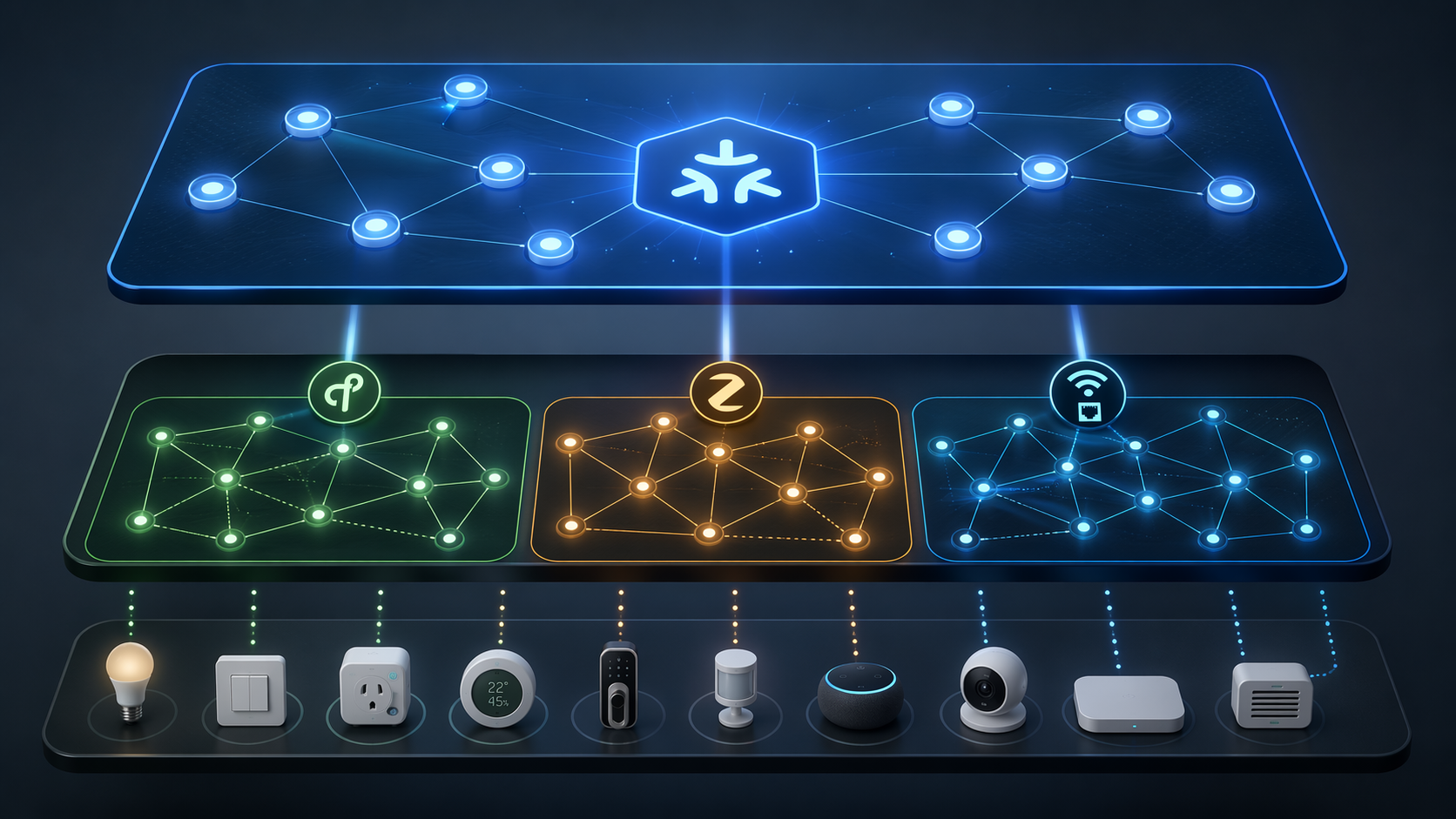
For 2026, the clean decision frame is simple enough to keep in your head while shopping: keep or expand Zigbee when you already have a stable mesh and mostly battery devices; choose Matter-over-Thread when you are building fresh or need cross-platform control; use a bridge when existing Zigbee gear still works and you only need it to appear in Apple Home, Google Home, Alexa, SmartThings, or another Matter ecosystem.
The Three-Layer Model That Prevents Most Bad Purchases
| Name on the box | What it is | What it usually means for you |
|---|---|---|
| Matter | Application layer for device identity, control, and interoperability | Helps a device work across supported ecosystems; still needs Thread, Wi-Fi, or Ethernet as transport |
| Thread | Low-power IPv6 mesh network based on IEEE 802.15.4 at 2.4 GHz | Good fit for Matter battery devices and small always-on accessories when you have border routers |
| Zigbee | Mature low-power mesh network based on IEEE 802.15.4 at 2.4 GHz | Strong fit for battery sensors, bulbs, buttons, and homes that already have a reliable Zigbee hub |
| Wi-Fi / Ethernet | IP networking already used by phones, laptops, routers, and many smart devices | Common Matter transport for powered devices, especially when low-power mesh is not needed |
Matter answers a different question from Zigbee and Thread. Matter asks: can this lock, plug, light, or sensor expose a common control model to multiple platforms? Thread asks: can low-power devices form an IP-based mesh without using Wi-Fi? Zigbee asks: can low-power devices join a mature non-IP mesh coordinated by a hub?
This is why “Matter vs Zigbee” is usually shorthand for a real but narrower question: should you buy a Matter-native device, often using Thread or Wi-Fi, or keep buying Zigbee devices that depend on a hub or bridge? That question is worth asking. It just should not be answered as if one logo replaces the other.
A Fast 2026 Buying Rule
- Already have a stable Zigbee hub and many battery sensors: buy more Zigbee unless Matter access solves a specific platform problem.
- Starting from scratch in a mixed Apple, Google, Alexa, or SmartThings home: favor Matter devices, especially Matter over Thread for low-power sensors and accessories.
- Buying powered plugs, lights, appliances, or controllers: Matter over Wi-Fi, Ethernet, Thread, or a bridge can all make sense; power source matters less than ecosystem fit.
- Replacing working Zigbee gear only because Matter exists: usually wasteful; bridge first, replace later when a device actually fails or lacks a feature you need.
- Confused by whether you need a hub, controller, or border router: pause before buying and sort the roles, because those words are not interchangeable.
If the transport choice is the part you are stuck on, the separate guide to Matter over Thread versus Matter over Wi-Fi is the cleaner rabbit hole. If the missing piece is hardware, start with which Thread border router to buy or the broader Matter hub and controller guide.
Battery Devices Are Where Zigbee Still Makes Its Case
For door sensors, motion sensors, leak sensors, buttons, and small multi-sensors, Zigbee’s biggest advantage is not glamour. It is maturity. The ecosystem is large, device prices are generally lower, and many homes already have a mesh dense enough that adding one more sensor is uneventful. Zigbee also avoids IP overhead and can keep operating locally through its hub when the internet is down.[1]
The Aqara FP300 comparison is a useful concrete signal, not a universal law. Published figures put the Zigbee version at roughly three years of battery life and the Thread version at roughly two years.[1] That does not prove every Zigbee sensor beats every Thread sensor by the same margin. Battery life changes with routing quality, signal strength, wake frequency, firmware behavior, reporting intervals, and how aggressively multiple ecosystems poll or subscribe to the device.
Still, if you already have a healthy Zigbee mesh, that one-year published gap is enough to slow down any automatic “upgrade everything to Thread” plan. A sensor hidden above a door or behind a washing machine is not a philosophical device. If it reports reliably and does not eat batteries, it has already earned its shelf space.
Thread is improving on this front. Matter 1.4 introduced sleeping-device improvements, and newer chip platforms such as Nordic’s nRF54 family are part of the effort to close the power gap.[1] That is encouraging, but it is not the same as saying every Matter-over-Thread sensor on a retail shelf in mid-2026 has caught up with the best Zigbee alternatives.
Thread’s Real Advantage Is Not That It Is Newer
Thread matters because it brings low-power mesh devices into an IP-native world. It uses IPv6, which is why Matter pairs with it naturally, and it can form a self-healing mesh for small devices without putting every sensor directly on Wi-Fi.[2] In a new home with no Zigbee investment, that is a cleaner long-term shape: border routers around the house, low-power Thread devices on the mesh, and Matter handling the common device language above it.
The border router piece is both the promise and the trap. Thread does not need a dedicated hub in the old Zigbee sense; border router capability can be built into speakers, displays, routers, and other always-powered devices such as HomePod mini, Nest Hub, and Echo hardware.[2] But “there is a border router somewhere in the house” is not the same as “the mesh is well placed, interoperable, and easy to diagnose.”
Thread 1.4 is important because it targets one of the annoyances early adopters kept running into: mixed-brand border routers forming separate Thread networks instead of one useful household mesh. Certification for new border routers became mandatory in January 2026, with standardized credential sharing intended to let those border routers join a unified mesh.[1] That is exactly the kind of plumbing standards work that matters more than a new logo on a box.
The caution is timing. A certification requirement in January does not instantly update every older border router, every app, every retail box, or every support article. If you are buying Thread hardware in 2026, check whether the border routers you plan to rely on actually support the Thread behavior you expect, not just whether the product family has Thread somewhere in its marketing.
Matter Helps Most When More Than One Ecosystem Needs Control
Matter’s practical value shows up when a household refuses to behave like a single-vendor demo. One person uses Apple Home, another prefers Google Home, someone talks to Alexa in the kitchen, and the automations may live in SmartThings, Home Assistant, or Homey. Matter gives supported devices a common way to be commissioned and controlled across participating ecosystems, instead of forcing every platform to maintain its own private integration for every device family.
That is not a small thing. It is also not magic. Matter support still depends on the device category, the platform implementation, firmware quality, and whether the features exposed through Matter match the features available in the vendor’s own app. For current pain points, the guide to common Matter device problems is more useful than pretending the badge guarantees a frictionless setup.
Matter 1.6, released on June 17, 2026, is still worth paying attention to because its improvements aim at real setup friction. NFC commissioning can make onboarding less dependent on scanning tiny codes or typing setup digits, while Joint Fabric is aimed at smoother multi-ecosystem homes where more than one fabric needs to participate.[3] Those are meaningful changes for the exact households Matter is supposed to help.
The retail caveat is the same as with Thread 1.4: specification progress arrives before universal product behavior. A device released before Matter 1.6 may not gain every new capability. A platform may expose support later than the spec date. A box may say Matter while the setup flow still depends on a vendor app for updates, advanced settings, or device-specific features.
Powered Devices Change the Calculation
Battery life dominates the sensor conversation, but it should not dominate every device category. A smart plug, relay, wall switch, light strip controller, or appliance has a different set of trade-offs. If it is always powered, the penalty for Wi-Fi, Ethernet, Zigbee routing, or Thread routing is less about coin-cell life and more about network reliability, placement, platform support, and price.
A powered Zigbee plug can strengthen a Zigbee mesh by acting as a router. A powered Thread plug can help a Thread mesh in the same general way. A Matter-over-Wi-Fi plug may be perfectly sensible if your Wi-Fi is strong and you want direct Matter compatibility without adding another mesh. For energy-monitoring plugs specifically, product behavior matters enough that it is better to compare actual models; the guide to Matter smart plugs with energy monitoring is the more practical next step.
Price also still matters. Zigbee devices are generally cheaper, while Matter-native devices still tend to carry a premium.[1] Paying that premium can be reasonable when it avoids ecosystem lock-in or reduces integration work. Paying it to replace a functioning $15 sensor that already does the job is harder to defend.
The Bridge Path Is the Least Wasteful Upgrade
Bridging is the part of the 2026 smart home that deserves more attention than it gets on packaging. A Matter bridge can make devices from another network, including Zigbee devices, appear to Matter ecosystems without replacing every endpoint. SmartThings, Home Assistant, Homey Pro, Aqara M3, and Philips Hue Bridge are all part of the current bridge conversation for exposing Zigbee devices into Matter-capable setups.[4]
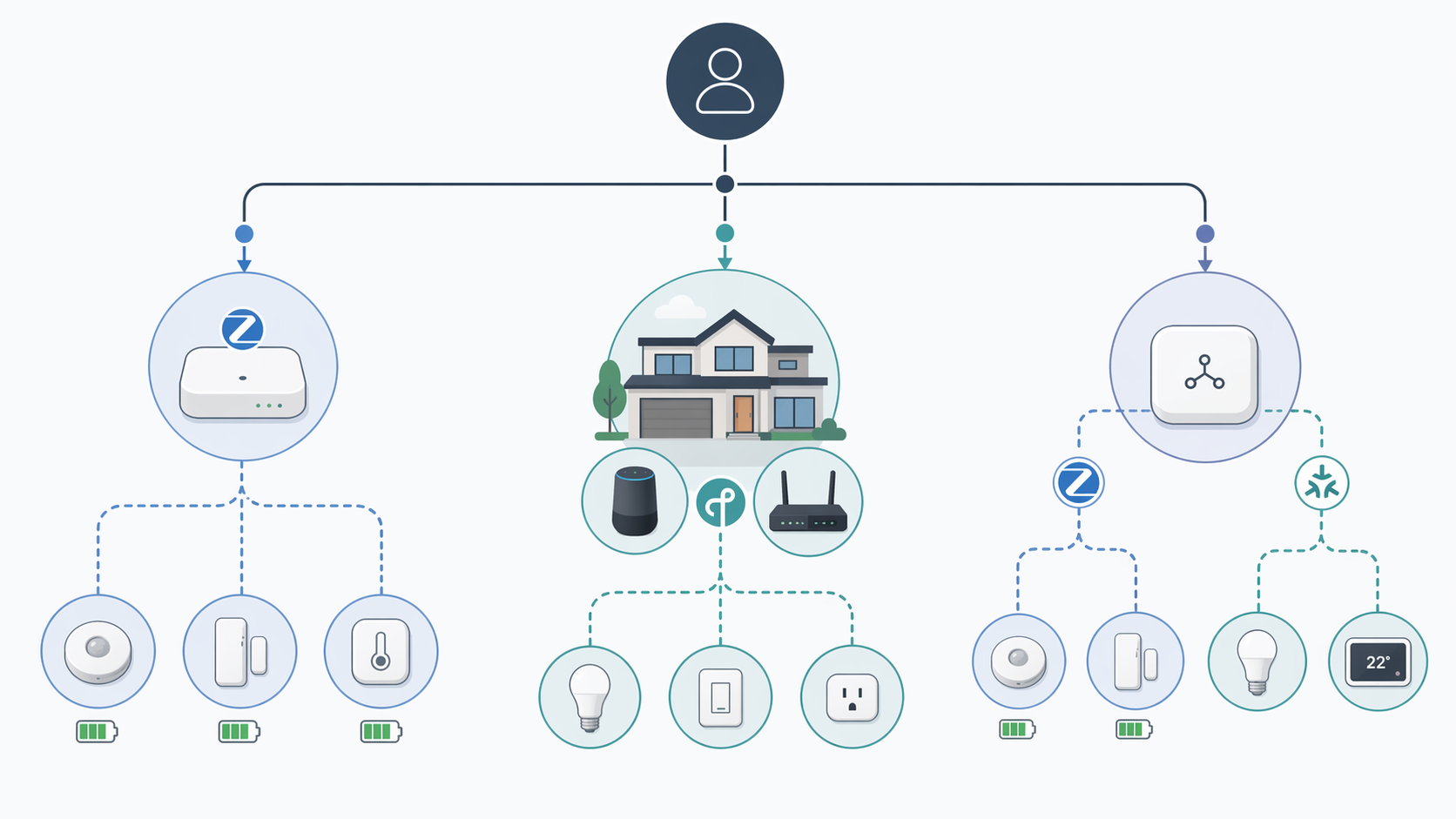
This is the path I would check before any large replacement project. If your Hue bulbs, Aqara sensors, or other Zigbee devices are stable, the useful question is not “Are they native Matter?” It is “Can my current hub or a reasonable replacement bridge expose them where I need them?”
Bridging does have limits. Some advanced device features may remain inside the manufacturer’s app. Some platforms expose bridged devices differently. Firmware updates may still require the original hub. But those limitations are often easier to live with than rebuilding a mature mesh, repairing automations, and sending working sensors to a drawer.
What to Choose in Common 2026 Setups
You already have a good Zigbee network
Keep it. Add Zigbee sensors, buttons, plugs, and lights when the device is affordable, reliable, and supported by your hub. If you want Apple Home, Google Home, Alexa, SmartThings, or another Matter controller to see those devices, investigate bridge support before replacing endpoints. A broader hub comparison such as the best home automation hub guide is more relevant here than a protocol purity argument.
You are building a new smart home
Favor Matter where the device category is mature enough and the product reviews are good. For low-power sensors and small accessories, Matter over Thread is the cleaner long-term route if you also plan a solid border-router layout. For powered devices, do not reject Matter over Wi-Fi just because it is not mesh; a powered plug or appliance on good Wi-Fi can be the simpler choice.
Your household uses more than one platform
Matter should move up your priority list. Multi-admin control is the reason to tolerate some early-standard rough edges. If the same device needs to be visible in more than one major ecosystem, buying a closed single-platform accessory in 2026 needs a better justification than it used to.
You mostly want cheap battery sensors
Zigbee is still hard to beat, especially when you already own a capable hub. Matter-over-Thread sensors are improving and may be the better ecosystem choice in a new build, but cost, battery replacement intervals, and actual platform behavior should decide the purchase.
You also need to compare Z-Wave
That is a different comparison. Z-Wave has its own radio, device ecosystem, and hub assumptions, so folding it into this Matter-Zigbee-Thread decision tends to muddy the layer model. Use the companion Zigbee vs Z-Wave vs Thread guide when Z-Wave is actually on your shopping list.
The Practical Verdict
In 2026, Zigbee is still the sensible expansion path for many existing smart homes, especially homes full of battery sensors and a hub that has already proved itself. Thread is the better-looking foundation for new low-power Matter devices, particularly as Thread 1.4 pushes mixed border routers toward one unified mesh. Matter is the interoperability layer that makes the whole setup less tied to one app or voice assistant, but it does not erase transport choices.
So the answer is not to crown one winner. Expand Zigbee when the mesh is stable and the devices are mostly battery-powered. Choose Matter and Thread when you are building fresh, sharing control across platforms, or deliberately moving toward IP-native infrastructure. Bridge working Zigbee devices into Matter ecosystems wherever possible before replacing them.
References
- The Matter Standard in 2026 – A Status Review, matter-smarthome.de
- Matter and Thread Explained: What Works in 2026, datawiresolutions.com
- Matter 1.6, Connectivity Standards Alliance, June 17, 2026
- Matter vs Zigbee in 2026, Homey.app wiki
Updates & Corrections
Protocol specifications and platform features change rapidly — especially with Matter version evolution. Report version changes, certification count updates, or platform policy changes that have occurred since the last editorial review.
Comments
Join the discussion with an anonymous comment.