The first disappointment with Matter devices usually does not look like a failed future. It looks smaller and more irritating: a remote that pairs but has no useful buttons in Google Home, a water detector that behaves in Apple Home but disappears from Alexa, or a Thread bulb that joins the “wrong” mesh even though there is already a perfectly good border router in the house.
That distinction matters in 2026. Matter can make devices easier to add, and some categories — especially lights, plugs, and many locks — are now boring in the best way. But “Matter-certified” still does not mean the same device type, the same features, or the same Thread network behavior across every major ecosystem. The buyer-facing problem is not that Matter is fake. It is that certification answers a narrower question than most shoppers think it answers.
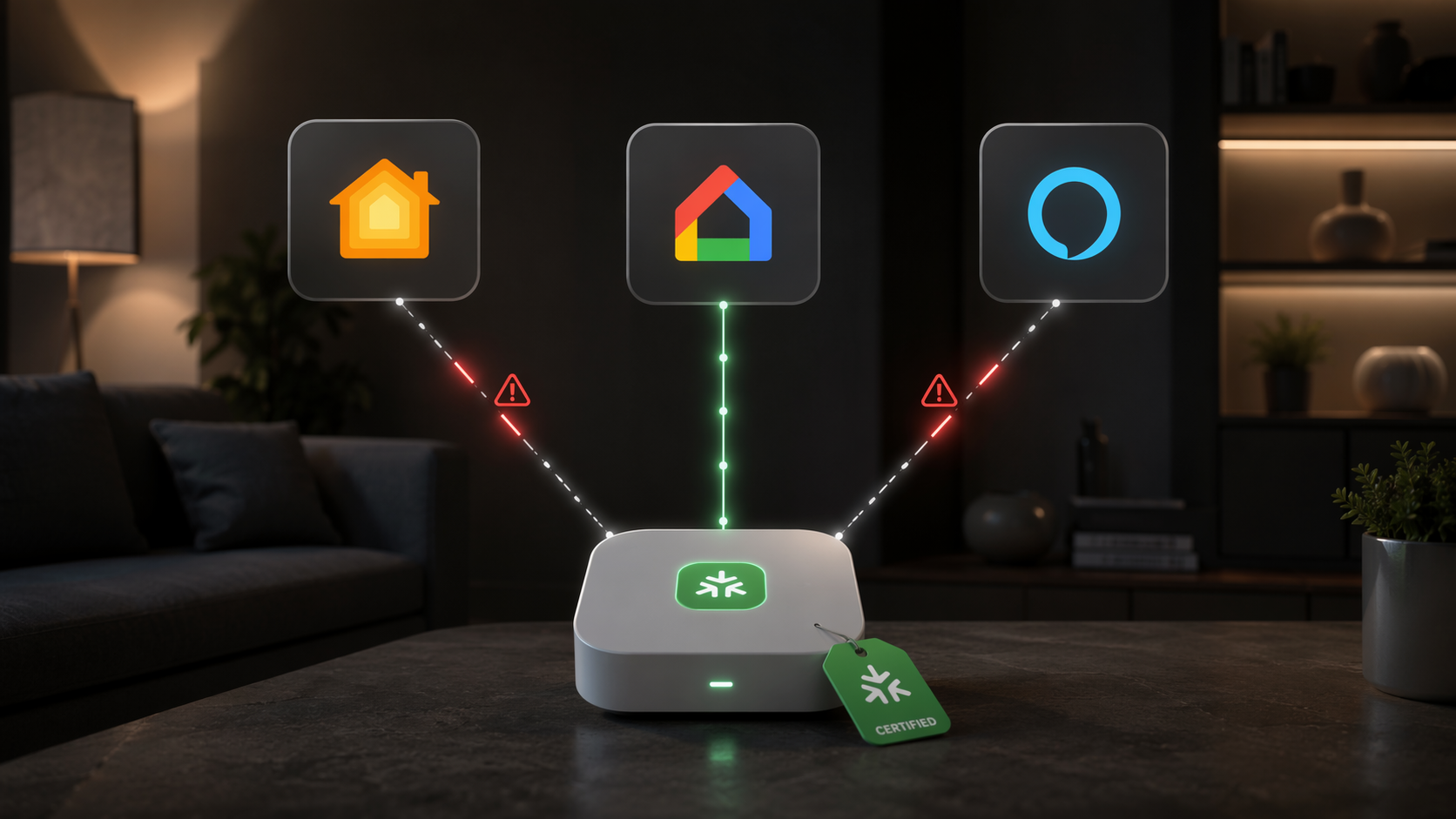
The failures fall into three clusters. First, platforms do not implement every Matter device type at the same pace, so a standard feature can exist on paper and still be absent from the app you actually use. Second, Thread border routers have not always behaved like one shared home network, especially in setups built before the newer Thread 1.4 requirements. Third, manufacturers still carry a heavy testing burden across Apple, Google, Amazon, SmartThings, and other ecosystems, which means two Matter devices can pass certification and still feel very different after setup.
| Failure cluster | What the owner sees | Why it happens |
|---|---|---|
| Platform implementation gaps | A device pairs, but its category or controls are missing in one ecosystem | The platform has not implemented that Matter device type or capability yet |
| Thread border router fragmentation | Thread devices join separate meshes instead of one shared network | Older or not-yet-updated border routers may not share credentials across brands |
| Manufacturer QA burden | A certified device works better in one app than another | Device makers still have to test and tune behavior platform by platform |
The “Any Platform” Promise Breaks First at Device Type Support
The clean version of the Matter pitch says you can buy one device and choose your platform later. The messier mid-2026 version is that platforms choose which parts of Matter to expose, and the gaps show up in ordinary rooms, not in standards documents.
A good example is the generic switch category. Matter 1.0 included generic switches, but Google Home still has not implemented them, according to a 2026 status review of the standard. The practical result is easy to miss until after purchase: some IKEA remotes can be Matter devices and still be non-functional in Google’s platform because Google Home has no useful place to put that device type yet.[1]
That is not a pairing problem in the usual sense. Rebooting the hub, scanning the QR code again, or standing closer to the router will not turn an unsupported device type into a supported one. If you are already stuck there, a targeted guide such as Matter Device Not Showing in Google Home? Start Here is more useful than another generic reset checklist, because the first question is whether Google Home supports the exact class of device you are trying to add.
Alexa has a different version of the same problem. Matter 1.3 defined leak sensors, but Alexa does not yet support them in the cited mid-2026 platform review. IKEA’s Klippbok water detector is the kind of device that exposes the gap neatly: it can work in Apple Home while not working on Amazon’s platform.[1]
That is exactly the sort of mismatch that makes a smart home feel dishonest. A leak sensor is not a decorative accessory. If it is under a sink or near a water heater, the owner expects the app to know what kind of device it is, raise the right alert, and let automations react. Saying “the device is Matter” is not enough if the chosen platform does not support that Matter category.
The careful way to read platform compatibility in 2026 is therefore narrower than the packaging suggests. Do not ask only whether a device supports Matter. Ask whether your primary platform supports that Matter device type today, and whether it exposes the controls you need. For newer categories, that check matters even more. The same pattern shows up around other device classes, from camera support to garage doors and smart blinds, where the standard, the retail device, and the platform interface may not arrive at the same time.
- For cameras, check the gap between spec support and actual devices using Matter 1.5 Camera Support Devices Available Now.
- For garage doors, check what Matter compatibility does and does not mean in What Matter compatibility means for garage doors in 2026.
- For blinds, check position and closure quirks in Smart Blinds Matter Closure Support.
This is also why large device-count claims need a little suspicion. A 2026 Matter device guide lists more than 750 certified products, which is real scale and worth acknowledging. It just does not answer the question most buyers care about at checkout: whether this exact sensor, remote, lock, bulb, bridge, or controller behaves properly in this exact ecosystem.[2]
IKEA Shows Why Certification Still Leaves Work for Manufacturers
IKEA is a useful proof point because it sells the kind of Matter devices people actually buy in quantity: affordable sensors, remotes, bulbs, and plugs. In March 2026, 9to5Mac reported acknowledged connectivity problems with IKEA’s budget Matter-over-Thread smart home devices, and framed the issue as evidence of a broader Matter problem: manufacturers still have to test against each major platform individually.[3]
That is the part many shoppers reasonably assumed Matter would remove. Before Matter, everyone learned to check whether a device had a HomeKit badge, worked with Alexa, talked to Google Home, or needed its own hub. Matter was supposed to reduce that platform-by-platform integration burden. It does reduce some of it. It does not eliminate the need for the manufacturer to discover how Apple, Google, Amazon, SmartThings, and others actually interpret and expose the same device.
The difference between those two claims is where the buyer gets trapped. A company can build to the standard, pass certification, ship a low-cost device, and still face real-world support problems once thousands of homes try every mix of controller, phone, border router, app version, and automation engine. IKEA’s March 2026 trouble is not proof that budget Matter devices are a bad idea. It is proof that low price does not make ecosystem QA optional.
It also ties directly back to the platform gaps. If a remote depends on a generic switch type that Google Home has not implemented, or a water detector depends on leak sensor support that Alexa lacks, the manufacturer’s support team becomes the place where the standard’s uneven rollout turns into a customer complaint. The owner does not care which company’s implementation is at fault. They bought a device with a Matter logo and a reasonable expectation that the main platform apps would understand it.
If IKEA devices are on your shortlist, the practical move is to check the individual model and the target ecosystem before buying multiples. A catalog such as Complete IKEA Matter Device Catalog for 2026 is more useful than a broad “IKEA supports Matter” statement, because the failures are model-and-platform specific.
Thread Can Be Local, Fast, and Still Not Be One Mesh
Matter-over-Thread is often sold as the clean path away from crowded Wi-Fi and single-brand hubs. In a good setup, that is fair. Thread is designed for low-power mesh devices, and Matter gives those devices a common application layer. The trap is assuming that every Thread border router in the home automatically contributes to one shared mesh.
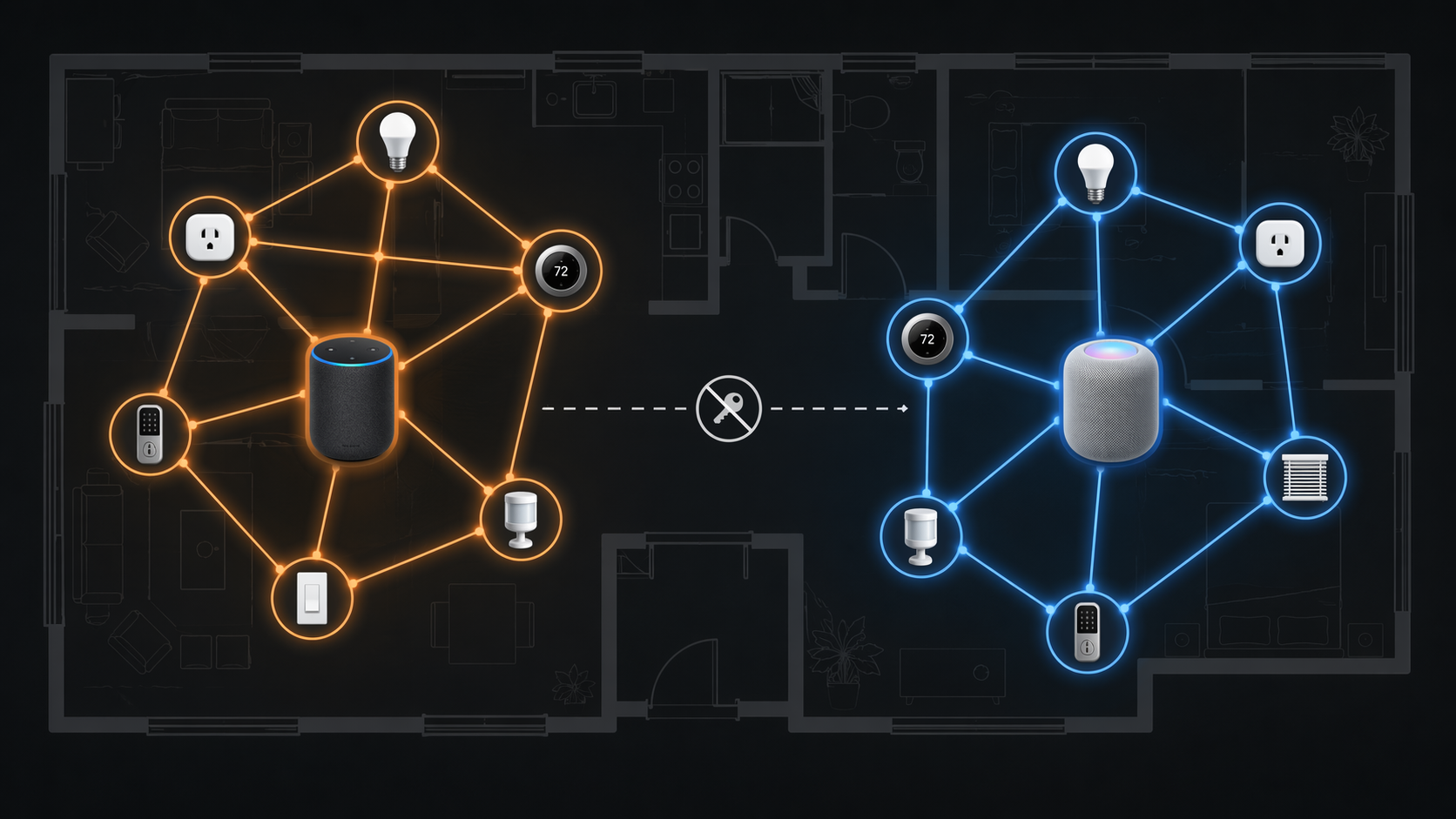
Before Thread 1.4 certification became mandatory in January 2026, border routers from different brands could create isolated Thread networks rather than sharing credentials. rAVe Pubs describes the common example plainly: an Echo and a HomePod in the same home could run separate Thread meshes instead of strengthening one another.[4]
From the couch, that looks irrational. You may have a HomePod mini in the kitchen and an Echo device in the hallway, both advertised as useful smart home infrastructure, while a Thread sensor still clings to one side of the house because the networks are not merged. The radio technology is not the whole story. The credential-sharing model and the ecosystem implementation decide whether those radios cooperate.
Thread 1.4 is meant to address that pain by making border router behavior more consistent, including a push toward unified credentials. The timing matters, though: the requirement becoming mandatory in January 2026 does not magically update every installed border router, every platform app, or every owner’s existing Thread network on the same day.[4]
This is where the controller vocabulary becomes more than pedantry. A Matter controller is not automatically a Thread border router, and a Thread border router is not automatically a guarantee of cross-ecosystem mesh sharing. If Google’s role in your setup is confusing, the distinction is worth sorting out before buying more Thread hardware; Google Nest Matter Controllers vs Devices: What's the Difference? is the kind of explainer that can prevent a drawer full of almost-useful hubs.
The pre-purchase question should be specific: do the border routers you already own support the newer Thread behavior your setup needs, and has your chosen ecosystem actually adopted it? “Has Thread” is too loose. “Can share Thread credentials with the rest of my home under the newer model” is closer to the thing that affects range, reliability, and your willingness to recommend the device to someone else.
Bridges Make Old Gear Useful, but They Do Not Preserve Everything
Bridges are one of Matter’s more practical compromises. They let existing ecosystems expose older Zigbee, Bluetooth, or proprietary devices to Matter without forcing everyone to replace a house full of working hardware. That is good. It is also not the same as making every brand-specific feature portable.
The 2026 status review notes feature loss when devices from systems such as Philips Hue, Aqara, and SwitchBot are bridged into Matter, including loss of manufacturer-specific features and Home Key support.[1] YourMatterHome’s 2026 device guide also flags platform-specific compatibility notes around bridged and certified devices, reinforcing the same caution: Matter exposure is often a common denominator, not a full clone of the manufacturer app.[2]
That does not make bridging a bad choice. It makes it a choice with a known tradeoff. If you mainly need lights to turn on, plugs to switch, and basic sensors to report state, a bridge can extend the life of good hardware. If you bought into a brand because of adaptive lighting behavior, advanced scene controls, security credentials, or device-specific options, assume some of that may stay behind the bridge.
Multi-Admin Works, but Sharing Is Still More Manual Than It Sounds
Multi-admin is one of Matter’s best ideas: add a device once, then share it with multiple ecosystems so Apple Home, Google Home, Alexa, SmartThings, or another controller can all see it. In practice, the current experience is still more one-at-a-time than the phrase suggests. MatterAlpha’s Matter 1.6 overview describes Joint Fabric as a way to make multi-ecosystem setups less tedious, but also notes that the benefit depends on adoption by the ecosystems involved.[5]
The Connectivity Standards Alliance’s Matter 1.6 announcement positions Joint Fabric as a feature for more intuitive multi-ecosystem experiences, alongside additions such as NFC commissioning for easier setup.[6] Those are sensible fixes to real friction. They should not be read as a guarantee that your present mix of controllers already behaves that way.
A Better Buying Discipline for Matter Devices in 2026
The safest way to buy Matter devices in 2026 is to treat the logo as the beginning of compatibility verification. It tells you the device participates in the standard. It does not prove that your preferred platform supports the device category, that your Thread border routers share a mesh, or that a bridged device keeps every feature you care about.
- Check the exact Matter device type against your primary platform before buying, especially for remotes, switches, leak sensors, cameras, garage doors, blinds, and newer sensor classes.
- For Thread devices, identify which products in your home are only Matter controllers and which are also Thread border routers.
- Confirm whether your Thread border routers support the newer shared-credential behavior instead of assuming all Thread routers form one mesh.
- If a device is bridged through Hue, Aqara, SwitchBot, or another hub, decide whether basic control is enough or whether you need brand-specific features.
- For multi-admin homes, verify that the ecosystems you plan to use have adopted the relevant Matter improvements, not just that the standard has defined them.
That discipline sounds less exciting than “works with everything,” but it matches the state of the market more honestly. Matter devices are often worth buying in 2026. They are just not a shortcut around checking the platform, the Thread network, the bridge, and the specific feature set before the box is open.
References
- The Matter Standard in 2026 – A Status Review, matter-smarthome.de
- Matter Devices List 2026: Complete Guide, YourMatterHome
- Ikea smart home failings point to a major problem with Matter, 9to5Mac, March 18, 2026
- Does Thread Matter in 2026? Comparing Matter, Thread, Zigbee, Z-Wave and Wi-Fi, rAVe Pubs
- Instead of new devices, Matter 1.6 focuses on making Matter less of a headache, MatterAlpha
- Matter 1.6 Enables More Intuitive Setup, Multi-Ecosystem Experiences, and Context-Driven Control, Connectivity Standards Alliance
Updates & Corrections
Protocol specifications and platform features change rapidly — especially with Matter version evolution. Report version changes, certification count updates, or platform policy changes that have occurred since the last editorial review.
Comments
Join the discussion with an anonymous comment.