If you are buying Matter-enabled smart home devices in July 2026, the useful question is not whether Matter “works.” It is whether the category you are buying has enough real products, enough platform support, and enough feature coverage that the badge can carry the purchase. In some aisles, it can. In others, the Matter logo is still only a starting clue.
The unofficial device universe is now large enough to be meaningful: buyer-facing catalogs and crowdsourced lists put Matter-compatible devices above 750 in mid-2026, though that should not be treated as an official Connectivity Standards Alliance count.[1] The number is useful context, but it hides the thing that matters at checkout: a $15.99 smart plug and a robot vacuum with partial Matter support are not equally ready just because both appear in a Matter list.
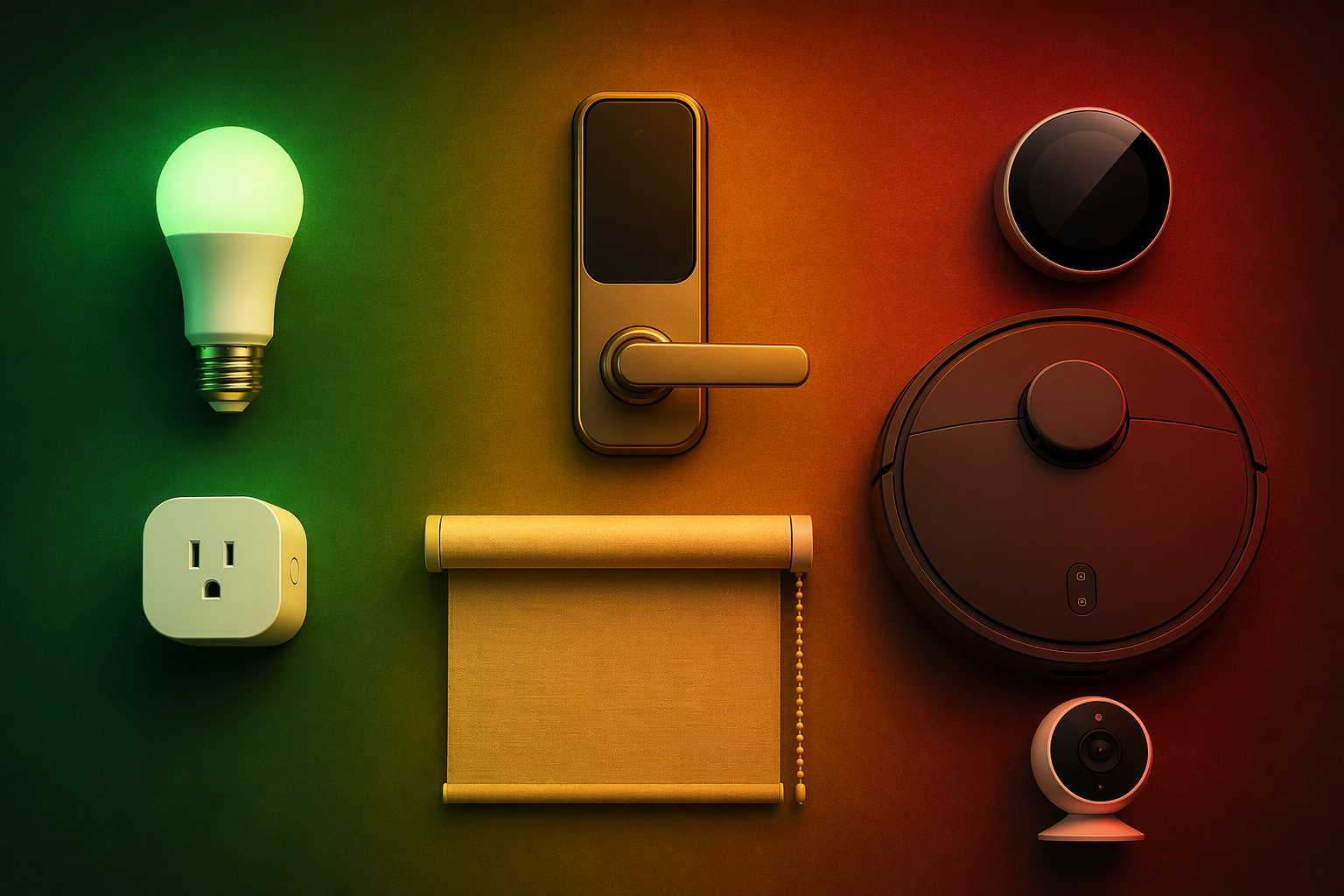
| Category | Readiness | What works well through Matter | What still does not | Buyer action |
|---|---|---|---|---|
| Lighting | Green | On/off, dimming, color control, scenes, local control, broad product choice from brands including Nanoleaf, IKEA, Philips Hue through its bridge, Govee, Sengled, and TP-Link Tapo. | Advanced brand effects, entertainment sync, firmware settings, and some specialty behaviors may still live in the maker app. | Buy confidently for normal bulbs, strips, and lamps. Keep the native app if you care about brand-specific effects. |
| Smart plugs and outlets | Green | On/off control, automations, local response, low-cost Wi-Fi and Thread options, and wide platform compatibility. | Energy monitoring is the catch: SmartThings and Home Assistant support it through Matter, while other major platforms may not expose the data yet.[2] | Buy confidently for switching. Buy only after checking your platform if energy data is the reason you want the plug. |
| Basic sensors | Green | Motion, contact, temperature, and occupancy-style triggers work well, especially on Thread devices with fast response and long battery life. | Sensor quality still varies by device, and Thread models need a healthy Thread network. | Buy confidently for simple automations. If your home has several border routers or flaky coverage, read up on unstable Thread mesh behavior before blaming the sensor. |
| Smart locks | Yellow | Lock/unlock, status, and basic automations can work well on supported locks from brands such as Aqara, Yale, Level, Schlage, and Kwikset. | Fewer than 20 certified options appear in current Matter catalogs, PIN-code support is platform-dependent, and Home Key is not universal.[2] | Buy carefully. Confirm your exact lock, platform, PIN-code needs, and fallback app before ordering. |
| Shades and blinds | Yellow | Open/close, position control, and automations can be solid on products from Eve MotionBlinds, IKEA, SmartWings, and Hunter Douglas. | Many models are Thread-based, which means you need a Thread border router and a stable mesh. | Buy if you already understand your Thread setup. Do not treat the shade as a self-contained purchase. |
| Thermostats | Red / verify carefully | Basic temperature control exists on a very small set of US models. | US selection is tiny, with about three Matter-capable options listed in mid-2026 catalogs; Ecobee has committed to Matter but has not yet delivered support.[3] | Verify the exact model before buying. In many homes, the native thermostat app is still the safer control center. |
| Robot vacuums | Red / verify carefully | Matter can cover basic start/stop behavior and mode switching on supported models. | Room mapping and detailed cleaning controls still require the manufacturer app.[2][3] | Do not buy for Matter alone. Buy the vacuum you like in its native app, then treat Matter as a bonus. |
| Cameras | Red / too early | Matter 1.5 added camera support, and early models are now appearing. | The category is new; only Aqara Camera Hub G350 and Ulticam IQ V2 were confirmed as shipping examples in early-2026 coverage.[4][5] | Wait unless you are comfortable testing early support and verifying your platform before purchase. |
| Appliances | Red / verify carefully | Some Matter appliance categories are visible in roadmaps and show-floor announcements. | Most buyer-relevant products are announced or emerging rather than proven everyday purchases. | Ignore the badge until the exact appliance is shipping and your platform exposes the controls you need. |
Green Categories: The Badge Usually Means What Buyers Hope It Means
Lighting, plugs, and basic sensors are the categories where Matter feels least like a science project. They are not perfect, and they do not erase every manufacturer app, but they are mature enough that a normal buyer can choose the device first and the ecosystem second.
Lighting gets the easiest green rating. There is real selection across inexpensive bulbs, light strips, lamps, bridge-based systems, and mainstream brands. IKEA Matter bulbs starting around $7.99 are a useful sign of where the category has landed: this is no longer just a premium early-adopter shelf.[1] A Matter bulb can be added to Apple Home, Google Home, SmartThings, Amazon Alexa, or Home Assistant, then used for ordinary on/off, dimming, color, schedules, and automations.
The native app still has a job. Philips Hue effects, Govee scene libraries, Nanoleaf-specific features, firmware updates, and entertainment sync features can sit outside the Matter layer. That is not a failure if the buyer understands the bargain. Matter is good at making the light behave like a light across platforms. It is not a promise that every brand-specific trick on the box will appear in every smart home app.
Smart plugs are similarly safe for the basic use case. A Tapo, Eve, Meross, or similar Matter plug that turns a lamp, fan, or coffee grinder on and off is one of the least dramatic ways to make a mixed-platform home less annoying. Tapo plugs around $15.99 also show why this category matters: buyers can standardize without spending bridge-system money on every outlet.[1]
Energy monitoring is the exception that catches people. The plug may measure energy, the box may advertise energy monitoring, and Matter may define the relevant cluster, but your chosen app may still hide that data. The Verge’s platform tracking has SmartThings and Home Assistant exposing Matter plug energy monitoring, while other major platforms have not supported that cluster in the same practical way.[2] If the automation is “turn this fan off at midnight,” buy the plug. If the reason is “track appliance draw in my phone’s main smart home app,” check the platform before the cart.
Basic sensors deserve their green rating because they do small jobs often. A contact sensor tells a platform that a door opened. A motion sensor starts a hallway light. A temperature sensor feeds an automation. Matter does not need to carry a complicated user interface for those tasks, which is why devices such as the Aqara P2, Eve Motion, and IKEA Paroll fit the standard better than more ambitious categories do.
Thread is a big part of why many sensors feel good in daily use. Current buyer guidance and hands-on reports point to Thread sensors delivering fast, often sub-second, response with battery life commonly discussed in the one-to-two-year range.[6] That is exactly the kind of unglamorous reliability that matters more than a giant compatibility logo. If you are still deciding between radio types, the practical split is covered in Should Your Matter Accessories Use Thread or Wi-Fi in 2026? and the broader protocol comparison in Matter Protocol vs Zigbee vs Thread – Which to Choose in 2026?.
The caution with Thread sensors is not the sensor category itself; it is the network underneath it. A house with one well-placed border router may behave better than a house with several border routers that do not cooperate cleanly. If a Thread contact sensor is slow or disappears, the fix may be mesh placement rather than replacing the device. The troubleshooting path belongs closer to Fix Unstable Thread Mesh with Multiple Border Routers than to another round of Matter logo shopping.
Yellow Categories: Good Devices, Conditional Purchases
Smart locks and shades are not failed Matter categories. They are categories where the missing detail is often the detail the buyer actually cares about. A light that turns on is a light. A lock that cannot manage household PIN codes in the app your family uses is an argument at the door.
Locks: Check PIN Codes Before You Check Out
A Matter smart lock can be perfectly sensible if your expectations are basic: lock, unlock, see status, include it in routines, and keep the manufacturer app for setup and deeper management. The problem is that locks are rarely bought for only basic lock/unlock. Buyers want guest codes, family codes, schedule rules, logs, keypad management, and sometimes phone-as-key features.
The platform split is blunt. Apple Home and SmartThings support PIN codes through Matter; Google Home and Amazon Alexa do not, according to The Verge’s compatibility tracking.[2] That means the same Matter lock can feel complete in one household and half-integrated in another. If the family already uses Google Home as the shared control surface, “Matter-supported” does not automatically mean “manage the keypad from Google Home.”
There is also no universal Home Key story. Apple Home Key remains a specific Apple ecosystem feature, not a general Matter feature that every lock and every platform receives. A buyer moving from an Apple-heavy setup to a mixed household should not assume that Home Key-like convenience travels with the Matter badge.
Selection is still smaller than the marketing glow suggests. Current catalog tracking shows fewer than 20 certified Matter lock options, with names such as Aqara U-series, Yale, Level, Schlage, and Kwikset appearing in the mix.[3] That is enough to shop, but not enough to treat lock buying like bulb buying. If you need help sorting the lock itself from the ecosystem claim, use Best Smart Locks for Home in 2026 as the product-first filter, then verify Matter behavior afterward.
- If you only need lock/unlock and status, a Matter lock can be a good buy.
- If you need PIN-code management inside Apple Home or SmartThings, verify the exact model and platform support.
- If you use Google Home or Alexa and PIN codes matter, assume the native lock app will remain part of daily management.
- If Home Key is the feature you want, shop for Home Key specifically, not just Matter.
Shades and Blinds: The Device May Be Ready Before the Network Is
Matter shades are one of the more pleasant yellow categories when the setup is right. Open, close, set a position, include the shade in a morning routine, lower it when the room gets hot: these are clean control tasks, and products from Eve MotionBlinds, IKEA, SmartWings, and Hunter Douglas show that the category is real rather than theoretical.
The catch is infrastructure. Many Matter shades are Thread-based, so the purchase quietly includes a requirement for a Thread border router. That may be an Apple TV 4K, HomePod mini, recent Nest Hub, SmartThings hub, Eero router, or another compatible controller depending on the home. A buyer with only a phone and a Wi-Fi router can buy the shade and still not have the Matter setup they imagined. Controller requirements are a recurring Matter issue, not a shade-only issue.[7]
This is where platform choice becomes more than a preference. Some homes are anchored around Apple Home because the household already owns Thread-capable Apple hardware. Others lean on SmartThings or Home Assistant because they expose more device types and advanced controls. If you are choosing the app as much as the device, Which Matter Smart Home App Should You Use in 2026? is the decision point to settle before ordering a room full of shades.
For one window, the risk is tolerable. For ten windows, verify the controller, the Thread layout, the platform controls, and the installer’s plan. Shades are expensive enough that “I thought Matter meant it would just work” is not a troubleshooting strategy.
Red Categories: The Badge Is Not Yet Enough
The red categories are not useless. They are simply not safe places to let the Matter badge make the purchase decision for you. Thermostats, robot vacuums, cameras, and appliances all have either limited selection, missing high-value features, or too little shipping history.
Thermostats: Too Few US Choices
Thermostats should have been an obvious Matter win. They are shared household devices, they sit at the intersection of comfort and energy cost, and nobody wants to rebuild heating schedules because one person changed phone platforms. The actual US market is still thin. Matter catalog tracking lists about three US thermostat options in mid-2026: Nest Thermostat, Nest Learning 4th Gen, and Meross Matter Thermostat.[3]
Ecobee is the awkward hole. The company has committed to Matter support, but support had not been delivered in the mid-2026 materials used for this guide.[3] That is not the same as saying Ecobee will never support Matter; it means a buyer should not buy an Ecobee today for a Matter feature that is still promised rather than available. For the narrower model-by-model question, use Which Matter Thermostats Work Across All Platforms? before treating any thermostat as a safe cross-platform buy.
Robot Vacuums: Start and Stop Are Not the Product
Robot vacuums are the classic example of Matter support being real but incomplete. Matter can expose basic commands such as start, stop, and mode switching on supported vacuums, including models from brands such as Roborock and iRobot.[2][3] That sounds fine until you remember why people buy higher-end robot vacuums: room maps, no-go zones, room-by-room cleaning, mop settings, dock behavior, and maintenance alerts.
Room mapping remains outside the useful Matter experience and still requires the manufacturer’s app.[2][3] So the buying advice is simple: choose the robot vacuum whose native app, navigation, dock, and cleaning performance you trust. If Matter lets you tell it to start from your main smart home app, treat that as a convenience layer, not the control plane.
Cameras: Matter 1.5 Makes Them Real, Not Mature
Cameras moved from wish-list to emerging category when Matter 1.5 added camera support in November 2025.[5] That is important, but new support in a standard is not the same thing as a mature buying category. Camera buyers care about live view reliability, recording, event history, person detection, package detection, local storage, cloud plans, privacy controls, and platform display behavior.
The confirmed shipping examples are still too few to generalize from. Early-2026 coverage identified Aqara Camera Hub G350 and Ulticam IQ V2 as shipping Matter camera examples.[4][5] That proves emergence. It does not yet justify telling mainstream buyers to choose a security camera primarily because it carries a Matter badge.
Appliances: Announcements Are Not Kitchen Reliability
Appliances are where Matter’s roadmap can sound more useful than the shopping shelf. CES 2026 brought Matter-related announcements and demos across categories, including products such as GE Smart Shades, IKEA Varmblixt, Eve Thermostat for the US, Aqara Camera Hub G350, and SwitchBot Lock Vision with 3D face recognition.[4] Some of those are not appliances, but they show the same pattern: the Matter direction is visible before the everyday buyer evidence is deep.
For ovens, washers, refrigerators, and other expensive appliances, the right standard is higher than “announced.” Verify that the exact model is shipping in the US, that your platform supports the appliance type, and that the controls exposed through Matter are the controls you actually expect to use. A manufacturer app may still be the only place for cycles, diagnostics, consumables, and remote-start rules.
The Feature Traps That Decide Whether Matter Is Enough
The most useful Matter shopping habit is to stop asking only “does it support Matter?” and start asking “which feature am I buying, and where will I control it?” The answer changes by category and by platform.
| Feature you may expect | Where the trap appears | What to verify |
|---|---|---|
| Energy monitoring | Matter smart plugs | Whether your app exposes the energy data. SmartThings and Home Assistant are the safer bets in the current source set.[2] |
| PIN-code management | Matter smart locks | Whether your platform supports lock PINs through Matter. Apple Home and SmartThings do; Google Home and Alexa do not.[2] |
| Home Key-style unlocking | Smart locks | Whether the lock specifically supports Apple Home Key. Matter alone does not provide a universal version. |
| Thread connectivity | Sensors and shades | Whether you already have a Thread border router and a stable mesh. |
| Room maps | Robot vacuums | Whether the manufacturer app remains required. For room mapping, it does.[2][3] |
| Camera history and detection | Matter cameras | Whether your platform supports the camera behaviors you need; the category is still new after Matter 1.5.[5] |
This is also why platform guides matter more in 2026 than buyers might expect. Home Assistant and SmartThings often expose more Matter device types and controls than simpler mainstream app experiences, while Apple Home, Google Home, and Alexa can be excellent for common devices but uneven on specific clusters or categories.[2] For a broader category-by-category companion, What Actually Works with Matter in 2026 is the better next stop; for the failure modes that do not show up on the shelf tag, read Three Hidden Problems With Matter Devices in 2026.
The clean mid-2026 rule is this: choose Matter freely for lights, plugs, and basic sensors; choose it carefully for locks and shades after checking platform features and Thread requirements; and treat thermostats, robot vacuums, cameras, and appliances as categories where the badge is not a substitute for verifying the exact device, exact platform, and exact feature you need.
References
- Matter Devices List 2026: Complete Guide — YourMatterHome
- Every device that works with Matter (December 2024) — The Verge, December 2024
- Overview: Devices Compatible with Matter — matter-smarthome.de
- The Matter Innovations at CES 2026 — matter-smarthome.de
- Most anticipated Matter features and devices in 2026 — Matter Alpha
- 10 Matter devices that actually impressed us in 2025 — Matter Alpha
- What Is a Matter Controller? Complete Guide 2026 — Gearbrain
Updates & Corrections
Protocol specifications and platform features change rapidly — especially with Matter version evolution. Report version changes, certification count updates, or platform policy changes that have occurred since the last editorial review.
Comments
Join the discussion with an anonymous comment.