The backup power decision usually starts in a very ordinary place: the refrigerator is full, someone is working from home, the sump pump may or may not make it through the storm, and the Wi-Fi has become the thing everyone notices first. In that moment, home energy solutions during a power grid crisis stop being an abstract energy topic. They become a household logistics problem.
That problem is getting harder to ignore. In March 2026 alone, more than 210,000 power outage events affected 46 states, and equipment failures had an average restoration time of 9.2 hours, according to LINIOTECH's 2026 outage analysis.[1] Weather is also doing much of the damage: EOS-E cites FEMA's 2024 finding that 83% of U.S. power outages are weather-triggered.[2] For a homeowner, those numbers do not have to mean a disaster movie. They mean more evenings where the fridge, router, medical devices, garage door, heat, AC, or sump pump may each become a separate decision.
The 20-Year Cost Comparison Changes the Starting Point
The strongest reason solar-plus-battery systems now belong in the first round of comparison is not that they sound cleaner or newer. It is the long-run ownership math. EnergySage's 2026 comparison estimates a 20-year cost of about $39,434 for a solar-plus-battery system versus $78,012 for a natural gas generator.[3]
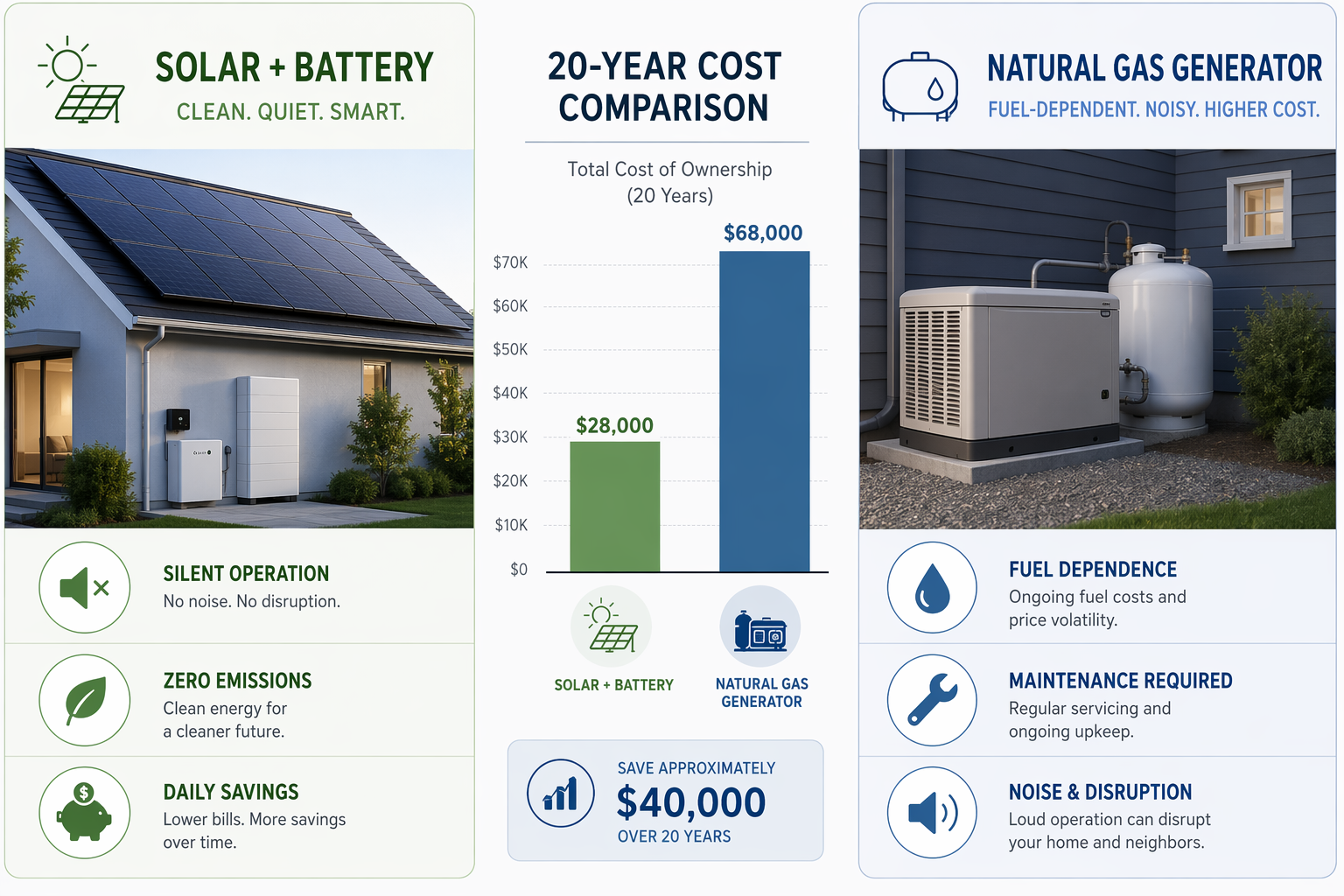
That is a large enough gap to change the question from "What will keep the lights on?" to "What will keep the lights on and still be useful the other 350-plus days of the year?" A standby generator may sit quietly until the grid fails. A solar-plus-battery system can lower grid purchases on normal days, store solar production, provide backup power during an outage, and qualify for the federal investment tax credit. EnergySage notes that the federal ITC covers 30% of eligible battery system cost in 2026, with additional state incentives varying by location.[3]
The caution is just as important as the headline. A 20-year comparison is a projection, not a promise. It depends on electricity rates, battery degradation, warranty terms, natural gas prices, installation design, and whether the homeowner actually uses the battery to reduce electricity costs outside outages. The number is useful because it includes costs homeowners often forget to count, not because every house will land on the same total.
| System | Typical strength | Main constraint |
|---|---|---|
| Solar-plus-battery | Lower projected 20-year cost, daily savings, quiet backup, no on-site emissions | High upfront cost and limited runtime if loads are too large |
| Battery-only | Fast, quiet backup for essential loads | Limited runtime and no solar recharge during multi-day outages |
| Portable generator | Low entry cost and flexible emergency use | Fuel handling, noise, setup, and safety burden |
| Standby natural gas generator | Strong option for long outages and high whole-home loads | High lifetime cost, maintenance, noise, and combustion risk |
Short Outages and Long Outages Are Different Purchases
A homeowner who loses power for three hours six times a year is not buying the same solution as someone who expects three days without power after a hurricane, wildfire, ice storm, or grid failure. The first household needs continuity. The second needs endurance. Confusing those two needs is how people overspend, undersize systems, or buy a machine that solves the scariest scenario while ignoring the outages they actually experience.
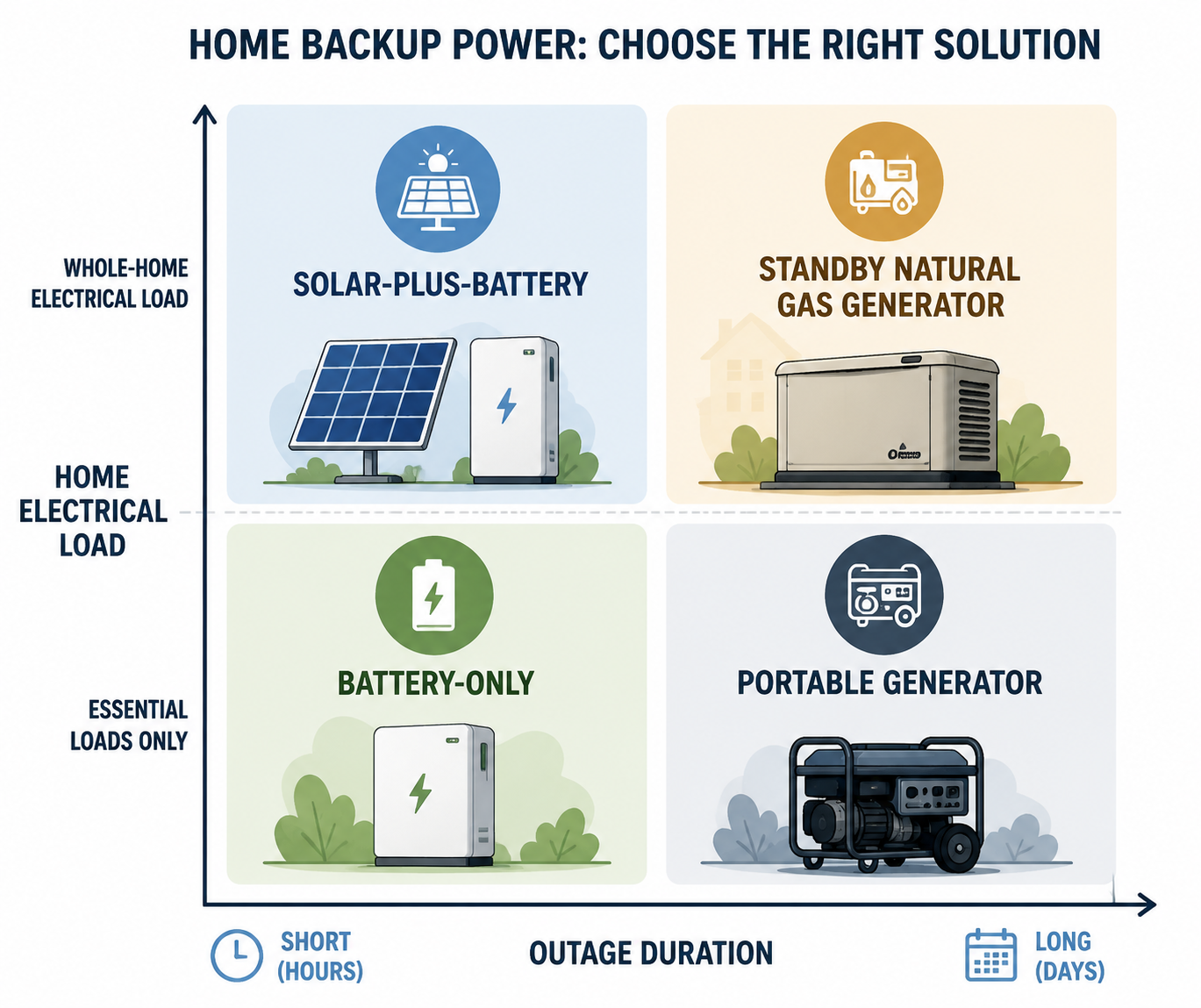
For frequent short outages, a whole-home or essential-load battery can feel less like backup equipment and more like an invisible appliance. Luminaid reports that whole-home battery systems can switch on in about 20 milliseconds, while CNET describes standby generators as typically taking about 10 to 30 seconds to start.[4][5] A few seconds may not matter for a lamp. It can matter for a router, home office equipment, security system, or anyone who is tired of resetting clocks, appliances, and smart devices after every flicker.
That speed is not the same as unlimited capacity. A battery must be sized around real loads. The refrigerator, modem, a few lights, phone charging, and a sump pump are very different from central air conditioning, electric heat, an electric range, a well pump, and multiple large appliances starting at the same time. The purchase decision gets much clearer once "whole home" is replaced with a written list of circuits that actually matter.
Where Solar-Plus-Battery Earns Its Keep
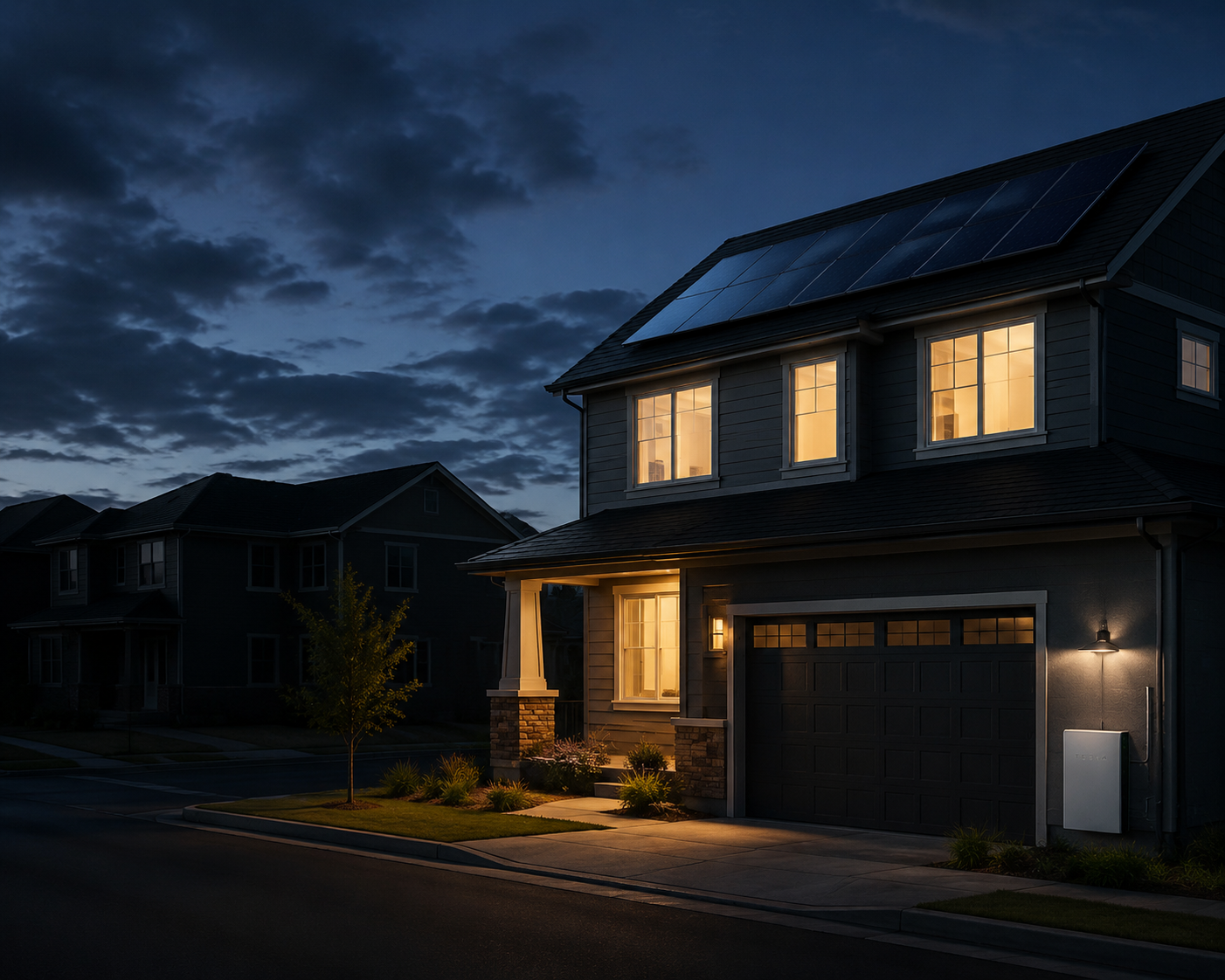
Solar-plus-battery is strongest when outages are frequent enough to be disruptive but not usually long enough to require days of full-house power. In that setting, the system does several jobs at once: it backs up selected circuits, stores solar energy, reduces dependence on peak grid electricity, and does it without fuel runs, engine noise, exhaust, or annual generator servicing.
The safety difference is not cosmetic. Batteries do not produce carbon monoxide. Fuel-burning generators require correct placement, ventilation, and operating discipline because exhaust can become dangerous if the generator is too close to living spaces. EcoFlow's 2026 comparison highlights the carbon monoxide issue as a key generator risk, while EnergySage estimates generator maintenance at about $200 to $600 per year.[6][3]
The daily-use side is where the economics become more persuasive. If a battery only waits for outages, it is an expensive insurance policy. If it charges from solar, shifts household energy use, and reduces grid purchases, it becomes part of the home's operating budget. Homeowners who already use smart thermostats, load controls, or time-of-use habits can often get more from the system by coordinating when major devices run; a deeper look at solar battery smart home automation is useful if the goal is to make the battery earn value on ordinary weekdays, not just during storms.
The obvious objection is the upfront bill. Installed costs commonly range from $20,000 to $50,000 or more for solar-plus-battery, compared with roughly $500 to $15,000 or more for generator options. Even if the 20-year math favors solar-plus-battery, that does not help a household that cannot absorb the initial cost, qualify for financing, or use the tax credit effectively. Long-run savings are only useful if the purchase can survive the first invoice.
Where Batteries Alone Make Sense
A battery-only backup system can be the middle path for a home that wants silent, indoor-safe backup but is not ready for rooftop solar. It can keep essential circuits running through shorter interruptions, avoid the chore of fueling a generator, and provide the fast switchover that makes brief outages less disruptive.
The limitation is recharge. Without solar, the battery starts the outage with whatever charge it has and then runs down. The available runtime for battery-only systems is generally about 12 to 24 hours, depending on loads. That can be plenty for a typical overnight outage and nowhere near enough for a multi-day event with heavy HVAC demand.
Battery-only also asks for discipline during an outage. If everyone treats the house as if the grid is still on, runtime disappears quickly. If the household agrees ahead of time that the battery serves the fridge, internet, medical needs, basic lighting, and perhaps a pump, it can cover the most annoying and costly parts of many short outages.
Why Generators Still Have a Real Role
Generators remain compelling for one blunt reason: as long as the machine works and fuel is available, they can keep producing power. That matters for extended outages, large homes, central HVAC, well pumps, and households that want something close to whole-home normalcy for several days. A properly installed standby natural gas generator can be deeply reassuring when the likely outage is not a short interruption but a long restoration window.
Portable generators sit at the other end of the budget range. They can be the right answer when the household needs emergency capability but cannot justify a five-figure installation. The tradeoff is that someone has to store fuel, move or connect equipment safely, keep the generator outside, manage extension cords or transfer equipment, tolerate noise, and maintain an engine that may sit idle until the worst day of the year.
That chore list is not a small detail. A backup system that requires calm, correct setup in bad weather is very different from one that transfers automatically. It may still be the right system, but the human work belongs in the cost comparison along with fuel, maintenance, and installation.
The Loads Decide More Than the Marketing Name
The most useful pre-purchase exercise is not choosing between "battery" and "generator." It is sorting the home into loads that must run, loads that would be nice to run, and loads that can wait. Most households discover that the essential list is shorter than the panic list.
- Essential: refrigerator or freezer, medical equipment, internet modem and router, phone charging, security equipment, a few lights, sump pump, garage access, or a well pump if the home depends on it.
- Important but negotiable: microwave, selected outlets, fans, a small window AC unit, boiler controls, or limited laundry use.
- High-load comfort: central AC, electric heat, electric water heating, electric range, EV charging, pool equipment, and multiple large appliances.
A solar-plus-battery system looks strongest when the essential list is the real target. A standby generator looks stronger as the owner moves toward high-load comfort during long outages. A portable generator may cover the essential list cheaply, but only if the household is comfortable with manual operation and safety requirements. A battery-only setup can cover a carefully chosen essential panel, but it should not be mistaken for a multi-day whole-home system unless the design and runtime numbers actually support that expectation.
Weather planning adds another layer. If the home's outages are mostly storm-related, preparedness may include both power and non-power decisions: leak sensors, charged radios, lighting, communication plans, and device recovery after the grid comes back. For households in storm-prone areas, smart home devices for hurricane preparedness can sit beside the backup power plan rather than replace it.
A Practical Decision Framework
The cleanest answer is conditional. For homeowners with frequent short outages, a long ownership horizon, usable roof space, and enough upfront budget or financing capacity, solar-plus-battery is usually the best fit because it is not only an emergency tool. It works on normal Tuesdays. It can lower energy costs, switch over almost instantly, avoid on-site emissions, and reduce the household's dependence on fuel logistics.
For homeowners with lower upfront budgets, a portable generator or smaller battery system may be more realistic. For homeowners who need several days of whole-home power, especially with central HVAC, electric heat, or well pumps, a standby generator can still be the more capable backup choice. The best system is the one sized to the outage pattern the house actually faces, not the most dramatic scenario anyone can imagine.
| If this is your reality | Start your comparison here |
|---|---|
| Frequent short outages, essential loads, long-term home ownership | Solar-plus-battery |
| Short outages, no solar budget yet, quiet backup preferred | Battery-only essential-load backup |
| Limited budget, occasional outages, manual setup acceptable | Portable generator with safe transfer equipment |
| Multi-day outages, heavy HVAC or well pump loads, whole-home expectations | Standby natural gas generator |
Before signing a contract, make the comparison boring on purpose: write down the essential circuits, check typical outage duration in your area, price both upfront cost and 20-year ownership cost, ask how battery degradation or generator maintenance is handled, verify federal, state, and utility incentives locally, and decide whether daily energy savings matter to your household. If the grid crisis is going to make homeowners spend serious money, the system should match the actual outage reality.
References
- Why Your Home Is Losing Power More Often in 2026 (And How Solar Storage Fixes It), LINIOTECH
- Power Cut Survival Kit: Items You Need and the Best Solution for Power Outages in 2026, EOS-E
- Home Battery Backup Power Vs. Generators (2026), EnergySage
- Your Guide to Home Backup Power Solutions for 2026, Luminaid
- Batteries or Generators: Choosing the Best Home Backup Power Solution, CNET
- Backup Battery vs. Gas Generator: What's Better for Whole-Home Power in 2026?, EcoFlow
Data Updates
Know about updated rebate programs, changed subscription prices, or new ENERGY STAR certifications? Submit a note below to help keep this content current. For formal data corrections, use the contact page.
Comments
Join the discussion with an anonymous comment.