
As of July 2026, a smart smokeless fire pit review has to start with a disappointment: the “smart” part is much thinner than the phrase suggests. The category essentially comes down to two genuine app-controlled products, the BioLite FirePit+ and the HPC Fire Sedona. Neither turns your backyard fire into something that fits cleanly into Alexa, Google Home, Matter, HomeKit, SmartThings, or native Control4 routines. A May 2026 connected-fire-pit roundup found no fire pit support for Alexa voice routines or Google Home automations, and specifically noted that the BioLite FirePit+ is Bluetooth-only with no cloud bridge.[1]
That does not make app control useless. It does make the label “smart” easy to overread. On the portable wood-burning side, the BioLite app changes fan speed. On the built-in gas side, the HPC Fire Sedona uses WiFi and Bluetooth for ignition and flame-height control, but it lives in a pro-installed gas-fire-feature world rather than the same shopping lane as a Solo Stove or Breeo.[1]
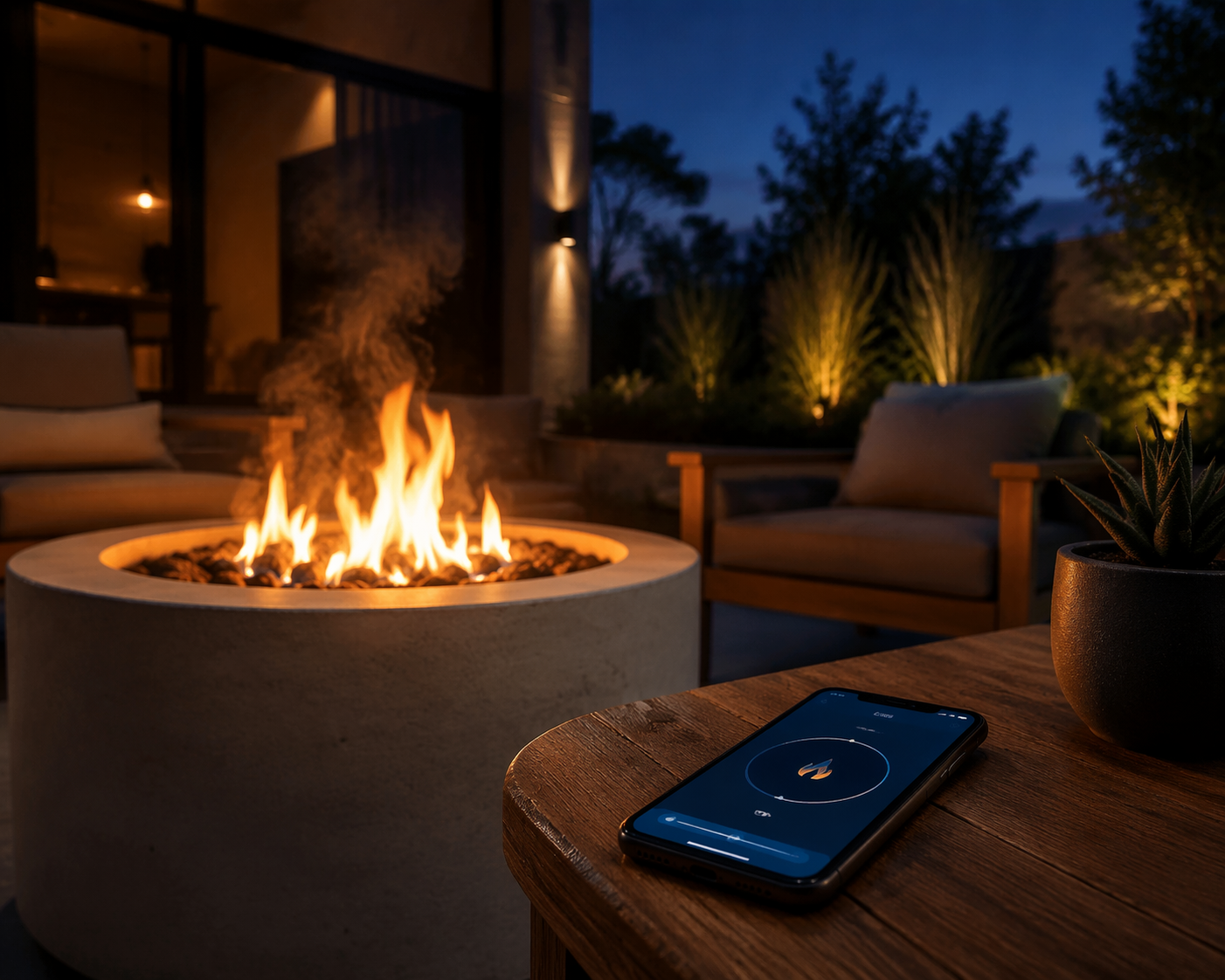
What “Smart” Actually Buys You
The BioLite FirePit+ is the only portable model here where the app meaningfully changes how the fire behaves. Its airflow system uses 51 air jets and four fan speeds controlled through the BioLite Energy app. The onboard 12,800 mAh battery is rated for up to 30 hours on low, 14 hours on medium, and 7 hours on high. The pit itself weighs 19.8 pounds, uses high-temp enamel-coated steel, and carries a 1-year warranty.[2]
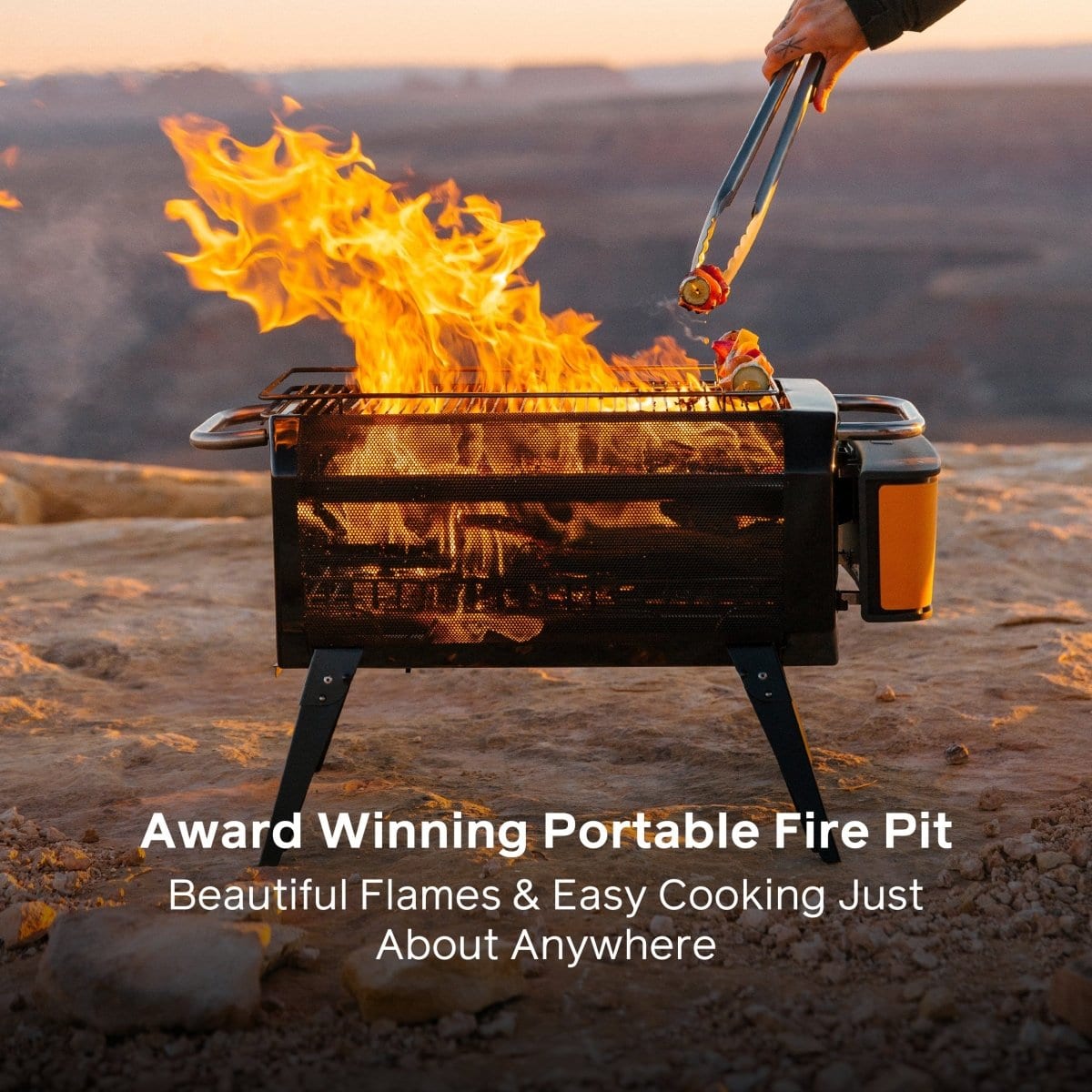
That is a real control surface, not just an app-shaped brochure. If the fire is struggling, the fan can push more oxygen through the burn chamber. If the flames are roaring, you can back the fan down. The benefit is practical: less poking, less guessing, and more direct influence over combustion than a passive pit gives you.
The catch is just as practical. A fire pit is not a lamp. If a phone disconnects, the battery is flat, or the fan becomes an irritating background noise, the failure is right there in front of your guests, heat, smoke, and all. Bob Vila’s testing framed the split well: shoppers “will be ideologically split by a fire pit that requires a battery and fan for full functionality,” with some seeing that as an overcomplication of a natural act.[3]
Price adds another wrinkle. The most defensible street-price range for the BioLite FirePit+ is roughly $250 USD, with connected-fire-pit coverage listing it around $230 to $270, though official listing context appears inconsistent and can show a much higher figure depending on region or bundle context.[1][2] At the lower end of that range, the BioLite is not absurdly expensive. At the higher official-looking number, it starts competing with larger, heavier, simpler pits that do not need a charged battery to work.
| Model | What Is Smart | What Is Not Smart | Best Read |
|---|---|---|---|
| BioLite FirePit+ | Bluetooth app control for four fan speeds | No Alexa, Google Home, Matter, HomeKit, SmartThings, or cloud bridge | A portable fire pit with useful combustion control, not a full smart-home device |
| HPC Fire Sedona | WiFi and Bluetooth app control for ignition and flame height | No Matter, HomeKit, SmartThings, or native Control4 integration as of the cited 2026 coverage | A premium built-in gas fire feature, not a normal portable-pit upgrade |
| Solo Stove Bonfire 2.0 | No app or platform control | No connected features | A passive secondary-combustion pit with proven smoke reduction |
| Breeo X24 | No app or platform control | No connected features | A durable passive pit for buyers who value build quality over connectivity |
The Missing Smart-Home Layer Matters
If “smart” only means “there is an app,” the BioLite qualifies. If it means the fire pit participates in the rest of a smart home, the category mostly does not. There is no routine that says, “When the patio door opens after sunset, turn on the fire pit fan and start a low-smoke burn.” There is no Matter device type making a backyard fire feature visible alongside lights, locks, thermostats, and sensors. There is no native Control4 path that makes the BioLite feel like part of a managed outdoor living system.[1]
The HPC Fire Sedona gets closer to the kind of control people imagine when they hear “smart outdoor fire.” App-based ignition and flame-height adjustment are legitimately useful on a gas feature, and gas ignition is a place where remote control can remove real friction. But it is a $2,000-plus, professionally installed gas product, not a portable smokeless wood pit. The same 2026 source that identifies its WiFi and Bluetooth control also notes the lack of native Matter, HomeKit, SmartThings, or Control4 integration; HPC had indicated a Control4 integration path, but no timeline was available in the research window.[1]
That distinction changes the buying question. The HPC Fire Sedona is not the thing most people mean when they ask whether to upgrade from a Solo Stove, Breeo, or other backyard wood burner. It is closer to choosing a permanent outdoor gas appliance, where permitting, gas-line work, professional installation, safety compliance, and service access are part of the project.
Smoke Reduction Is Still the Real Test
The word “smokeless” needs its own correction before any model comparison gets too confident. Consumer Reports put it plainly in January 2026: “None of the smokeless fire pits we've tested produce a fire that's truly smokeless… it's better to think of them as smoke-less.”[4] That is the right baseline. These pits can reduce smoke, especially after the fire gets hot and secondary combustion is working, but wet wood, poor loading, startup, wind, and smoldering fuel still matter.
Once the claim is narrowed to smoke reduction, passive pits look much stronger. Wirecutter’s 2026 edition reports that the Solo Stove Classic Bonfire reduced smoke by about 70% to 80% in side-by-side testing, while separately noting Solo Stove’s own 95% smoke-reduction claim for the Bonfire 2.0.[5] Those are not the same kind of evidence: one is independent comparative testing, the other is a manufacturer claim. But together they show why a non-connected pit remains hard to beat for the core job.

The Solo Stove Bonfire 2.0 is not smart in any platform sense. It does not pair, update, notify, or automate. Its advantage is that the double-wall airflow design keeps doing its job without a charged battery or a connected phone. At a listed $315 in the research brief, it sits close enough to the BioLite’s commonly cited street range that the comparison is not just philosophical; it is a direct value choice.[5]
Breeo pushes the decision in a different direction. The Breeo X24 is heavier, more expensive, and less portable than BioLite, but it answers a different anxiety: long-term durability. Popular Mechanics named the Breeo X24 “best overall” on material quality in 2026, and the model is offered in Corten steel or 304 stainless steel, weighs 62 pounds, is USA-made, and carries a lifetime warranty.[6] That is not an app feature. It is the kind of no-login, no-battery confidence that still counts as good design.
Where BioLite Makes Sense
The BioLite FirePit+ deserves more credit than a simple “gadgets bad” take would give it. Its fan is not decorative. Airflow is one of the levers that changes how a wood fire burns, and BioLite gives that lever to the user in a way a passive pit does not. For a person who camps, moves the pit often, wants visible flames, and likes adjusting the burn from a chair, the FirePit+ can feel like a real improvement.
It is also the connected model that best fits the phrase “portable smart smokeless fire pit.” The HPC Fire Sedona may be more sophisticated as an installed system, but it is not cross-shopping with a collapsible chair and a bag of firewood. BioLite’s 19.8-pound weight keeps it in the portable conversation, and its battery ratings are long enough for normal evenings as long as the user remembers that high fan speed cuts runtime to 7 hours.[2]
The buyer who should consider it is fairly specific:
- You want app-adjustable fan control, not just a fire pit with a marketing claim.
- You are comfortable charging another outdoor device before hosting or camping.
- You value portability more than the mass and lifetime-warranty feel of a heavier steel pit.
- You do not expect Alexa, Google Home, Matter, HomeKit, SmartThings, or Control4 integration.
That last point is not a footnote. It is the buying boundary. BioLite’s app control can improve fire handling, but it does not make the fire pit part of a whole-home automation system in 2026.
Where Passive Pits Still Win
For most households, the strongest argument against a smart smokeless fire pit is not nostalgia. It is that passive secondary-combustion pits already reduce the main annoyance without adding a failure chain. A Solo Stove or Breeo does not become unusable because an app is stale, a phone is elsewhere, or a battery pack is drained. If the wood is dry and the fire is built properly, the design does the work.
That matters because smoke reduction is not only about comfort. Smoke particles can bother children, older adults, people with asthma, and anyone sensitive to air-quality swings. If that is the real concern, the more useful smart-home move may be measuring conditions around the fire rather than automating the fire pit itself. A guide to smart air quality monitors for sensitive groups is a more relevant companion purchase than a disconnected fire-pit app, and a broader smart home air quality monitor guide can help decide which sensors and alerts are worth paying for.
There is also a scoring problem hidden inside some connected-product roundups. SmartHomeExplorer’s SHE Score weights App & Smart Integration at 25% and Smokelessness at 25%, which helped the BioLite score 8.2 out of 10 while the Solo Stove scored 7.5 out of 10, held back by zero connectivity.[1] That weighting is valid if the assignment is to rank connected fire pits. It is less persuasive if the buyer’s real question is which fire pit will create the cleanest, least fussy evening in the yard.
The 2026 Buying Decision
Buy the BioLite FirePit+ if you specifically want a portable wood-burning pit with app-adjustable fan control and you accept the battery, Bluetooth, and warranty trade-offs. It is the only portable smart option in this group that changes combustion in a meaningful way.
Look at the HPC Fire Sedona if you are planning a built-in gas fire feature and want app ignition and flame adjustment as part of a professionally installed outdoor project. Treat it like a gas appliance decision, not a casual upgrade from a portable smokeless pit.
Choose a Solo Stove Bonfire 2.0 or Breeo X24 if you mainly want a cleaner backyard wood fire with fewer things to manage. Solo Stove has the stronger independent smoke-reduction evidence in the materials available here. Breeo has the stronger material-quality and durability story. Neither is smart, and that is part of the appeal.
The smart smokeless fire pit category could become more convincing when platform integration, reliable local or cloud control, or Matter support arrives. In Q3 2026, the smarter purchase for most people is still the simpler fire pit, with smart-home tools used around the fire to monitor air quality rather than inside the fire pit to automate it.
References
- Best Smart & Connected Fire Pits 2026, SmartHomeExplorer, May 2026
- FirePit+ Smokeless Fire Pit, BioLite
- BioLite FirePit Review, Bob Vila
- Best Smokeless Fire Pits of the Year, Consumer Reports, January 2026
- The Best Smokeless Fire Pits, Wirecutter, 2026 edition
- Best Smokeless Fire Pits, Popular Mechanics, 2026