A security camera can absolutely catch backyard wildlife, as long as the backyard part of that sentence does real work. If the camera is aimed at a birdbath, feeder, compost path, fence gap, or the strip of grass where a possum takes its time, today’s smart home security cameras for wildlife can deliver useful clips and app alerts. If the goal is a deer crossing 70 feet away, a fox trotting through darkness, or any animal that gives the camera only a half-second chance, a dedicated trail camera is still the better tool.
The mismatch is mostly mechanical, not philosophical. Oregon State University Extension says a trigger speed under 0.5 seconds is ideal for wildlife cameras; most smart security cameras are slower than that, often behaving more like home-monitoring devices that need a second or two to notice, classify, wake, and record.[1] Wirecutter’s outdoor security camera testing also puts typical motion detection closer to the short-yard range: many outdoor Wi-Fi cameras detect movement up to about 40 feet, with useful image detail falling off for animals beyond roughly 20 to 30 feet.[2]
The useful question is not “can it see animals?”
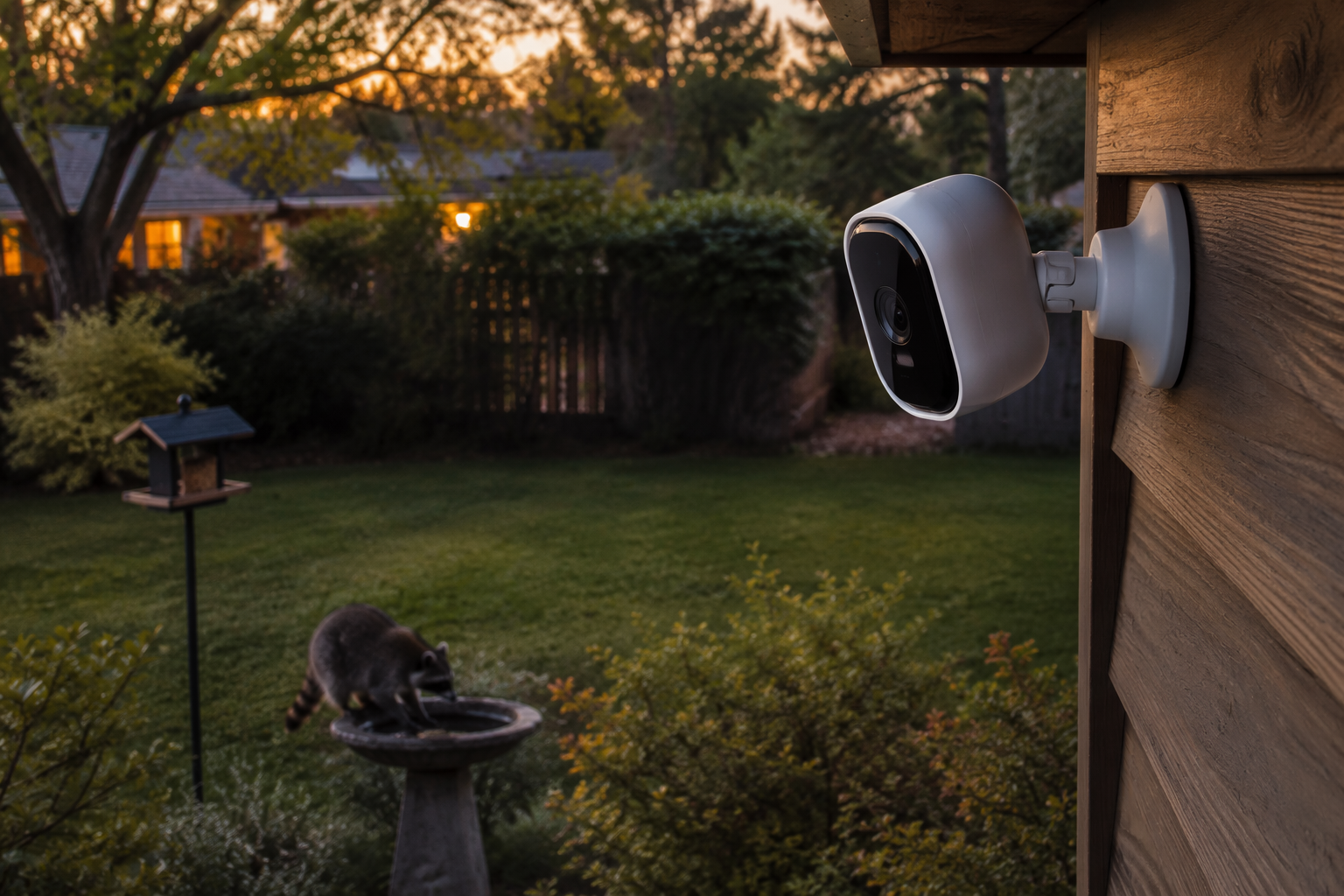
Most decent outdoor smart cameras can see an animal if the animal is close, slow, and already inside the camera’s preferred zone. That does not make them trail cameras. The better question is whether the camera can catch the part of the visit you care about.
| If this is your wildlife goal | A smart security camera is enough when | Buy a trail camera when |
|---|---|---|
| Watch feeders, birdbaths, and patio visitors | The subject is within about 20-30 ft and lingers | You need stills of wary or fast animals |
| Get phone alerts when something enters the yard | You value live view, push alerts, and smart home integration | You do not want Wi-Fi dependence or cloud features |
| Record nocturnal behavior | Visible light is acceptable and may help identify color | You need no-glow IR that does not announce the camera |
| Monitor a distant trail, tree line, or game path | The path is close to the house and inside Wi-Fi range | The subject may pass quickly or stay 50-100 ft away |
That table is the whole buying decision in miniature. Smart cameras win on convenience: app alerts, live view, two-way audio you probably should not use on wildlife, easy sharing, and familiar ecosystems. Trail cameras win on the things animals do not negotiate with: speed, distance, battery endurance, and stealth.
Where security cameras fall behind trail cameras
Trigger speed is the first boundary. A backyard raccoon at a water bowl gives a security camera several chances. A rabbit crossing a side yard may not. OSU’s under-0.5-second benchmark exists because wildlife often appears, moves through the frame, and disappears before a slower camera has recorded anything useful.[1]
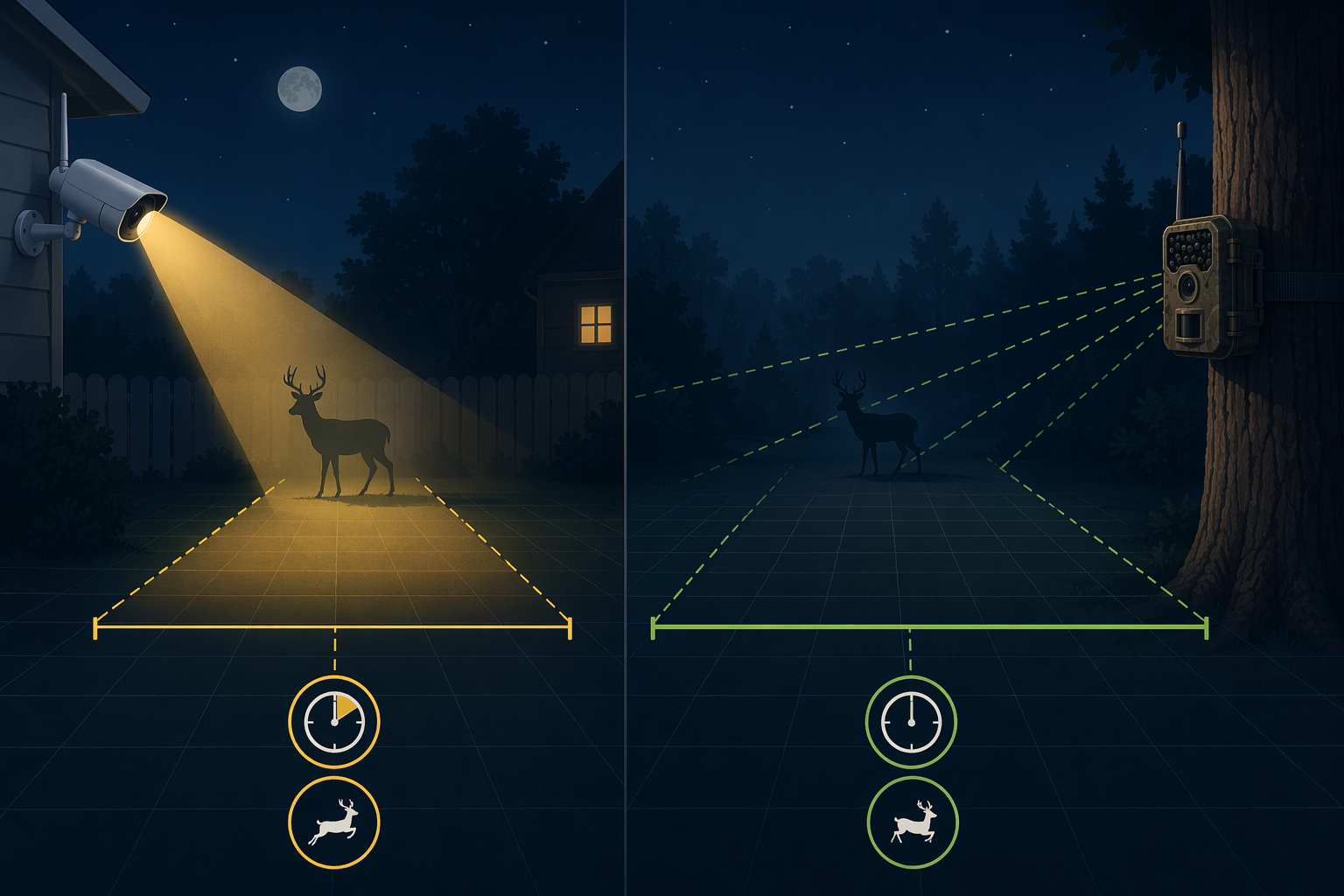
Detection range is the second boundary. Smart security cameras are built around porches, driveways, doors, and short yards. Wirecutter found many outdoor Wi-Fi cameras detect motion up to about 40 feet, but animal detail is a much more demanding standard than simply knowing that something moved.[2] A blurry gray shape at the back fence is technically a clip. It is not the same as knowing whether the visitor was a cat, fox, raccoon, or skunk.
Night lighting is the third boundary, and it matters more for wildlife than for porch security. Many smart cameras use visible white light to produce color night vision. That can be useful if the animal tolerates it. It can also change the scene you are trying to observe. Trail cameras commonly use infrared illumination, and no-glow models are designed to be much less obvious to animals and people.
Best smart security camera choices for backyard wildlife
The best choice depends less on the most impressive spec sheet and more on which weakness you can live with. For broader camera shopping outside wildlife use, our smart security camera buyer’s guide covers the general home-security side. For animals, the short list is narrower.
Google Nest Cam: strongest classification case
Nest Cam belongs first because its animal detection is supported by independent testing, not just a manufacturer promise. Wirecutter found the Google Nest Cam (Wired, 2nd Gen) was the best model it tested at classifying person, animal, and vehicle motion at 2K resolution.[2] That matters if the goal is fewer useless alerts from passing shadows, cars, or branches.
For wildlife, Nest is best suited to fixed observation points: a porch feeder, a water dish, a side-yard path, or a low fence opening. Its appeal is not that it turns into a field camera. It is that it can separate “animal” from other common motion better than many rivals, then put the clip in an app a normal household already uses. If you are already deciding among Google models, the Google Nest camera lineup guide is the more detailed place to compare form factors.
Arlo: good animal alerts, with important limits
Arlo is tempting for wildlife because it explicitly offers animal detection, but the fine print matters. Arlo says animal, vehicle, and person detection works within about 50 feet in daytime and about 25 feet at night, and it excludes small rodents.[3] That last part is not trivia if your “wildlife” is mostly squirrels, chipmunks, mice near a shed, or whatever keeps emptying the feeder tray.
Arlo’s other practical catch is cost. Arlo Secure starts at $10 per month for the relevant detection features.[3] That may be acceptable if Arlo is already your home camera system, but it is less charming if you are buying one camera mostly to find out whether the midnight visitor is a possum or the neighbor’s cat. For a wider look at recurring camera fees, use the smart home subscription costs tracker before treating the sticker price as the real price.
TP-Link Tapo: the low-cost route if local storage matters
Tapo is the practical pick for the buyer who wants animal-aware backyard clips without turning one birdbath camera into another monthly bill. Its appeal is total cost of ownership: local microSD storage is available, cloud service is optional, and the product line includes battery-powered outdoor models with person, vehicle, and pet differentiation. The long battery-life claims are manufacturer estimates, so a busy feeder, winter temperatures, and frequent recording can cut into them quickly.
This is the camera lane for patient subjects. If you want to know who visits the water source after dinner, Tapo can make sense. If you are trying to catch a fox sprinting along the rear property line, a cheaper smart camera is still a smart camera, with the same category limits.
Eufy SoloCam S340: flexible viewing without a basic subscription
Eufy’s SoloCam S340 is interesting for wildlife because it combines 3K resolution, 8x zoom, solar power, 360-degree pan and tilt, and no subscription requirement for basic AI detection, according to Eufy’s own outdoor wildlife camera guidance.[4] Those are manufacturer claims, so they deserve more caution than independent lab results, but the feature mix is genuinely relevant to backyard watching.
Pan and tilt help when the camera covers a patio corner, garden edge, and feeder in the same general zone. Zoom helps only if the original image is clean enough to enlarge; it does not solve poor nighttime lighting or a subject that is already too far away. Solar power is useful when the camera is mounted high enough that nobody wants to fetch a ladder every few weeks.
Reolink Argus Track: resolution and tracking for open backyard zones
Reolink’s Argus Track leans on 4K resolution, auto-zoom tracking, and color night vision in its wildlife-camera positioning.[5] That combination can be useful in a yard where animals enter from more than one direction and do not stay perfectly centered. Tracking is more helpful on a lingering raccoon than on a fast animal crossing at the edge of detection.
Color night vision is the feature to examine closely. For security, a visible spotlight can be an advantage. For wildlife behavior, it may be the reason the animal looks up, freezes, or leaves. If the camera’s best night footage depends on a light the animal can see, the clip may be clearer and less natural at the same time.
When a trail camera is the honest recommendation
A dedicated trail camera is not the less modern answer. It is the more specialized one. Wirecutter’s trail camera pick, the Bushnell Core S-4K No Glow, is built around the wildlife job: faster triggering in the 0.2-to-0.5-second range, stronger still-image capture with interpolated 4K output, and no-glow infrared illumination, but no live streaming or app-first smart home control.[6]
That trade is exactly why trail cameras still exist. They do not care whether your porch Wi-Fi is strong. They do not need to wake up a cloud service before deciding whether the shape in the frame is worth recording. They are not trying to also be a doorbell, siren, intercom, and package monitor.
- Choose a trail camera for fast animals crossing a narrow path.
- Choose a trail camera for subjects beyond the short-yard range of Wi-Fi cameras.
- Choose a trail camera when invisible night capture matters more than color footage.
- Choose a trail camera when still-image quality is more important than app alerts.
Placement matters more than another resolution upgrade
A badly placed 4K camera will still give you a beautiful clip of nothing. Start by choosing a place where animals already slow down: a birdbath, feeder, water bowl, garden edge, compost route, fence opening, or the vegetation line where animals enter the open yard. Eufy’s garden camera guidance specifically points to feeding stations, water sources, and vegetation edges as useful observation locations.[7]
Height helps. OSU recommends positioning wildlife cameras higher and angling them downward, which also happens to work well for many smart security cameras because it reduces false triggers from distant background motion and keeps the subject inside the detection zone longer.[1]
- Aim across an animal’s likely path rather than straight at a distant open yard.
- Keep the main subject area inside roughly 20-30 ft when identification matters.
- Avoid aiming at roads, reflective windows, moving branches, or bright porch lights.
- Test at night before trusting the setup; daytime success proves very little.
- Use visible spotlights only if clearer color footage matters more than minimizing disturbance.
Subscriptions, ecosystems, and the trap of “just one more feature”
Wildlife watching makes subscriptions feel different from security monitoring. Paying every month to protect a front door is one decision. Paying every month because a camera will not reliably tell a raccoon from a leaf without a cloud plan is another. Arlo’s relevant animal detection sits behind Arlo Secure, which starts at $10 per month.[3] Eufy’s strongest pitch is that basic AI detection does not require a subscription on models such as the SoloCam S340.[4]
Ecosystem fit still matters, just not enough to rescue the wrong camera. If your household already uses Google Home, Alexa, or another platform, a compatible camera is easier to live with. Our smart home platforms comparison is useful if the camera also needs to fit broader automation plans. For wildlife, though, platform convenience comes after the basics: distance, trigger behavior, night lighting, storage, and whether the camera can actually see the animal you care about.
The purchase decision
Buy or reuse a smart security camera if your wildlife watching is close-range, backyard-based, and app-driven. Nest Cam is the safest AI-classification pick when animal/person/vehicle sorting matters. Arlo can work well for larger animals within its stated range, but its nighttime distance, subscription requirement, and small-rodent exclusion are real limits. Tapo is attractive when local storage and low ongoing cost matter. Eufy and Reolink become more interesting when solar power, pan/tilt, zoom, resolution, or local-first operation solve a specific placement problem.
Buy a trail camera if the camera’s real job is wildlife first: fast trigger, longer range, better stills, and less visible night capture. A security camera is a pleasant backyard window. A trail camera is the tool for animals that do not pause under the feeder and wait for your Wi-Fi camera to wake up.
References
- Wildlife cameras: Snapshot of what you need to know — OSU Extension Service
- The Best Outdoor Security Cameras — Wirecutter
- Arlo Animal, Vehicle, and Person Detection — Arlo
- Outdoor Wildlife Camera — eufy
- Outdoor Wildlife Camera — Reolink
- The Best Trail Camera — Wirecutter
- Garden Camera — eufy
Corrections & Community Notes
Spotted an outdated spec, changed compatibility, or new firmware behavior? Submit a correction below to help keep this profile current. For formal editorial updates, use the contact page.
Comments
Join the discussion with an anonymous comment.