
Devices
Three Smart Home Layers That Protect Against New Jersey Floods
New Jersey homeowners preparing for flood watch season need more than a single leak sensor. This guide explains the three-layer smart home protection stack — whole-home monitor, shutoff valve, and point sensors — with protocol-specific device recommendations that work together to cover every flood scenario.
- Apple HomeNot stated
- Google HomeNot stated
- AlexaNot stated
- SmartThingsNot stated
- Home AssistantNot stated
New Jersey does not make water risk feel theoretical. Rebuild by Design estimates that by 2050, 565,000 parcels in the state — about 1 in 6 — could face high flood risk, representing $435.9 billion in exposed property value and 1.3 million residents affected. Its parcel method counts land where at least half of the parcel falls in the 100-year floodplain, so it is not a substitute for checking your own address. Still, as a statewide planning signal, it is hard to shrug off. For New Jersey flood watch season, the useful question is not which gadget has the nicest app. It is what still catches the water when the leak starts somewhere you did not plan for. [1]
That matters because the expensive water event is not always the storm surge everyone pictures. It can be a supply line that lets go while you are at work, a toilet valve that runs behind a closed bathroom door, a water heater pan that fills after midnight, or a basement sensor that cannot reach the hub when the power is out. The Insurance Information Institute reports that 1 in 67 insured homes files a water or freezing damage claim annually, and that water and freezing damage is the second most common homeowners insurance claim. [2]
A single leak puck under the sink is better than nothing. It is also easy to overestimate. The pucks only know what touches them. A flow monitor only sees water moving through the main. A valve can stop water, but only if something tells it to close and it still has a way to move. The practical stack has three layers: a whole-home water monitor, an automatic shutoff valve, and point-of-leak sensors.
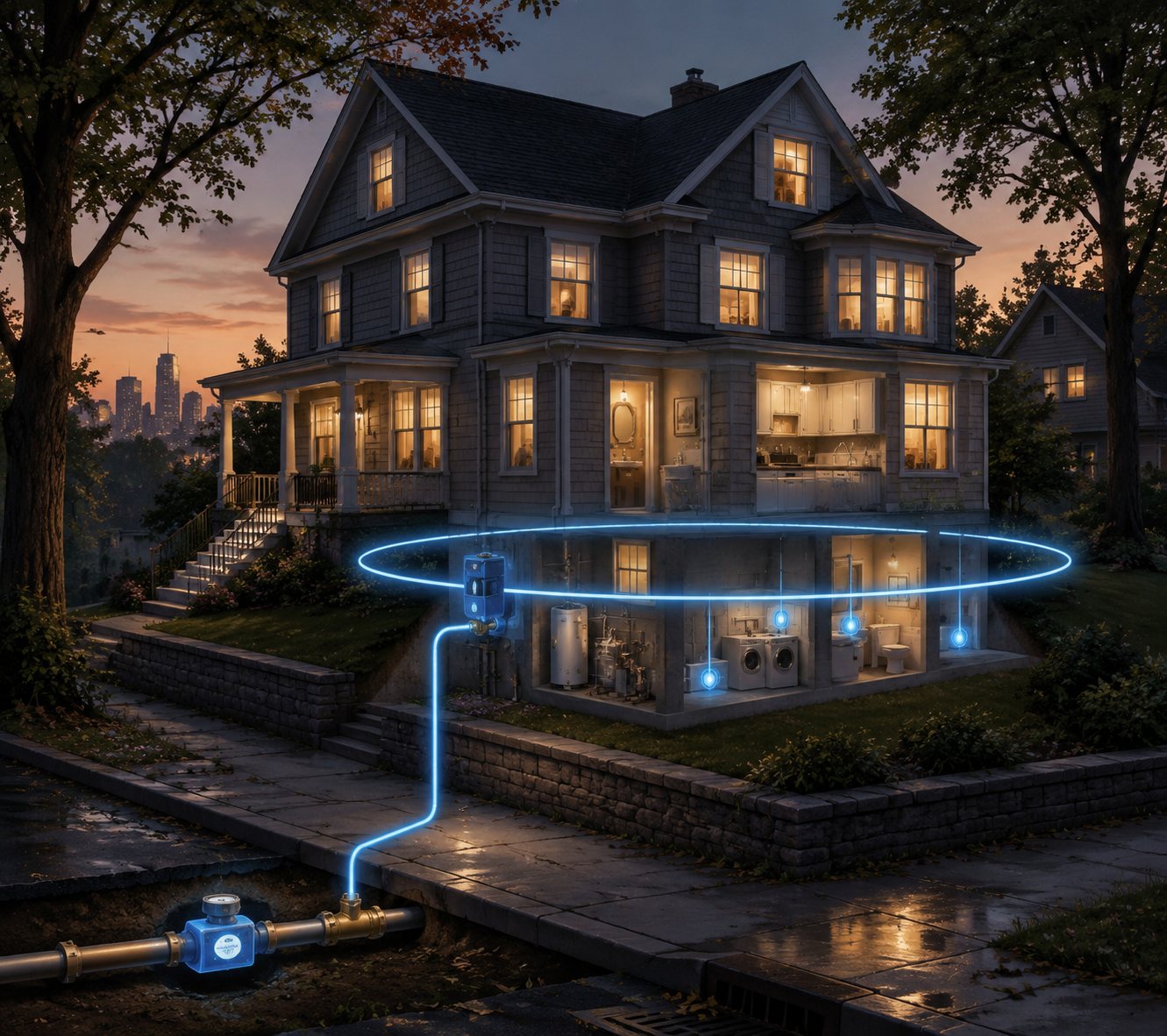
The Three Layers Do Different Jobs
The stack is not about buying three versions of the same alarm. Each layer covers a different failure mode:
| Layer | What It Sees | What It Misses Without Help | Why It Belongs in the Stack |
|---|---|---|---|
| Whole-home water monitor | Abnormal flow through the main water line, including bursts and unusual continuous use | Water that enters from outside, appliance pan overflow before flow looks abnormal, local puddles that do not change main-line behavior | It can catch leaks nowhere near a point sensor |
| Automatic shutoff valve | Nothing by itself unless paired with a trigger | The leak, if no monitor or sensor tells it to close | It turns detection into action |
| Point-of-leak sensors | Water touching the sensor at a fixture, appliance, basement, or crawlspace location | Leaks that happen somewhere else, especially inside a wall or along a main line | They catch local trouble quickly and cheaply |
This is the part glossy roundups usually blur. They compare battery life, app design, and siren volume, then leave you to assume the winner protects the house. But a sensor under the washing machine does not know the upstairs toilet supply line burst. A shutoff actuator clamped to the main does not know anything until a hub, monitor, or automation tells it to close. A flow monitor may notice abnormal water use, but it is not the right tool for rainwater entering through a basement window well.
The buying decision gets clearer once you stop asking for one device to be perfect. You are looking for overlap. If the main line bursts, the monitor should recognize the flow and the valve should close. If a slow fixture leak starts under a sink, a nearby point sensor should alarm before water reaches the next room. If the power goes out during a storm, the local pieces should still have a path to act, or you should know exactly which protections you have lost.
The Whole-Home Monitor Is the Layer People Misunderstand
A whole-home monitor is usually installed on or near the main water line and watches water use patterns for the house. Its value is not that it replaces sensors. Its value is that it sees events your sensors will never touch. If a pipe breaks in a ceiling bay, behind a finished wall, or in a part of the basement where nobody placed a puck, a monitor has a chance to notice the abnormal flow because the water still passed through the main.
That distinction matters in older New Jersey houses where plumbing routes are not always obvious after renovations. A sensor plan based only on visible fixtures can leave gaps behind tubs, in utility rooms, and along finished basement runs. A whole-home monitor is the one layer that does not depend on guessing every future puddle location.
Phyn Plus is the standout here because there is at least a third-party validation trail behind the leak-detection claim. SmartHomeExplorer’s 2026 ranking cites a Utah State University five-valve study in which Phyn Plus 2nd Gen achieved 97.3% leak detection accuracy, calling it the only peer-reviewed third-party validation in the category. That does not mean it will catch every real-world leak in every house. It does mean the accuracy claim is not just app-store confidence dressed up as engineering. [3]
Moen Flo sits in the same whole-home category but asks for a different kind of trust. It is a WiFi and cloud-centered system, and that can be perfectly acceptable in a house with stable power, reliable internet, and a homeowner who wants carrier-facing reporting. The caveat is built into the design: when the router or internet path is gone, remote alerts and cloud decisions are weaker than local automations built around a hub and battery-backed devices.
There is no need to pretend the whole-home monitor solves outside flooding. If water is coming up through a basement drain, over a sill, or through the foundation after heavy rain, the main water line may not show anything unusual. That is why the stack keeps going. The monitor is the broadest plumbing-layer detector, not a floodproofing system for the property.
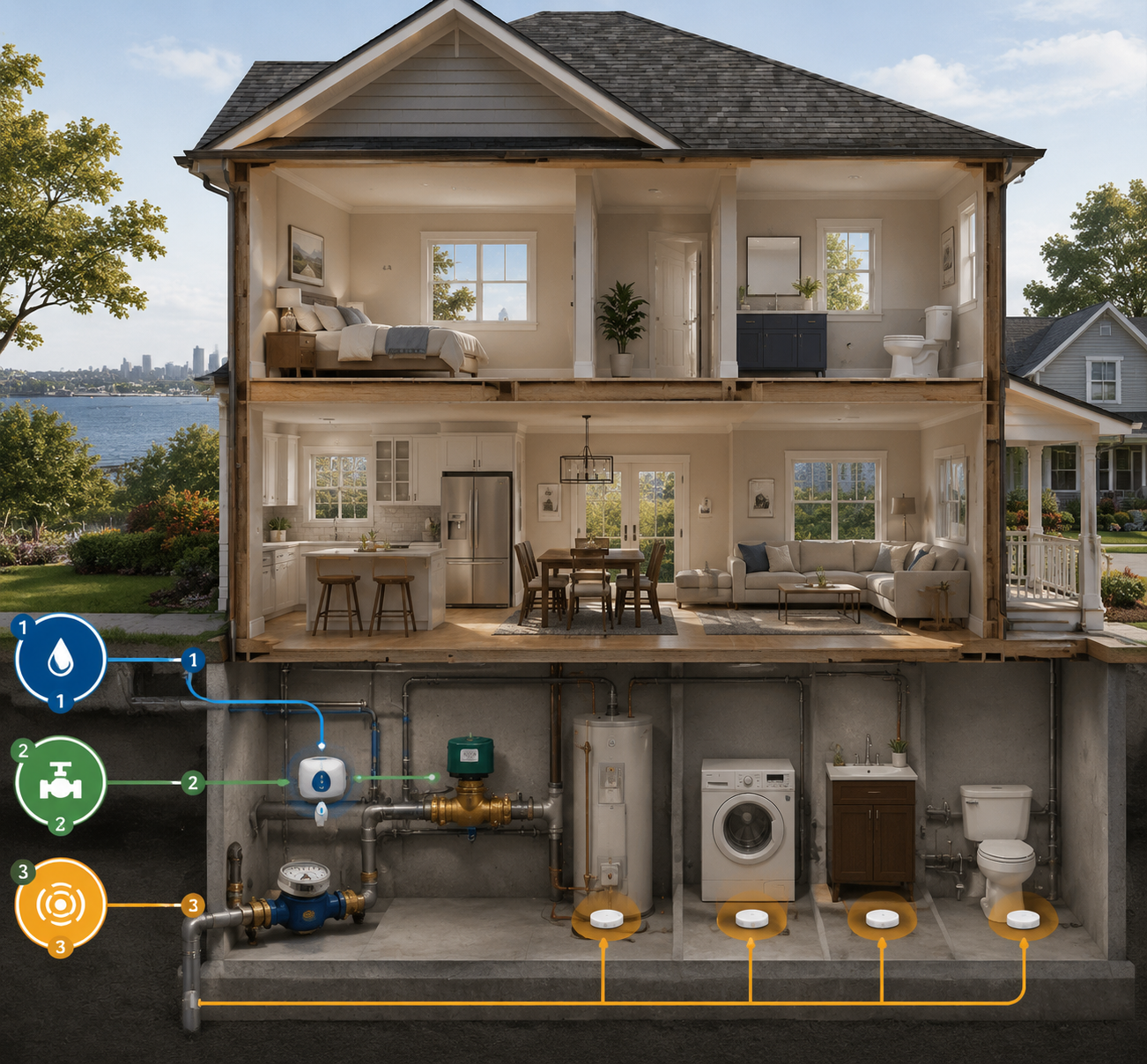
The Shutoff Valve Is Where Detection Becomes Consequence
The automatic shutoff valve is the layer I would least want to skip after cleaning up water once. Alerts are useful, but alerts still leave someone responsible for getting home, finding the right valve, and turning it before the damage spreads. A motorized valve gives the system a physical action: close the water.
This is also where protocol choice stops being a hobbyist argument. If the valve depends on a cloud command, the router, modem, and service path matter. If it is paired locally to a Z-Wave, Zigbee, Matter-over-Thread, or LoRa setup, the question shifts to whether the hub, valve, and sensors still have power and whether the automation runs locally. A storm outage is exactly the wrong time to discover that “smart” meant “waiting for a server.”
Zooz Titan is the cleaner fit for a Z-Wave home because it is a valve actuator designed to integrate into that local-control world, and it accepts optional battery backup. Aqara’s Smart Valve Controller T1 is the practical Zigbee/Matter-side choice for homes already built around Aqara, Apple Home, Home Assistant, or another compatible hub. YoLink’s valve controller belongs in the conversation when distance is the problem: detached garages, far crawlspaces, and basement corners where a mesh network struggles.
The operational test is simple enough to write on the box before you buy: if a sensor detects water during a power outage, what exact path closes the valve? If the answer requires the home router, the internet, a vendor cloud, and a powered hub with no backup, then you have an alerting product that may be excellent on a normal Tuesday and much less useful during a storm night.
For readers already deep into hub compatibility, this is the point to check device support before ordering. A deeper compatibility pass belongs in a separate hub-specific guide like Which Smart Flood Sensors Actually Work With Your Hub. Firmware changes, driver support, and hub integrations can change the difference between a local automation and a cloud-assisted one.
Point Sensors Still Earn Their Place
Point sensors are the easiest layer to understand because they behave like little sentries: water touches the contacts, the sensor reports wet, and the system sends an alert or triggers an automation. They belong under sinks, near toilets, behind or beside washing machines, by water heaters, beside sump pits, and in basement or crawlspace spots where water has shown up before.
They are also the layer most likely to create false confidence. A sensor two feet from the leak is not a sensor at the leak. A puck under the vanity may catch a supply-line drip, but it will not know the shower valve behind the wall is leaking into a cavity. That is not a failure of the sensor; it is the physical limit of contact detection.
Zooz ZSE41 and ZSE42 fit Z-Wave homes; the ZSE42 adds temperature sensing, which can be useful near freeze-prone plumbing. Aqara Water Leak Sensor T1 fits the Zigbee/Matter path. YoLink sensors fit the long-range path where you care less about mesh elegance and more about whether the crawlspace sensor can reach the controller. First Alert L1 is a WiFi option with a local siren, but like other WiFi-first sensors, remote alerts depend on the router and internet path staying alive.
If the broader storm plan includes National Weather Service alerts, sirens, phones, and household notification rules, treat leak sensors as one input in the larger alert layer. The buying decision here is device coverage; setup details belong in a practical alarm guide such as Set Up Smart Home Flood Alarms That Save Lives in Flash Floods.
Choose the Stack by Protocol, Not by Brand Loyalty
Once the three layers are clear, the shopping list should be organized by protocol. That is the only way to avoid buying devices that look compatible in a cart but behave like separate islands during an outage.
| Protocol Path | Best Fit | Recommended Devices | Main Caveat |
|---|---|---|---|
| Z-Wave | SmartThings, Hubitat, Home Assistant homes that already use Z-Wave and want local automations | Zooz Titan Valve Actuator; Zooz ZSE41 leak sensor; Zooz ZSE42 temperature/leak sensor | Hub and valve power still need planning; use UPS and available battery options where appropriate |
| Zigbee/Matter | Aqara-heavy homes, Apple Home users, and Home Assistant users with compatible coordinators | Aqara Smart Valve Controller T1; Aqara Water Leak Sensor T1 | Verify current Matter, hub, and regional support before purchase |
| LoRa | Detached garages, crawlspaces, basements, and long runs where mesh networks struggle | YoLink Water Leak Sensor kit; YoLink Valve Controller | Ecosystem is more specialized, but range is the reason to consider it |
| WiFi | Homes that want simpler app setup and are comfortable with cloud dependence | Moen Flo whole-home monitor; First Alert L1 leak detector | Router and internet outages can interrupt remote alerts and cloud behavior |
Z-Wave is the practical choice when you already have a serious hub and want local leak-to-valve automations. It is not glamorous, but it is mature, and in this job boring is a compliment. A UPS-backed hub, Z-Wave leak sensors, and a Zooz Titan give you a path where the sensor and valve do not need to ask a cloud service for permission to act.
Zigbee and Matter are attractive when the house already runs on Aqara or a compatible multi-protocol hub. Aqara’s valve controller and leak sensor make sense as a matched pair, especially for people who want the flood stack to sit inside Apple Home or Home Assistant. The warning is compatibility churn. Matter support and hub behavior are improving, but “works with” still needs to mean “runs the automation you expect, in the mode you expect.”
LoRa is not the default for every house, and that is fine. Its job is distance. YoLink’s long-range approach is useful where a detached garage, crawlspace, or far basement corner makes a normal mesh network unreliable; the research brief identifies a 1/4-mile range for the YoLink path. PCMag also verified YoLink’s local-operation behavior in 2026 testing, which is the kind of outage detail worth caring about before a storm, not after one. [5]
WiFi is the convenience path, and sometimes convenience is enough. Moen Flo is a serious whole-home option, especially where reporting and insurer conversations matter. First Alert L1 gives a simple WiFi leak detector with a local siren. The tradeoff is plain: if a power outage takes down the router, cloud alerts and remote app behavior go with it unless you have backed up the network gear. WiFi devices can still be part of the stack, but they should not be confused with a fully local outage plan.
Insurance Discounts Are Worth Checking, Not Assuming
Insurance is one reason to prefer a documented shutoff and monitoring system over a drawer full of cheap sensors. TheSmartestHouse reported in August 2024 that State Farm, USAA, Liberty Mutual, Nationwide, Allstate, Farmers, Amica, and Travelers offered 5–10% discounts on the water-damage portion of policies for smart shutoff or leak detection devices. It also noted that Moen Flo with FloProtect, priced at $5.99 per month, can generate insurance-grade event reports accepted by multiple carriers and includes $5,000 deductible reimbursement. [4]
That sentence needs guardrails. A discount on the water-damage portion of a policy is not the same as 10% off the whole homeowners premium. Availability can vary by state, carrier, underwriting rule, policy form, and device requirement. A carrier may want proof of professional installation, a specific device class, an active monitoring plan, or a certificate-style report. Before buying a system mainly for the insurance benefit, ask the carrier what qualifies in New Jersey and what documentation they will accept.
The better way to think about insurance is as a possible offset, not the justification. Buy the stack because it can reduce the time water is running or sitting unnoticed. Treat any discount as something to verify in writing before checkout.
A Practical Buying Order for a New Jersey Home
If I were buying from scratch for flood watch season, I would not start with the cheapest sensor multipack. I would start with the main water line and work outward.
- Choose the whole-home monitor first if plumbing leaks are the main concern. Phyn Plus is the stronger pick when independent validation matters; Moen Flo is attractive when app experience, shutoff integration, and insurer-facing reports matter more.
- Choose the shutoff valve around your control path. Use Zooz Titan for a Z-Wave local-control build, Aqara T1 for a compatible Zigbee/Matter build, and YoLink Valve Controller where long range is the problem.
- Place point sensors where water first appears, not where the app diagram looks tidy: water heater, washing machine, under sinks, toilet bases, sump area, basement low spots, crawlspace entries, and any past trouble area.
- Back up the parts that make decisions. A UPS for the hub and router, fresh sensor batteries, and a valve battery option can matter more than another feature badge.
- Confirm the insurance rule before assuming savings. Ask the carrier which devices, reports, monitoring plans, and installation records qualify on your specific policy.
This buying order does not replace the unglamorous New Jersey basics: grading, gutters, sump pump maintenance, battery backup pumps, clear drains, stored valuables off the basement floor, and storm preparation. Smart water devices are strongest against plumbing failures and early interior detection. They are not a permit to ignore the outside water.
Once the hardware decision is made, setup becomes the next project: pairing, naming, test closures, notification routing, household procedures, and weather-mode automations. A setup-focused guide such as Build a Smart Home Storm and Flood Preparedness System is the right place for that. Home Assistant users tying water shutoff into storm logic may also want a broader automation plan like Build a Unified Extreme Weather Mode for Heat Waves and Storms.
The Narrow Answer
The strongest smart-home water protection for a New Jersey house is the full stack: a whole-home monitor to catch abnormal main-line flow, a motorized shutoff valve to stop the supply, and point sensors where local leaks or outside water first show up. Match that stack to the protocol your home can support during an outage — Z-Wave, Zigbee/Matter, LoRa, or WiFi with known caveats — and verify any insurance benefit with the carrier before assuming it applies. Firmware, hub support, and carrier rules change often enough that the last compatibility check should happen before purchase, not after the first wet floor.
References
- New Jersey Flood Risk, Rebuild by Design.
- Water and freezing damage claim frequency, Insurance Information Institute.
- SmartHomeExplorer 2026 ranking, SmartHomeExplorer, 2026.
- Insurance discount landscape, TheSmartestHouse, August 2024.
- YoLink local-operation behavior testing, PCMag, 2026.
Report an issue with this profile
If a compatibility claim looks stale or incorrect, tell us — we re-verify before changing what's published.