Which Smart Water Leak Sensors Measure Up to Their Specs?
Advertised specs for smart water leak sensors often don't match measured home performance. This roundup compares measured alert latency, siren loudness, and offline-notification lag across leading models, with every figure sourced, dated, and separated from the marketing claim.
Last updated
Smart water leak sensors are often sold as if they “prevent flood damage.” The useful correction is harsher and more useful: most of them are alarms. Wirecutter puts it plainly—like smoke detectors, leak detectors “function only as alarms”—so they matter only if the alert reaches someone who can act before the water spreads too far.[1] If you want the stronger version of prevention, you are looking at a flow-monitor-plus-shutoff system, not a puck under the sink; PCMag lists the Flo by Moen Smart Water Shutoff at about $550, with professional installation and a 7–10 day learning period before small-leak detection.[2] For insurer and shutoff context, see NestGrid’s separate look at smart leak detectors and insurance; this piece stays with what a sensor can actually prove in a home.
Measured leak-sensor performance, separated from the claim
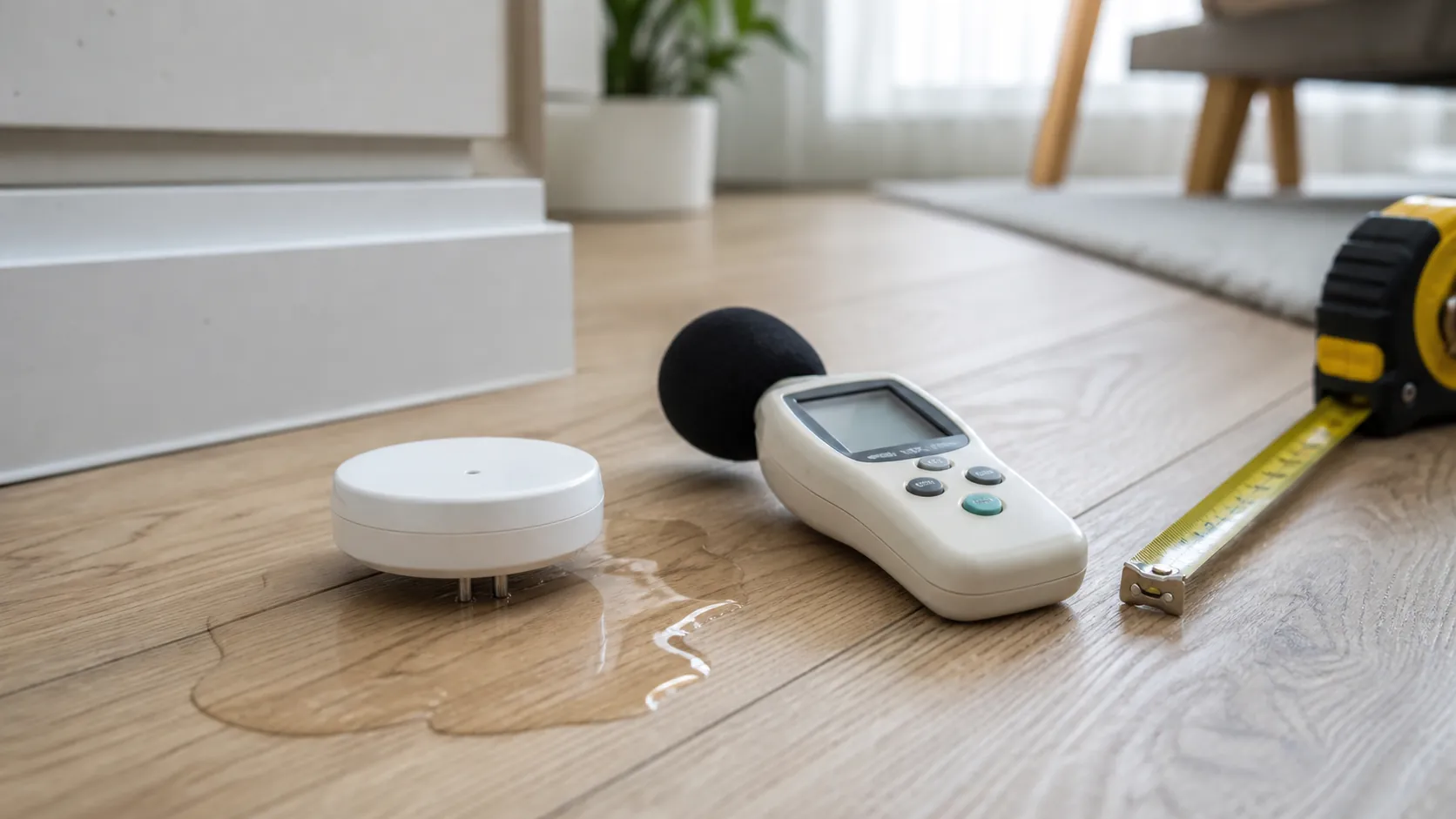
The table below gives marketing claims their own lane. A loudness rating, range number, or “instant alert” promise does not get to sit beside a measured home result as if they were the same kind of evidence.
| Device | Advertised or stated claim | Measured or observed home behavior | Offline behavior | Battery / range / ecosystem note | Status |
|---|---|---|---|---|---|
| D-Link SW-A11KT | Smart leak sensor kit with hub and remote sensor pod | Wirecutter’s 2026 home test reported water trigger in under 1 second; push notification arrived in 3–5 seconds. Siren measured about 73 dB at 10 ft, 66 dB at 20 ft, and 49 dB behind a closed door.[1] | Hub offline alert arrived in about 3 minutes; sensor-pod offline alert arrived after 36 minutes.[1] | Hub-based kit; useful if the hub can sit where the household’s network is stable. | Confirmed in one stated home-test method |
| Kidde Water Leak + Freeze Detector | Advertised 85 dB alarm | Wirecutter measured a peak of 94 dB from 10 ft, exceeding the advertised siren rating.[1] | Not the central offline example in the available measured dataset. | Leak plus freeze detection; the loudness result is the standout measured figure. | Confirmed for siren loudness in one home test |
| YoLink Water Leak Sensor 4 | Advertised 105 dB siren; YoLink also markets long-range LoRa coverage, including a quarter-mile range claim in the available materials | Wirecutter measured water detection within 2 seconds, but the advertised 105 dB siren measured 74 dB at 10 ft. Wirecutter confirmed reliable operation at 125 ft in a detached garage, not the full quarter-mile claim.[1] | Wirecutter reported a full 12 hours before notification after battery removal.[1] | LoRa hub ecosystem; range may be valuable, but the specific long-range claim is only partly verified by the cited home test. | Confirmed for fast detection; downgraded for siren and offline lag |
| X-Sense Wi-Fi Water Leak Detector | Wi-Fi leak detection with shallow-water sensitivity | Wired reported that it detects pools as shallow as 0.4 mm, using a method that included drip-on-top, pooling-below, rapid-flooding, and battery-removal checks.[3] | Battery-removal behavior was part of Wired’s method, but the available research brief does not provide a specific lag number. | Wi-Fi model; useful to compare sensitivity, not a substitute for a cited offline-lag figure. | Confirmed for shallow-pool detection by one stated method |
| TP-Link Tapo T300 | Push alerts and local alarm | Wired reported push notifications within 1–2 seconds and an alarm of about 90 dB.[3] | Battery-removal checks were part of Wired’s method; the available brief does not provide the exact offline-notification delay. | Part of TP-Link’s Tapo ecosystem. | Confirmed for alert speed and alarm level by one stated method |
| Shelly Flood Gen4 | Matter-native, multi-platform sensor | PCMag identifies it as Matter-native and compatible with Alexa, Google, HomeKit, Matter, and SmartThings via Bluetooth, Wi-Fi, and Zigbee.[2] | No independent latency, siren, or offline-lag number in the available measured materials. | About $40 in PCMag’s coverage; 6.5-ft sensing cable can be daisy-chained to about 490 ft.[2] | Investigating for measured alarm behavior; useful compatibility counterpoint |
| Aqara Water Leak Sensor T1 | Zigbee 3.0, IP67, CR2032 battery with up to 2 years’ life | The available materials support hub and spec notes, not independent siren or latency measurements.[4] | No measured offline-lag figure in the available materials. | Requires an Aqara hub to bridge into Apple Home.[4] | Workaround / compatibility-dependent |
| Ikea Klippbok | Matter-over-Thread leak sensor at about $8 | HomeKit News reviewed it as a Matter-over-Thread leak sensor; the reviewer reported occasional connected/disconnected flapping. A reader comment disputed drip sensitivity because the probes sit about 2 mm above the floor, but that is a single-case observation, not a broad measured conclusion.[5] | No measured offline-lag figure in the available materials. | Needs an Apple Home hub acting as a Thread border router, such as HomePod mini, HomePod 2nd gen, or compatible Apple TV 4K; no IKEA hub required.[5] | Investigating; young Matter-over-Thread category |
| Zooz ZSE42 | Z-Wave water leak sensor | The available materials support hub compatibility, not independent alert-speed or loudness measurements. | No measured offline-lag figure in the available materials. | Supported by Z-Box, Alarm.com, Ezlo, Home Assistant with Z-Wave JS, HomeSeer, Homey, Hubitat 2.2.9+, and SmartThings; not supported by Ring, Qolsys/2Gig alarm panels, or Alexa/Google speakers without a Z-Wave hub.[6] | Compatibility-confirmed; measured performance still unverified here |
| GoveeLife / Govee long-range models | GoveeLife 5-year battery claim; Govee 1,800-ft range claim in available marketing materials | No independent reproduced measurement in the available research brief for those exact claims. | No measured offline-lag figure in the available materials. | Treat battery-life and range claims as claims until a current, dated test reproduces them in a stated environment. | Unverified for purchase-decision use |
Fast detection is real, but “instant” still needs a stopwatch
The best news in the measured data is that several sensors do notice water quickly. Wirecutter’s D-Link SW-A11KT result is the cleanest example: the sensor triggered in under a second, and the push notification followed in 3–5 seconds in a 700-sq-ft home test.[1] YoLink’s Water Leak Sensor 4 also detected water within 2 seconds in that same Wirecutter dataset.[1] Wired’s TP-Link Tapo T300 result sits in the same practical band, with push notifications reported within 1–2 seconds.[3]
Those are useful numbers because they separate two events buyers often blur together. Trigger-to-siren time tells you when the device itself reacted. Push-notification delay tells you when the phone found out. If you are standing near the washing machine, the local siren matters. If the sensor is under a guest-bath vanity while you are at work, the phone alert is the event that changes the outcome.
Wired’s X-Sense note is different but still valuable: it detected pools as shallow as 0.4 mm under a test method that included drip on top, pooling below, rapid flooding, and battery-removal checks.[3] That does not rank it above every sensor in every house. It does tell you the reviewer checked more than one style of leak, which is exactly the kind of method detail missing from too many product pages.
The siren number can collapse behind a door
The YoLink siren result is the number that should make a buyer slow down. A 105 dB-rated siren measured 74 dB at 10 ft in Wirecutter’s 2026 test.[1] That does not mean the sensor failed to detect water; it did detect within 2 seconds.[1] It means the loudest promise on the sheet did not describe what the reviewer heard at a normal room distance.
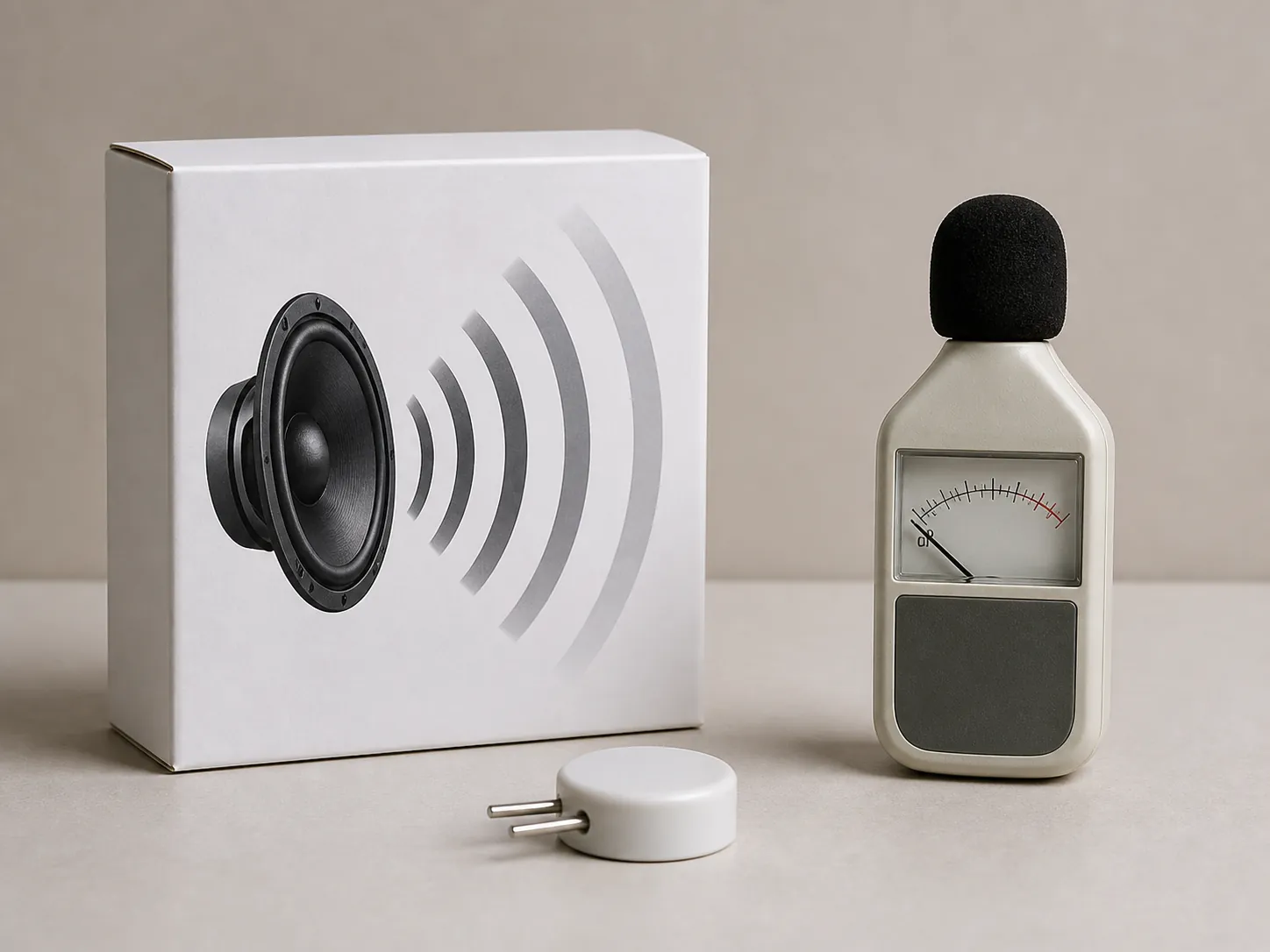
D-Link’s measured siren is more modest but better documented across real listening positions: about 73 dB at 10 ft, 66 dB at 20 ft, and 49 dB behind a closed door.[1] That last number is the one a spec sheet rarely wants to foreground, and it is often the one the sleeping person upstairs actually lives with.
Kidde is the pleasant exception in the available Wirecutter data. Its Water Leak + Freeze Detector advertised an 85 dB alarm and peaked at 94 dB from 10 ft in the test.[1] That still does not prove how it will sound through your basement door, but it is at least a case where the measured result did not trail the advertised rating.
Offline alerts are where reliability gets less flattering
A leak sensor that silently disappears from the network is a false comfort. This is why offline-notification lag belongs beside siren loudness and water-detection speed, not buried in an app-settings footnote.
Wirecutter’s D-Link results show the difference between parts of the same kit: the hub produced an offline alert in about 3 minutes, while the sensor pod took 36 minutes to generate an offline alert.[1] YoLink’s battery-removal result is more severe: Wirecutter reported that it took a full 12 hours to notify after the battery was removed.[1]
That matters during the boring failures: a dead coin cell, a hub moved to a weak outlet, a router reboot, a power outage that leaves the sensor ecosystem half-awake. If offline behavior is the part of your setup that worries you most, NestGrid’s smart-home recovery after a power outage is the better follow-up than another product ranking.
Range, battery life, and hub claims that should not carry the purchase
YoLink’s LoRa approach may be genuinely useful in garages, outbuildings, and larger homes. Wirecutter confirmed reliable operation at 125 ft in a detached garage.[1] What that does not confirm is the full quarter-mile range claim. The fair label is partial verification: useful range shown in one home test, advertised maximum not reproduced by the cited source.
The same discipline applies to GoveeLife’s 5-year battery claim and Govee’s 1,800-ft range claim in the available marketing materials. They may turn out to be reasonable under the manufacturer’s conditions. They do not become household outcomes until someone states the test environment, the distance, the obstructions, the battery age, and the date. Until then, they are not the numbers I would use to decide whether a sensor belongs behind a water heater or under a second-floor sink.
Battery chemistry and radio protocol still matter. Low-power protocols such as Z-Wave and Zigbee are common for battery sensors placed in basements, attics, and other awkward corners; the Z-Wave Alliance/Vesternet guide also recommends testing sensors with water on the probes, replacing batteries promptly, and exercising shutoff valves about every 6 months.[7] That is maintenance, not glamour, and it is closer to reliability than a range badge printed on a box.
Compatibility notes, kept in their lane
A sensor that cannot talk to your household system will not behave like a good sensor, no matter how fast its probes react. Still, hub compatibility is a setup issue, not the center of this comparison. If you already have a hub, start with NestGrid’s hub-by-hub leak sensor guide or the separate smart water leak sensor hub compatibility page before buying.
- Aqara Water Leak Sensor T1: Zigbee 3.0, IP67, CR2032 battery with up to 2 years’ life, and it requires an Aqara hub to bridge into Apple Home.[4] Make It Work Tech also warns that Aqara sensors can be flaky in Home Assistant without suitable Zigbee repeaters such as Aqara plugs, Third Reality plugs, or IKEA bulbs.[8]
- Ikea Klippbok: a low-cost Matter-over-Thread leak sensor that needs an Apple Home hub acting as a Thread border router; HomeKit News reported occasional connected/disconnected flapping, and a reader comment disputed drip sensitivity because the probes sit about 2 mm above the floor.[5]
- Zooz ZSE42: a Z-Wave sensor with a real hub requirement. Zooz lists support for Z-Box, Alarm.com, Ezlo, Home Assistant with Z-Wave JS, HomeSeer, Homey, Hubitat 2.2.9+, and SmartThings, and says it is not supported by Ring, Qolsys/2Gig alarm panels, or Alexa/Google speakers without a Z-Wave hub.[6]
- Shelly Flood Gen4: PCMag’s useful counterpoint because it is Matter-native and works across Alexa, Google, HomeKit, Matter, and SmartThings via Bluetooth, Wi-Fi, and Zigbee; the available materials, however, do not include independent measured alarm latency or offline lag.[2]
- Z-Wave in Home Assistant: Make It Work Tech notes that sensors such as the Zooz ZSE42 and Aeotec Water Sensor 7 Pro can initially hide entities under S2 security in Z-Wave JS, which is a setup workaround rather than a water-detection failure.[8]
How to re-test the part that matters in your own house
Third-party tests are better than spec sheets, but they are still someone else’s walls, routers, doors, and sleeping arrangements. Before trusting any leak sensor in a real failure path, spend 10 minutes measuring the parts that decide whether the alarm is heard.
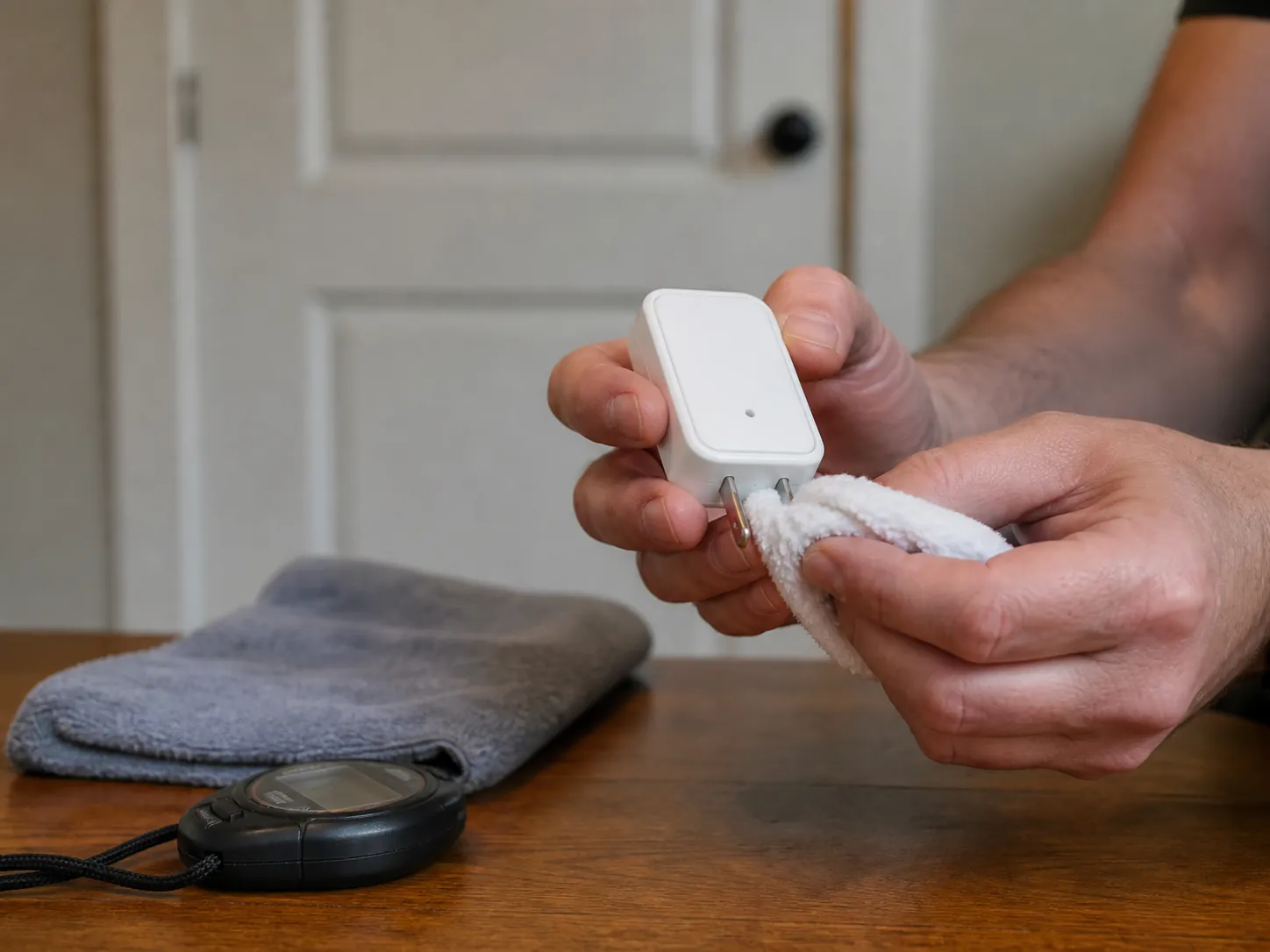
- Wet the probes with a damp cloth or a shallow puddle. Start a stopwatch when water touches the contacts. Record when the local siren starts.
- Keep timing until the push notification arrives. Write down the phone used, whether it was locked, and whether it was on Wi-Fi or cellular.
- Stand where a person would actually be: the next room, the bedroom, or behind the closed basement door. If you have a sound level meter, measure there; if not, at least record whether the alarm is clearly audible over normal household noise.
- Remove the battery or disconnect the hub, depending on the design. Time how long the app takes to say the device is offline. Stop pretending an offline alert exists if it arrives after the window in which you would act.
- Record the date, firmware version if visible, hub model, battery type, sensor location, and distance from the router or hub. Repeat the test after a major app update, router replacement, or hub migration.
On the evidence here, the safest buying judgment is not “pick the loudest advertised sensor.” D-Link has the most complete measured profile in the cited Wirecutter data: very fast trigger, 3–5 second push notification, documented sound drop-off through distance and a closed door, and a hub offline alert in about 3 minutes.[1] Kidde earns attention because its measured siren exceeded its advertised 85 dB rating.[1] YoLink earns credit for fast detection and useful tested range at 125 ft, but its 105 dB siren claim and 12-hour battery-removal notification lag are exactly why measured behavior has to outrank the box.[1]
References
- The Best Smart Leak Detector, Wirecutter, updated 2026
- The Best Smart Water Leak Detectors, PCMag
- The Best Water Leak Detectors, Wired
- HomeKit Weekly: Why water leak sensors are still the most critical smart home upgrade for 2026, 9to5Mac, January 17, 2026
- IKEA KLIPPBOK Leak Sensor w/ Matter Over Thread Review, HomeKit News, January 31, 2026
- ZSE42 Water Leak XS Sensor Compatible Hubs, Zooz Support
- Water Leak Detection Systems: Protecting Your Home from Costly Damage, Z-Wave Alliance / Vesternet
- Best Water Leak / Flood Sensors for Home Assistant, Make It Work Tech
Known issues with this device / protocol
Spec-version history
For active regressions on this protocol, see Update Watch.
No linked Update Watch entries yet.