
Why Smart Water Leak Detectors Are Alarms, Not Prevention
A smart water leak detector is an alarm, not a flood barrier — it prevents damage only if someone acts on the alert. This guide draws the line between point sensors and whole-home flow monitors with automatic shutoff, and spells out the minimum response plan that makes either option actually prevent water damage.
Last updated
Puck-style smart water leak detectors are alarms. They detect water, make noise, and send a phone alert. They do not close a pipe, stop a supply line, or keep a washing-machine hose from continuing to dump water while nobody is home. Wirecutter puts the distinction bluntly: leak detectors “function only as alarms” and, like smoke detectors, reduce damage only when someone responds to the warning.[1]
If you searched for smart water leak detectors for home flood prevention, the buying answer starts with three different outcomes:
- A point leak sensor detects water where it is placed and alerts someone.
- A whole-home flow monitor or valve system can detect abnormal water use and shut off water automatically or by remote command.
- A response plan turns an alert into action: who gets the notification, who checks the leak, and who closes the valve.
Only the second and third outcomes deserve the word prevention. The puck by itself is the beginning of the chain, not the end of it.
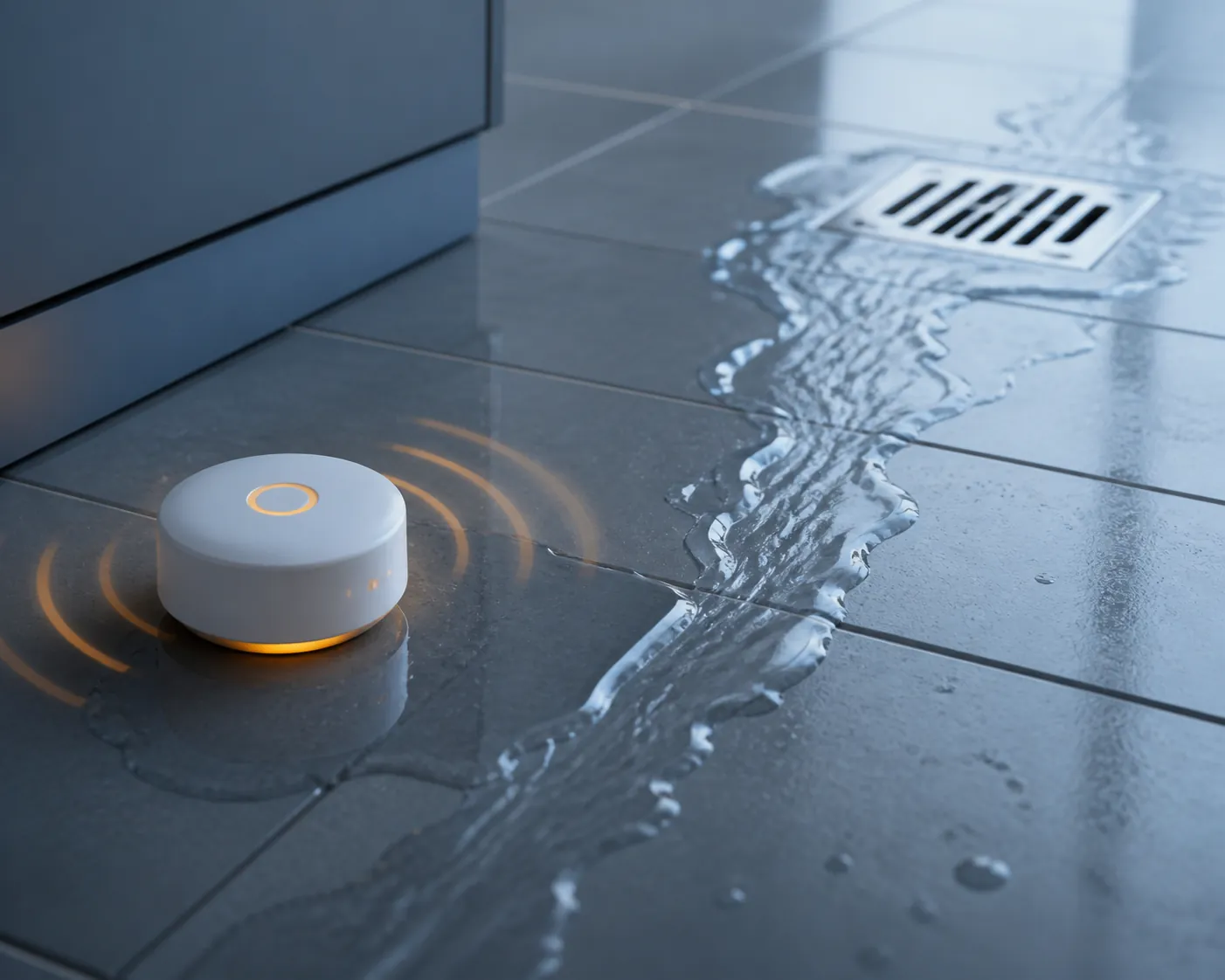
The alert is only one link in the chain
The useful question is not “Can this sensor detect water?” Many can. The better question is: after water touches the sensor, what has to happen before the water stops?
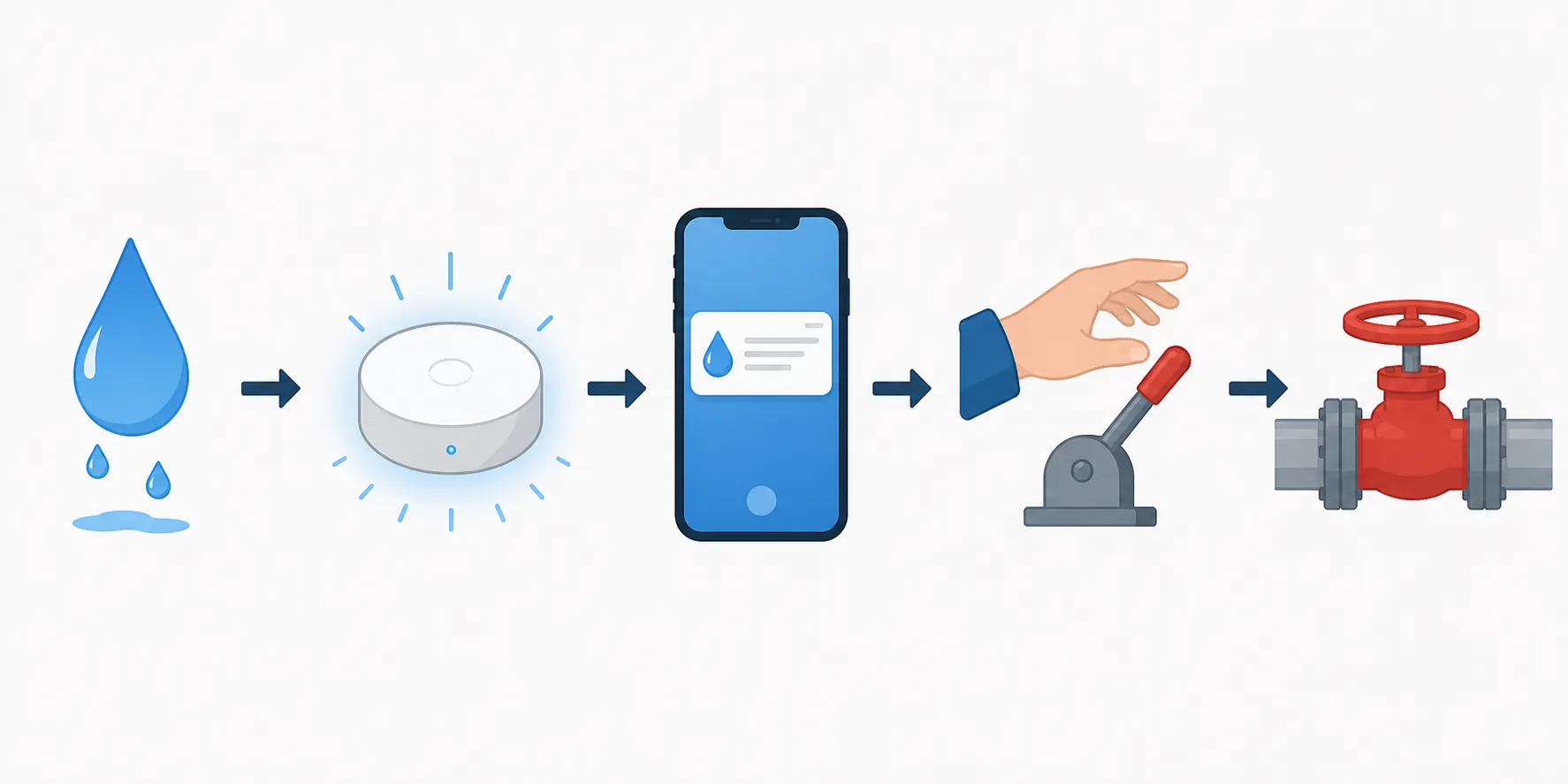
A basic leak-alert chain looks like this:
- Water reaches the sensor.
- The sensor detects it and sounds locally, sends an app alert, or both.
- The right person sees or hears the alert.
- That person knows what to do.
- A valve is closed, a fixture is isolated, or someone enters the home and stops the source.
The first two steps can be impressively fast. Wirecutter measured the D-Link sensor sounding its siren in under a second and sending a push notification in about 3 to 5 seconds. YoLink alerts arrived in about 1 to 2 seconds, and Kidde alerts arrived in “seconds.”[1] Those are useful numbers. If you are upstairs, awake, and holding your phone, a fast alert can save flooring, drywall, cabinets, and a miserable weekend.
But speed when wet is not the same as reliability when unattended. A sensor can have a quick alarm path while alive and still leave a long blind spot when it is dead, disconnected, or missing power. In Wirecutter’s testing, a D-Link pod took about 36 minutes after battery removal to report offline. The YoLink app took about 12 hours after battery removal to report that status.[1]
That gap is not trivia. If the device is offline under a sink before the supply line fails, there may be no alarm at all during the period when the homeowner thinks the house is being watched. A sensor that reports water in seconds can still be a poor prevention device if nobody knows it has been unavailable for half an hour, half a day, or longer.
What a puck sensor is good for
A small leak detector makes sense anywhere water should never be on the floor: under a water heater, beneath a sink, behind a washing machine, near a dishwasher, beside a sump area, or close to a refrigerator supply line. It is cheap compared with opening a wall, and it notices water earlier than a person usually would.
That is not a small benefit. The mistake is treating early warning as physical control. A puck sensor cannot decide that a toilet supply has split and then rotate the main shutoff. It cannot wake a neighbor unless you configured the neighbor to receive alerts. It cannot help if the only phone receiving push notifications is on Do Not Disturb across town.
So the right way to buy these devices is to place them where early warning matters and then make the response path boringly clear. If you only want to know about a leak while you are home, a local siren and a phone alert may be enough. If you travel often, own a second home, or have finished space below plumbing, the same puck sensors may need to be paired with a valve, a trusted responder, or both.
The device classes are not interchangeable
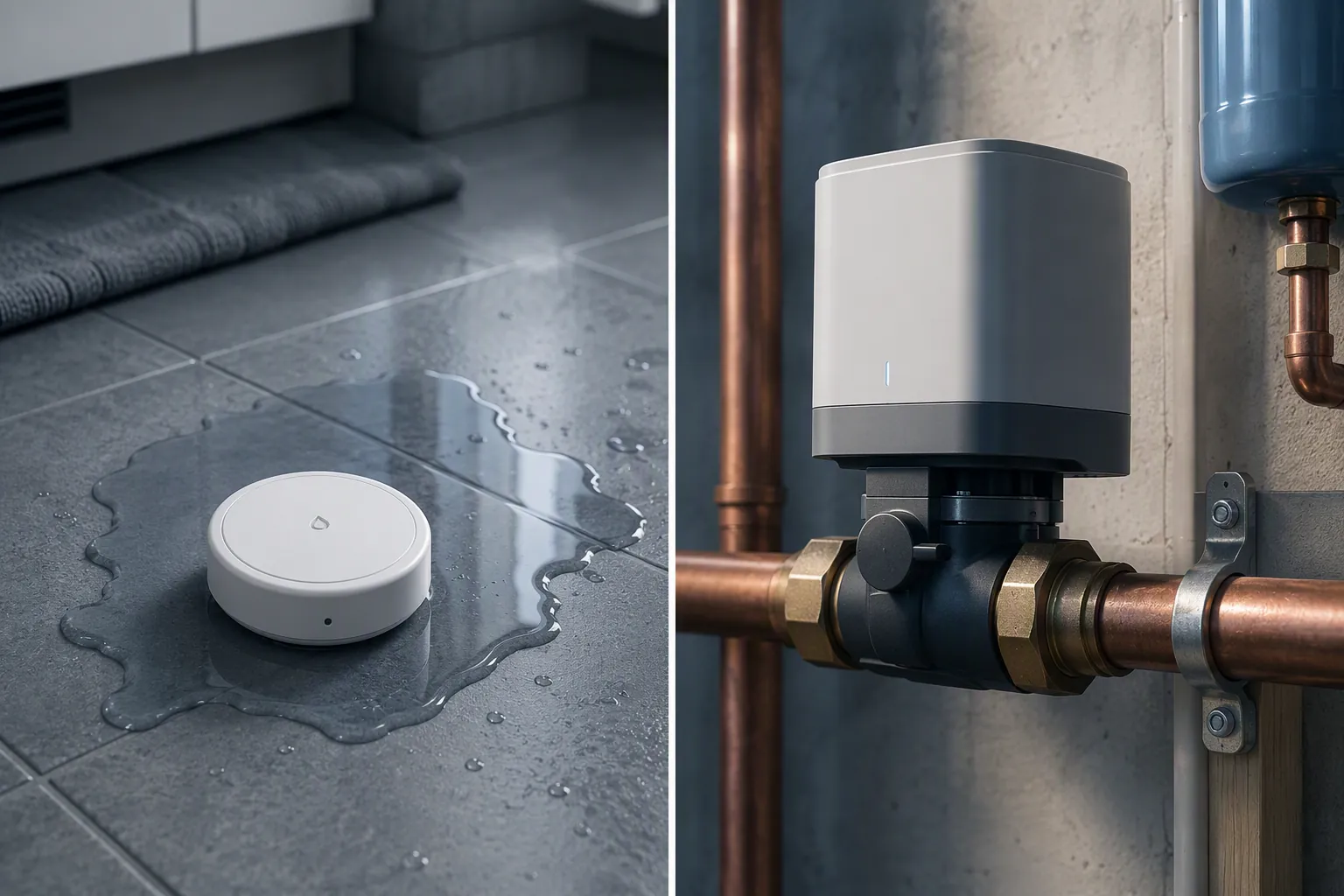
| Device class | What it can do | What it cannot do by itself | When it fits |
|---|---|---|---|
| Point leak sensor | Detect water at one location and alert a person | Stop water flow | You have someone who can respond quickly |
| Sensor plus controllable shutoff valve | Detect water and close a paired valve manually or through automation, depending on setup | Guarantee correct action unless the system is configured, powered, connected, and maintained | You want alerts to trigger or enable a shutoff action |
| Whole-home flow monitor with automatic shutoff | Monitor water use at the main line and shut off abnormal flow | Spot every small puddle at every fixture without supporting sensors | You need unattended protection, especially when nobody is home |
The price jump between those rows is the part many “best leak detector” articles glide past. PCMag’s 2026 coverage lists the Flo by Moen whole-home monitor at $550, with professional installation adding more than $200. It also notes that the system needs a 7- to 10-day learning period before it can reliably flag leaks.[2] In other words, real shutoff is more expensive than scattering a few pucks under sinks, and it is not always fully useful the minute the box is opened.
SafeWise, in its July 2025 pricing, described a YoLink shutoff kit at around $300 for a valve, three sensors, and a hub, while placing Flo by Moen shutoff valves above $500.[3] Consumer Reports’ accessible system references include the Flo by Moen Smart Water Shutoff and Guardian by Elexa among its top water-leak detector systems, with Guardian by Elexa listed around $350.[4][5]
Those are not interchangeable purchases. A puck sensor is a watcher. A valve-capable system is a watcher with hands. A whole-home shutoff system is closer to unattended mitigation, though it still has commissioning, maintenance, connectivity, and installation realities.
A minimum response plan for leak sensors
If you buy point sensors, do not stop at pairing them to an app. A leak alert becomes useful only when it lands in front of someone who can do something specific.
- Name the responder. If the alert goes only to one person who travels, sleeps through notifications, or keeps the phone silenced, the plan is weak.
- Decide the first action. For a small sink leak, that may mean checking the cabinet. For a water-heater leak, it may mean shutting the cold supply or main valve.
- Make the valve findable. A main shutoff hidden behind storage boxes is not a response plan.
- Check offline notifications. The system should tell you when a sensor, hub, or battery has stopped being trustworthy, and you should know how long that warning can take.
- Test the chain occasionally. Wet the contacts, confirm the siren or app alert, and confirm that the right people receive it.
This is where compatibility matters, but not in the way product pages like to make it matter. Zigbee, Z-Wave, Wi-Fi, Matter, LoRa-style long-range hubs, and platform integrations are all secondary to the result: does the alert reach the person or automation that can stop water? If your next question is which sensor works with your hub, use the dedicated smart water leak sensor hub compatibility guide or the water leak sensors by hub guide. This page’s job is the earlier decision: whether a sensor-only setup matches the outcome you expect.
For homes where response cannot be assumed, move the buying decision up a class. Pair sensors with a smart valve, or choose a whole-home monitor with automatic shutoff. A remote-close valve can be enough if someone reliable will see the alert. Automatic shutoff matters when nobody can be counted on to act quickly.
Where automatic shutoff changes the answer
Automatic shutoff is the line where the system begins to behave like prevention instead of notification. Devices and systems in this category include whole-home monitors such as Flo by Moen and Phyn Plus, valve-based options such as YoLink’s valve kit, Guardian by Elexa, and retrofit controllers such as Aqara’s Valve Controller T1. The exact architecture differs, but the shared feature is simple: the system has a way to close water, not merely complain about it.
That does not make every shutoff system the right buy. A whole-home monitor on the main line may catch unusual continuous flow even when no puck sensor is sitting under the exact leak. A point-sensor-plus-valve setup may respond well to known danger spots, such as a water heater pan or laundry area. A retrofit valve controller may be attractive when replacing plumbing is undesirable, but it still depends on correct mechanical fit and reliable control.
If you are deciding between point sensors and whole-home monitoring, the practical split is covered more directly in the point sensors vs. whole-home flow monitors guide. The short version here: if your goal is unattended prevention, buy something that can shut water off.
Insurance discounts are a side benefit, not the definition of prevention
Some insurers recognize water mitigation devices, but that does not mean every sensor qualifies or that every policy gets the same discount. USAA’s Connected Home program includes water leak detection among connected-home options, and Amica lists discounts for water damage mitigation devices.[6][7]
Treat that as a reason to call your carrier before buying, not as a reason to buy the cheapest puck and assume it counts. Ask what device class qualifies, whether automatic shutoff is required, whether professional installation matters, and whether the discount applies in your state and policy type. For a deeper insurance-specific discussion, see the leak detection and California insurance guide.
The buying decision
Buy puck-style smart water leak detectors if you want early warning in specific spots and you have a real responder. They are good alarms. Put them where water first appears, make sure the alert reaches more than one person if needed, and rehearse how the water gets shut off. If you want automations that do more than beep, the pre-monsoon leak sensor deployment guide is the more useful next step.
Buy a shutoff-capable system if the home needs protection while people are away, asleep, unreachable, or unlikely to find the main valve in time. That can mean a whole-home flow monitor with automatic shutoff, a valve kit paired with sensors, or another setup where the alert can directly lead to water being closed.
Do not call the setup flood prevention until the water can actually be stopped.
References
- The 3 Best Smart Water-Leak Detectors of 2026 | Reviews by Wirecutter, Wirecutter
- The Best Smart Water Leak Detectors We've Tested for 2026, PCMag, June 12, 2026
- Best Water Leak Sensors of 2026, SafeWise, July 2025
- Best Smart Water Leak Detectors, Consumer Reports
- Best Water Leak Detector Systems, Consumer Reports
- Connected Home, USAA
- Water Damage Mitigation Devices, Amica
Known issues with this device / protocol
Spec-version history
For active regressions on this protocol, see Update Watch.
No linked Update Watch entries yet.