
Can a smart water leak detector help in a water shortage?
During a water shortage, a smart leak detector can be genuine conservation hardware, not just damage insurance: the EPA puts household leak waste at over 10,000 gallons per year, and utilities like LADWP rebate qualifying monitors. The payoff depends on matching point sensors or whole-home flow monitors to what you need to catch, claiming the right rebate, and confirming the device works with the hub you already own.
Last updated
During a water shortage, a smart water leak detector can help, but the useful version of that answer is narrower than the packaging usually suggests. It helps when it finds water that would otherwise keep running: the toilet that quietly refills, the hose bib that never quite closes, the supply line that drips into a cabinet until the bottom shelf swells. The EPA’s archived WaterSense Leak Facts page puts household leak waste at more than 10,000 gallons per household per year, says 10% of homes have leaks wasting 90 gallons or more per day, and estimates that fixing easily corrected leaks can save homeowners about 10% on water bills. The same archived page gives the memorable household-scale number: one drip per second can waste more than 3,000 gallons per year [1].
Those are the archived EPA WaterSense figures, and they should be kept attached to that source rather than blended casually with other EPA fact-sheet editions. The point is still clear enough for a homeowner making a purchase decision under shortage messaging: leak detection is not just flood insurance. It can be a way to find a measurable conservation problem on the private side of the meter.
That private-side boundary matters. Energy.gov notes that the United States loses about 2 trillion gallons of treated water per year to distribution main breaks, which no under-sink puck will solve [2]. A home leak detector is not a city infrastructure plan. It is a tool for the part of the waste that starts after water reaches the property.
The useful split: sensors that see water and monitors that see flow
The first mistake is treating every smart water leak detector as the same product. They are not trying to catch the same failure.
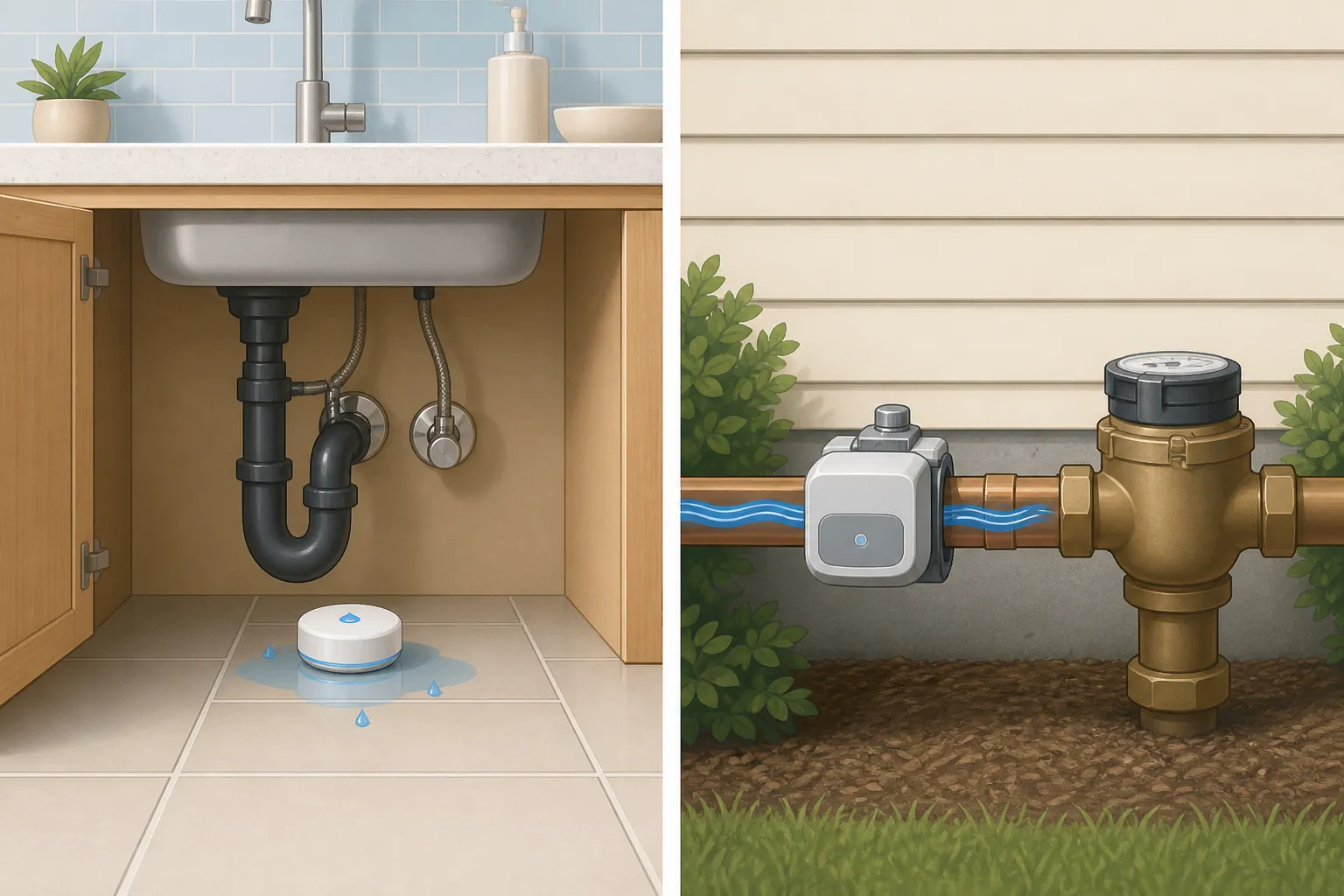
Point sensors and rope or cable sensors tell you that water is physically present where the sensor sits. Whole-home flow monitors watch water movement and usage patterns, usually from the meter or main line. Auto-shutoff valves add a response layer by closing the water supply when a leak is detected, but they are better thought of as an escalation choice than the starting point for every buyer. The placement strategy for spot sensors, rope or cable sensors, and shutoff valves is central to whether the system works at all [3].
| Device type | What it is good at catching | What it can miss | Where it belongs |
|---|---|---|---|
| Point leak sensor | Water that reaches one known risk spot | Leaks that never touch the sensor; continuous running inside a toilet tank; irrigation or hose leaks away from the device | Under sinks, beside water heaters, behind washing machines, near toilets, below appliance supply lines |
| Rope or cable leak sensor | Water across a wider perimeter than a single puck can cover | Flow that stays inside plumbing or drains away before touching the cable | Along water heater pans, under long cabinet runs, around sump or mechanical areas |
| Whole-home flow monitor | Continuous or unusual water use, including some hidden leaks that never puddle near a point sensor | Exact leak location may still require investigation; performance depends on meter or pipe compatibility, Wi-Fi, and software interpretation | At the meter or main supply, where the device can observe total household use |
| Automatic shutoff valve | Stopping water after a serious leak or alarm condition | It does not by itself make a poor detection setup accurate; installation can be more involved | Main line installations where automatic intervention is worth the added cost and plumbing work |
For conservation, the difference is practical. A puck under a kitchen sink may be perfect for a supply-line drip that would otherwise rot the cabinet. It will not notice a toilet flapper leaking all night unless water escapes the fixture. A whole-home flow monitor is better suited to that “something is running when nobody is using water” problem, although it may only tell you to go looking, not hand you the exact wet fitting.
That is why a shortage-motivated buyer should start with the leak target, not the brand list. If the house has a vulnerable water heater, laundry closet, or sink cabinet, point sensors are cheap and direct. If the worry is a higher bill, a running toilet, a cracked irrigation line, or a slow leak nobody will ever step in, a whole-home flow monitor is usually the more relevant class.
Where rebates change the math: LADWP and Flume as a dated example
The economics look different when a utility subsidizes the hardware. As a Q3 2026 example, LADWP’s SoCal Water$mart residential rebate page lists up to $150 for qualifying flow or leak detection devices on single-family property. The page also includes eligibility and installation limits, including requirements around Wi-Fi at installation and restrictions involving utility meters, so it is not a blanket promise for any device with “leak” in the name [4].
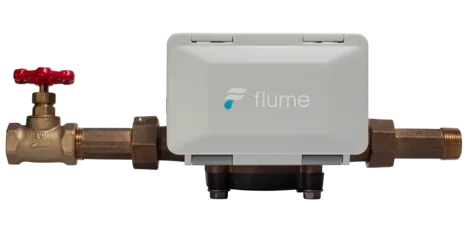
The Flume program shows why a whole-home monitor can move from “interesting gadget” to “reasonable conservation hardware” when the local program lines up. In an April 2026 post, the Los Angeles Office of Public Accountability said there were 25,000 Flume installations among LADWP customers and described a $25 refundable device cost for eligible LADWP single-family customers. The same post relayed Flume-reported figures of 100,000 statewide installs and about a 14% average water-use reduction, largely attributed to early leak detection [5].
That 14% figure is useful, but it should be handled honestly. It is a vendor-reported reduction relayed by LA OPA, not an independent NestGrid test and not proof that every household will cut water use by the same amount. A home with an undetected running toilet may see a very different result from a home that is already tight and disciplined about irrigation.
Flume’s California rebate page is helpful as a starting point for finding programs, but rebate pages are not permanent law. The amount, eligible utility, device model, property type, and installation rules can change, so the official utility page has to win over a retailer listing or an old forum post [6].
Rebate math is local math
The right way to read the LADWP example is not “Flume pays for itself everywhere.” It is “a whole-home monitor can become a low-cost conservation measure when the utility, property type, hardware, and installation requirements all match.” In another city, the same device might have no rebate. In a multifamily building, the meter arrangement may make the program irrelevant. In a house with weak Wi-Fi at the meter, the device may fail the installation test before it ever finds a leak.
Alert reliability is part of conservation
For water damage, a fast alarm is obviously valuable. For water shortage conservation, it is still valuable, but there is another reliability question: will anyone know if the sensor has gone offline?
Wirecutter’s 2026 leak detector testing is useful here because it separates detection speed from offline behavior. In its tests, D-Link detected water in under a second, and YoLink detected water in about 2 seconds with a 105 dB alarm. But offline-notification behavior varied widely: YoLink hub loss generated a notification in about 3 minutes, while Kidde and YoLink battery-removal scenarios took more than 12 hours [7].
Those are third-party test results, not NestGrid lab results. The lesson for a buyer is still plain: a sensor that quickly detects water is only useful if it is online, powered, and able to alert the right person. For a vacation home, a rental, or a meter monitor installed far from the router, offline notification may matter as much as the headline detection time.
Do the compatibility check before the rebate form
A rebate does not help much if the device will not work with the system already on the wall. Before buying, confirm three different kinds of fit: plumbing fit, program fit, and ecosystem fit.
- Plumbing fit: Does the device support your meter, pipe location, valve layout, and Wi-Fi conditions? Whole-home monitors are especially sensitive to this.
- Program fit: Does your utility rebate cover this exact device type and property type? Is pre-approval required? Does the purchase have to come through a specific program channel?
- Ecosystem fit: Does the detector pair with your hub or platform directly, through a bridge, or only through the vendor’s app?
For the ecosystem part, do not rebuild the compatibility table from memory while standing in a store aisle. Start with NestGrid’s smart water leak sensor hub compatibility guide and then check the hub-by-hub leak sensor guide for the platform you actually own. If the house uses SmartThings, Apple Home, Alexa, Home Assistant, Hubitat, Z-Wave, Zigbee, or a vendor hub, the radio and bridge requirements are not interchangeable.
Matter is relevant, but it is not a magic eraser for every water-device mismatch. Matter 1.3 added leak and freeze detectors and controllable water valves as device types, which matters for future leak alerts and shutoff escalation. That does not mean every existing water monitor, meter clamp, valve, hub, and automation platform will suddenly work together without checking the product’s actual Matter support [8].
An app-only device can still be the right purchase if it qualifies for the rebate and catches the leak target you care about. The mistake is assuming it will also trigger the sirens, lights, voice announcements, shutoff valves, and dashboard automations already built into the home. If those automations matter, confirm them before the box is opened.
A purchase sequence that keeps the conservation goal intact
| Before buying | What to verify | Why it matters during a shortage |
|---|---|---|
| Name the leak target | Known wet locations, hidden continuous flow, irrigation, toilets, water heater, laundry, vacation-home monitoring | The target decides whether a point sensor or whole-home monitor is useful |
| Choose the device class | Point sensor, rope/cable sensor, whole-home flow monitor, or shutoff valve layer | A cheap sensor in the wrong location may never see the water being wasted |
| Check the official utility page | Rebate amount, eligible device list, property type, purchase channel, installation requirements | The real cost can change sharply when a rebate applies, but only if the device qualifies |
| Confirm installation conditions | Meter access, pipe or valve location, Wi-Fi reach, power or battery plan, permission if not owner-occupied | A monitor that cannot stay connected cannot report continuous waste |
| Confirm hub and alert behavior | Platform support, bridge requirements, offline notifications, shared household alerts | The right person has to receive the alert while the leak is still fixable |
| Decide whether shutoff is needed | Manual response, plumber response, smart valve, or main-line automatic shutoff | Conservation alerts are useful; uncontrolled flooding may justify a stronger response layer |
For many homes, that sequence will lead to a mixed setup: a whole-home flow monitor for unexplained use, plus a few point sensors at the ugly failure spots. If automatic shutoff is part of the plan, treat it as plumbing and safety work, not just another checkbox in an app. NestGrid’s storm and flood preparedness setup guide is a better place to think through response automation than a rebate page.
So, can a smart water leak detector help in a water shortage? Yes, if the purchase is tied to a real leak target, not just a promise of peace of mind. The strongest case is a verified one: EPA household leak waste is large enough to matter, some utilities subsidize detection hardware, and monitored programs can produce measurable reductions. The payoff comes when the device catches the kind of waste your house is likely to have, the local rebate actually applies, and the detector works with the system that will alert you before the leak becomes normal.
References
- Fix a Leak Week, EPA WaterSense.
- Water-Efficient Technology Opportunity: Distribution System Leak Detection, Energy.gov.
- Water Leak Detection Systems: Protecting Your Home from Costly Damage, Z-Wave Alliance.
- Residential SoCal Water$mart Water Rebate Program, LADWP.
- What LA Homeowners Should Know About LADWP’s Smart Home Water Monitor Program: Flume, Los Angeles Office of Public Accountability, April 2026.
- California Water Monitor Rebates, Flume.
- The Best Smart Water-Leak Detector, Wirecutter.
- Matter 1.3 Specification Released, Connectivity Standards Alliance.
Known issues with this device / protocol
Spec-version history
For active regressions on this protocol, see Update Watch.
No linked Update Watch entries yet.