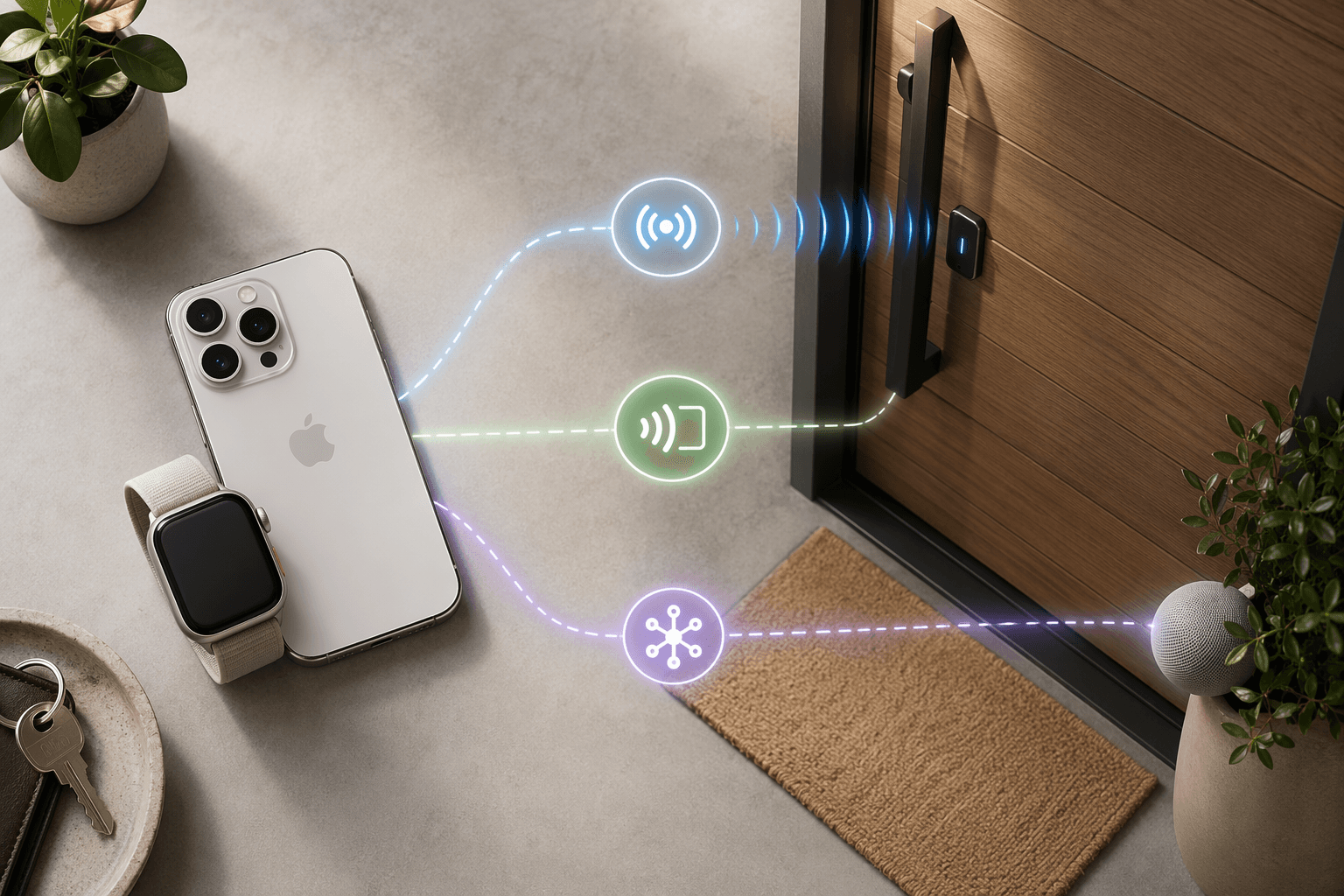
Shopping for the best smart locks for home in an Apple household used to mean checking one box: does it work with Apple Home? In 2026, that question is too blunt. Apple Home Key can mean tapping an iPhone or Apple Watch to the lock, walking up to a door that unlocks hands-free through UWB, or choosing a Matter-over-Thread setup that reduces app juggling but may remove a feature you actually liked.
The short version is this: start with the Schlage Encode Plus if you want the safest, most-reviewed Apple pick with strong physical security, Thread, and NFC Home Key. Look hard at the Aqara Smart Lock U400 if hands-free UWB unlocking is the whole reason you are upgrading and retail availability checks out. Choose the Aqara U100 when fingerprint speed matters more than having the newest Home Key trick. Treat Level Lock Pro and Kwikset Halo Select as more conditional buys, because their Matter and app-management choices can change the daily experience more than the spec sheet suggests.
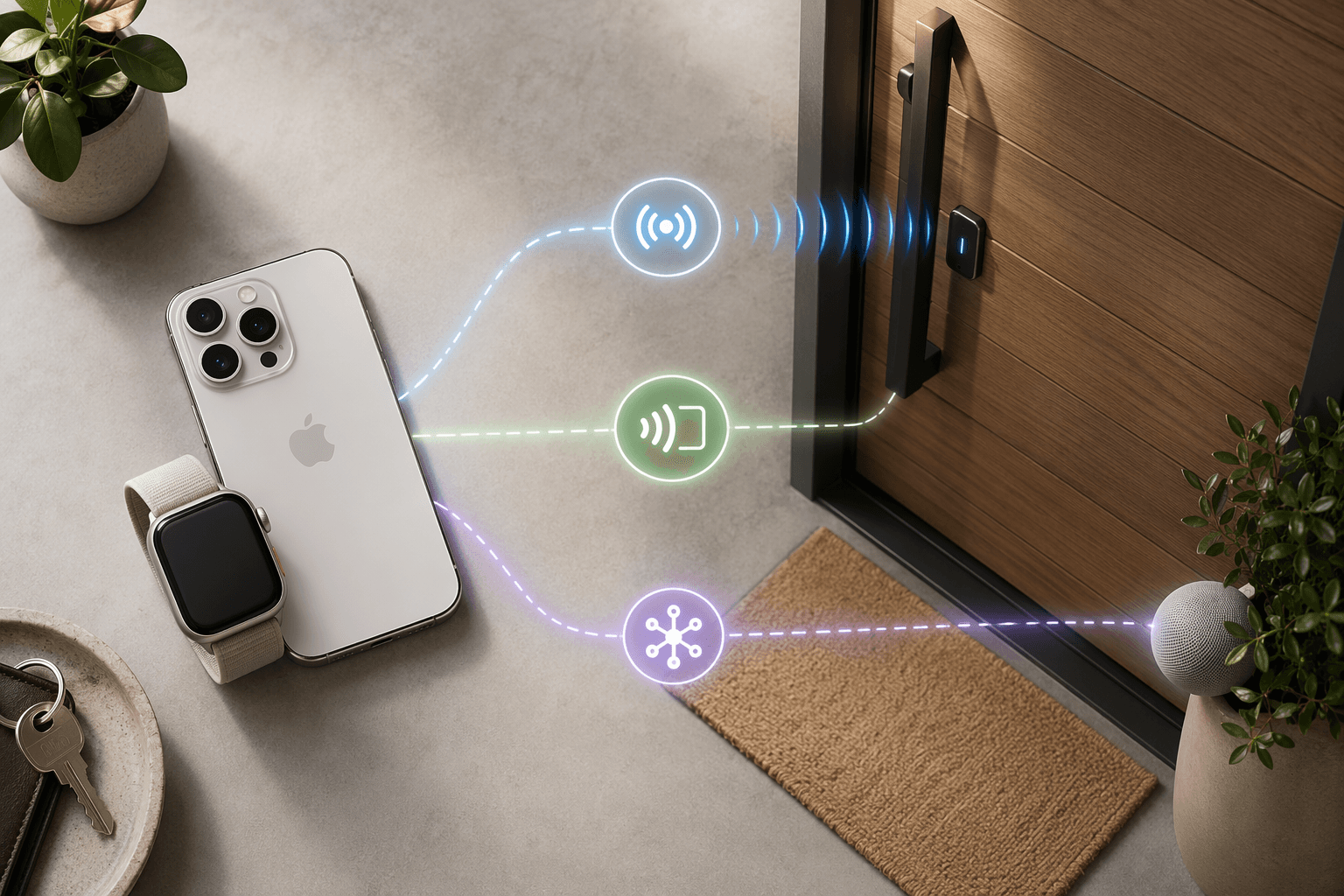
The 2026 Apple Home Key decision frame
| If your household cares most about... | Start with... | What you gain | What to check before buying |
|---|---|---|---|
| A proven Apple-friendly lock with strong physical security | Schlage Encode Plus | NFC Home Key, built-in Thread, ANSI Grade 1/AAA security, broad reviewer support | No UWB hands-free unlocking and no Matter support as of mid-2026 |
| The door unlocking as you approach | Aqara Smart Lock U400 | First UWB hands-free Home Key implementation plus Matter-over-Thread | Availability and whether its newer implementation fits your household’s tolerance for early-adopter edges |
| Fast entry without always using a phone or watch | Aqara U100 | Very fast fingerprint access among Home Key locks | How much you are willing to manage through Aqara’s ecosystem |
| A minimalist exterior look | Level Lock Pro | Matter-over-Thread path and less visible smart-lock hardware | Feature limits, hub dependence, and whether app-free setup is worth the trade-offs |
| Matter support from a mainstream lock brand | Kwikset Halo Select | Matter-over-Thread option | Matter mode disables Kwikset’s auto-unlock feature |
That table is intentionally not a ranking. The top reviewers do not produce one universal winner: Wirecutter, CNET, PCMag, and The Verge test across different priorities and name different overall favorites. What does converge is the Schlage Encode Plus as a durable Apple-user recommendation, especially because it combines Home Key, built-in Thread, and ANSI Grade 1/AAA security in a package that has been repeatedly tested and recommended by major reviewers.[1][2][3]
This category is also no longer a tiny enthusiast corner. Fortune Business Insights projects the smart lock market at $4.22 billion in 2026, with a 19.7% compound annual growth rate, which helps explain why lock makers are now competing on subtler ecosystem details instead of simply adding app control to a deadbolt.[4]
Home Key is not one experience anymore
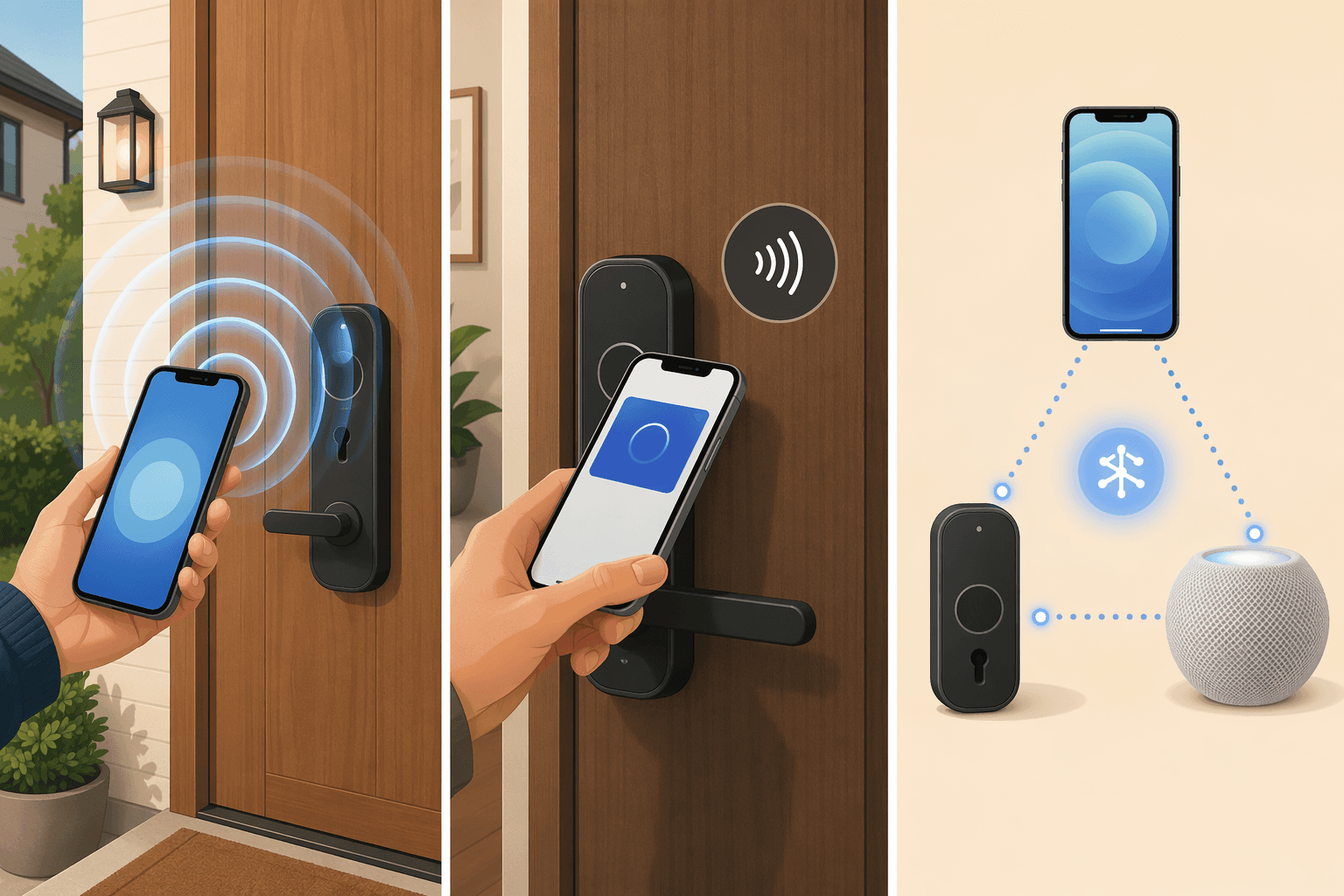
The phrase “Apple Home Key” sounds tidy, but the hand motion at the door can be completely different from one lock to another. That hand motion matters because locks are not like lamps or speakers. A lock is used when someone is carrying groceries, rushing a child inside, letting in a dog walker, or standing in rain while a battery is cold. Tiny differences become household policy.
UWB hands-free Home Key: the least physical version of coming home
The Aqara Smart Lock U400 is the headline-grabber because it is described in 2026 testing as the first lock to support UWB hands-free Home Key unlocking. Instead of tapping a phone or watch, the lock unlocks automatically as you approach, and it also supports Matter-over-Thread.[3]
That is not a small upgrade if your current routine is a wrist twist with a bag on one shoulder and a leash in the other hand. NFC Home Key already removed the need to open a lock maker’s app; UWB can remove the deliberate unlocking gesture. The right household for the U400 is the one that will notice that missing gesture every day.
The caution is not that UWB is a gimmick. It is that the U400 is a newer 2026 product, and the research available in early 2026 treats it as advanced but still tied to practical availability checks. If you need a lock installed this weekend, confirmed stock and return policy matter as much as the technology.
NFC tap-to-unlock: less magical, more proven
NFC Home Key is the version most Apple households already understand: hold an iPhone or Apple Watch near the lock, and the door unlocks. The Schlage Encode Plus is the most important example here. It has NFC tap-to-unlock, built-in Thread, and ANSI Grade 1/AAA security, but it does not have UWB hands-free unlocking or Matter support as of mid-2026.[1][2][3]
For many homes, that is a better compromise than it sounds. A tap is still fast, still familiar, and still easier than launching a manufacturer app. It also gives the person at the door a clear moment of intent. That can be reassuring in a busy household where a front door should not feel too eager to unlock merely because a phone is nearby.
Matter-over-Thread: cleaner setup, not automatically easier living
Matter-over-Thread is attractive because it promises a more interoperable smart home and, in some locks, lets you set up through Apple Home without starting in the manufacturer’s app. That matters if the goal is to keep the front door from becoming another account, another notification channel, and another app your spouse has to understand.
But Matter is not a free lunch. The Kwikset Halo Select is the clearest warning: in Matter mode, it disables Kwikset’s own auto-unlock feature.[3]
That is exactly the trade-off to find before purchase, not after installation. If your whole reason for buying a smart lock is automatic arrival behavior, a more interoperable mode that removes auto-unlock may be worse for your household than a less universal setup that keeps the feature you use five times a day. For a deeper background on why Matter and Thread are related but not interchangeable, this is the moment to read a Matter protocol explainer before choosing hardware.
Schlage Encode Plus: the safest Apple starting point
The Schlage Encode Plus remains the lock to beat for Apple households that want a reliable answer more than a novelty. Its case is not based on one spectacular feature. It is the combination: Home Key, built-in Thread, strong physical-security ratings, and repeated reviewer confidence from Wirecutter, CNET, and The Verge.[1][2][3]
That repeated support matters because a front-door lock is a terrible place to discover that a device is clever in a demo and annoying in a Tuesday routine. With the Encode Plus, the main limitations are clear. You get NFC tap-to-unlock, not UWB hands-free unlocking. You get Thread, but not Matter as of mid-2026. You get a lock that is easy to recommend to an Apple-first household, but not one that answers every future-platform question.
The physical-security piece is also not decorative. ANSI Grade 1/AAA gives the Encode Plus credibility as a lock, not merely as a smart-home accessory.[1] If you are replacing the main deadbolt on the door everyone uses, that baseline should carry weight.
The Encode Plus is the pick for a household where the sentence “just tap your watch” will work for nearly everyone. It suits families that want Apple Home integration, remote access through the right hub, notifications, and a conventional keypad without betting the whole front door on the newest unlocking method.
Aqara U400: the most interesting lock if hands-free is the point
The Aqara U400 is the lock that changes the physical ritual. If it works as intended in your home, you do not tap, twist, or wake anything. You approach, and the door unlocks. For Apple households that have been waiting for Home Key to feel less like a digital keycard and more like presence-aware access, this is the most exciting 2026 option identified in early testing.[3]
It also carries Matter-over-Thread, which makes it more future-looking than the Encode Plus on interoperability. That pairing is why the U400 deserves more attention than a normal new-model mention. It combines the newest Apple-native convenience with the smart-home protocol many buyers have been told to look for.
Still, the U400 should be bought with eyes open. A lock can be technically ahead and still be the wrong choice for a household that needs boring predictability. Check actual retail availability, read current owner feedback, and think through who else uses the door. Hands-free unlocking is delightful for the primary iPhone user; it is less helpful if guest access, backup routines, or mixed-device family members become harder to manage.
The other Apple Home Key locks worth considering
Aqara U100
The Aqara U100 is the more grounded Aqara choice. Its best argument is speed at the door without depending on a phone or watch: Wirecutter found it had the fastest fingerprint reader among Home Key locks in its testing.[1]
That matters for kids, relatives, and anyone who tends to arrive with a dead phone. Fingerprint access can be more practical than a beautiful Home Key flow if several people need quick entry and do not all live inside the same Apple habits.
Level Lock Pro
Level Lock Pro belongs on the shortlist for people who dislike the look of obvious smart-lock hardware and want a Matter-over-Thread path. The trade-off is that the cleaner exterior and cleaner setup story should be weighed against the exact feature set you need in Apple Home and any functions that still depend on Level’s own app.[3]
Kwikset Halo Select
Kwikset Halo Select is the lock to examine carefully if you are drawn to a mainstream brand plus Matter. The important buying detail is not that it supports Matter-over-Thread; it is that Matter mode disables Kwikset’s auto-unlock feature.[3]
If you are comparing Kwikset models, read a Kwikset Matter breakdown before deciding that the Matter version is the obvious version. Interoperability only helps if the features left behind are not the ones your household wanted.
Lockly Visage and premium smart locks
Lockly Visage and other premium locks with facial-recognition or video-style features sit in a different buying lane. They may be attractive if the front door is also a monitoring point, but that is not the same as buying the simplest Apple Home Key lock. Premium facial-recognition and video-oriented models commonly move into the $350-and-up tier, while many mainstream smart locks sit closer to the $150-to-$250 sweet spot and entry-level models fall around $50 to $100.[5]
Hubs, guests, batteries, and the chores hidden behind convenience
The lock body is only half the purchase. The other half is the household around it: who gets codes, who receives alerts, what happens when you are away, and how often someone has to replace batteries.
You probably need a current Apple Home hub
Most Home Key locks require an Apple Home hub for remote access and notifications. In 2026, that means a HomePod or Apple TV; iPads no longer fill that hub role as of February 2026.[3]
This is the first compatibility question to settle if you want to lock or unlock from away, see door status remotely, or receive notifications when someone comes home. If your Apple Home setup is fuzzy, read an Apple HomeKit platform overview before buying a lock. A good lock with the wrong home architecture becomes a local accessory with disappointing remote behavior.
Guest access may still pull you back into the manufacturer app
Home Key is wonderful for the people who live in your Apple ecosystem. Guests are messier. Dog walkers, cleaners, short-term visitors, and relatives may need codes rather than Home Key credentials, and some locks still handle the fullest guest-code management through the manufacturer’s app.
That does not make those locks bad. It does mean “works in Apple Home” should not be read as “I will never open another app.” Before buying, check where temporary codes are created, where schedules are edited, and whether every adult in the house can manage access without borrowing the one phone that originally set up the lock.
Battery life depends heavily on the radio
Wi-Fi-only smart locks tend to average about three to six months of battery life, while Thread or Bluetooth locks can reach about 12 months.[6] That difference is practical, not theoretical, if the lock is on a busy door.
Treat those numbers as expectations, not promises. Usage frequency, temperature, lock alignment, and polling behavior can all change real results. A lock that struggles to throw the bolt because the door is slightly misaligned will punish batteries no matter how efficient its radio is.
Matter and Aliro are worth watching, but not a reason for most buyers to wait
Matter support is moving fast enough that any 2026 lock guide needs humility. Locks that lack Matter as of mid-2026, including the Schlage Encode Plus, could change through later firmware or product revisions. The current buying decision should be based on what the lock does now, not what a standards roadmap might eventually allow.
Aliro, the Apple-, Samsung-, and Google-backed credential standard for NFC and UWB access, is also worth watching. But in 2026, limited hardware availability makes it a future consideration rather than a reason most households should keep an aging deadbolt for another year.
Which Apple Home Key smart lock should you buy?
Most Apple households should begin with the Schlage Encode Plus. It is the most reassuring blend of Apple convenience, reviewer consensus, Thread support, and physical lock credibility. It is not the most futuristic option, and the lack of Matter may bother buyers building a heavily cross-platform smart home, but it is the easiest recommendation for people who want a front door that feels settled rather than experimental.
Convenience-first early adopters should give the Aqara U400 serious attention. UWB hands-free Home Key is the first Apple lock feature in a while that changes the act of coming home, not just the app used to manage it. Confirm availability, check current reviews, and make sure guest access will not become the chore that replaces key fumbling.
Matter-focused buyers should slow down before assuming the most interoperable lock is the easiest lock to live with. If Matter mode removes auto-unlock, shifts guest management, or changes how the household actually enters the door, the better protocol choice may not be the better daily choice. For a broader non-Apple comparison, a general best smart locks for home guide is useful; for an Apple household, the right answer starts with the unlocking ritual you want every day.
References
- The Best Smart Lock, Wirecutter
- Best Smart Locks of 2026, CNET
- The best smart door locks, The Verge
- Smart Door Lock Market Size, Share & Industry Analysis, Fortune Business Insights
- Best Smart Locks 2026, SafeHome.org
- Smart Locks Buying Guide, SafeHome.org
Reader Feedback
Share your purchase experience, flag outdated picks, or ask clarifying questions about the checklist items.
Comments
Join the discussion with an anonymous comment.