
Thermostat Settings That Save Energy in Houston Heat Waves
A Houston heat-wave thermostat playbook: exact set points, schedule shifts, and fan/eco settings with every number sourced, so you can cut cooling costs without guessing.
In a Houston heat wave, the useful answer is not just “raise the thermostat.” It is a settings playbook: the cooling set point, the schedule shift, the fan mode, and the eco or adaptive feature that should stay on or off during extreme heat. The problem is that those numbers have to come from somewhere specific. Advice can sound confident with a neat summer set point and a promised bill cut, but without a dated source for the number and the conditions behind it, that confidence is not worth much in a Houston living room in August.
So the clean answer starts with a boundary: without dated support, no exact Houston heat-wave set point, savings percentage, pre-cooling window, or fan-runtime rule should be treated as verified. What can be given is the coordinated routine a sourced playbook would need to follow, and how to use it without mistaking one thermostat setting for the whole strategy.
The heat-wave settings snapshot
| Control | What to change | Evidence needed before claiming a number |
|---|---|---|
| Cooling set point | Use the highest indoor temperature the household can tolerate during occupied hours, then keep it consistent enough that the system is not chasing frequent manual changes. | The exact recommended cooling temperature and whether it applies to occupied hours, sleeping hours, away hours, or all cooling periods. |
| Schedule | Shift cooling demand away from the worst afternoon stress where possible, while avoiding a recovery period so aggressive that the system runs hard when everyone is home. | Any exact start time, end time, pre-cooling period, or utility peak window. |
| Fan mode | Use the fan setting that supports comfort without turning the blower into an all-day electricity user or humidity problem. | Whether the recommendation is Auto, On, Circulate, or a manufacturer-specific mode, and under what humidity or comfort assumptions. |
| Eco, adaptive, or learning mode | Check whether the feature changes set points during occupied heat-wave hours; if it does, override or limit it rather than assuming the app knows the household’s comfort limit. | The specific feature name, manufacturer behavior, and any evidence that the setting saves energy without creating discomfort during extreme heat. |
That table is deliberately less satisfying than a one-line answer, but it avoids the bigger mistake: treating a single set point as if it automatically saves energy. In practice, the set point only works as intended if the schedule, fan behavior, and eco controls are not pulling against it.
Why one thermostat adjustment is usually the weak version of the plan
A higher cooling set point is the obvious place to start because it changes what the air conditioner is being asked to maintain. But if the thermostat schedule still drops the target temperature before the hottest part of the day, the system may spend the afternoon recovering from its own programming. If the fan is left running continuously, the house may feel air movement, but the blower is still using electricity and may affect comfort in humid conditions. If an eco feature makes a large automatic adjustment when someone is still home, the resident ends up fighting the thermostat manually, which usually means the plan will not last.
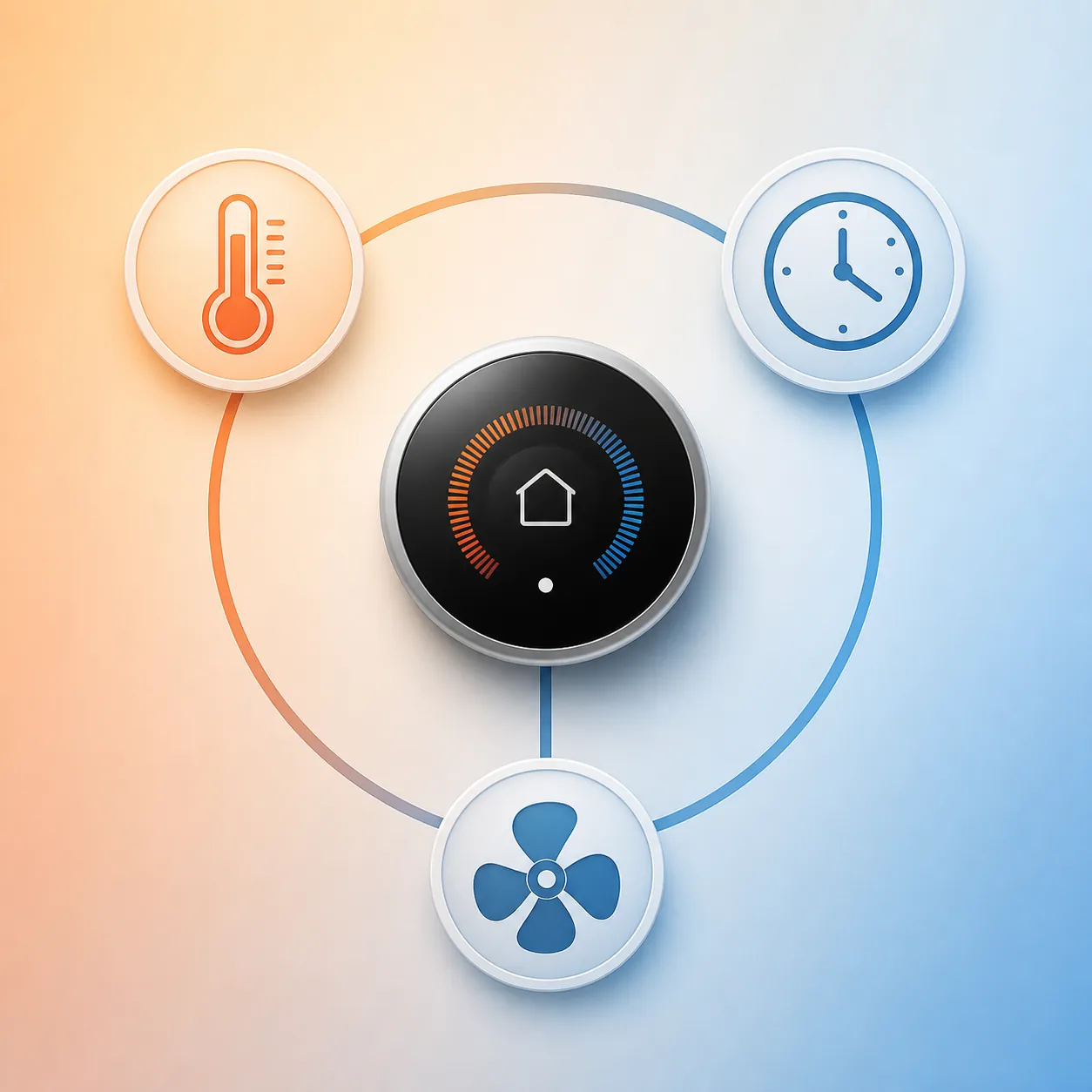
That is the reason the meaningful unit is not one clever setting. It is the alignment of four controls: temperature target, time of day, fan behavior, and automation limits. A household can still choose a conservative version of the routine, especially with older equipment, renters’ restrictions, medical comfort needs, pets, or rooms that heat unevenly. The important part is to change the controls in the same direction instead of asking one setting to carry the whole savings claim.
How to build the routine without inventing savings
Start with the occupied cooling set point. Choose the highest setting that keeps the home tolerable during the hours people are actually there. Do not start with an app’s most aggressive eco setting unless everyone in the home can live with the result. In a heat wave, comfort failures matter because they cause people to override the system repeatedly, and repeated overrides make the schedule meaningless.
Then look at the schedule. The schedule should answer two practical questions: when does the house need to be comfortable, and when is it acceptable for the temperature to drift upward? A renter who gets home in the early evening may need the thermostat to begin recovering before arrival. Someone home all day does not have the same room to shift cooling demand. A schedule that ignores occupancy is not a smart setting; it is just a timer.
After that, check the fan. Many thermostats make the fan control look harmless because it is not the temperature set point, but the fan setting changes how long the blower runs. For most households, the setting needs to be chosen on purpose rather than left in a mode that keeps air moving all day simply because it feels active. If comfort depends on more circulation, use the least aggressive fan option that solves the room-to-room problem.
Finally, audit the eco, learning, adaptive recovery, or energy-saving mode. These features can be useful, but their labels are not proof of savings in a specific apartment or house. During a Houston heat wave, the feature to watch is any one that automatically changes the cooling target while people are home, delays recovery too long, or creates a temperature swing large enough that someone has to correct it by hand.
A simple way to test whether the settings are working together
Use one hot day as a check, not as a laboratory-grade proof. Before changing anything, write down the current cooling set point, schedule, fan mode, and eco or learning features. Then change the coordinated group, not one control at a time: raise the occupied set point within the household’s comfort limit, adjust the schedule around actual occupancy, set the fan deliberately, and limit any automation that causes surprise temperature changes.
- If the home becomes uncomfortable before the scheduled recovery period, the schedule is too aggressive.
- If someone keeps lowering the thermostat manually, the selected set point is not usable for that household.
- If the fan runs far more than expected, the fan mode deserves the next adjustment.
- If an eco feature changes the temperature at the wrong time, narrow its permissions or turn off that specific behavior.
This kind of check does not prove a savings percentage. Weather, insulation, equipment condition, sun exposure, occupancy, and utility pricing can all change the bill. What it does show is whether the thermostat is behaving coherently: maintaining a tolerable target, avoiding unnecessary recovery fights, and not letting automation create work for the person living with the heat.
What a sourced Houston playbook would still need
A fully sourced Houston heat-wave routine would need dated support for each exact number it recommends. The cooling set point should identify whether it comes from an energy agency, a local utility, a thermostat manufacturer, or an independent study. A schedule recommendation should name the relevant time window and explain whether it reflects grid demand, household comfort, or a utility pricing program. A fan-mode recommendation should distinguish between energy use and comfort. Eco-mode claims should separate manufacturer disclosures from independent evidence.
That distinction matters because “recommended” and “proven to save money in a Houston heat wave” are not the same claim. Adoption of a smart thermostat is not the same as effective use. A setting that saves energy in a model home is not automatically a good fit for a west-facing rental with weak insulation. A feature that reduces runtime during away hours may still be a bad match if it lets the indoor temperature climb beyond what the household can comfortably recover from.
The safest operational conclusion is narrower and more useful: do not hunt for one magic smart-thermostat setting. Build a coordinated heat-wave routine, verify each exact number against a dated source you trust, and judge the result by whether the home stays tolerable without constant manual correction.