
A smart home can pass every compatibility test and still fail the one the buyer never ran. The locks work locally. The thermostats support Matter. The cameras do not require a subscription. The broadband options are tolerable. Then, after closing, the owner learns that the quiet acreage sits near a proposed 500-kV transmission corridor tied to data center load.
That is the practical problem behind data-center-driven eminent domain fights. The issue is not whether buyers should reject every property near a substation, power line, or data center campus. It is whether they should spend weeks checking device ecosystems while accepting vague answers about the land that will hold those devices for the next decade.
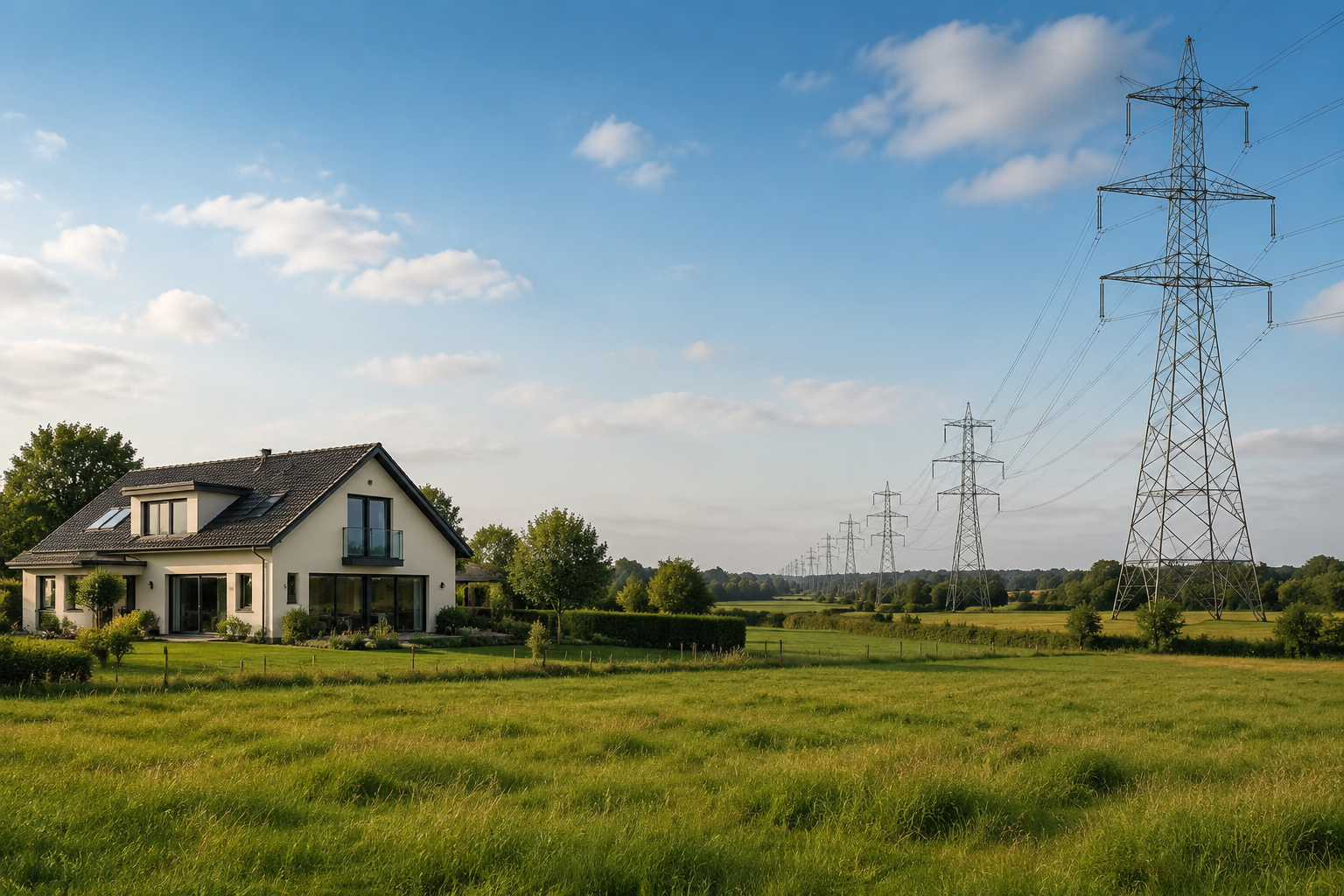
Before buying in a data-center-expansion region, especially rural or fast-growing suburban markets in Georgia, Washington, Ohio, Virginia, Indiana, and parts of the Midwest, the property itself needs a compatibility check. Not a vibe check. A document check.
The risk looks different when a transmission route has a name
Georgia Power’s Ashley Park-Wansley project is the case buyers should study because it turns an abstract worry into a route, a voltage class, a project page, and affected homes. The utility describes the project as a new 500-kV transmission line between the Ashley Park and Wansley substations, with an expected route length of about 35 miles.[1]
Local coverage tied the line to power demand from at least four AI data centers and reported that more than 330 properties could be affected, with roughly 20 to 30 homes reportedly slated for demolition.[2][3] Those are not normal nuisance facts. A buyer can learn to live with road noise. A buyer cannot casually absorb the risk that a house, barn, pasture, driveway, tree line, or buildable portion of a parcel may sit inside a corridor needed for high-voltage transmission.
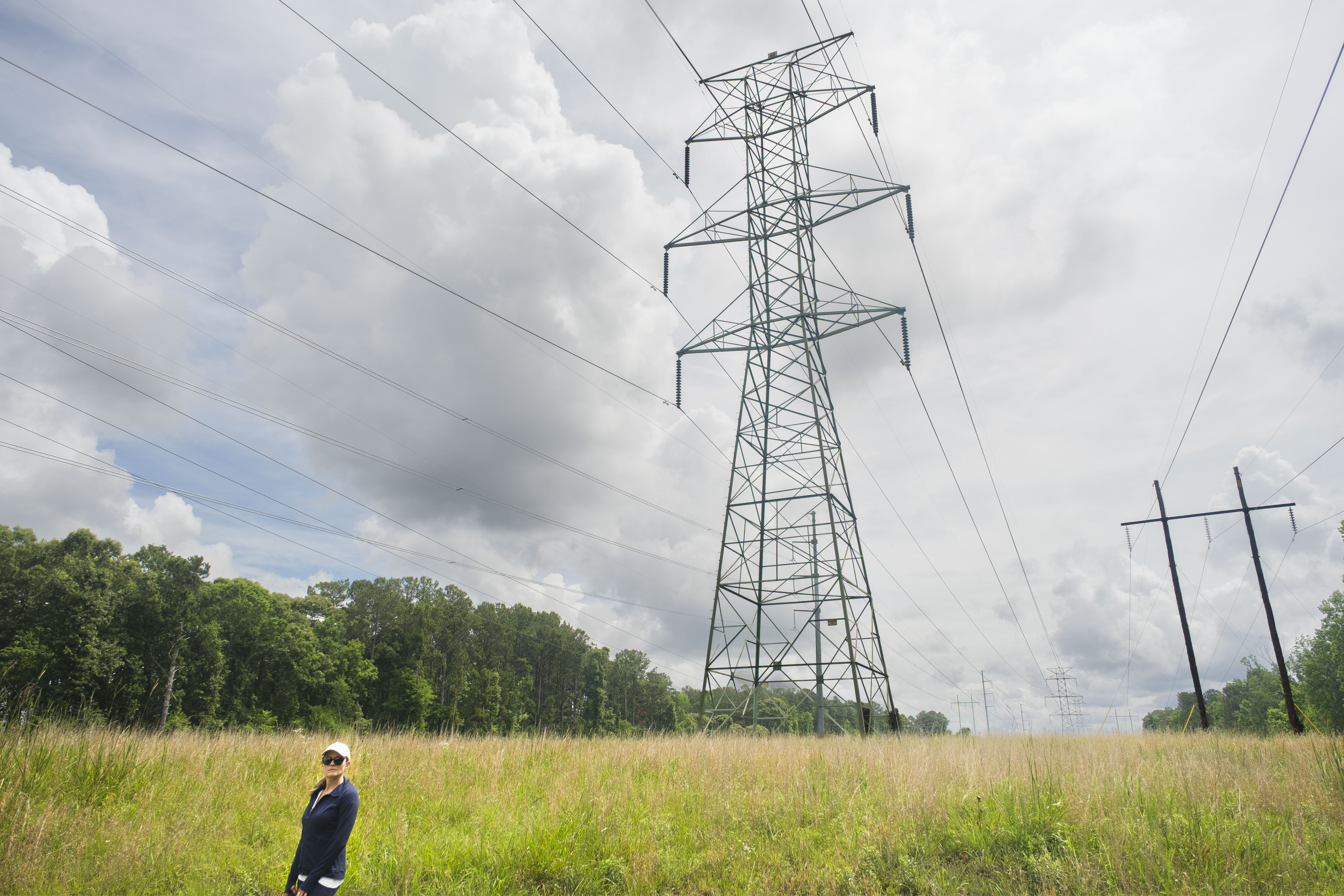
The uncomfortable part for home shoppers is that this kind of risk may become visible in public records before it becomes visible in a showing. A listing can truthfully present a property as private, rural, and quiet on the day of the tour. A seller disclosure form may not answer the question the buyer actually needs answered: whether a utility, county, regional transmission planner, or data center developer has already left a paper trail nearby.
Project Wansley also shows why the phrase “near a data center” is too small. The data center building may not be next door. The bigger residential impact can come from the infrastructure built to serve it: transmission lines, substations, access roads, construction staging, tree clearing, permanent easements, and, in the worst cases, condemnation proceedings.
An easement can be small on paper and permanent in real life
The Washington example is irritating in a different way because the number is so specific. In Grant County, homeowners and farmers said Grant County PUD sought permanent easements for transmission infrastructure serving Microsoft data center buildings. One family was offered $2,415 for a permanent easement over one-third of an acre, described as 25% of fair market value, for 100-foot transmission poles tied to Microsoft’s 21 data center buildings in the area.[4]
A buyer should not treat an easement as a line item only a lawyer can understand after the contract is signed. Easements can decide where structures may be built, where trees may grow, whether future improvements are practical, and how a later buyer reads the property. A beautiful parcel with an excellent smart-home retrofit plan can become a constrained parcel once a permanent utility right is recorded through the wrong part of it.
This is where smart-home due diligence should widen. A buyer who asks whether a hub supports Thread should also ask whether the county recorder shows existing transmission rights-of-way. A buyer comparing cellular backup plans should also check whether the parcel sits between a proposed substation and a newly approved data center campus. The first question protects gadgets. The second protects the platform those gadgets depend on.
Where to look before making an offer
Seller disclosures and agent comments are not enough. Disclosure law varies by state, and many forms are built around known defects, past damage, hazards on the property, or disputes already in motion. They are not reliable substitutes for checking whether a future transmission project is moving through planning records.
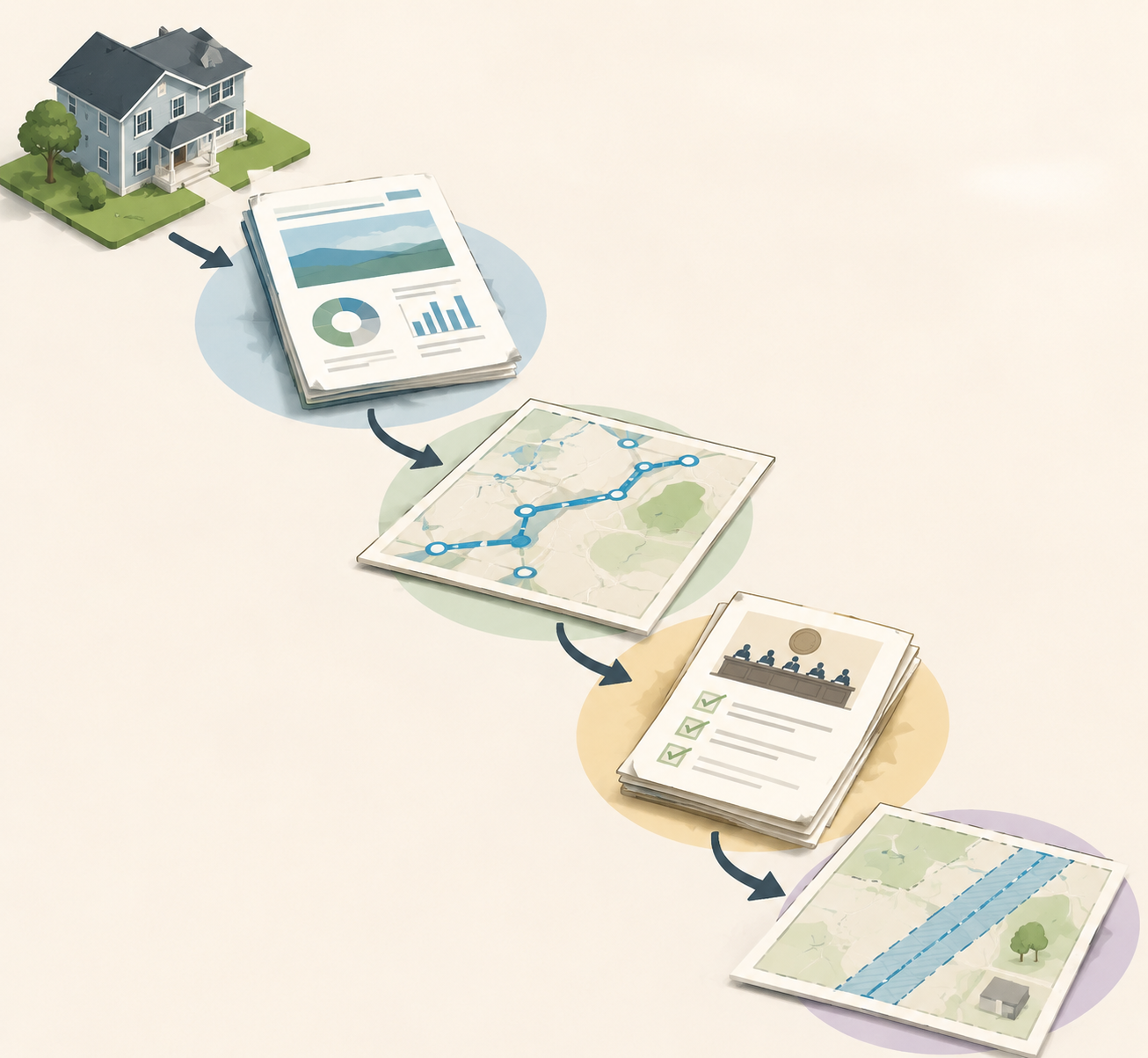
The search does not have to be elegant. It has to be repeatable. For each property, use the parcel address, parcel ID, county name, nearest substation name if known, nearest highway or road crossing, and the names of nearby utilities. Keep screenshots or PDFs with dates. If the deal proceeds, send the documents to the attorney, title company, or buyer’s agent and ask direct written questions.
| Record to check | What it can reveal | What to search |
|---|---|---|
| Utility Integrated Resource Plans | Forecasted demand, planned generation or transmission needs, and whether large-load customers are changing the utility’s buildout assumptions | Utility name + IRP, integrated resource plan, large load, data center, transmission |
| Transmission project portals | Named projects, route alternatives, public meeting maps, voltage, substations, estimated schedules, and affected corridors | Utility name + transmission projects, substation names, county name, 500 kV, 230 kV, route map |
| County zoning and planning dockets | Data center approvals, rezoning requests, substations, special-use permits, site plans, and public hearing notices | County planning commission, board of supervisors, zoning docket, data center, substation, energy campus |
| County recorder and GIS parcel maps | Existing easements, rights-of-way, parcel boundaries, tax map overlays, and whether the property already carries utility encumbrances | Parcel ID, owner name, easement, right-of-way, transmission, utility, GIS |
| Regional transmission planning materials | Projects that cross utility territories or appear before they are familiar to local real estate agents | Regional transmission organization, planning queue, reliability project, interconnection, load growth |
Start with the utility’s own project pages. They are often cleaner than rumor threads and more current than a listing agent’s memory. On the Georgia Power page for Ashley Park-Wansley, for example, a buyer can see the utility’s framing of the project, the voltage class, the substations involved, and the project’s public-facing status.[1] That does not tell a buyer everything, but it gives the search a proper noun. Proper nouns matter: once a project has a name, it becomes easier to find maps, meeting notices, news coverage, and filings.
Then read the county record like a future owner, not like a casual neighbor. A zoning docket may show that a data center campus was approved two roads away. A planning commission packet may include a substation site plan. A board agenda may refer to an electrical service corridor without using language that sounds alarming. Search agendas and PDFs, not just web pages, because the useful map is often buried in an attachment.
The recorder’s office and GIS system answer a different question: what rights already exist on this parcel? Existing transmission easements do not always mean a new taking is coming, but they change how the land can be used. They can also show the path of older corridors that utilities may later widen, rebuild, or parallel. If the parcel map has a long, narrow utility strip, do not admire the acreage total until someone has explained what can and cannot happen inside that strip.
Integrated Resource Plans are slower reading, but they are worth checking in regions where hyperscale data centers are moving fast. An IRP will not usually say, “this exact house is at risk.” It may show the larger load story: demand forecasts, major transmission needs, and how industrial or data center growth is changing utility planning. That is enough to justify a deeper route search before a buyer waives contingencies.
A practical pre-offer search sequence
- Search the property address and parcel ID with the words “easement,” “right-of-way,” “transmission,” “substation,” and “data center.”
- Search the county planning site for data center, substation, battery storage, transmission, utility corridor, and large-load terms.
- Search the electric utility’s transmission project page for the county, nearby substations, and voltage references such as 500 kV or 230 kV.
- Search the utility’s most recent IRP for large-load growth, data centers, new transmission, and named substations.
- Open the county GIS map and look for existing utility corridors, substations, rail lines, industrial zoning, and undeveloped tracts large enough for data center campuses.
- Ask the title company or closing attorney to flag recorded easements and explain them in writing before inspection or due diligence deadlines expire.
This is the same discipline buyers already bring to connected-home decisions. If you would not buy a house full of locked-in devices without understanding subscriptions and local control, do not buy the land without understanding the upstream infrastructure record. For the device side of that habit, see our smart home gadgets buyer framework.
How to read proximity and property-value claims
The property-value part deserves care. Buyers should not ignore it, and they should not turn every distance number into a universal rule. Transmission lines, substations, and data centers affect markets through visibility, noise, perceived health risk, actual land-use limits, construction disruption, and buyer psychology. Those forces do not price every parcel the same way.
Orchard reports that lots within 1,000 feet of transmission lines sell for 17.9% less on average, while also noting that properties within 150 feet can see reductions in the 10% to 30% range.[7] The National Association of Realtors summarizes research indicating an average value reduction of about 10% within half a kilometer of high-voltage power lines.[8]
Those figures are useful as warning lights, not appraisals. A house directly under a new visible corridor is not the same as a house screened by terrain, trees, and distance. A George Mason University/Schar School study found that homes closer to data centers in Northern Virginia sold for higher prices, but that mature, planned market is not the same as a rural county where buyers expected farms, woods, and two-lane roads. A property already priced with industrial adjacency in mind is not the same as one marketed as secluded residential acreage.
The better question is not “how many percent will this lose?” The better question is “which future buyer pool am I inheriting?” If the likely next buyer must accept a tower view, an easement across the best building site, construction traffic, or an unresolved condemnation dispute, resale risk has moved from theoretical to practical.
| Condition | Buyer interpretation |
|---|---|
| Existing line visible but no new route activity found | Still price the visual and resale effect, but separate known conditions from speculative future taking. |
| Named transmission project nearby with route alternatives | Treat the property as higher risk until maps, meeting records, and utility contacts clarify whether the parcel is inside or near a corridor. |
| Recorded easement crosses usable land | Ask what activities are prohibited and whether future widening, access, or vegetation clearing is allowed. |
| Approved data center campus nearby without visible power plan | Do not stop at the site plan; search for substations, feeder lines, and regional transmission upgrades. |
| Mature data center market with planned infrastructure | Avoid assuming automatic discount, but verify noise, traffic, utility rights, and comparable sales. |
Why this is becoming a buyer issue in 2026
The national opposition numbers explain why this is showing up in more local searches. NBC News, citing Data Center Watch and 10a Labs, reported that 75 data center projects worth about $130 billion were blocked or delayed in the first quarter of 2026, the highest quarterly figure tracked by that group.[5] Gallup reported in March 2026 that 70% of Americans opposed AI data centers being built near their homes.[6]
Those numbers measure opposition and delay, not automatic danger to any particular house. They do show that data center siting has moved from a specialized development topic into a residential due diligence topic. Buyers are more likely to encounter neighbors organizing, counties revising zoning rules, utilities proposing upgrades, and developers negotiating infrastructure packages that were not part of the neighborhood story a few years earlier.
Community opposition can matter, but it is not a substitute for parcel-level research. Food & Water Watch’s playbook for stopping data centers focuses on organizing, public records, hearings, pressure campaigns, and local permitting fights.[9] That may help residents respond once a project surfaces. A buyer still needs to know whether the property under contract is already inside the likely risk area of someone else’s plan.
There is also a timing problem. Opposition often becomes loud after route maps circulate. A buyer wants to know earlier, while inspection, financing, title review, and attorney review still give them leverage. Once the closing is complete, the buyer has fewer clean exits and more expensive options.
What to ask before relying on a clean-looking listing
A clean search is not a guarantee. Records are fragmented. Utility planning may lag behind developer announcements. Route alternatives may shift. County sites can be badly indexed. Some documents are posted as scanned PDFs that normal search engines miss. Legal disclosure duties vary by state, and a seller may not know about a project even when the records are public.
Still, vague uncertainty is not a reason to skip the work. It is a reason to ask better questions while the buyer can still negotiate.
- Has any utility contacted the seller about access, survey work, easements, route studies, or vegetation clearing?
- Are there recorded utility easements, pipeline easements, access easements, or rights-of-way on the title commitment?
- Have nearby parcels been rezoned or approved for data centers, substations, battery storage, or industrial power users?
- Do utility transmission maps show a named project, alternative corridor, or substation expansion within the area?
- Does the county GIS map show existing corridors that could be widened, rebuilt, or paralleled?
- If the buyer plans solar, backup batteries, outdoor cameras, gates, trenching, fiber runs, or outbuildings, would any easement limit that work?
The last question belongs in a smart-home guide because land constraints become technology constraints. A buyer planning a hardened network closet, driveway sensors, gate automation, backup power, exterior lighting, private fiber, or a detached office needs usable land and predictable access. A permanent utility corridor can change that plan as surely as a weak Wi-Fi backhaul can.
This also overlaps with other neighborhood-level infrastructure risks. A buyer worried about roadside camera networks, license-plate readers, and local surveillance systems can read our guide to Flock Safety camera risks for smart home owners. The common habit is the same: look beyond the device and check the systems being installed around the home.
The purchasing judgment
Do not expect public records to predict every eminent domain action. Do not expect a real estate agent to know every transmission project. Do not expect a seller disclosure form to capture a utility planning process that has not yet reached the front porch.
But before buying a smart home in a data-center-expansion region, treat land-infrastructure research as part of compatibility due diligence. Check the IRP. Check the transmission project portal. Check county zoning dockets. Check recorded easements and parcel maps. Then decide whether the home is still a stable platform for the smart-home investment you are about to make.
References
- Ashley Park-Wansley 500 kV Transmission Line Project, Georgia Power.
- Residents fume as Georgia Power seizes homes under eminent domain, New York Post, May 21, 2026.
- The data center boom is transforming Georgia. Some residents could lose their land., The Atlanta Journal-Constitution, May 2026.
- WA homeowners, farmers say their land is being stolen, The Spokesman-Review, May 13, 2026.
- Data center opposition sharply rising in 2026, study finds, NBC News.
- Americans Oppose AI Data Centers in Their Area, Gallup, March 2026.
- Power Lines and Property Value, Orchard.
- Power Lines, National Association of Realtors.
- How to Stop a Data Center Near You, Food & Water Watch, March 5, 2026.