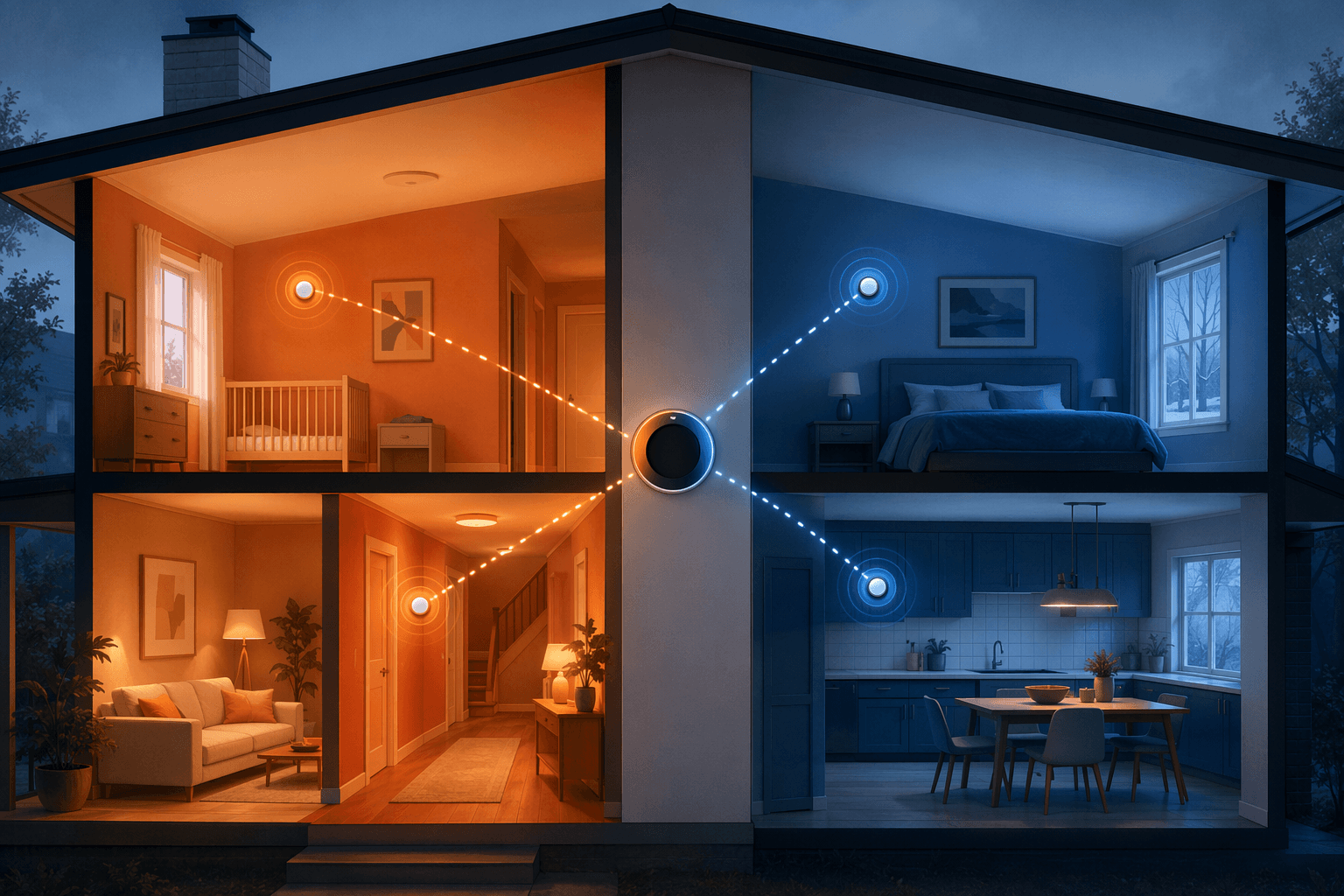
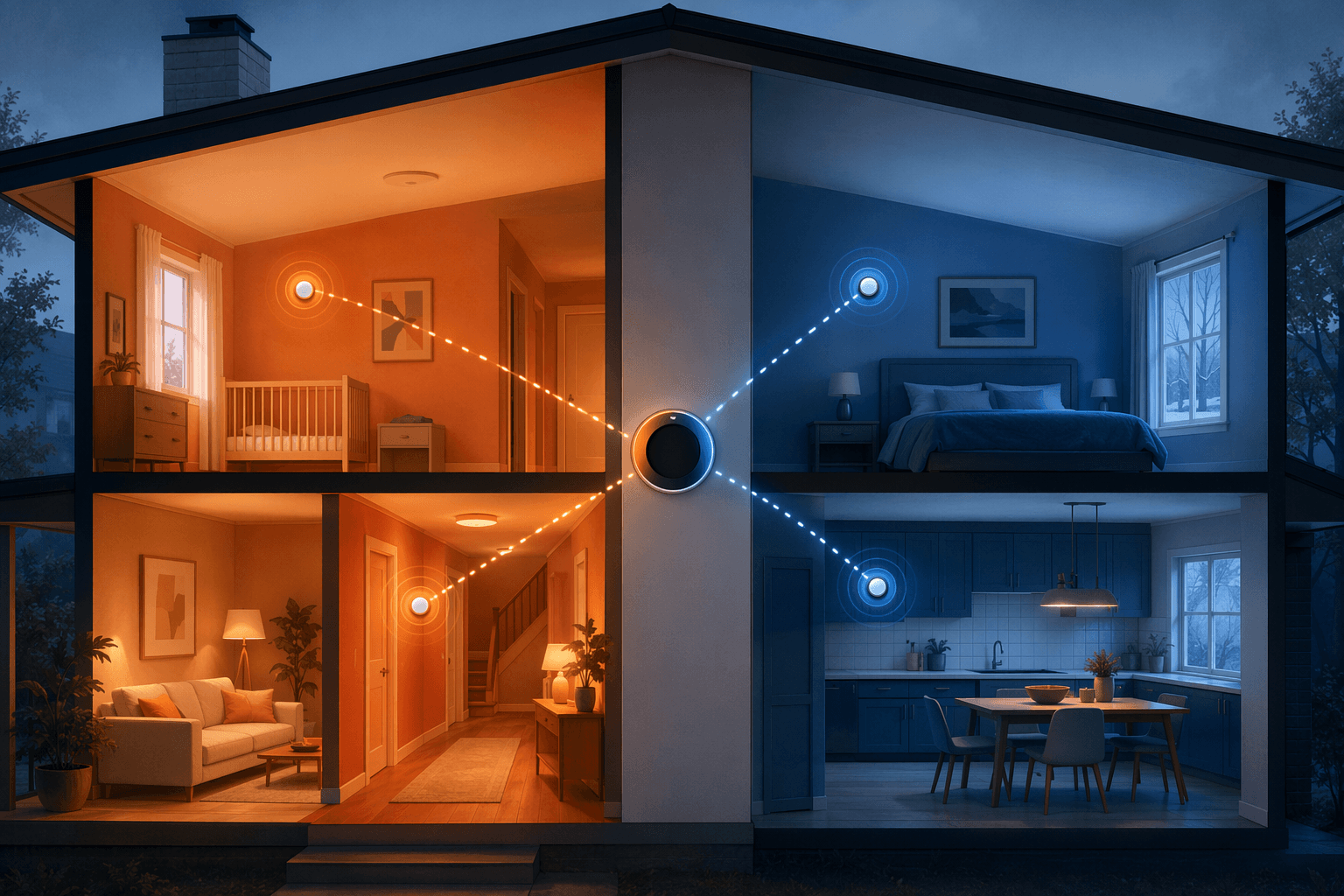
The hallway thermostat is satisfied. The bedroom is not. That is the whole reason most people start shopping for a smart thermostat with remote sensor support: not because the thermostat needs a nicer screen, but because the room that actually matters is not the room where the thermostat happens to be mounted.
Remote sensors can help, but they do not turn a normal single-zone HVAC system into room-by-room climate control. If one furnace or air conditioner serves the whole zone, it still heats or cools the whole zone at once; sensors only change which room, or group of rooms, the thermostat tries to satisfy before it stops the system.[1][2] That distinction matters. A sensor can make the nursery the deciding room at night. It cannot cool the upstairs office while leaving the downstairs living room untouched unless the home also has zoning hardware or another way to control airflow separately.
That caveat does not make sensors minor. It makes the sensor system the real product. Ecobee, Nest, Honeywell, and Sensi all sell thermostats that can read temperatures away from the wall unit, but they make very different decisions about presence detection, room averaging, sensor capacity, wireless range, battery life, and what the buyer has to pay after the thermostat is already in the cart.
Remote Sensor Comparison
| Thermostat | What the remote sensor detects | Comfort logic | Maximum sensors | Stated or typical range | Battery life | Sensor included? | Approx. sensor cost |
|---|---|---|---|---|---|---|---|
| Ecobee Smart Thermostat Premium | Temperature and occupancy | Follow Me can average occupied rooms; Smart Home/Away uses motion | Up to 32 | About 45 ft using proprietary RF | About 5 years | Yes, one SmartSensor included | About $75 per pair, or $37.50 each |
| Nest Learning Thermostat 4th Gen | Temperature only | Can average sensors; no presence-aware room following | Up to 6 | About 50 ft over Bluetooth LE | Not specified in cited sources | No | About $38 each |
| Honeywell Home T9 | Temperature, humidity, and motion | Can follow rooms where motion is detected | Up to 20 | Typically about 50-75 ft; XRSENSOR model claims up to 200 ft | Not specified in cited sources | Varies by bundle | About $30-40 each |
| Sensi Touch 2 | Temperature only | Simpler remote temperature balancing; no presence-based averaging | Up to 15 | Not specified in cited sources | Not specified in cited sources | No, all sensors sold separately | About $40 each |
| Honeywell X8S | Remote sensor support; long-range claims | Newer Honeywell premium sensor path, with limited long-term reliability data | Not specified in cited sources | Long-range claims | Not specified in cited sources | At least one sensor included | Not specified in cited sources |
The table explains why these thermostats should not be treated as interchangeable. Ecobee is not just “a thermostat that works with sensors”; it has occupancy-aware sensors and room-following logic. Nest’s 4th generation is a serious improvement over the older Nest sensor model because it can finally average across sensors, but its sensors still do not know whether anyone is in the room. Honeywell T9 has the most ambitious sensor package on paper, with temperature, humidity, motion, and high sensor capacity, but its discontinued status changes the buying advice. Sensi Touch 2 is easier to understand: it can scale to several rooms, but the sensors are temperature-only and sold separately.
The HVAC Caveat Buyers Should Not Skip
A remote sensor changes the thermostat’s evidence. It does not change the ductwork. If the main thermostat is in a warm hallway and the upstairs bedroom runs cold in winter, a bedroom sensor can tell the system to keep heating until that bedroom reaches the target. The likely consequence is that other rooms may get warmer than before. Sometimes that is exactly the trade a household wants. Sometimes it exposes a bigger balancing problem.
This is also why the best sensor system depends on the house pattern. A remote sensor used only for sleeping comfort has a different job from a network of sensors in a long ranch house, a finished basement, a nursery, a home office, and a living room that fills and empties at irregular times. The purchase should start with the rooms that need to be satisfied, not with the thermostat body on the wall.
Presence Detection Is the Real Divide
Temperature-only sensors answer one question: what is the temperature in this room? Presence-aware sensors answer a second, more useful question: is anyone using this room right now? The difference is not academic when a house has a guest room, spare bedroom, finished basement, or office that is occupied unpredictably.
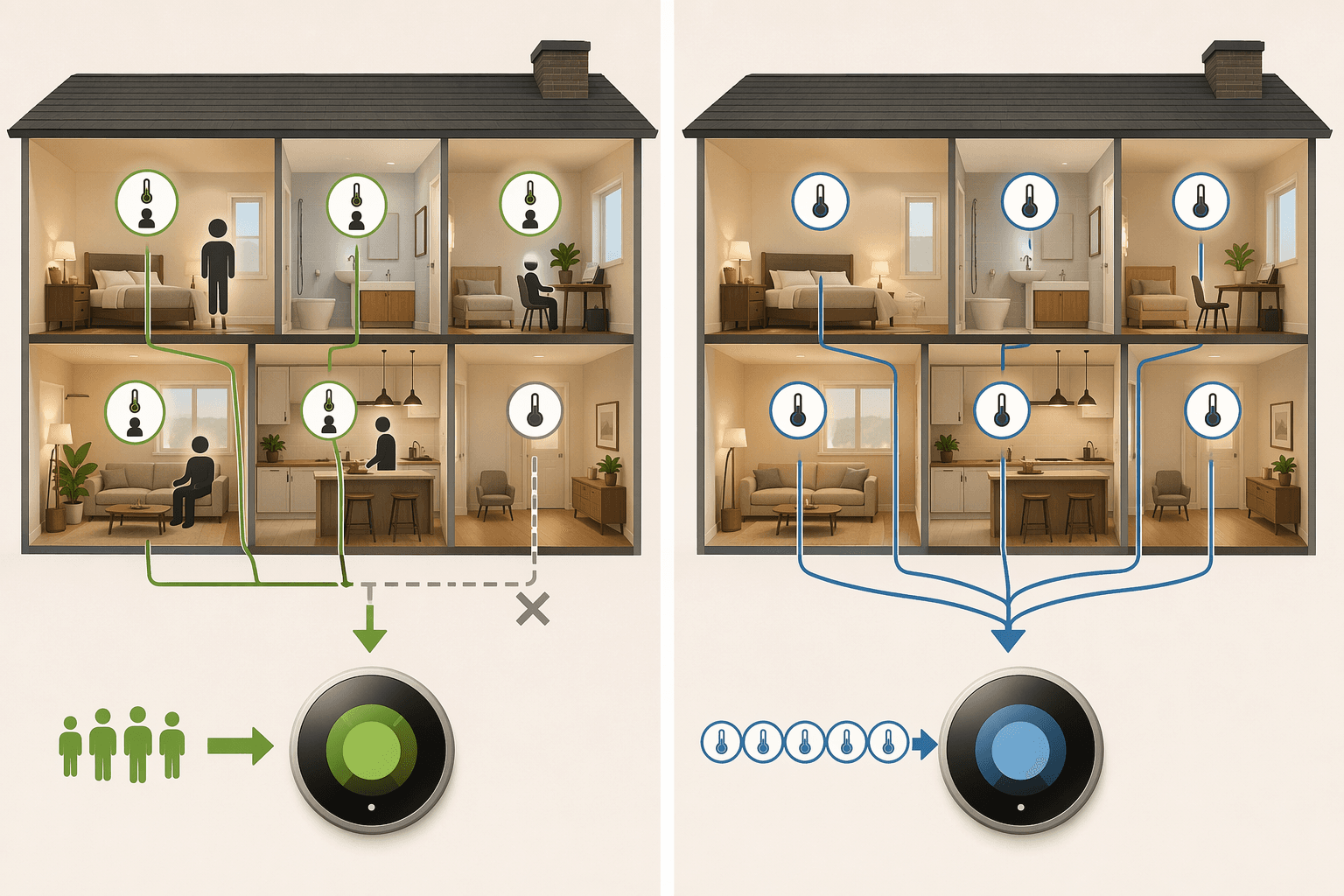
Ecobee’s SmartSensor measures temperature and occupancy, supports up to 32 sensors, has an approximately 45-foot proprietary RF range, and is rated for about 5 years of battery life. Ecobee Premium includes one SmartSensor, while additional sensors are sold at about $75 per pair.[3][4][5] The important behavior is Follow Me: Ecobee can average the temperatures in occupied rooms instead of giving equal weight to every sensor in the system. Smart Home/Away can also use motion information to adjust when no occupancy is detected.[4]
That makes Ecobee the strongest fit for households where room use changes throughout the day. A living room in the evening, a home office during work hours, and a bedroom at night should not all have the same priority at all times. Presence detection gives the thermostat a way to stop treating an empty room as equally important just because a sensor exists there.
Nest’s 4th-generation Learning Thermostat is better than older Nest setups for multi-room comfort because it finally supports averaging across sensors. The earlier 3rd-generation approach could prioritize one room on a schedule, but it did not offer the same kind of averaging across rooms. The current Nest sensors remain temperature-only, support up to 6 sensors, use Bluetooth LE with a range of about 50 feet, and cost about $38 each.[6][2]
That improvement matters. A household that wants the thermostat to consider the bedroom and hallway together now has a more credible Nest option than it did before. But Nest still cannot tell whether the cool spare bedroom is empty or whether someone is actually trying to sleep there. For a regular schedule, that may be acceptable. For shifting occupancy, it is a weaker sensor system than Ecobee or Honeywell T9.
Honeywell T9 is the specification standout in another way. Its room sensors track temperature, humidity, and motion; the system supports up to 20 sensors; and it can follow rooms where motion is detected. Typical range is described around 50-75 feet, while the XRSENSOR model claims up to 200 feet.[7][8] For a large or awkward floor plan, those numbers are not decorative. They decide whether the sensor network can actually reach the rooms causing the complaint.
The T9 problem is availability. Honeywell lists the T9 as discontinued or sold out as of Q2 2026 in the Honeywell T9 profile cited below.[9] That does not erase what the T9 sensor system does well, and existing owners still have a capable multi-room setup. It does mean a new buyer should be careful about paying a premium for leftover inventory or building a new comfort plan around a model that may be harder to replace later.
Sensi Touch 2 sits on the simpler side. It supports up to 15 room sensors, but all are sold separately at about $40 each. The sensors are temperature-only, with no motion or humidity detection, and the system does not offer presence-based averaging.[10][3] That is not a flaw for every buyer. If the goal is to keep one bedroom from being ignored by a hallway thermostat, temperature-only sensing may be enough.
Honeywell X8S is the harder call. It is a newer premium model, released in late 2025, includes at least one sensor, and is positioned around long-range sensor claims.[8][7] The attraction is obvious for homes where range is the limiting factor. The restraint is also obvious: it does not yet have the same long-term reliability record as established Nest and Ecobee lines, or even the older Honeywell T9.
Averaging, Priority, and Follow Logic
The phrase “remote sensor” hides several different behaviors. Some systems average multiple rooms. Some prioritize a scheduled room. Some can follow occupancy. Some simply let the thermostat read a temperature somewhere else. These are not small interface differences; they decide which person in the house waits for the system to catch up.
| Sensor behavior | What it does in daily use | Best fit |
|---|---|---|
| Temperature-only priority | Uses a selected room sensor as the deciding temperature source during a chosen period | Bedrooms at night, a nursery, or a predictable home office schedule |
| Temperature averaging | Blends readings from multiple selected sensors instead of obeying only the wall thermostat | Compact homes where several occupied rooms need a reasonable shared compromise |
| Presence-aware averaging | Weights or selects rooms based on detected occupancy, not just sensor placement | Households where people move among rooms unpredictably |
| Motion-plus-humidity sensing | Adds occupancy and humidity context to room-level temperature readings | Larger homes, many-room monitoring, or rooms where humidity affects comfort |
Ecobee’s Follow Me behavior is the most complete version of the idea because it connects temperature to occupancy. If the living room and office are occupied, those rooms can matter. If the basement sensor sees a cool room but no one is downstairs, it does not have to keep dragging the whole system toward that unused space. That is the difference between reporting a problem and knowing whether the problem currently matters.
Nest’s 4th-generation averaging closes a real gap. A buyer who ruled out Nest because earlier remote sensor behavior was too limited should reassess the current model. Still, averaging without presence has a ceiling. If three rooms are included and one is empty, the thermostat is still using that empty room’s temperature unless the user changes the setup or schedule.
Honeywell T9’s motion-aware room following is the closest rival to Ecobee on comfort logic, and its humidity sensing gives it another layer of room context. Humidity does not make a room warmer or cooler by itself, but it affects how comfortable the room feels and can matter in basements, bedrooms, and climates where cooling is partly a moisture problem.
Sensi’s simpler system is easiest to justify when the room priority is known in advance. If the problem is “the upstairs bedroom is cold every night,” the sensor does not need to detect motion to be useful. If the problem is “someone may be in the office, basement, guest room, or den at different times,” temperature-only scheduling starts to feel like a manual workaround.
Cost Changes the Shape of the System
A thermostat with one remote sensor is a different purchase from a thermostat that needs six. Sensor pricing matters because uneven-temperature problems are often discovered room by room. The first sensor goes in the bedroom. Then someone notices the office. Then the basement. Then the nursery. The system cost grows quietly.
Ecobee’s included SmartSensor gives the Premium model a practical head start, and the additional pair price works out to about $37.50 per sensor.[3][4] Nest sensors are about $38 each, but without presence detection.[6] Sensi sensors are about $40 each and also temperature-only.[10][3] Honeywell T9 sensors are roughly $30-40 each and include motion, with the discontinued thermostat caveat attached.[7][9]
That makes Ecobee’s sensor pricing look better than it might at first glance. It is not simply near Nest and Sensi on price; it is near them while adding occupancy detection. For a two- or three-sensor setup, that is usually the more meaningful comparison than the thermostat’s display, voice assistant options, or app polish.
Manufacturer energy-savings claims should stay in the background here. Ecobee’s 26% savings claim is manufacturer material cited in CNET coverage, and Nest’s 12-15% figure comes from Google’s own study.[8][6] Those numbers may be directionally useful, but they are not the best way to choose among remote sensor systems. A sensor purchase is first about whether the HVAC system is listening to the right room.
Which Sensor System Fits Which House?
The right answer changes once the house becomes specific. A compact two-story home with one bad bedroom does not need the same system as a long ranch layout with weak signal reach, or a busy household where rooms fill and empty all day.
For Unpredictable Occupancy
Ecobee Premium is the cleanest recommendation when people move through the house unpredictably. Its sensors combine temperature and occupancy, and Follow Me can focus comfort around occupied rooms instead of treating every sensor as equally important.[4] That makes it the best match for families with shifting schedules, hybrid workdays, playrooms, guest rooms, and living spaces that matter at different hours.
Honeywell T9 also fits this use case well on sensor behavior, especially because its sensors add humidity and motion. The trouble is not the logic; it is the discontinued status for new buyers. If a buyer already owns a T9, the sensor system remains one of the strongest. If they are buying from scratch in 2026, availability and replacement confidence have to be part of the decision.
For One Bedroom, Nursery, or Office
Nest 4th Gen becomes much easier to recommend when the goal is predictable room comfort. If the buyer wants the bedroom considered every night, temperature averaging and scheduled room attention may be enough. The 6-sensor limit is not restrictive for a small setup, and the per-sensor price is in line with Ecobee and Sensi.[6]
Sensi Touch 2 also belongs in this category. It is not trying to infer which room matters from motion, but a simple bedroom or office problem may not require that. The buyer should just include the sensor cost from the beginning because the thermostat does not include one.
For Large Homes and Long Floor Plans
Range and sensor count start to matter more in a long ranch house, a thick-walled older home, or a layout with a finished basement far from the thermostat. Ecobee’s 32-sensor support is generous, but its approximately 45-foot RF range may require careful placement.[3][4][5] Nest’s roughly 50-foot Bluetooth LE range and 6-sensor limit are more restrictive for sprawling layouts.[6]
Honeywell T9’s 20-sensor capacity and the XRSENSOR’s claimed range of up to 200 feet are the specs that stand out for reach.[7] Honeywell X8S is also interesting here because it is positioned around long-range sensor performance, but the sources available for Q2 2026 do not support treating it as a proven winner yet.[8][7]
For Many-Room Monitoring
If the plan is to monitor many rooms, the maximum sensor count quickly filters the list. Ecobee supports up to 32 sensors, Honeywell T9 supports up to 20, Sensi Touch 2 supports up to 15, and Nest 4th Gen supports up to 6.[3][7][10][6] Those limits do not mean every home should be filled with sensors. They do matter when a buyer wants to cover bedrooms, offices, basement spaces, and main living areas without hitting the ceiling too early.
Sensor count alone is not the whole answer. Ten temperature-only sensors can still create a dumb average if the system does not know which rooms are occupied. For many-room monitoring, Ecobee’s combination of high capacity and occupancy detection is stronger than a large sensor count by itself. Honeywell T9 would be a very strong alternative if it were still a straightforward current-model purchase.
For Risk-Averse Buyers
Risk-averse buyers should separate two kinds of risk: model availability and maturity. Honeywell T9 has mature, compelling sensor behavior, but discontinued availability is a practical risk. Honeywell X8S is current and promising, especially for range, but it lacks the long-term reliability record of established Ecobee and Nest lines in the cited sources.
For that buyer, Ecobee Premium is the steadier sensor-first choice when occupancy matters. Nest 4th Gen is the steadier choice when the household prefers the Nest ecosystem and only needs temperature averaging for a few rooms. Sensi Touch 2 is a reasonable simpler option when the buyer wants remote temperature readings without paying for presence-aware logic they will not use.
The Practical Verdict
Ecobee Premium is the strongest all-around sensor system for uneven temperatures in a lived-in house, especially when occupancy changes by room and time of day. The included sensor, occupancy detection, Follow Me averaging, high sensor capacity, and reasonable per-sensor cost make it the most complete answer for people buying the thermostat because the wall location is wrong.
Nest Learning Thermostat 4th Gen is no longer easy to dismiss for remote sensors. Averaging is the important upgrade, and it makes Nest credible for bedrooms, nurseries, and small multi-room setups. It remains weaker when presence matters because its sensors are temperature-only.
Honeywell T9 deserves respect for sensor depth and capacity. Temperature, humidity, motion, room following, and up to 20 sensors are exactly the kinds of specs that matter for multi-room comfort. Its discontinued status is the reason it stops short of being the easy 2026 recommendation for new buyers.
Sensi Touch 2 is best for simpler temperature-balancing jobs where presence detection would be nice but not necessary. Honeywell X8S is the watch item for buyers who need range and want a current Honeywell model, but the available research supports caution until it has more reliability history.
Choose the sensor behavior that matches the rooms you actually need to satisfy. For this purchase, the remote sensor system is the thermostat.
References
- The Best Smart Thermostats for 2026, CNET, 2026.
- The Best Smart Thermostat, Wirecutter, 2026.
- The Best Smart Thermostats for 2026, PCMag, 2026.
- SmartSensor for doors and windows, Ecobee.
- Ecobee vs Nest: Smart Thermostat Comparison, Smart Home Compared, June 2026.
- Nest Temperature Sensor and Nest Learning Thermostat, Google Nest Help.
- T9 Smart Thermostat with Sensor, Honeywell Home.
- Honeywell Home X8S Smart Thermostat, Honeywell Home.
- Honeywell T9 Smart Thermostat, site device profile, Q2 2026.
- Compare Sensi smart thermostats, Sensi.
Data Updates
Know about updated rebate programs, changed subscription prices, or new ENERGY STAR certifications? Submit a note below to help keep this content current. For formal data corrections, use the contact page.
Comments
Join the discussion with an anonymous comment.