
Is a Smart Home Hub Worth It After Apple's Price Hikes?
Apple's June 2026 price increases make 'is a smart home hub worth it' a timing-and-role question, not a simple yes or no. Separating confirmed post-hike hub prices from attributed iPhone 18 Pro estimates, the guide shows what a HomePod mini or Apple TV still does that an iPhone can't, and maps buy-now, wait-for-refresh, and skip-the-hub calls to specific needs.
Last updated
After Apple’s June 25, 2026 price increases, the smart-home hub decision became easier to resent and harder to ignore. The HomePod mini moved from $99 to $129, the full-size HomePod from $299 to $349, the Apple TV 4K Wi-Fi from $129 to $199, and the Apple TV 4K Wi-Fi + Ethernet from $149 to $249 in the U.S. [1] At the same time, iPhone 18 Pro pricing is still only estimated: Jeff Pu of GF Securities has put the possible increase at $250 to $300 over the current $1,099 and $1,199 Pro starting prices, while 9to5Mac summarized separate WSJ/TechInsights modeling at $1,299 to $1,399 and Mark Gurman’s expectation at $100 to $200 more. [2][3]
That distinction matters. The hub prices are confirmed post-hike baselines as of Q3 2026. The iPhone 18 Pro figures are attributed estimates as of August 25, 2026, not Apple pricing. So the useful question is not whether every Apple device is getting too expensive. It is narrower: what must a HomePod mini or Apple TV do that an iPhone 15 Pro or newer cannot?
| Item | Status on August 25, 2026 | Why it matters for the hub decision |
|---|---|---|
| HomePod mini, HomePod, Apple TV 4K prices | Confirmed June 25, 2026 U.S. increases: HomePod mini $129, HomePod $349, Apple TV 4K Wi-Fi $199, Apple TV 4K Wi-Fi + Ethernet $249 [1] | These are the current baseline prices to use when deciding whether to buy hub hardware now. |
| iPhone 18 Pro pricing | Unconfirmed estimates: Jeff Pu at +$250 to +$300; WSJ/TechInsights modeling at $1,299 to $1,399; Gurman expecting +$100 to +$200 [2][3] | These estimates raise the opportunity-cost question, but they should not be treated as Apple’s announced prices. |
| Rumored Apple HomeHub display | Unconfirmed | It may be worth watching, but it should not be the reason to buy or delay unless Apple actually announces it. |
The iPhone can start the home; it still does not replace the home hub
If you own an iPhone 15 Pro or newer, the phone is no longer helpless without a hub for basic Matter onboarding. With iOS 18, Apple added a path for adding Matter devices to Apple Home without first requiring a HomePod or Apple TV home hub, using the iPhone’s newer radio capabilities for supported accessories. [4] For a household that only wants to pair a compatible device from the couch and control it while at home, that is a real reason not to rush into a $129 speaker or a $199 streaming box.
The limit is role, not branding. Your iPhone is with you. It sleeps, travels, changes networks, gets rebooted, and belongs to one person. A home hub is meant to stay in the home and remain available for the household. Apple’s own home-hub support path still points to HomePod, HomePod mini, or Apple TV for controlling the home while away and running automations. [5] Thread routing is also not something an iPhone simply becomes for the home; Thread-based accessories need a Thread border router, which can be a supported Apple home hub or another supported third-party border router. [6]
This is the cleanest way to separate the purchase from the feeling of duplication. Buying a HomePod mini just so an iPhone user can add one Matter plug is weak. Buying a hub because the front-door sensor needs to trigger lights when nobody is home, because a water-leak alert should matter while you are away, or because Thread devices need a stable border router is a different decision.
The old “use an iPad you already own” escape hatch should also be treated carefully. In the current Apple Home architecture, Apple’s supported home-hub path is HomePod, HomePod mini, or Apple TV, not iPad. [5] If an iPad still appears to work in a particular legacy setup, that is not the path to plan a new 2026 Apple Home purchase around.
For the phone-side version of this boundary, see NestGrid’s iPhone smart-home hub compatibility guide and the companion phone-is-not-a-hub explainer. This article is the other side of the decision: whether to spend money on the hub hardware itself after the June 2026 price reset.
The Q3 2026 decision matrix
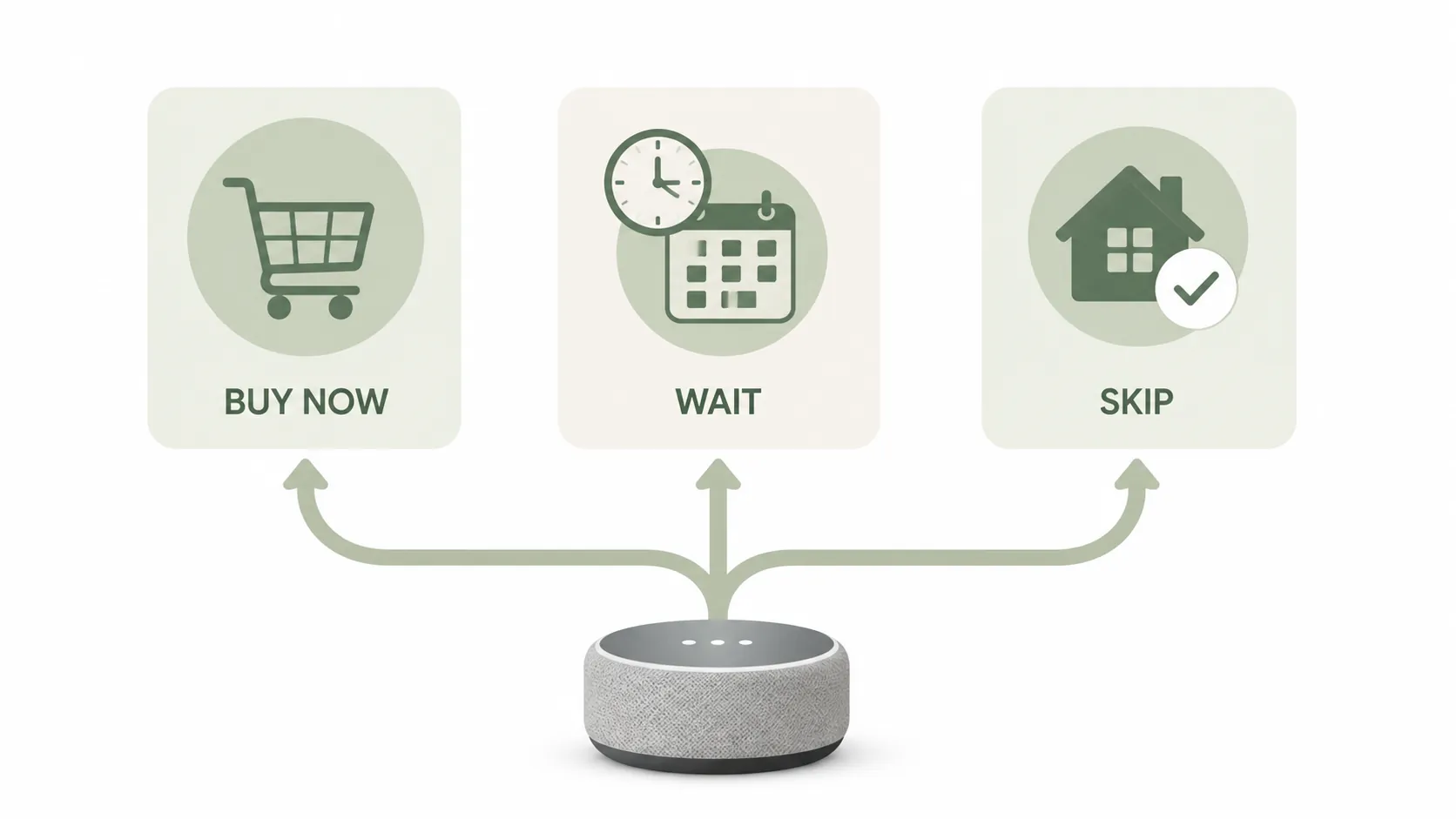
| Your actual need | Better call | Reason |
|---|---|---|
| You need automations, remote access, or Thread routing before any late-2026 refresh | Buy now | Those are hub-role functions, not just phone setup conveniences. Paying more is unpleasant, but the device is doing work the iPhone does not reliably do as the household’s always-home coordinator. [5][6] |
| You only need to add a few Matter devices from an iPhone 15 Pro or newer and can live without away-from-home control or automations for now | Wait | The phone can cover basic Matter setup for supported accessories, while current hub hardware is facing both higher prices and buyer-guide caution. [4][7] |
| You mostly control devices locally, do not use serious automations, and do not need Thread border routing | Skip the dedicated hub for now | There is no good reason to buy a HomePod mini or Apple TV merely to duplicate simple phone-based control. |
| You were already buying an Apple TV 4K for streaming, family use, or Ethernet placement | Buy only if the non-hub use also justifies it | The hub role can strengthen the purchase, but it should not be hidden inside a purchase you would otherwise avoid at $199 or $249. [1] |
| You are mainly waiting for the rumored Apple HomeHub display | Wait, but do not count it as a product yet | An unannounced display should not drive a current hub recommendation. It can only affect timing if your present setup can safely get by without the hub-only functions. |
When buying now is still defensible
Buying a first hub after the price hike makes sense when the home already has a job waiting for it. The most obvious cases are remote access and automations. If you expect lights to react when a door opens, a leak sensor to matter when nobody is home, or a schedule to run without depending on one person’s phone, the hub is not a decorative add-on. It is the device that stays behind.
Thread can make the same point in a less visible way. A Thread accessory may look like an ordinary smart-home purchase, but the network still needs a border router. Apple’s support material treats Thread border routing as a role for supported home hubs or supported third-party border routers, not as a generic iPhone feature. [6] If your planned accessory mix depends on Thread, check the exact hub model before buying rather than assuming every Apple box on a shelf solves it.
The practical split between HomePod mini and Apple TV is usually not about which one has the nicer spec sheet. If you want the lowest Apple-home-hub entry point and can use a small speaker, the HomePod mini’s new $129 price is the floor. If an Apple TV already belongs in the room for streaming, shared household use, or wired placement, the higher $199 or $249 price may be easier to justify because the device is not being bought only as infrastructure. [1]
The mistake is buying now because a hub sounds mandatory in every Apple Home setup. It is not. The defensible buy-now case starts with the missing function, then chooses the hardware.
When waiting is the lower-risk choice
Waiting is strongest when your iPhone can carry the near-term setup and the hub would mostly be a hedge. That is especially true in Q3 2026 because the price hike landed while Apple’s current hub options are not fresh hardware. MacRumors’ Buyer's Guide flags both Apple TV and HomePod mini as “Don’t Buy,” and the June price coverage framed the increase against the wait for new models. [7][1]
That does not mean nobody should buy. A “Don’t Buy” label is a timing signal, not a house rule. It carries the most weight for someone who can tolerate a few months of simpler control, can delay Thread-heavy purchases, or does not yet know which automations will actually matter. It carries less weight for someone who already has devices installed and is losing useful features every day without a hub.
The iPhone 18 Pro rumor cycle should be treated the same way. If the next iPhone may cost more, tying up another $129 to $249 in hub hardware deserves scrutiny. But the estimates are still estimates, and they do not answer the hub-role question by themselves. A rumored iPhone price increase can make waiting feel smarter; it cannot make automations run or Thread route in a home that needs those functions now. [2][3]
The rumored Apple HomeHub display belongs even further from the center of the decision. It may become relevant if Apple announces it, prices it, and defines how it works as a hub. Until then, it is a reason to avoid overconfidence, not a product to budget around.
When skipping the hub is reasonable
Skipping the dedicated hub is reasonable when the home is intentionally simple. If the setup is a few accessories controlled from an iPhone while people are home, and nobody depends on automations, remote access, or Thread routing, the higher post-hike prices make restraint easier to defend.
This is also where personal tolerance enters. Some households value a shared speaker, Siri access in a room, or an Apple TV interface enough that the hub role feels like a bonus. Others see those same benefits as clutter. The technical answer can say what the hub adds; it cannot decide how much a household values convenience, voice control, or familiarity.
The one caution is to skip consciously. A household that skips a hub should know what it is giving up before buying sensors or Thread devices that assume always-on infrastructure. If the plan changes, use the iPhone 18 Pro HomeKit setup recipe after choosing the hub path, and cross-check the phone-side cost question in NestGrid’s iPhone 18 Pro Max smart-home price guide.
The dated answer
As of August 25, 2026, a smart home hub is worth buying after Apple’s price hikes only when it has an immediate always-home job: remote access, automations, or Thread border routing. If an iPhone 15 Pro or newer covers the next few months of basic Matter setup, waiting is the cleaner call while Apple TV and HomePod mini sit under buyer-guide caution and refresh rumors remain unresolved. If the home is deliberately light and local, skipping the dedicated hub is not a compromise; it is the correct way to avoid paying for hardware that has no role yet.
References
- Apple TV and HomePod Just Went Up in Price Amid Wait for New Models, MacRumors, June 25, 2026
- iPhone 18 Pro Models Could Be Up to $300 More Expensive, Says Analyst, MacRumors, July 31, 2026
- iPhone 18 Pro price: Here’s how much more it could cost, 9to5Mac, August 6, 2026
- Apple now lets you add Matter devices to Apple Home without a hub, The Verge, September 18, 2024
- Set up your HomePod, HomePod mini, or Apple TV as a home hub, Apple Support
- Use Matter accessories with Apple Home, Apple Support
- MacRumors Buyer's Guide, MacRumors
Known issues with this device / protocol
Spec-version history
For active regressions on this protocol, see Update Watch.
No linked Update Watch entries yet.