
What China Trade Sanctions Mean for Your Smart Home
US–China trade policy now reaches smart-home gear through four separate measures — device tariffs, the FCC router ban, China's IoT export controls, and the end of de minimis — and most devices keep working even when they cost more. This dated breakdown separates what breaks from what just costs more, with buy, hold, or keep guidance for US owners as of August 2026.
Last updated
As of August 2026: most installed smart-home gear keeps working
For U.S. smart-home owners, China trade sanctions and related trade measures do not create a single on/off event for your house. A working camera, plug, hub, thermostat, or older router does not usually stop working because a tariff rate changed. The real split, as of August 25, 2026, is between gear that merely gets more expensive and gear that now needs a model, purchase-channel, or component-risk check before you buy.
- Keep: installed smart plugs, cameras, sensors, hubs, and routers that are still receiving security updates and working with your Wi-Fi. Trade policy is not a reason by itself to rip them out.
- Verify before buying: new consumer router models produced in foreign countries covered by the FCC action. The FCC says the restriction applies to new models, while previously authorized routers remain importable, sellable, and usable; the firmware-update waiver has been extended to at least January 1, 2029.[1][2]
- Reprice before ordering: direct-from-China or Hong Kong parcels that used to slide in under the $800 de minimis threshold. That channel changed after the exemption ended for China and Hong Kong on May 2, 2025, and globally by late August 2025; sub-$800 China parcels now face roughly a 54% tariff or a $100 flat fee.[3]
- Expect pressure, not instant failure: device tariffs can raise shelf prices or shrink promotional inventory. Yale Budget Lab put the U.S. average effective tariff rate at about 16.9% as of January 2026, and CTA reported consumer-technology importers paid $23.5 billion in tariffs in 2025, up from $4.0 billion in 2024.[4][5]
- Watch the support horizon: China’s IoT, rare-earth, and dual-use controls are mainly an availability and future-support risk, especially for components a shopper cannot identify from a product photo.[6]
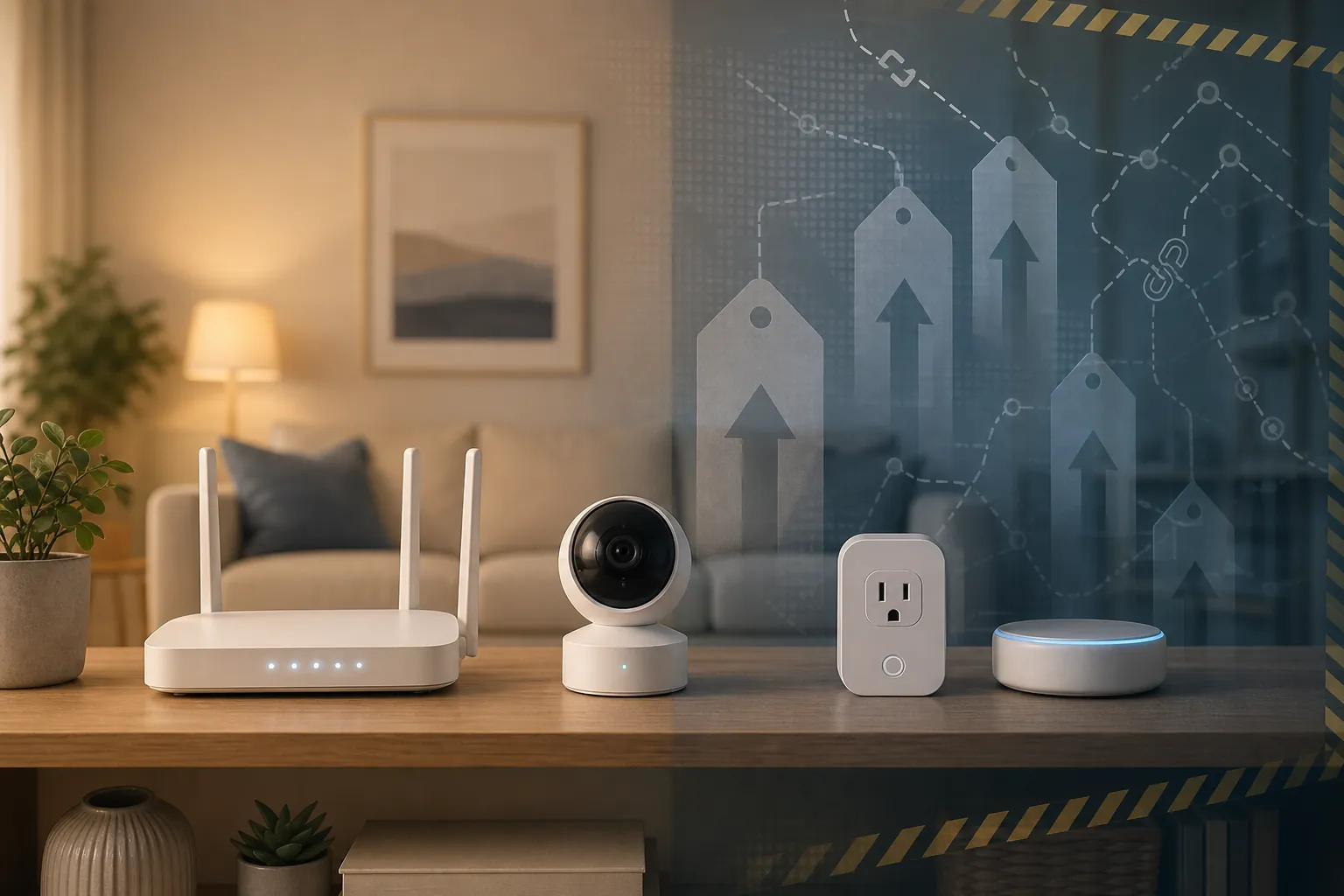
That distinction matters because unnecessary churn is where a lot of smart-home pain starts. A router swap can break bulbs that were fine yesterday. A replacement camera may require a new subscription tier. A bargain plug that looked cheaper than the name-brand option can stop being a bargain once the landed cost is visible. The safest answer is not “buy American” or “avoid China” as a blanket rule. It is: check the device category, the policy channel, the purchase path, and the date.
Four policy threads, three ways they reach your devices
For a smart-home owner, the policy map is easier to read if it is sorted by consequence. The same headline can touch price, availability, and support horizon differently.
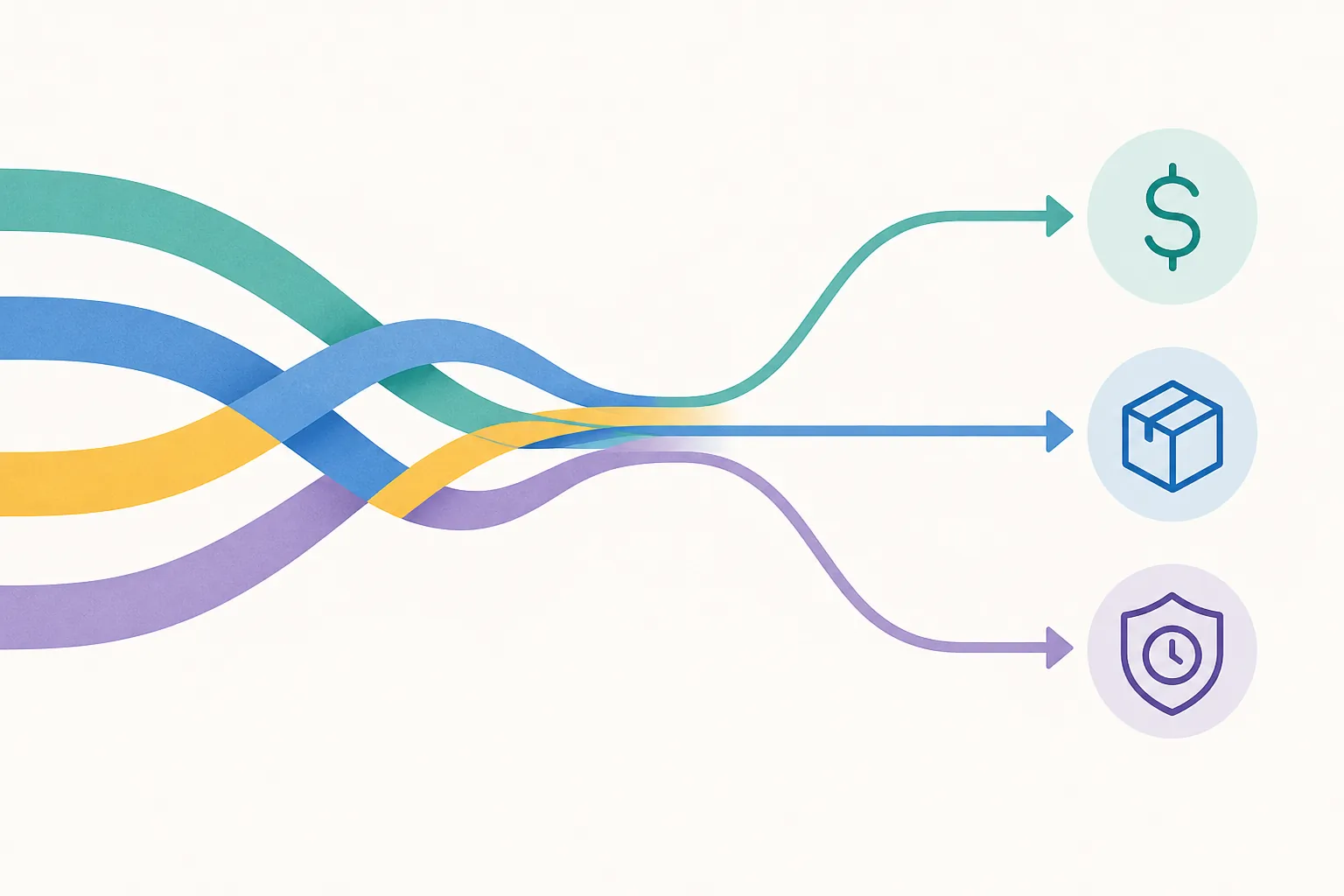
| Policy thread | Price channel | Availability channel | Support-horizon channel |
|---|---|---|---|
| Device tariffs | Import costs can become higher shelf prices, smaller discounts, or fewer cheap bundles. Yale Budget Lab estimated consumer electronics and electrical equipment could face about 18% short-run price increases under full passthrough as of January 2026.[4] | Retailers may carry fewer low-margin variants, delay launches, or favor models with better tariff math. | Usually indirect. Tariffs do not disable installed devices, but they can make brands trim accessories, replacement parts, or low-volume SKUs. |
| FCC foreign-made consumer router restriction | Not primarily a tariff. The price effect comes from model substitution, compliance work, and reduced choice rather than a simple duty line. | Directly relevant to new models of covered foreign-produced consumer routers. Previously authorized routers remain importable, sellable, and usable.[1][2] | Important but bounded. Firmware-update authorization for covered routers has been extended to at least January 1, 2029, so existing authorized gear is not cut off immediately.[1] |
| China IoT, rare-earth, and dual-use export controls | May raise component costs where controlled materials or semiconductor compounds are involved, but the shopper usually sees this as a product price or margin change rather than a labeled materials surcharge.[6] | Can affect availability of components used in sensors, radios, optics, power electronics, and industrial IoT supply chains; this is more likely to show up as delayed or changed models than a dead device on your shelf.[6] | Meaningful for future parts, model continuity, and long-term repairability. The April 2026 measures add compliance friction that can discourage transparent supply-chain documentation.[6] |
| End of de minimis | Direct-from-China bargain parcels are more exposed because sub-$800 shipments no longer receive the same duty-free treatment; China/Hong Kong ended May 2, 2025, and the global end followed by late August 2025.[3] | Some ultra-cheap direct-import listings may disappear, consolidate shipping, raise minimum order values, or become less predictable at checkout. | Mostly indirect. The bigger risk is buying obscure devices with thin documentation and weak update promises because the low price still looks attractive before fees. |
The table is also a warning against headline math. A tariff number does not tell you whether a device is legal to import. A router authorization rule does not tell you whether your smart plug will keep working. A rare-earth control does not mean your camera goes dark tonight. These are separate mechanisms, and they need separate decisions.
Tariffs usually become price pressure, not device failure
The tariff channel matters because smart-home adoption is price-sensitive. Parks Associates reported that 45% of U.S. internet households own at least one core smart-home device, and that affordability is the top barrier among non-owners.[7] That is exactly the layer where a few dollars can change behavior: extra sensors for a back door, a second indoor camera, a four-pack of plugs, or the difference between a budget hub and waiting another year.
The 2026 tariff baseline needs a date stamp. Yale Budget Lab estimated the U.S. average effective tariff rate at about 16.9% as of January 19, 2026, the highest since 1932, and estimated about an 18% short-run price increase for consumer electronics and electrical equipment under full passthrough.[4] CTA’s May 2026 snapshot gives the importer-side view: consumer-technology importers paid $23.5 billion in tariffs in 2025, compared with $4.0 billion in 2024, while the industry average tariff rate rose from 1% to 7%.[5]
Those figures are useful because they are dated, not because they will stay still. The recent path has already included a February 2025 increase, a much steeper April 2025 spike, a May 2025 truce level, a February 2026 Supreme Court IEEPA ruling, Section 122 moves, and July 2026 Section 301 forced-labor tariffs in the 10% to 12.5% range.[4] A smart-home buying guide that treats one rate as permanent is already doing the wrong job.
Brand exposure is real, but it is not tidy brand blame. Seam’s assembly-exposure tables are helpful because they show how many familiar smart-home categories still depend on China-linked manufacturing, including locks, cameras, sensors, thermostats, and hubs.[8] That does not prove a given model will rise by a given percentage. It tells you where to expect margin pressure, SKU trimming, or fewer generous sale prices.
Wyze’s floodlight case is a concrete example of how ugly the import bill can get: PCMag reported that Wyze imported $167,000 worth of floodlights and was required to pay $255,000 in tariffs.[9] Use that as evidence of hardware import pressure. Do not use every Wyze price change as tariff evidence. A subscription price increase, for example, can be a service-cost decision rather than proof that tariffs are flowing through to cloud plans.
For budget buyers, the practical result is simple: compare the final cart price, not the product-page price. If you are shopping the under-$50 tier, the safer play is a supported device sold through a channel with clear returns and firmware history, not the absolute cheapest listing that only looks cheap before duties, shipping, and replacement risk. The same discipline applies to any budget smart-home starter kit.
The router rule is narrower than the panic version
Routers deserve their own treatment because they sit underneath the whole smart home. The March 23, 2026 FCC action is not a general command to unplug every foreign-made router. The FCC FAQ says the restriction covers new models of foreign-produced consumer routers, while previously authorized routers remain importable, sellable, and usable.[1] Wired’s explainer reaches the same owner-level conclusion: this is a new-model authorization issue, not a retroactive household shutdown.[2]
That does not make the rule irrelevant. If you are buying a router in late 2026, you should verify the exact model and authorization status before treating a sale price as safe. Router listings are often messy: one product family can have multiple hardware revisions, regional variants, and model suffixes. The box photo is not enough.
There is also a reason not to over-focus on a single market-share number. Public discussion of TP-Link’s U.S. router position has used competing estimates, including roughly 35% in Wired’s coverage, higher estimates cited elsewhere, and lower company-positioned figures.[2] For a household decision, the share argument is less useful than the model question: is this exact router currently authorized, supported, and appropriate for your network?
If your current router is stable, patched, and not on the wrong side of its vendor support life, trade policy alone is not a reason to replace it. In fact, a rushed router swap is one of the easiest ways to create smart-home problems that look like device failures but are really Wi-Fi changes: different SSID, different password, band steering behavior, WPA mode changes, or a new router that handles 2.4 GHz devices differently. If you already made that swap and devices disappeared, start with the network-rejoin path in Smart Home Device Not Responding After a Wi-Fi Change before blaming sanctions.
Export controls are the slow-risk channel
China’s rare-earth and IoT export-control actions are the easiest part to exaggerate and the hardest part for a shopper to inspect. They do not map neatly to “this camera works” or “this plug fails.” They matter because modern connected devices depend on materials, chips, sensors, magnets, optical components, power electronics, and radio modules that may sit several layers below the brand printed on the box.
Keep the layers separate. The April 2025 controls remain in force. The October 2025 extraterritorial 0.1% rare-earth rule was suspended for one year from November 10, 2025. The April 2026 measures are separate: IoT M2M Council reported that China’s State Council Orders No. 834 and 835 and the expanded Dual-Use Catalogue, with 846 entries, add controls involving indium phosphide and other III-V compounds, samarium alloys, bismuth, tellurium, and related materials.[6]
The important smart-home consequence is not that an installed motion sensor suddenly stops sensing. It is that future model availability, repair-part access, component substitution, and documentation may become harder. The same IoT M2M Council analysis flags an Article 13 “audit trap,” where supply-chain transparency itself can create compliance exposure.[6] That is the kind of risk a consumer does not see on a product page, but it can still decide whether a brand keeps a model alive for three more years or quietly replaces it with a different platform.
This is where hubs, cameras, locks, and energy devices deserve more patience than impulse gadgets. A hub or camera platform is not just a piece of plastic with a radio. It is firmware, cloud service, app maintenance, replacement accessories, and compatibility promises. If the product already looks abandoned, export-control friction is one more reason not to buy into it. If it is actively supported and sold through normal U.S. retail channels, the better move is to verify support status rather than assume the entire category is unsafe.
Cheap direct imports changed more than cheap domestic shelves
The end of de minimis changes the bargain-gadget calculation more directly than many people expected. Before the change, a sub-$800 direct parcel could often arrive with less visible duty friction. After the China and Hong Kong exemption ended on May 2, 2025, and the global end followed by late August 2025, the final cost of a cheap direct-from-China smart plug, LED controller, camera, or sensor became less predictable.[3]
This does not mean every low-cost gadget on a U.S. retailer’s shelf is suddenly a bad buy. A domestic retailer may have already absorbed, negotiated, or passed through import costs before you see the price. It does mean a direct-import listing deserves a landed-cost check. If the fee structure turns a $22 gadget into a much more expensive purchase, the bargain disappears before you even get to the harder questions: does it have a real support page, does it use a known app, does it receive firmware updates, and can you return it if it arrives as a different hardware revision?
For smart homes, the cheapest device is often the one you do not have to replace. A plug that keeps its firmware updated, stays paired after router maintenance, and works with your existing platform is worth more than a mystery device that saves a few dollars on day one and costs you an evening later.
Buy, hold off, or keep: the August 2026 device-level guide
| Device or purchase situation | Status as of August 2026 | What to check |
|---|---|---|
| Existing installed smart plugs, bulbs, sensors, cameras, hubs | Keep, unless there is a separate security, app-support, or compatibility reason to replace | Confirm firmware/app support, account access, and platform compatibility. Trade policy alone is not a failure event. |
| Existing router that is stable and still patched | Keep with caution | Check vendor security updates and FCC-related status if it is a covered foreign-produced model. The firmware-update waiver runs to at least January 1, 2029.[1] |
| New consumer router purchase | Verify before buying | Check the exact model, hardware revision, FCC authorization, vendor support term, and return policy. Do not rely on brand name alone.[1][2] |
| Router replacement during a sale | Hold off if the only reason is policy panic | Replacing a router can create Wi-Fi compatibility problems for 2.4 GHz devices. Replace for security, performance, or support reasons, not because a headline made the old router feel illegal. |
| Sub-$800 direct-from-China smart-home gadget | Reprice or avoid if the landed cost is unclear | The end of de minimis makes direct parcels more exposed to tariffs or flat fees. Confirm final cost, delivery terms, returns, and firmware support.[3] |
| Budget plugs, sensors, LED controllers, and cameras from U.S. retail | Buy selectively | Prefer models with documented app support, Matter or platform compatibility where relevant, clear returns, and recent reviews from the current hardware revision. |
| Smart-home hub | Buy or keep based on platform need, not tariff fear | A hub is worth it when it reduces device churn or improves local control. If price is the concern, compare the same buy/wait/keep logic used for hub upgrades. |
| Camera subscription or cloud plan | Separate service pricing from hardware tariffs | A cloud-plan price increase is not automatically tariff pass-through. Check whether the change affects recordings, AI detection, device limits, or warranty support. |
| Locks, thermostats, panels, and higher-cost installed devices | Buy with support-horizon checks | Tariff and component exposure matter more because replacement is costly. Verify warranty, battery availability, app history, and whether the model is current. |
For hubs, the trade-policy answer folds into the normal compatibility answer. If a hub lets you keep working Zigbee, Z-Wave, Thread, or Matter devices in service longer, it can be a stabilizer rather than another thing to replace. If the hub only duplicates what your phone app already does, tariff-driven price pressure is a good reason to wait. The same buy-now/wait/keep framework applies in Is a Smart Home Hub Worth It After Apple’s Price Hikes?.
For cameras, the cleanest check is split in two. Hardware price and availability belong to the tariff, de minimis, and component channels. Recording plans, AI detection, cloud storage, and device-count limits belong to the service channel. A camera can become more expensive to buy for one reason and more expensive to keep for another. Treat those as two bills, not one mystery surcharge.
For plugs and sensors, support matters more than prestige. These are the devices most tempting to buy as direct imports and the easiest to scatter around a home in large numbers. A bad batch can create more reset work than the purchase saved. If the price advantage survives duties and shipping, still check app reputation, local-control options, and whether the listing identifies the current hardware version.
For routers, do not generalize from one brand or one market-share estimate. Verify the exact model. Keep a stable, patched router unless there is a separate security or performance reason to move. If you do replace it, plan the migration like a compatibility project: save SSID and password details, confirm 2.4 GHz behavior, check WPA settings, and give yourself time to re-pair stubborn devices.
The verification habit that prevents bad replacements
A smart-home trade-policy check should fit on one line: date, device category, purchase channel, status label. “August 25, 2026 — new router — U.S. retail — verify FCC authorization.” “August 25, 2026 — installed camera — already working — keep unless support ends.” “August 25, 2026 — $35 direct-import plug bundle — reprice landed cost and returns.”
That habit is more useful than trying to predict the next trade move. Tariff actions, waivers, court rulings, export-control changes, and negotiated lists can invalidate a clean answer quickly. As of August 2026, the owner-safe position is to keep working installed gear unless there is a separate security, support, or compatibility reason to replace it; verify any new router model against the FCC restriction; treat cheap direct imports as newly risky on landed cost; and expect tariff pressure to appear as higher prices or thinner availability rather than mass device failure.
References
- Recent Updates to FCC Covered List Regarding Routers Produced in Foreign Countries, FCC
- The US Government’s Foreign-Made Router Ban, Explained, Wired
- Retail panic: What the end of the de minimis exemption means for brands around the globe, NBC News
- State of U.S. Tariffs: January 19, 2026, Yale Budget Lab, January 19, 2026
- Consumer Technology Industry Tariff Impact Snapshot: May 2026, Consumer Technology Association, May 2026
- China tightens global control of IoT, IoT M2M Council
- Tariff Impact on the Smart Home Industry, Parks Associates
- Tariffs Impact on Smart Home Devices, Seam
- Wyze Imports $167K Worth of Floodlights, Forced to Pay $255K With Tariffs, PCMag
Known issues with this device / protocol
Spec-version history
For active regressions on this protocol, see Update Watch.
No linked Update Watch entries yet.