
If you came here looking for the smart home device that pipes ShakeAlert straight into Alexa, HomeKit, Google Home, or SmartThings, the useful answer is also the frustrating one: that native path does not exist as of July 2026. ShakeAlert covers more than 50 million residents in California, Oregon, and Washington, and it feeds public alerts through channels such as MyShake and Android, but the mainstream consumer hubs do not receive ShakeAlert messages as first-class triggers for automations.[1][2]
That does not make smart home devices useless for earthquake safety. It means the buying decision has to be split into four jobs that are often blurred together in product pages: early warning, in-home shaking detection, utility shutoff, and post-quake monitoring. A device can be good at one of those jobs and bad at the others.
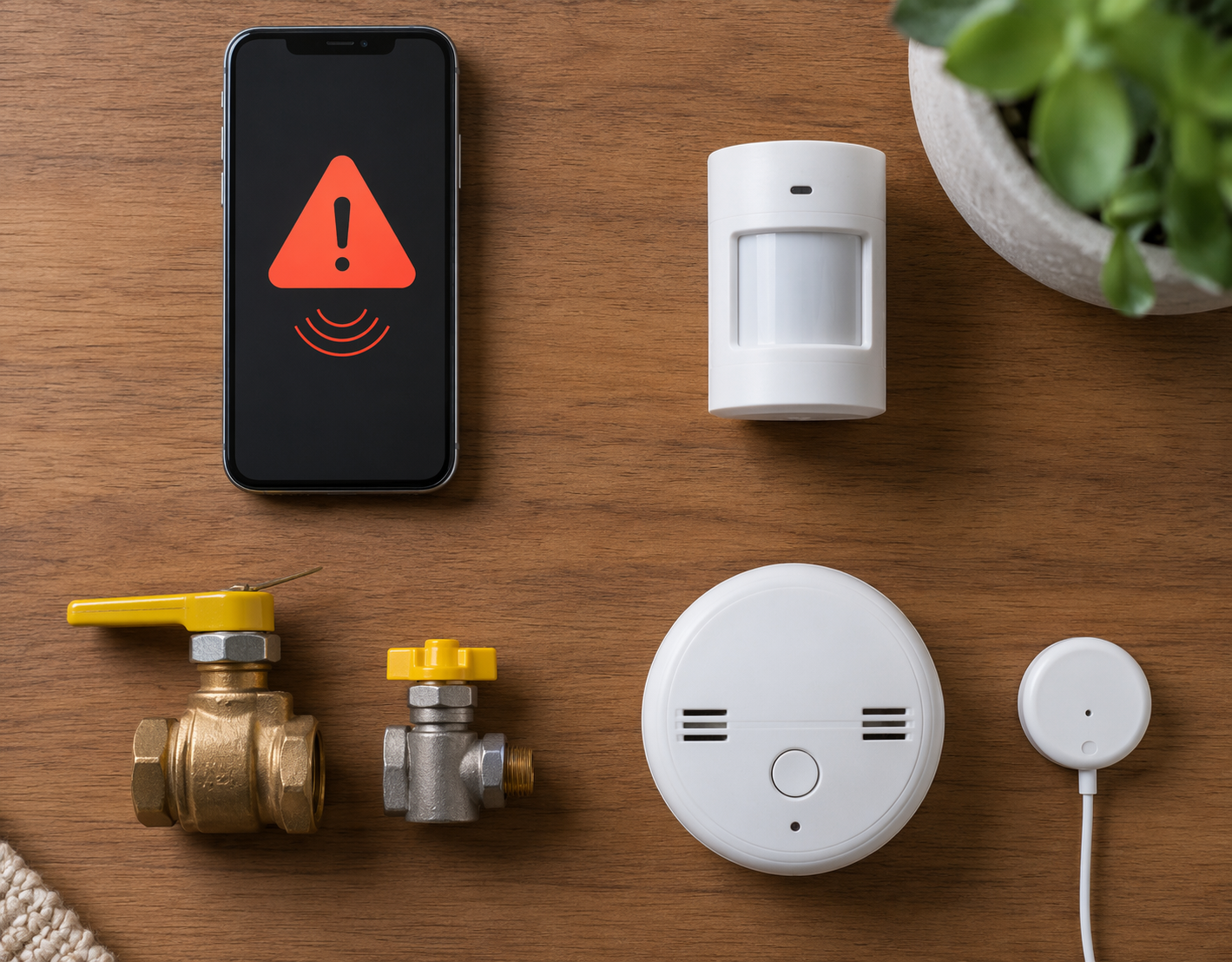
| Category | What it actually does | Typical devices | Smart home fit | Best use |
|---|---|---|---|---|
| Early warning | Warns people before or as shaking arrives, depending on distance and system timing | MyShake, Android alerts, standalone P-wave alarms | Mostly outside smart home platforms | Human action: drop, cover, hold on |
| In-home detection | Notices vibration or local shaking after the house starts moving | Fibaro Motion Sensor ZW5, Raspberry Shake | Possible with Z-Wave or Home Assistant, depending on device | Automation input with false-positive risk |
| Utility shutoff | Stops or limits damage from broken water lines or gas flow | Moen Flo, Zooz Titan, Aqara Valve Controller, mechanical gas shutoff valves | Strong for water; gas is often best handled mechanically | Damage control after shaking starts |
| Post-quake monitoring | Reports smoke, CO, or water leaks after the event | Smart smoke/CO alarms, leak sensors | Usually strong, often already in the home | Finding secondary hazards when no one is standing in that room |
Start with alerts, but do not build the whole plan around them
For anyone in California, Oregon, or Washington, the first earthquake safety “device” is probably already in a pocket. MyShake is free, and Android phones can receive earthquake alerts through the operating system. MyShake has sent alerts for more than 194 earthquakes since 2019, totaling 6.8 million alerts, according to UC Berkeley’s MyShake program.[2]
The catch is geography and integration. ShakeAlert is a West Coast system, not a national blanket. Readers in Alaska, Hawaii, Oklahoma, Utah, Montana, South Carolina, and other seismic regions cannot assume the same early-warning access.[3] And for smart home owners, the more irritating limit is that a phone alert is not the same as a hub trigger.
Home Assistant users will find a USGS integration, but it polls public feed data at 5-minute intervals. That can be useful for awareness, dashboards, notifications, or logging after a quake is reported. It is not ShakeAlert early warning, and it should not be treated as a seconds-before-shaking automation source.[4]
Standalone P-wave alarms are the other low-cost early-warning option. These small devices, often sold for about $7 to $60, listen for the faster compression waves that can arrive before more damaging S-waves and may give seconds of warning.[5] That can be enough time to get away from a window or stop reaching for a shelf. It is not enough time to make a cloud routine dependable, and these units generally do not integrate with smart home platforms.
So the early-warning recommendation is deliberately plain: use the free public alerts if you live where they are available, add a standalone alarm if you want a dedicated siren, and do not buy a smart home hub expecting it to become a native ShakeAlert receiver.
The device most smart home buyers overestimate: vibration detection
In-home detection is where smart home devices for earthquake safety start to look tempting. A vibration sensor sees the house move, then a routine turns on lights, unlocks a door, pauses HVAC, or closes a valve. The problem is timing. If the sensor is inside your house, it is not warning you before the shaking reaches your house. It is reacting once the room is already moving.
The Fibaro Motion Sensor ZW5 is the most practical smart-home-native option in this category for many existing Z-Wave homes. It is sold as a motion sensor, but it includes an accelerometer that can report vibration intensity on a magnitude-like scale and trigger Z-Wave automations.[6] Community testing has reported detection of table shaking around M1.2 and firm impacts around M3.0, but the same discussion makes the important limitation clear: the sensor cannot know whether the vibration came from an earthquake, a slammed cabinet, a dropped object, or someone handling the device.[7]
| Device | Estimated price | Protocol | Platform fit | Use it for | Do not use it for |
|---|---|---|---|---|---|
| Fibaro Motion Sensor ZW5 | $60–100 | Z-Wave | SmartThings, Hubitat, Home Assistant, other Z-Wave hubs | Local vibration-triggered routines | Definitive earthquake identification |
| Raspberry Shake 1D | About $500 | Network-connected seismograph | Possible with Home Assistant and custom setups | Serious seismic monitoring and data logging | A simple consumer automation trigger |
| QuakeLogic PX-01 Cube | Request for pricing | Commercial system | Not a normal consumer smart home product | Enterprise or commercial seismic monitoring | Typical homeowner buying lists |
That makes the Fibaro useful, but only with a sober automation design. Turning on lights after a vibration threshold is reasonable. Sending a notification that says “possible shaking detected” is reasonable. Automatically shutting off every utility on a low threshold is asking a small plastic sensor to make a decision it was not designed to make.
Calibration is the whole product here. A threshold that fires when a child bumps a table will be ignored after the third false alarm. A threshold set high enough to avoid daily nuisance events may miss weaker shaking. Mounting matters, too: a sensor loose on a shelf is measuring shelf behavior as much as building motion. The most defensible role is as one input among others, not as the home’s official earthquake detector.
Raspberry Shake sits at the other end of the spectrum. It is a real home seismograph at about $500 and can be interesting for technically inclined owners who want seismic data in Home Assistant or a small personal station.[8] For most households, that is more instrument than safety device. QuakeLogic’s PX-01 Cube is even farther outside the normal consumer lane: it is positioned as a commercial product with request-for-pricing sales rather than a buy-and-pair smart home sensor.[9]
Water shutoff is the upgrade most likely to matter after the shaking
If there is one purchase to prioritize, make it water shutoff. A smart valve does not predict earthquakes. It does not prevent shaking. It limits a common and expensive consequence: water continuing to run after a pipe, fixture, supply line, or appliance connection fails.
This is where marketing language can get sloppy. A product such as Moen Flo monitors water flow, pressure, and related patterns, and can shut off the main line when it detects abnormal use that suggests a leak or burst pipe.[10] That is valuable damage control. It is not earthquake detection.
| Water shutoff option | Estimated price | Connection | Installation style | Best fit | Main tradeoff |
|---|---|---|---|---|---|
| Moen Flo | About $500 | Wi-Fi | Installed inline on the water main | Homeowners who want whole-home monitoring and automatic shutoff | Higher cost and more installation work |
| Zooz Titan | About $140 | Z-Wave | Motorized actuator on an existing valve | Z-Wave homes that want local automation around the main shutoff | Depends on valve compatibility and mounting |
| Aqara Valve Controller | About $50 | Aqara ecosystem, typically Zigbee through a hub | Motorized actuator on a compatible valve handle | Lower-cost targeted shutoff or simple retrofit projects | Ecosystem dependence and mechanical fit |
Moen Flo is the polished whole-home choice if the budget and plumbing setup support it. Its value is not just that it can close a valve; it watches the water system continuously, which helps with non-earthquake leaks as well. That makes the price easier to justify than a single-purpose earthquake gadget, especially in houses where the main shutoff is hard to reach or where no one is home during the day.
Zooz Titan is the more smart-home-native answer for Z-Wave households. It is an actuator rather than a full inline water-monitoring system, so the quality of the installation depends on the existing valve and how cleanly the motor can operate it. The upside is platform fit: if the home already runs Z-Wave, the shutoff can sit closer to local automation logic rather than depending entirely on a separate cloud account.
Aqara’s valve controller is the budget lever. It is attractive when the goal is to close a specific valve or experiment with automated shutoff at much lower cost. It is not a substitute for confirming the valve type, handle clearance, hub support, battery state, and whether the routine still works when the internet is unavailable.
The cleanest earthquake automation is conservative: if a credible vibration event is detected, turn on lights and notify people; if a leak sensor later reports water, close the valve. Closing water on every vibration may be acceptable in a second home or a vacant property. In an occupied house, the nuisance cost of false shutoffs is real, so the trigger should match the household’s tolerance.
Gas is different: the best option may not be smart
Gas shutoff is the one place where smart-home elegance should lose to mechanical reliability. A seismic gas shutoff valve such as Little Firefighter is not app-controlled and does not need Wi-Fi, a hub, a battery, or a cloud service. It is designed to close when sufficient seismic motion is detected, with installed costs commonly framed around the $100–200 range in this buyer category.[11]
That lack of integration is a feature, not a defect. During a damaging quake, power may be out, broadband may be down, and the smart home stack may be busy recovering. A gas safety device that does one job without asking the router for permission deserves a place in an otherwise smart setup.
The important distinction is operational. A mechanical gas shutoff is not a notification device, and after it trips, gas service generally needs to be handled carefully according to local utility and safety guidance. Do not pair the idea of gas safety with clever automations unless a qualified installer and local rules support the setup.
Post-quake monitoring is where ordinary smart sensors earn their keep
The devices that help after a quake may already be on the shopping list for more boring reasons: smoke alarms, CO detectors, and water leak sensors. They are not earthquake-specific, which is partly why traditional emergency-prep guides tend to skip them. Wirecutter’s 2026 earthquake preparedness guide, for example, recommends conventional supplies and tools rather than smart home devices; that reflects its testing scope more than a verdict that automation has no role.[12]
Smart smoke and CO detectors are useful because the first few minutes after shaking are messy. People are checking on family, shoes, pets, exits, and glass. A detector that can sound locally and send a phone alert may catch a secondary fire or combustion issue in a part of the house no one has reached yet.
Leak sensors are the companion to a water shutoff valve. Put them where water damage starts quietly: under sinks, behind toilets, near the water heater, by the washing machine, around the dishwasher, and near any known weak plumbing area. If the home has a smart shutoff, the useful routine is direct and boring: leak detected, valve closes, people get notified.
What to buy at each budget
The right earthquake setup depends less on owning every category and more on buying the next device that changes an outcome. A phone alert changes human response. A vibration sensor changes automations. A water valve changes how long a broken pipe runs. A smoke, CO, or leak sensor changes how quickly a hidden problem is noticed.
| Budget tier | Approximate spend | Buy or enable | What improves |
|---|---|---|---|
| Essential | $0–100 | MyShake or Android alerts where available, a standalone P-wave alarm if desired, and basic leak sensors | Human warning and first signs of water damage |
| Enhanced | $100–500 | Fibaro Motion Sensor ZW5, Aqara Valve Controller or Zooz Titan, smart smoke detector, leak sensor set | Local automation and lower-cost shutoff |
| Comprehensive | $500+ | Moen Flo, whole-home valve automation, optional Raspberry Shake, monitored security integration | Whole-home water control, richer monitoring, and better remote awareness |
Essential: do the free alert work first
Install or enable the public alert options that apply to your region before buying hardware. In the ShakeAlert states, that means MyShake and phone OS alerts. If you want something that sits in a bedroom or hallway and makes noise without depending on a phone being charged, a standalone P-wave alarm is the add-on. Then place leak sensors in the rooms most likely to create expensive damage.
Enhanced: add automation, but keep the triggers modest
This is the tier where the Fibaro ZW5 makes sense for a Z-Wave home. Use it to turn on lights, start a local notification, or mark a possible shaking event in your home automation history. Pair that with a valve actuator if your plumbing allows it, and let leak sensors carry the burden of confirming water trouble.
Comprehensive: spend on water control before seismic novelty
At the higher tier, the money is better spent on a robust water shutoff system than on a seismograph for curiosity’s sake. Moen Flo or a comparable whole-home shutoff can help during everyday leaks and post-quake plumbing failures. Raspberry Shake is a valid project for people who truly want seismic data; it should not come before water shutoff, smoke/CO coverage, and leak sensing in a safety-focused budget.
A compatibility-aware setup that does not overpromise
For a Z-Wave-heavy house, the practical path is MyShake or Android alerts, Fibaro ZW5 for possible shaking input, Zooz Titan or another compatible valve actuator, Z-Wave smoke/CO detection where appropriate, and leak sensors tied to a shutoff routine. For an Aqara or Zigbee-leaning house, the lower-cost valve controller and leak sensors may be the better fit, with the understanding that hub support and mechanical valve fit matter more than the product photo.
For a homeowner who wants the fewest moving parts, the strongest mix is also the least glamorous: public alerts on phones, a mechanical seismic gas shutoff valve installed properly, a smart water shutoff valve on the main line, smoke/CO detection, and leak sensors. Add vibration-based automations only after deciding what should happen when the sensor is wrong.
That configuration does not turn the house into an earthquake predictor. It gives people the best available public warning, lets the home take a few limited actions during or after shaking, and focuses the serious money on the consequence a smart home can actually reduce: uncontrolled water, unnoticed fire or CO risk, and hazards no one has reached yet.
References
- ShakeAlert, ShakeAlert.org
- MyShake, UC Berkeley
- After quake, California looks to expand earthquake warning system to other states, AP / Twin Cities, June 25, 2026
- USGS, Home Assistant
- Best Earthquake Alert Alarms 2024, Rolling Stone, 2024
- Motion Sensor, Fibaro
- Fibaro Motion Sensor - Earthquake detection, SmartThings Community Forum
- Raspberry Shake 1D, Raspberry Shake
- PX-01 Cube, QuakeLogic
- Flo Smart Water Monitor and Shutoff, Moen
- Little Firefighter, Little Firefighter
- The Best Emergency Preparedness Supplies, NYTimes Wirecutter, 2026
Reader Feedback
Share your purchase experience, flag outdated picks, or ask clarifying questions about the checklist items.
Comments
Join the discussion with an anonymous comment.