Why Lighting Is the Fastest-Payback Upgrade in Your Home
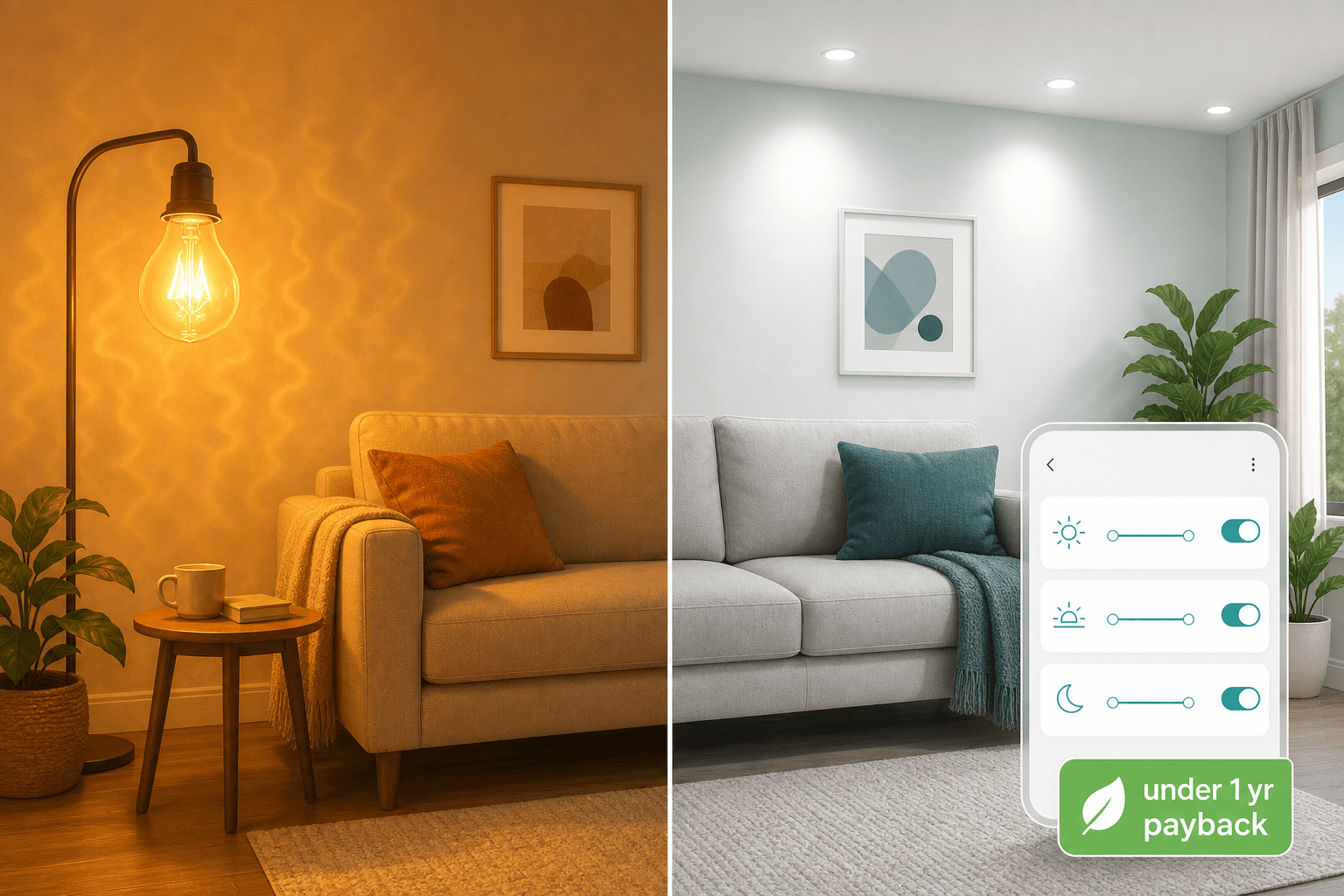
Most energy upgrades — insulation, windows, heat pumps — cost thousands of dollars and take years to pay back. Lighting is different. According to the U.S. Department of Energy, lighting accounts for roughly 15% of an average home's electricity use, and switching entirely to LEDs saves the average household about $225 per year. At current LED prices of $3–8 per bulb, that payback happens in under 12 months.
This article works through the upgrade ladder step by step — from incandescent to plain LED, then to LED plus smart switches or smart bulbs — with dollar math at each stage. The goal is to help you decide exactly how far to upgrade before the additional investment stops making financial sense.
LED vs. Incandescent and CFL: The Baseline Savings Case
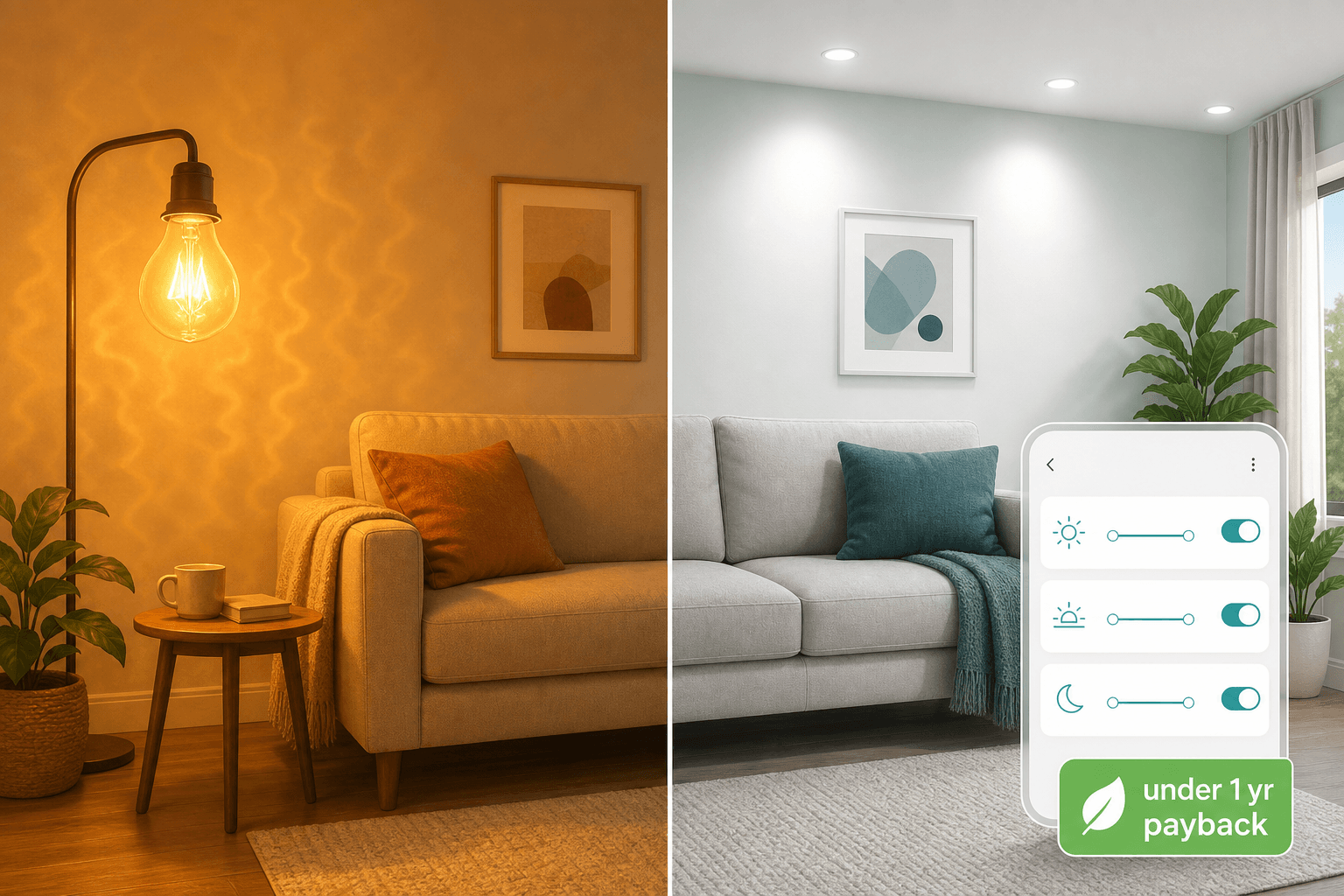
The efficiency gap between incandescent and LED is not marginal — it is structural. Incandescent bulbs release about 90% of their energy as heat; CFLs release about 80%. LEDs convert most of their input to light. A 9–10W LED produces the same output as a 60W incandescent — an 83–85% reduction in wattage.
Here is the per-bulb dollar math at 4 hours of daily use and $0.16/kWh:
| Bulb Type | Wattage | Annual kWh (4 hrs/day) | Annual Cost | Bulb Price | Lifespan |
|---|---|---|---|---|---|
| 60W Incandescent | 60W | 87.6 kWh | ~$14.00 | $1–2 | ~1,000 hrs |
| CFL (equivalent) | 14W | 20.4 kWh | ~$3.25 | $3–5 | ~8,000–10,000 hrs |
| Standard LED | 9–10W | 13.1–14.6 kWh | ~$2.10–$2.35 | $3–8 | ~25,000–50,000 hrs |
Replacing a single 60W incandescent with a $5 LED saves roughly $11–12 per year in electricity alone. At that rate, the LED pays for itself in about five months. Over the LED's 25,000-hour lifespan, it avoids the cost of replacing 25 or more incandescent bulbs.
Scale that across a typical home. A household running 30 incandescent bulbs at moderate usage levels can expect to save roughly $225 per year by switching entirely to LEDs — consistent with the DOE's published household savings figure. The full swap costs $90–240 in bulbs and pays back in well under a year.
Smart Switches: Circuit-Level Control and Per-Fixture Cost Advantage
A smart switch replaces a standard wall switch and controls every bulb on that circuit. It does not require smart bulbs — standard LEDs work fine. That distinction matters for cost.
A smart switch typically costs $30–80. In a living room with a six-bulb fixture, that single switch controls all six bulbs. The alternative — six individual smart bulbs — costs $60–240 or more for the same room. The cost-per-fixture advantage of smart switches grows with every bulb on the circuit.
Beyond cost, smart switches add three meaningful capabilities that drive energy savings:
- Scheduling: Set lights to turn off automatically at bedtime or when you leave for work. Lights that run zero hours save the full per-hour cost.
- Occupancy detection: Motion-sensing smart switches turn lights off when a room is empty. The DOE confirms occupancy sensors reduce output in unoccupied spaces and can pay for themselves quickly in high-traffic rooms.
- Dimming: Reducing output to 70% reduces wattage proportionally and extends bulb life. Most LED-compatible dimmers work with standard LED bulbs, not just smart bulbs.
For a living room circuit with six 9W LEDs running 5 hours per day, the annual electricity cost is about $15.77. Scheduling alone — cutting that to 3.5 hours per day — saves roughly $4.73 per year. Add occupancy sensing and the savings grow further. A $50 smart switch in that room pays back in roughly 4–6 years from scheduling and occupancy gains alone, before accounting for any rebates.
Smart Bulbs: Per-Fixture Control, Color, and the Honest Payback Math
Smart bulbs screw into a standard socket and connect directly to Wi-Fi, Zigbee, or a similar protocol — no switch replacement required. That makes them the right choice for renters, for fixtures where switch replacement is impractical, or for situations where per-fixture control (including color and individual dimming) is the goal.
The honest energy-savings comparison between a smart bulb and a plain LED is narrow. Both use 7–10W to produce 60W-equivalent output. The difference is standby power draw: smart bulbs consume 0.2–0.5W in standby to maintain their wireless connection. At $0.16/kWh, that adds roughly $1.30–$1.50 per bulb per year versus about $1.20 for a plain LED — a difference of pennies.
The ROI case for smart bulbs relative to plain LEDs does not rest on the energy-draw difference. It rests on whether you actually use the automation features — scheduling, occupancy routines, and dimming — that reduce total on-time. A smart bulb that runs on a fixed schedule and turns off when you leave the house saves real money. A smart bulb used exactly like a manual switch does not.
- Smart bulb cost: $10–40 per bulb (color-capable models at the higher end)
- Annual energy cost vs. plain LED: roughly $0.10–$0.30 more per bulb — not a meaningful savings differentiator
- Payback vs. plain LED: driven entirely by automation-driven on-time reduction, not hardware efficiency
- Best use case: single-fixture control, renter situations, color and scene use, or rooms where switch replacement is not feasible
Automation Multipliers: How Scheduling, Occupancy, and Dimming Add Up
Switching to LED is the hardware efficiency layer. Smart controls are the behavioral efficiency layer. Both matter, and they compound.
The largest gains come from reducing lighting on-time. Occupancy sensors and scheduling can cut lighting energy consumption by 30–60% in high- and medium-traffic areas — rooms like kitchens, hallways, and home offices where lights are frequently left on. In low-traffic spaces like attics, utility rooms, or guest bathrooms, the reduction can reach 90% when occupancy sensing replaces manual switching.
Here is a worked example for a kitchen with four 9W LEDs currently running 6 hours per day:
- Baseline (no controls): 4 bulbs × 9W × 6 hrs × 365 days = 78.8 kWh/year = $12.61/year
- With scheduling (cut to 4 hours/day): 52.6 kWh/year = $8.41/year — saves $4.20/year
- With occupancy sensing (40% on-time reduction from scheduling baseline): 31.5 kWh/year = $5.05/year — saves $7.56/year vs. uncontrolled
Across a full home with 30 bulbs, those automation gains translate to $50–150 in additional annual savings on top of the LED hardware savings — depending on how many rooms have occupancy-prone usage patterns.
Daylight harvesting — using light sensors to dim or turn off lights when natural light is sufficient — adds a further layer in rooms with significant window exposure. This is most practical with smart switches or smart bulbs connected to a hub that supports lux-based automations. The incremental savings are real but harder to estimate without knowing your specific room geometry and climate.
Side-by-Side ROI: Four Upgrade Paths Compared
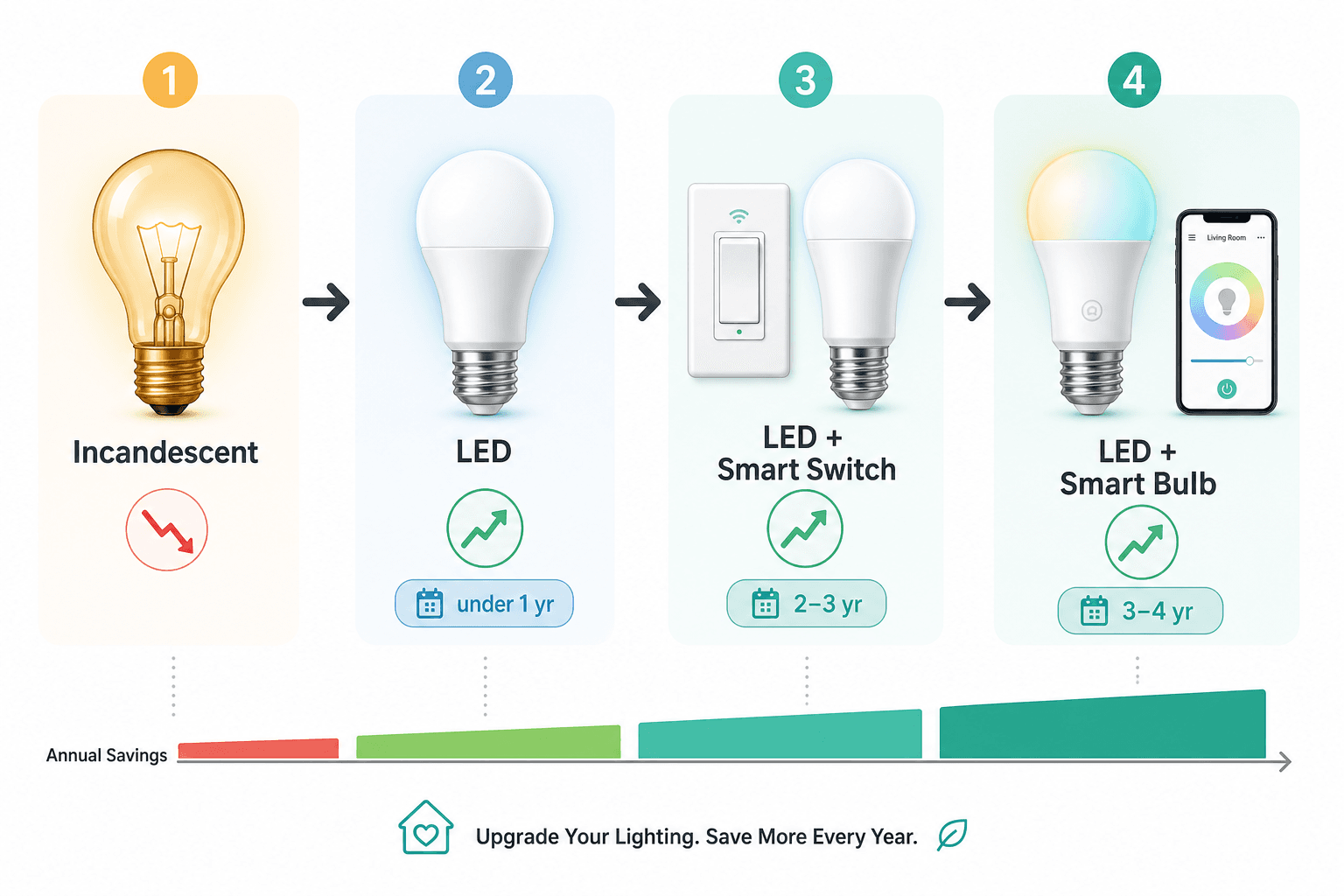
The table below compares the four upgrade paths on a per-room basis, using a standard living room with six 60W-equivalent fixtures running 4 hours per day as the reference scenario. All figures use $0.16/kWh and 2025–2026 U.S. retail pricing.
| Upgrade Path | Upfront Cost (6-fixture room) | Annual Energy Savings vs. Incandescent | Payback Period | Key Limitation |
|---|---|---|---|---|
| Incandescent (baseline) | $0 | $0 | — | High energy cost, frequent replacements |
| Plain LED | $18–48 (6 bulbs × $3–8) | ~$70–75/year | < 1 year | No automation; manual switching only |
| LED + Smart Switch | $48–128 ($30–80 switch + plain LEDs) | ~$80–100/year (LED savings + scheduling/occupancy) | 1–2 years | Requires neutral wire; no per-bulb color control |
| LED + Smart Bulbs | $60–240 (6 bulbs × $10–40) | ~$75–95/year (LED savings + automation if used) | 2–4 years | Higher per-fixture cost; standby draw negligible |
The plain LED path has the fastest payback by a significant margin — under 12 months in most households. The smart-switch path adds $30–80 in hardware cost but spreads that cost across all bulbs on the circuit, making it increasingly efficient as fixture count grows. The smart-bulb path has the highest per-fixture cost and longest payback, but it is the only option that requires no wiring changes.
When Smart Lighting ROI Makes Sense — and When It Doesn't
The LED swap is almost always worth doing. The smart-layer investment requires more judgment.
Scenarios where smart controls clear a reasonable ROI
- High-usage rooms with occupancy problems: Kitchens, home offices, hallways, and children's bedrooms where lights are routinely left on. A smart switch or occupancy-sensing bulb pays back faster here than anywhere else.
- Multi-bulb circuits: A $50 smart switch controlling eight fixtures costs $6.25 per fixture. Eight smart bulbs at $15 each cost $120. The switch wins on cost-per-fixture for any room with three or more bulbs on one circuit.
- Existing smart home ecosystems: If you already have a hub, voice assistant, or automation platform, the marginal cost of adding smart lighting to existing routines is low. An away-mode automation that turns off all lights when you leave the house requires no additional hardware.
- ENERGY STAR rebates: Many utilities offer rebates on ENERGY STAR-certified LED bulbs and smart controls. A $10–20 rebate on a $50 switch cuts payback from 2 years to under 18 months. Check your utility's rebate program before purchasing.
Scenarios where the smart-layer investment is harder to justify
- Low-usage rooms: A guest bedroom used 20 minutes per day, a storage closet, or a garage visited briefly — these rooms have so little on-time that even perfect occupancy sensing saves only a few dollars per year. A $15 smart bulb in a guest bedroom could take 8–10 years to pay back versus a plain LED.
- Renters without switch access: Smart switches require physical installation and are typically not permitted in rental units without landlord approval. Smart bulbs are the only viable path, and the payback is longer. Plain LEDs remain the fastest-payback option for renters who cannot install controls.
- Rooms you already control well manually: If you reliably turn off a room's lights when you leave, the automation gain is minimal. Smart controls save the most where human behavior is inconsistent — not where it is already disciplined.
Quick-Start Recommendations by Scenario
The math above leads to four clear starting points depending on your situation:
- Pure savings maximizer — start with plain LEDs everywhere: Replace every incandescent and CFL with a standard LED. This delivers the full ~$225/year household savings with a sub-12-month payback. No hub, no app, no wiring required. Do this first regardless of what else you plan to add.
- High-traffic room with multiple bulbs — smart switch path: Install a smart switch in your kitchen, living room, or home office. Pair it with scheduling (off at midnight, off when you leave) and occupancy sensing if the switch supports it. This is the lowest cost-per-fixture path for multi-bulb rooms and does not require smart bulbs.
- Renter or no-wiring-change situation — smart bulb path: Use smart bulbs in your highest-usage rooms only — living room, bedroom, home office. Set up scheduling automations immediately after installation. Skip smart bulbs in low-usage rooms; use plain LEDs there instead.
- Whole-home automation path: Start with plain LEDs everywhere. Then prioritize smart switches for multi-bulb circuits in high-usage rooms, and smart bulbs only where per-fixture or color control is needed. Build an away-mode automation that turns off all lights when the household leaves. Check your utility's rebate program before purchasing any ENERGY STAR-certified hardware to reduce upfront cost.
In every scenario, the LED baseline comes first. Smart controls are a second layer that extends savings further — but only in the rooms and usage patterns where the math supports it.
Data Updates
Know about updated rebate programs, changed subscription prices, or new ENERGY STAR certifications? Submit a note below to help keep this content current. For formal data corrections, use the contact page.
Comments
Join the discussion with an anonymous comment.