
Robot Vacuum Alternatives After the FCC Ban
The FCC's July 28 Covered List addition covers foreign-made robot vacuums, but existing devices and previously authorized models are unaffected. Here's what the ban actually restricts, which models you can still buy, and what a real alternative looks like — verified as of July 31, 2026.
Verified July 31, 2026: the FCC action does not make your existing robot vacuum illegal to own or use. It also does not remove previously authorized robot vacuums from store shelves. The immediate effect is narrower: foreign-produced advanced robotic devices newly added to the FCC Covered List cannot receive new FCC equipment authorization going forward, while devices and models already authorized remain unaffected under the FCC’s own FAQ language. [1]
That distinction matters if you searched for robot vacuum FCC ban alternatives because a headline made it sound as if every Roborock, Roomba, Ecovacs, Dreame, Eufy, Shark, or Narwal in the country was about to brick itself. That is not what the current documents say. The practical alternatives right now are timing decisions: buy a currently authorized model while it remains available, consider the US-assembled Matic with caveats, or keep using the vacuum you already own while watching firmware and security support.
| Status as of July 31, 2026 | What it means for you |
|---|---|
| Confirmed | The FCC added foreign-produced advanced robotic devices to the Covered List on July 28, 2026, after a July 27 National Security Determination. [2][3] |
| Confirmed | Robot vacuums are covered when they meet the FCC’s advanced-robotic-device thresholds. [1] |
| Confirmed | Existing devices and previously authorized models are unaffected; consumers may continue using them, and retailers may continue selling or importing already approved models. [1] |
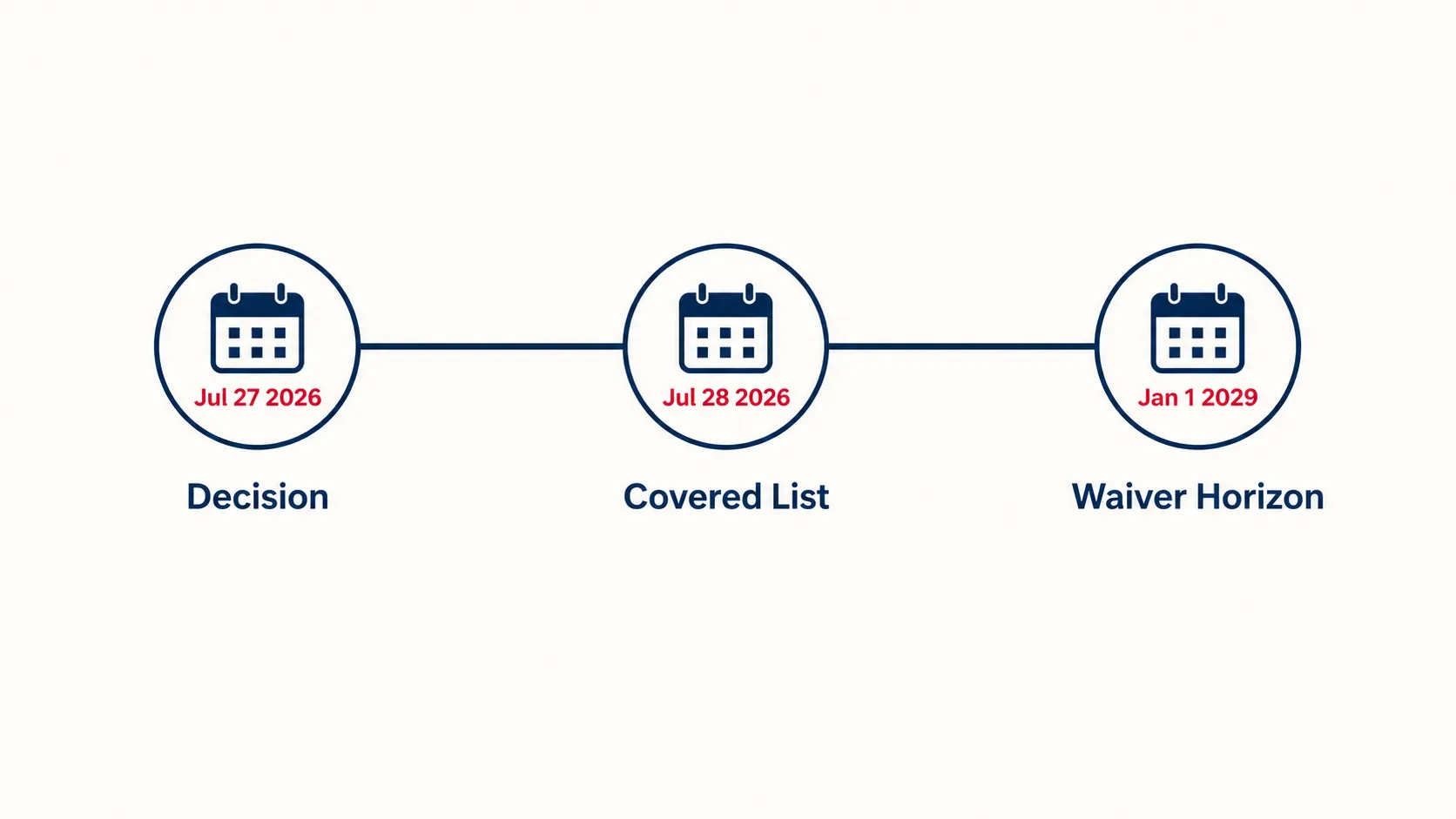
| Confirmed | A waiver permits software and firmware security and compatibility updates for covered equipment through at least January 1, 2029. [4] |
| Investigating | Future waiver grants, Conditional Approval outcomes, and model-by-model authorization visibility are still developing. |
| Monitoring | Retailer stock depletion is unknown. A model can be legal to sell and still become hard to find. |
What the FCC actually changed
The FCC’s July 28 release added “foreign-produced advanced robotic devices” to the Covered List, following a National Security Determination dated July 27, 2026. The agency framed the move as a national-security restriction on covered communications-capable equipment, not as a consumer possession ban. [2][3]
The Covered List mechanism is about authorization. In plain shopping language: a newly introduced covered foreign-produced robot vacuum cannot receive the FCC authorization it would need for lawful US marketing. But a vacuum model that already has FCC authorization is not retroactively stripped of that authorization by this addition. The FCC FAQ says existing devices and previously authorized models are unaffected, and that consumers may continue using them. It also says retailers may continue selling and importing already approved models. [1]
This is the point where loose wording does real damage. “New authorization blocked” is not the same sentence as “your robot vacuum is banned.” If you own a functioning vacuum, the policy document does not tell you to unplug it, throw it out, or replace it this week.
Why robot vacuums are included
Robot vacuums are not named because they are vacuums. They are captured because modern docked robot vacuums look a lot like the FCC’s defined category of advanced robotic devices: they move on the ground, use sensors to understand their surroundings, connect to networks, and run local or remote software for navigation.
The FCC FAQ lays out the thresholds. Covered devices include ground-locomotion robots over 4.4 pounds when combined with a dock, with an environmental sensor, wired or wireless connectivity of at least 200 kbps, and local or remote navigation software, including AI or machine-learning model weights. That combination is ordinary in a high-end robot vacuum with mapping, obstacle avoidance, app control, and a self-emptying or wash dock. [1]
FCC officials also confirmed to reporters that robot vacuums are covered. The Verge reported on July 29 that FCC media relations director Katie Gorscak said robot vacuums fall under the rule, and USA Today separately reported on July 30 that FCC deputy communications director Will Wiquist confirmed the same point. [5][6]
So the careful answer is not “robot vacuums were excluded.” They were included. The careful answer is that inclusion affects new authorization for covered foreign-produced models, not ownership or continued use of already authorized ones.
If you already own one, the best alternative may be no alternative
If your robot vacuum is already in your home, your starting position is better than the headlines suggest. The FCC FAQ says existing devices are unaffected and consumers may continue using them. [1]
The more practical question is support. Will your app keep working? Will the vendor keep shipping bug fixes, map-related updates, cloud compatibility patches, and security updates? The FCC’s Office of Engineering and Technology waiver order permits software and firmware updates for security and compatibility through at least January 1, 2029. [4]
That date is not a promise that every manufacturer will support every model beautifully until then. It is a regulatory horizon for allowed updates. For an owner, it is still useful: it means the policy change should not immediately cut off routine security or compatibility maintenance for affected authorized devices.
The sensible owner move is boring and defensible: keep the vacuum on supported firmware, keep the app updated, check whether the manufacturer posts a US support notice for your model, and avoid panic-replacing a working machine solely because of the July 28 Covered List addition. If the dock charges, the map loads, the app still connects, and replacement parts are available, the policy document has not created an emergency in your hallway.
If you were about to buy, authorization date matters more than brand comfort
For buyers, the answer is less comforting but still not chaotic. A previously authorized model can still be sold and imported, according to the FCC FAQ. [1] That makes “buy a currently authorized model while it is still available” a legitimate strategy, not automatically fear-buying.
The catch is verification. Retail listings are not regulatory records, and stock turns over. If you are shopping this week, treat the purchase like a dated compatibility decision. Record the listing date, the exact model number, the FCC ID if the seller provides it, and whether the seller is offering existing US stock rather than promising a future revision.
- Prefer listings with exact model numbers, not only family names such as “Qrevo,” “X Ultra,” or “Roomba Max.”
- Look for an FCC ID in the manual, label image, support page, or product documentation.
- Save a copy of the product page and purchase confirmation showing the date.
- Be cautious with preorders, “new 2026 revision” listings, and marketplace sellers that blur US and non-US stock.
- If Matter or Apple Home support is the reason you are buying, verify that the exact US model supports it now, not only that the brand announced it.
USA Today’s July 30 shopper guide named several currently discussed options, including the Dreame X60 Max Ultra Complete, Shark AV2501S AI Ultra, iRobot Roomba Max 705, Eufy C28, and Roborock Qrevo Curv. Treat those as dated market examples, not as a fresh round of independent NestGrid-tested recommendations. [7]
The buyer’s question is no longer just “which one cleans best?” It is also “was this exact model already authorized, and am I buying existing authorized stock?” That is irritating paperwork for a vacuum purchase, but it is better than replacing a headline with a guess.
The realistic alternatives are narrower than a normal buying guide
A normal robot-vacuum comparison would cover suction, mop pressure, object avoidance, dock maintenance, pet-hair pickup, and app design. This is not that moment. The FCC action makes the alternative question more specific: what can a US buyer do without pretending that a simple brand swap escapes global manufacturing reality?
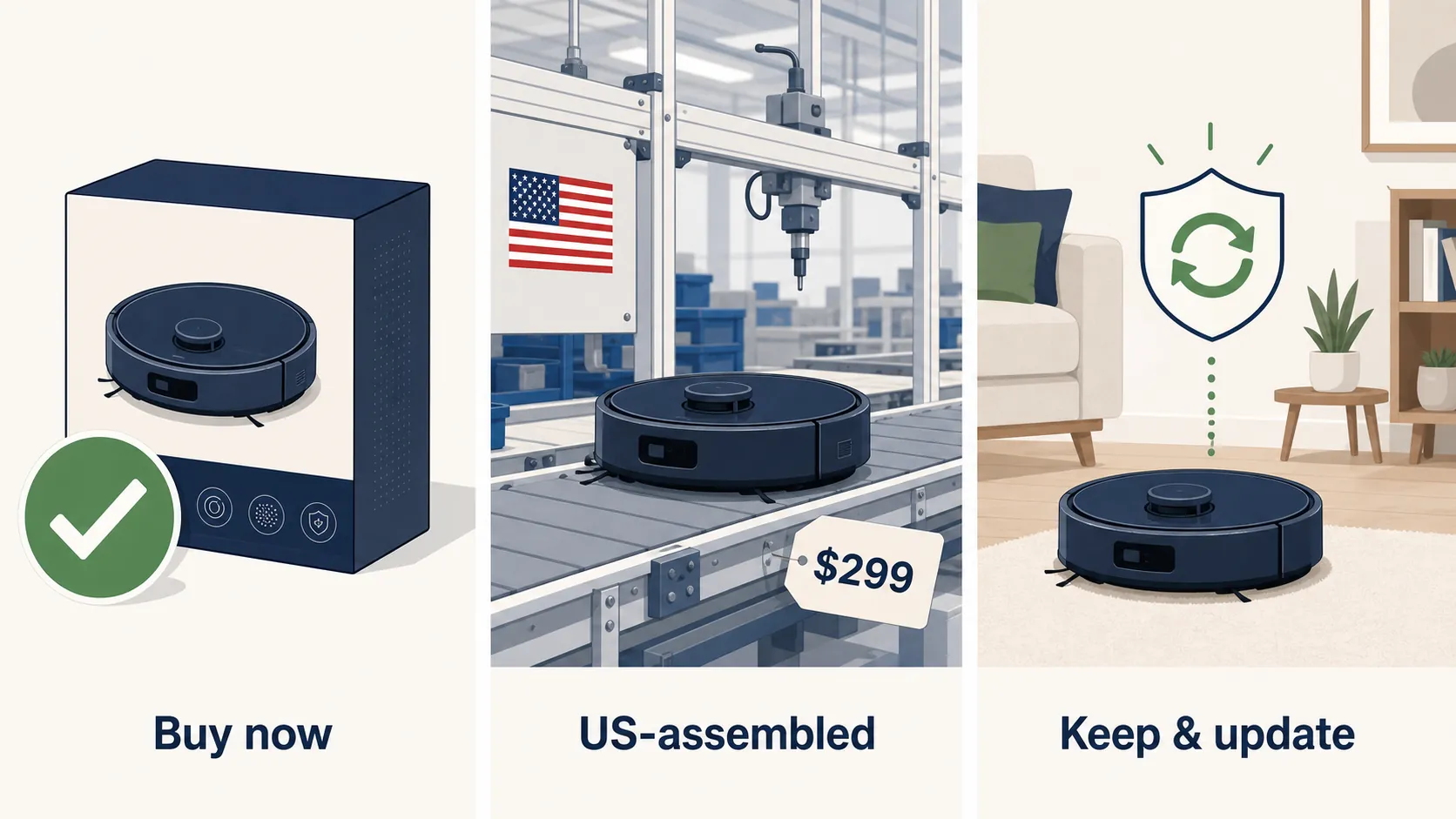
| Path | Who it fits | What to verify |
|---|---|---|
| Buy an already authorized model now | You were already planning a purchase and want mainstream choices while stock is still available | Exact model number, FCC ID or authorization evidence, seller stock date, return window |
| Consider Matic | You want a US-assembled robot vacuum and can tolerate a premium price and uncertainty | Current price, ship date, warranty, and whether any waiver or exemption has actually been granted |
| Keep your existing vacuum | You already own a working unit and do not need an upgrade | Firmware notices, app support, cloud features, parts availability, and security-update posture through the January 1, 2029 waiver horizon |
Path 1: buy an already authorized model while stock exists
This is the most practical route for someone who was already comparing robot vacuums before the FCC news broke. The rule does not require you to abandon the category. It does make timing and documentation more important than they were last week.
Do not assume every listing from a familiar brand is equally situated. A previously authorized model and a future hardware revision can share a marketing family name. That is why the exact model number matters. If the listing cannot identify the product precisely, it is not a good listing for this regulatory moment.
Path 2: consider Matic, but do not call it a clean exemption yet
Matic is the obvious name people bring up because it is assembled in Mountain View, California, and is positioned as a domestic alternative. It is also expensive: reporting and Matic’s own site place it roughly in the $1,245 to $1,495 range, depending on configuration and offer timing. [7][8][9]
The caveat is important. The Verge reported that Matic’s CEO said the company does not yet meet the 65% domestic-component threshold discussed in relation to the Buy American domestic-end-product standard. That means “US-assembled” should not be casually upgraded into “automatically exempt” unless and until the relevant waiver or approval position is confirmed. [5]
Matic may still be the right purchase for a buyer who values US assembly, privacy posture, or avoiding the mainstream docked-vacuum supply chain. It is not a magic $300 substitute for a Roborock, Dreame, or Eufy. It is a premium choice with an open regulatory question as of July 31, 2026.
Path 3: keep the device and watch the support window
For many owners, keeping the current vacuum is the least wasteful and least risky path. The FCC documents leave room for continued use, continued sale of already authorized models, and software or firmware updates for security and compatibility through at least January 1, 2029. [1][4]
If your model is already aging, this is a good moment to check battery availability, brush and bag supply, dock parts, and whether the app still receives updates. Those are ordinary ownership questions that now carry more weight because future replacement choices may be narrower.
Why “just buy American” is not a complete answer
The robot-vacuum market is not arranged for an easy patriotic filter. IDC figures reported by PCMag and The Verge put the top five global robot-vacuum manufacturers as Chinese companies — Roborock, Ecovacs, Dreame, Xiaomi, and Narwal — with roughly 70% of global market share as of 2025. [10][5]
The non-Chinese-brand picture is also not a clean domestic escape hatch. iRobot, the Roomba company, was acquired by Shenzhen Picea Robotics in January 2026 and manufactures in China and Vietnam, according to USA Today’s explainer. The same report notes that Shark manufactures in China and Vietnam, Dyson in Singapore, China, and Malaysia, and Samsung and LG across Korea and other Asian manufacturing bases. [6]
That does not make every product identical. Ownership, manufacturing location, authorization status, software architecture, and support obligations are different questions. It does mean a buyer cannot solve this by scanning for a familiar Western logo on the box.
Matter and Apple Home buyers should be especially literal
If your smart home depends on Apple Home, the FCC timing intersects awkwardly with Matter vacuum support. Apple Home supports robot vacuums through Matter rather than native HomeKit, and Matter vacuum support became visible in Apple’s ecosystem with iOS 18.4 coverage. [11]
MacRumors reported that future Matter-compatible vacuums from brands such as Roborock and Ecovacs may be constrained in the US under the new ban. [12] The useful takeaway is not that Apple Home robot vacuums are impossible. It is that future US availability for foreign-produced Matter vacuum models may be less predictable than the Matter roadmap alone suggests.
For a purchase this week, confirm the exact integration that exists today. A future Matter firmware promise is weaker than a currently working integration on the exact US model you are buying.
What remains unresolved
The ruling is only a few days old as of this update. The strongest facts are the dated FCC actions, the FAQ boundary for existing and previously authorized products, and the OET waiver horizon. The weaker facts are the ones that depend on future agency decisions, company filings, and inventory behavior.
- Waiver outcomes: Matic and other companies may seek or discuss waiver paths, but this article does not treat ungranted waivers as exemptions.
- Conditional Approval: The Hacker News reported a January 1, 2028 application deadline for a Department of War pathway for robots, but that point should be treated cautiously unless matched to the controlling agency guidance. [13]
- Retail stock: no public source can reliably say how long each already authorized model will remain available at major retailers.
- Model lookup: authorization status may be easier to verify for some exact models than others, especially as retailers mix older stock, refreshed bundles, and marketplace listings.
For now, use the dated boundary. If you own a robot vacuum, keep using it and watch firmware support. If you were already about to buy, verify the exact model and authorization evidence before purchase, and understand that available stock may change. If you want a US-assembled option, Matic is the known candidate, but it is not a clean confirmed exemption as of July 31, 2026.
References
- FCC FAQs on Covered List update, FCC
- FCC News Release DOC-423682A1, FCC
- National Security Determination, FCC
- OET Waiver Order DA-26-789A1, FCC
- US robot ban sweep up Chinese vacuums, The Verge
- Foreign robot ban rules Roombas vacuums, USA Today, July 30, 2026
- Robot vacuum ban what to buy now, USA Today, July 30, 2026
- Robotic vacuums swept up new US crackdown over national security risks, Fox Business
- Matic robots, Matic
- FCC Ban on Foreign-Made Robots Includes Robot Vacuums, PCMag
- What the vacuum robots in iOS 18 reveal about Matter, matter-smarthome.de
- Foreign-Made Robot Vacuums Ban, MacRumors, July 30, 2026
- FCC Blocks New Foreign-Produced Robots, The Hacker News
Resolution
Investigating — no confirmed fix yet.
Protocol background
For general spec/firmware mechanics, see Compatibility & Protocols.
No linked protocol reference for this update yet.