Amazon's Nova AI is ending, but your Alexa smart home is fine
Amazon is winding down several Nova AI models, but your Alexa smart home will still work. We break down which models are affected, why your devices won't break, and what the real risk from the Alexa+ migration is.
Update Watch, July 31, 2026: Amazon's Nova wind-down is real. The affected models are Nova Premier, Nova Omni, Nova Reel, and Nova Canvas; they were reported as being phased out on July 28, 2026, and AWS Bedrock lists those same models as Legacy since March 2026 with end-of-life in September 2026.[1][2][3] That is not, by itself, a reason to expect your Echo speakers, lights, locks, plugs, thermostats, or Alexa routines to stop working.
The useful answer is narrower than the headline: Amazon is winding down several Nova models, but those are not the models Amazon has described as the main path for Alexa+ smart-home handling. The thing to watch is not Nova Premier disappearing from Bedrock. The thing to watch is the Alexa+ migration layer, because that is where users are already reporting broken classic skills, missing device-group behavior, routine regressions, slower responses, and commands that need new phrasing.
What Amazon Is Actually Winding Down
The discontinued group matters because it sounds broad. Nova Premier reads like a flagship reasoning model. Nova Omni sounds like the kind of multimodal system people imagine sitting behind a voice assistant. Nova Reel and Nova Canvas are clearly generative media models. Put those names in a headline next to Alexa, and it is easy to assume the whole smart-home stack is losing its brain.
But AWS Bedrock's lifecycle table is more precise than that. It marks Nova Premier, Nova Omni, Nova Reel, and Nova Canvas as Legacy, with end-of-life in September 2026.[3] Legacy and EOL are real operational markers for developers using those models through Bedrock. They do not automatically tell us that a household's Alexa skill, Zigbee device, Matter device, Ring integration, or thermostat command is being switched off.
| Model or system | Current status in the available material | Smart-home meaning |
|---|---|---|
| Nova Premier | Legacy in AWS Bedrock; EOL September 2026 | No direct evidence that it is the primary Alexa+ smart-home control path |
| Nova Omni | Legacy in AWS Bedrock; EOL September 2026 | No direct evidence that its EOL breaks Alexa device control |
| Nova Reel | Legacy in AWS Bedrock; EOL September 2026 | Media-generation model, not a documented smart-home control dependency |
| Nova Canvas | Legacy in AWS Bedrock; EOL September 2026 | Image-generation model, not a documented smart-home control dependency |
| Nova Sonic | Still part of the remaining Nova portfolio in the available material | Relevant to voice handling in the documented Alexa+ architecture |
| Nova Lite | Still part of the remaining Nova portfolio in the available material | Relevant to lightweight tasks in the documented Alexa+ architecture |
| Claude routing | Still described as part of Alexa+'s complex reasoning path | Relevant when Alexa+ needs heavier reasoning |
That table is the difference between a scary AI-platform story and a useful smart-home diagnosis. If you are a developer who built directly on the retiring Bedrock models, September 2026 is a real deadline. If you are asking whether your kitchen Echo will still turn off the living-room lamp tonight, the Nova deprecation alone is not the failure mechanism.
Alexa+ Is Routed Through a Different Mix
Amazon's public explanation of Alexa+ describes a routed system rather than one single model doing everything. At launch in February 2025, Amazon described Alexa+ as using model routing and specialized "experts" to handle different jobs across the assistant experience.[4] In the available material, the smart-home-relevant path is described around Nova Sonic for voice, Nova Lite for lighter tasks, and Anthropic's Claude for more complex reasoning, not around Nova Premier, Omni, Reel, or Canvas.
That does not mean Amazon has published a neat household wiring diagram that says exactly which model touched every request. It has not. The safer reading is that Amazon's documented Alexa+ architecture points away from the deprecated Bedrock models as the primary smart-home path. That is enough to reject the broad claim that "Nova is ending, so Alexa smart homes are about to die." It is not enough to promise that every Alexa+ migration will be painless.

There is also a business reason Amazon would keep changing this routing. Business Insider reported on July 23, 2026, that Amazon has been pushing to reduce Alexa AI costs and use Anthropic models less, shifting more requests toward in-house systems.[5] That matters as platform pressure, not as proof that your lock or light is about to fail. Cost routing can change the assistant underneath you; it does not automatically identify the component that broke a routine.
The Real Risk Is the Alexa+ Migration Layer
The part that deserves attention is less glamorous and more annoying: migration. WIRED reported in January 2026 on forced Prime upgrades to Alexa+ and limits on reverting after the early-access rollout.[6] That is the kind of change that can turn a stable house into a troubleshooting session, because the user's visible system still looks like Alexa while the interpretation layer, skill path, and feature behavior may no longer be the same.
This is where the evidence gets practical, but also messier. Amazon forum and Reddit reports point to users with established Alexa setups seeing failures after Alexa+ enrollment or migration. A HomeSeer forum thread is especially worth watching because the user says disabling Alexa+ immediately restored Alexa Classic skills, directly challenging Amazon's claim in that exchange that Alexa+ "has no effect on Alexa Classic skills."[7] That before-and-after pattern is the kind of report that deserves investigation, but it is still a user report, not a universally reproduced NestGrid-confirmed fix.
The Verge's Jennifer Pattison Tuohy described a related failure mode in October 2025: features that used to work now do not, or require new phrasing, and some Alexa+ responses took more than 10 seconds.[8] For a smart-home user, that is not a philosophical AI problem. It is the hallway light not responding the way it did last week, the bedtime routine hanging long enough that someone repeats the command, or a phrase that used to control a group suddenly being interpreted differently.
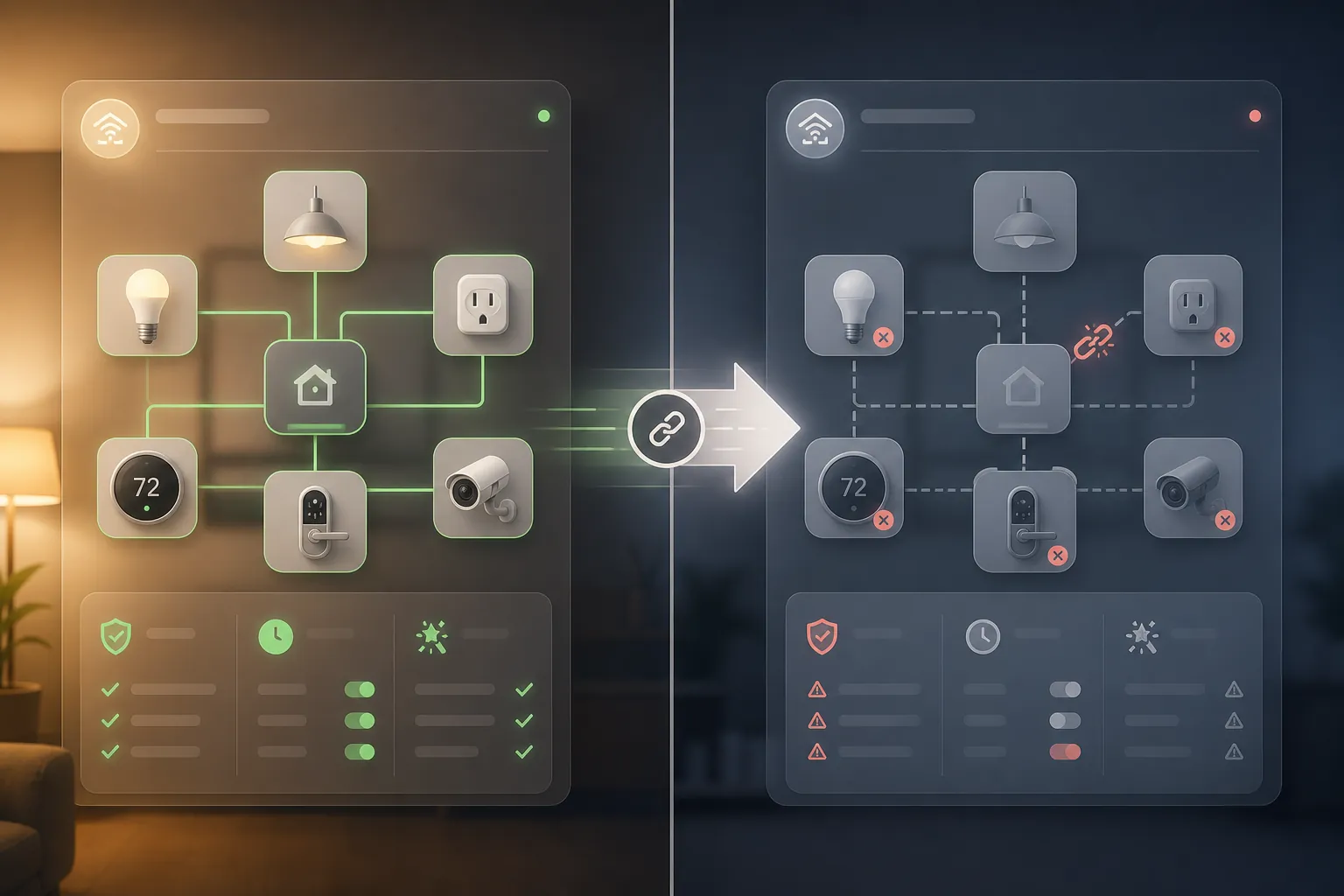
NestGrid should not label those individual failures as Confirmed unless they are reproduced firsthand. The current status is stronger than random noise and weaker than verified universal breakage: Monitoring for broad Alexa+ migration risk, Investigating for repeatable reports involving classic skills, device groups, routines, and phrasing changes.
What Counts as a Real Warning Sign
If nothing in your home changed except you read a headline about Nova Premier or Nova Omni, there is no useful emergency action to take. Do not tear out Alexa, factory-reset Echo speakers, or rebuild routines because of the Nova lifecycle table. That table is a developer-facing model status signal, not a household outage notice.
- Treat Alexa+ enrollment or forced migration as relevant if failures begin immediately afterward.
- Treat broken Alexa Classic skills as migration evidence, especially if disabling Alexa+ restores them.
- Treat device groups differently from individual device failures; a group regression can come from interpretation or grouping logic rather than the device itself.
- Treat new phrasing requirements as a compatibility change, not user error.
- Treat latency over normal household tolerance as a real smart-home failure, even if the command eventually works.
Amazon's July 23, 2026 developer announcement for new AI-powered smart-home building tools also points in the same direction: the integration path is changing, and developers are being pushed toward new ways to build Alexa+ experiences.[9] That is not an admission that old integrations are broken. It is a sign that smart-home compatibility is moving through a platform transition, which is exactly where long-running automations tend to get fragile.
Do Not Let the AI Cost Story Swallow the Smart-Home Answer
There is a larger Amazon AI overhaul happening around this. CNBC reported layoffs in Amazon's AGI unit in July 2026.[10] Business Insider has reported pressure to lower Alexa AI costs and reduce reliance on Anthropic models.[5] Reuters and Business Insider both confirmed the flagship Nova wind-down.[1][2] Those facts help explain why Alexa+ may keep changing under the hood.
They still do not prove that Alexa smart-home control is collapsing. The bridge between "Amazon is cutting or rerouting AI costs" and "my thermostat routine will fail" has to run through an actual compatibility layer: skills, groups, routines, device discovery, permissions, voice interpretation, or response latency. That is where the user-visible evidence is appearing, and that is where troubleshooting should focus.
The right practical judgment is boring, which is usually what you want from a smart home. Do not switch ecosystems because Nova Premier, Omni, Reel, and Canvas are being wound down. Do pay close attention if Alexa+ arrives on your account, if a classic skill stops responding, if a device group behaves differently from individual devices, if a routine loses steps, or if a command suddenly needs a phrase no one in the house had to say before. Those are the near-term compatibility risks worth tracking.
References
- Amazon overhauls AI strategy, phasing out most Nova models, Business Insider, July 28, 2026
- Amazon winds down most flagship AI models in strategy overhaul, Business Insider reports, Reuters, July 28, 2026
- Model lifecycle, AWS Documentation
- Introducing Alexa+, the next generation of Alexa, About Amazon
- Amazon pushes to lower Alexa AI costs and use Anthropic models less, Business Insider, July 23, 2026
- Alexa Plus early access rollout 2026, WIRED, January 2026
- Alexa Breaks Alexa Classic Skills - Amazon Says No, I Say Yes, HomeSeer Forum
- Alexa Plus and Gemini for Home problems and solutions, The Verge
- Alexa+ new ways to build experiences, Amazon Developer, July 23, 2026
- Amazon lays off some employees in its AGI unit, CNBC, July 22, 2026
Resolution
Investigating — no confirmed fix yet.
Protocol background
For general spec/firmware mechanics, see Compatibility & Protocols.
No linked protocol reference for this update yet.