
Amazon AGI Layoffs Won't Slow Alexa Smart Home
Worried Amazon's AGI layoffs and Nova model wind-down mean Alexa smart home is stalling? This dated analysis separates the cuts from the concurrent expansions — including the July 23 Alexa+ developer toolkit launch with 15+ brands — showing that the two moves are not contradictory.
If you searched for amazon agi layoffs impact alexa smart home development because your lights, locks, leak sensors, plugs, vacuum, and routines already depend on Alexa, the important thing is not the headline word “AI.” It is the calendar. Amazon confirmed AGI layoffs on July 22, 2026; launched an Alexa+ smart home developer toolkit the next day; and then, on July 28, Business Insider reported that Amazon was winding down several flagship Nova models. Those are related AI-company events, but they do not point in the same product direction.
The July 22 cuts hit Amazon’s AGI organization, including model customization and post-training roles and the AGI Lab, with the exact number undisclosed in public reporting.[1] On July 23, Amazon opened a preview developer toolkit for Alexa+ smart home control, naming more than 15 participating brands across appliances, lighting, locks, plugs, vacuums, water protection, pet products, and energy devices.[2] On July 28, Business Insider reported that Amazon was moving some Nova models to KTLO status while shifting resources toward a new Frontier Model Research effort.[3]
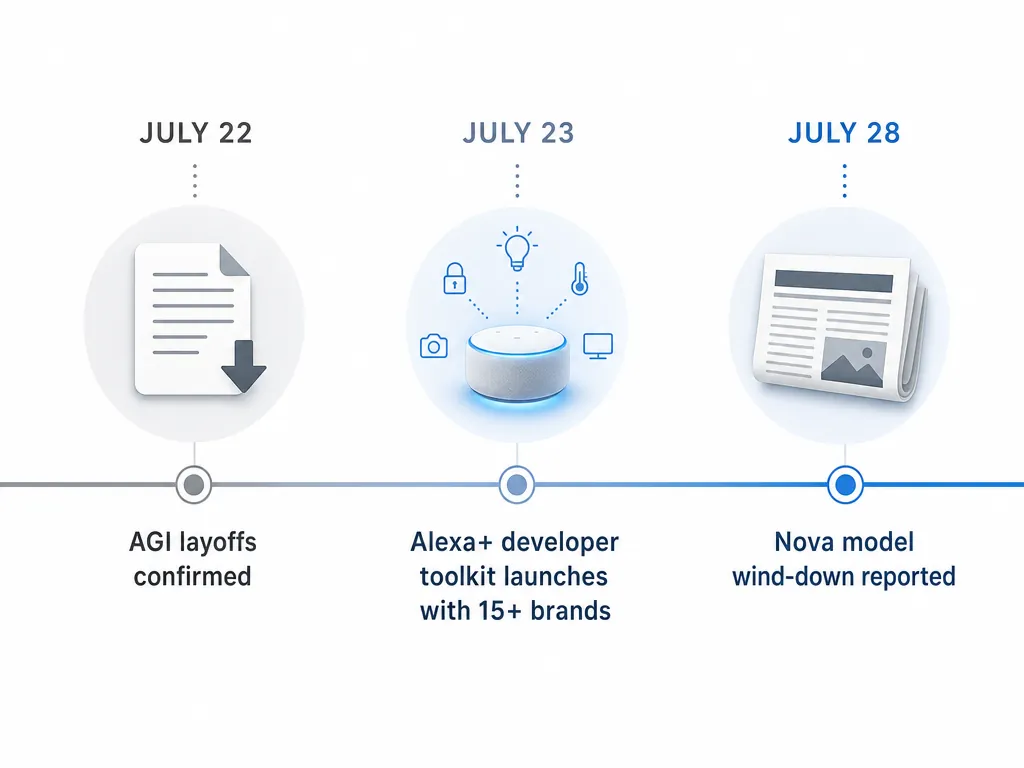
That sequence matters because Alexa smart home development is measured at the integration surface: device partners, APIs, routines, hubs, voice control, app behavior, and developer access. A model-team reduction can affect future AI quality, and it matters to the people whose jobs were cut. But it is not, by itself, evidence that Amazon is backing away from Alexa-compatible devices.
What Was Cut, and What Was Not Shown to Be Cut
The reported AGI cuts sit on the model-building side of Amazon’s AI organization. CNBC reported that the July 22 layoffs affected model customization and post-training work and included people in Amazon’s AGI Lab; Reuters and other outlets also reported the number as undisclosed or “several hundred,” rather than a precise public count.[1]
That distinction is not corporate hair-splitting for smart-home buyers. If Amazon had closed a device cloud, ended a Works with Alexa path, pulled support from routine triggers, removed a hub function, or told manufacturers to stop building against Alexa+, that would be a direct ecosystem regression. The July 22 reporting does not show that.
The broader context is still real. CNBC reported that Amazon’s total layoffs since October 2025 exceeded 30,000, including 14,000 in October 2025, 16,000 in January 2026, and additional smaller rounds afterward.[1] The AGI group had also been through leadership changes: Rohit Prasad left in December 2025, AGI Lab head David Luan left in February 2026, and AGI work had been consolidated under Peter DeSantis in December 2025.[1]
That is evidence of restructuring. It is not evidence, on its own, that Alexa smart home integrations are being starved. The useful question is narrower: did Amazon continue opening paths for device makers and Alexa+ users in the same period? The answer, at least from the July 23 launch, is yes.
The July 23 Alexa+ Toolkit Is the Smart-Home Signal
Amazon’s Alexa+ smart home developer toolkit launched in preview on July 23, one day after the AGI layoffs were confirmed.[2] Preview is an important word. It means this is not the same as a finished, universally available feature set in every household. But a preview developer toolkit is still a concrete investment signal because it gives device companies a path to build against the next Alexa control layer.
The partner list is the part homeowners should care about more than the AI branding. Amazon named Bosch, Delta, Ecovacs, Eufy, Govee, iRobot, Moen Flo, PetSafe, Pila Energy, SONOFF, Tapo, Twinkly, Whirlpool, and Yale Home among the brands involved in the preview.[2] That list cuts across several everyday categories: door locks, appliances, lighting, robot vacuums, leak prevention, pet devices, smart plugs, and connected fixtures.
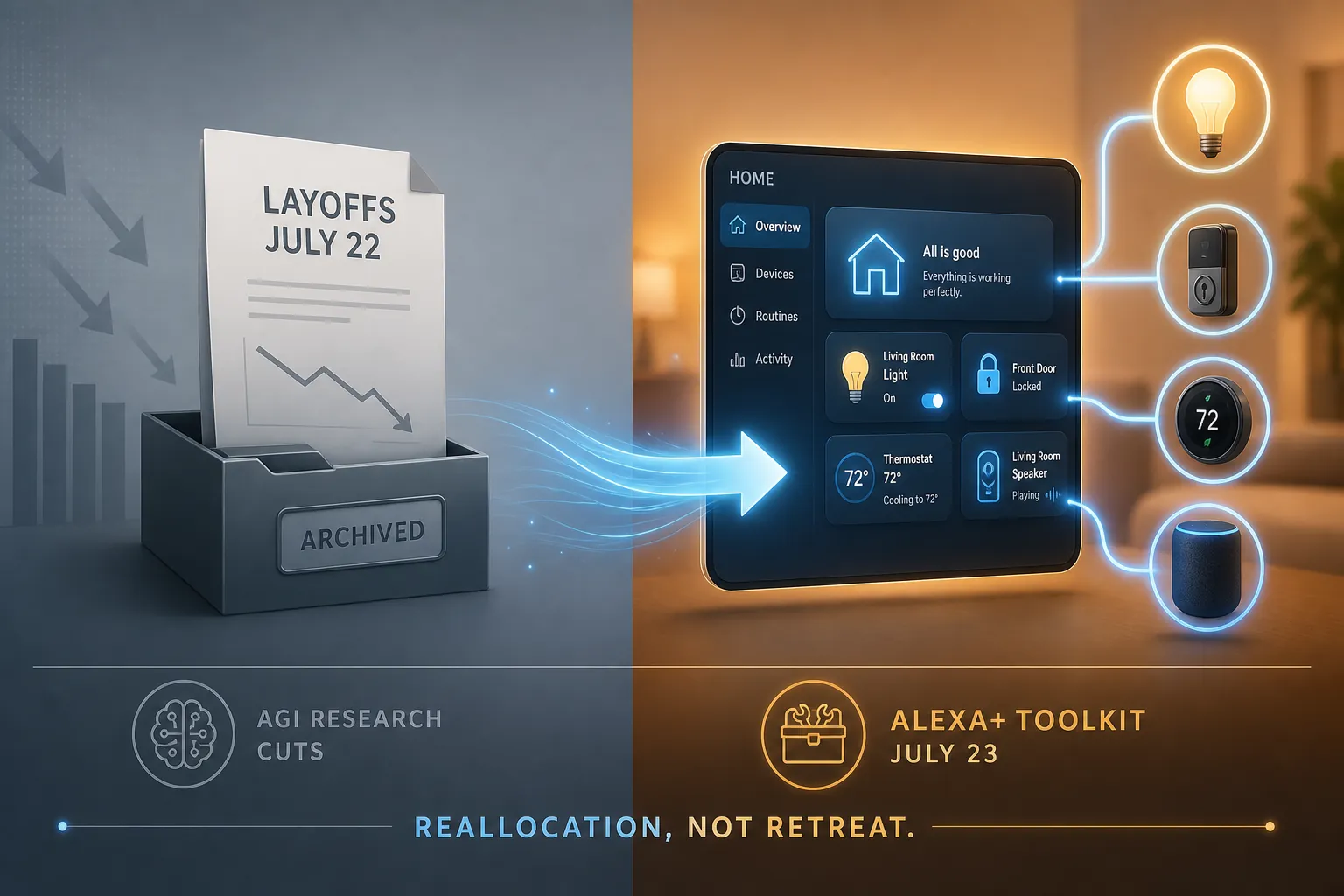
This does not mean every device from every named brand suddenly gains richer Alexa+ behavior. Brand participation can start with a subset of products, accounts, app versions, or regions. It also does not guarantee that every preview capability ships unchanged. But it does mean Amazon was not merely keeping Alexa alive with old integrations while cutting AI work elsewhere. It was asking smart-home companies to build for Alexa+.
Amazon also said Alexa+ users increased smart home activity by about 50% in the first month and created twice as many Routines.[2] Those are Amazon-supplied engagement signals, not independent proof that every Alexa household will find the new system better. They do, however, explain why Amazon would keep pushing the smart-home layer even while narrowing other AI work: routines and device control are where Alexa has existing household behavior to defend.
| July 2026 event | What it directly concerns | Smart-home relevance |
|---|---|---|
| July 22: AGI layoffs confirmed | Model customization, post-training, AGI Lab, broader AI restructuring | Indirect risk to future AI quality, but no reported removal of Alexa smart-home paths |
| July 23: Alexa+ smart home toolkit preview launches | Developer access, partner integrations, routines, device-control experiences | Direct evidence that Alexa+ smart-home work was still expanding |
| July 28: Nova wind-down reported | Flagship model portfolio and FMR resource shift | Relevant to underlying AI strategy, but not a documented Alexa compatibility cut |
The Nova Report Does Not Equal “Alexa Lost Its Brain”
The Nova story needs careful handling. Business Insider reported on July 28 that Amazon was winding down flagship Nova models including Premier, Omni, Reel, and Canvas to KTLO status, while redirecting resources toward a Frontier Model Research effort led by Pieter Abbeel, who came through Amazon’s Covariant acquisition.[3] The report cited anonymous sources, and Amazon’s official response was that it continually evolves its model lineup while continuing to support models in production.[3]
So the safe reading is not “Nova vanished.” Business Insider also reported remaining Nova work including Nova 2 Sonic, Nova 2 Lite, Nova Forge, and Nova Act.[3] More importantly for Alexa owners, the relationship between any one deprecated Nova model and Alexa+ smart-home behavior is not fully documented in the public material. Amazon describes Alexa+ as using LLMs on Amazon Bedrock, a platform that can involve different model options. The available evidence does not support a straight line from the reported Nova changes to broken device control.
There is still a bounded risk here. If Amazon reduces too much internal model work, future Alexa+ quality could depend more heavily on fewer research paths or outside model providers. That could matter later for latency, reliability, cost, natural-language understanding, or how well Alexa handles messy multi-device commands. But that is a future product-quality risk, not a July 2026 finding that Alexa smart home development has stalled.
Why MCP and Amazon Wallet Matter Less Than the Toolkit, but Still Matter
The July 23 Alexa+ announcement was not limited to lights and locks. Amazon also said Alexa+ would support Model Context Protocol integrations with Canva, Lyft, Priceline, Virgin Atlantic, and Headspace later in the year.[2] That is not a smart-home compatibility proof in the same way as Yale Home, Govee, Tapo, or iRobot appearing in a device-toolkit context. It does show Amazon was still expanding Alexa+ as an action-taking assistant, not freezing it after an internal AI cut.
Amazon Wallet belongs in the same secondary bucket. The company described new voice-purchase support with early adopters including Atom Tickets, Fandango, Priceline, and Taskrabbit.[2] That is commerce infrastructure, not a guarantee that your door lock will behave better. But it points to the same product posture: Amazon was putting Alexa+ in front of customer actions, payments, and partner workflows the day after the AGI cuts became public.
What This Means Before You Buy or Replace Devices
As of July 31, 2026, the evidence supports resource reallocation, not an Alexa smart-home retreat. Amazon appears to be narrowing parts of broad model work while continuing to expand Alexa+ as a customer-facing platform, including smart-home developer access and named device-brand participation.
That is useful, but it should not make anyone careless. The Alexa+ toolkit is in preview. A preview integration can change before general availability. A brand name in a launch post is not the same as support for every model number, every Matter bridge, every Wi-Fi device, or every regional app account. If you are buying a lock, appliance, plug, vacuum, leak sensor, or lighting system because of Alexa, verify the exact compatibility path at the time of purchase: device model, hub requirement, protocol, app version, routine support, and whether Alexa+ features are actually available to your account.
The July AGI and Nova headlines alone are not a good reason to assume Alexa smart home development is dying. They are a reason to watch Amazon’s execution closely: whether preview partners ship, whether routines become more reliable rather than merely more conversational, whether Matter and device-cloud handoffs stay stable, and whether Alexa+ control reaches ordinary households without turning compatibility into a scavenger hunt.
References
Resolution
Investigating — no confirmed fix yet.
Protocol background
For general spec/firmware mechanics, see Compatibility & Protocols.
No linked protocol reference for this update yet.