
Why the AI Singularity Race Is Breaking Your Smart Home Assistant
The push toward AGI-level assistants has already caused real, documented regressions in smart home reliability. This Update Watch details confirmed breakdowns from Amazon's Alexa+ and Google's Gemini migration, explains the architectural incompatibility, and explores locally-run Home Assistant AI as a dependable alternative for those willing to configure it.
If your smart speaker still hears you but no longer does the boring thing you asked for, that is not just vague update rot. In the 2025–2026 push to turn voice assistants into generative AI companions, both Amazon and Google have moved household control away from the old model — match a known phrase to a known device action — and toward model-based interpretation. That shift matters because the AI assistant future being sold from keynote stages has already arrived in kitchens and hallways as something much less glamorous: lights that do not turn off, routines that miss steps, and displays that lose functions people were using yesterday.
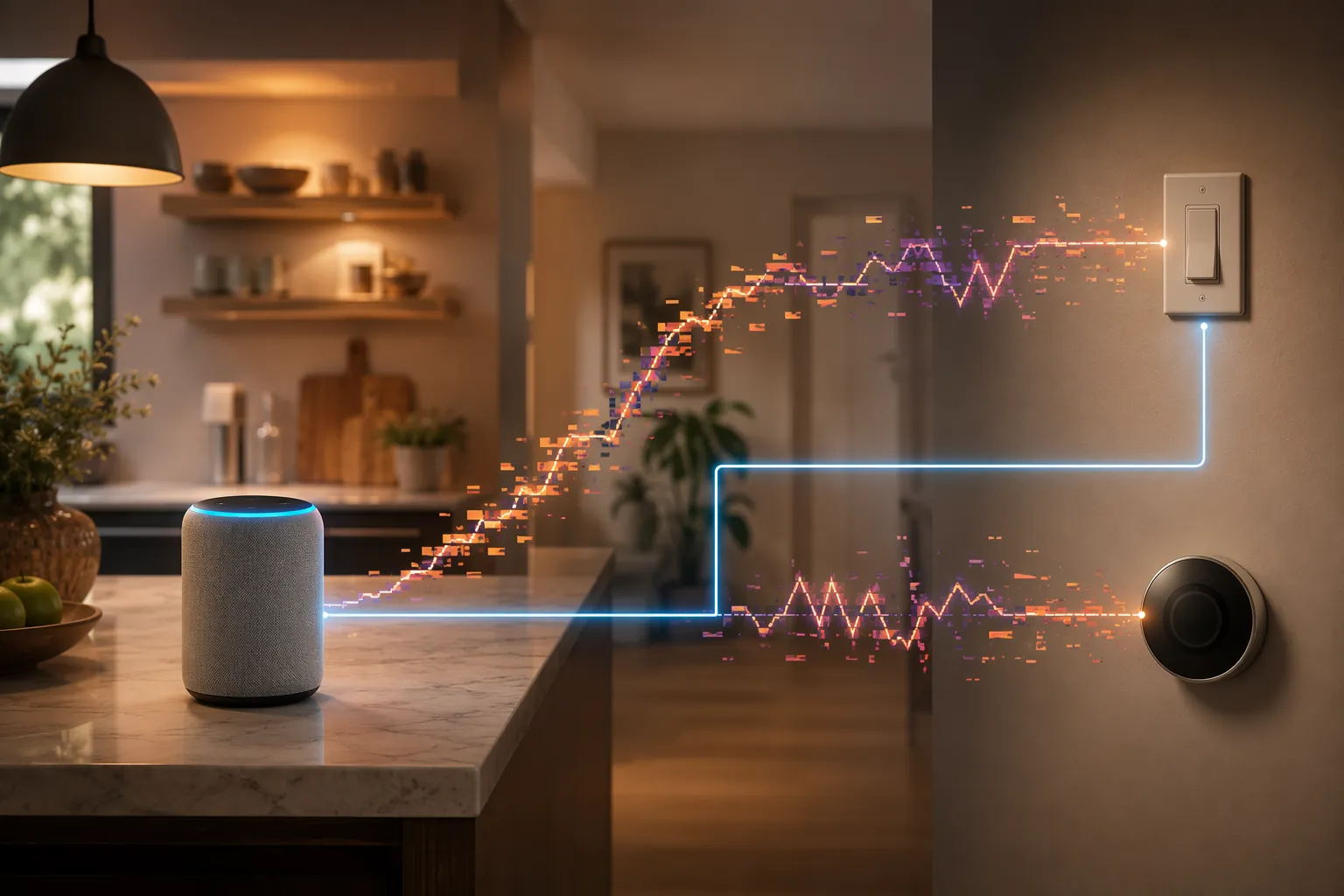
Amazon announced Alexa+ on February 26, 2025, as a generative overhaul of Alexa. By mid-2026, published reporting and smart-home community accounts were describing the same practical failure pattern: routines failing, device names being misread, and multi-step actions choosing the wrong target or inventing a target relationship that was not configured that way in the home.[1] That is the difference between a chatbot mistake and a home-control mistake. A chatbot can misunderstand a dinner plan. A home assistant can turn on the wrong room.
The Alexa+ Regression Is the Cleanest Warning
Alexa was never perfect, but its most dependable smart-home behavior came from being limited. “Turn off the hallway lights” did not need imagination. The assistant needed to identify the device group called hallway lights, call the right smart-home service, and confirm that the command executed. When that chain was narrow, users could usually troubleshoot it: rename the device, rebuild the group, fix the routine, check the skill, reconnect the hub.
Alexa+ changes the failure surface. Matter Alpha’s explainer, which also points to TheStreet coverage and broader community complaints, describes users reverting after generative behavior made smart-home control less predictable rather than more capable.[1] The important part is not that a large language model can misunderstand speech. Everyone who has used one knows that. The important part is that Alexa+ was placed in the path between a command and a household action.
That is where “smarter” starts to mean “less repairable.” A conventional routine that fails usually has a visible cause: a missing device, a broken cloud integration, a changed skill permission, a phrase conflict. An LLM-mediated failure can look like a household ghost. The assistant heard the words, generated a plausible interpretation, and took an action that made sense to the model but not to the person standing under the light.
This is also why forum noise should not be dismissed outright, even when individual threads are hard to cite. The published reports establish the failure class; community complaints show how often the class appears in ordinary homes. The repair question is not whether every complaint is independently verified. It is whether the platform now has a new, documented way to fail that users cannot inspect.
Google’s Gemini Story Is Messier, Which Makes It More Useful
Google’s migration from Assistant to Gemini is not a simple collapse story. Android Authority’s hands-on account describes Google cutting at least 35 Assistant features in early 2024, removing another 7 features in March 2025, and confirming Assistant’s retirement by March 2026.[2] That is a real loss of utility, especially for people who bought smart displays and speakers because Assistant already handled timers, media, routines, lists, and device control in familiar ways.
But the same account also reports that Gemini revived some aging Nest hardware, including the 2018 Home Hub and 2019 Nest Hub Max, while other smart-home functions regressed.[2] That contradiction is worth keeping. It prevents the easy version of the story, where every generative AI update simply makes everything worse. In some places, Gemini gave old hardware a second life. In others, it broke the reason people kept that hardware plugged in.
That mixed result is exactly what a platform migration looks like when the company is replacing the assistant’s brain faster than it is rebuilding the assistant’s chores. A Nest display can become more conversational and still be worse at a narrow task. A model can answer a more flexible question and still mishandle a lamp, thermostat, or routine. Those are not contradictions inside the home; they are contradictions inside the product strategy.
The user experiences the distinction in a much simpler way. Yesterday the command worked. Today the assistant says something clever, routes the request differently, or no longer supports the function at all. The company may describe this as a transition. In a working household, it is a regression.
Why Better Language Can Make Worse Device Control
The core mismatch is architectural. Home Assistant’s engineering team laid it out clearly in its 2025 AI architecture post: large language models introduce variable latency, unpredictable output formatting, and no guarantee that a requested command will actually execute.[3] Those weaknesses are tolerable when the task is optional interpretation. They are not tolerable when the task is “unlock,” “heat,” “stop,” “dim,” or “turn off.”
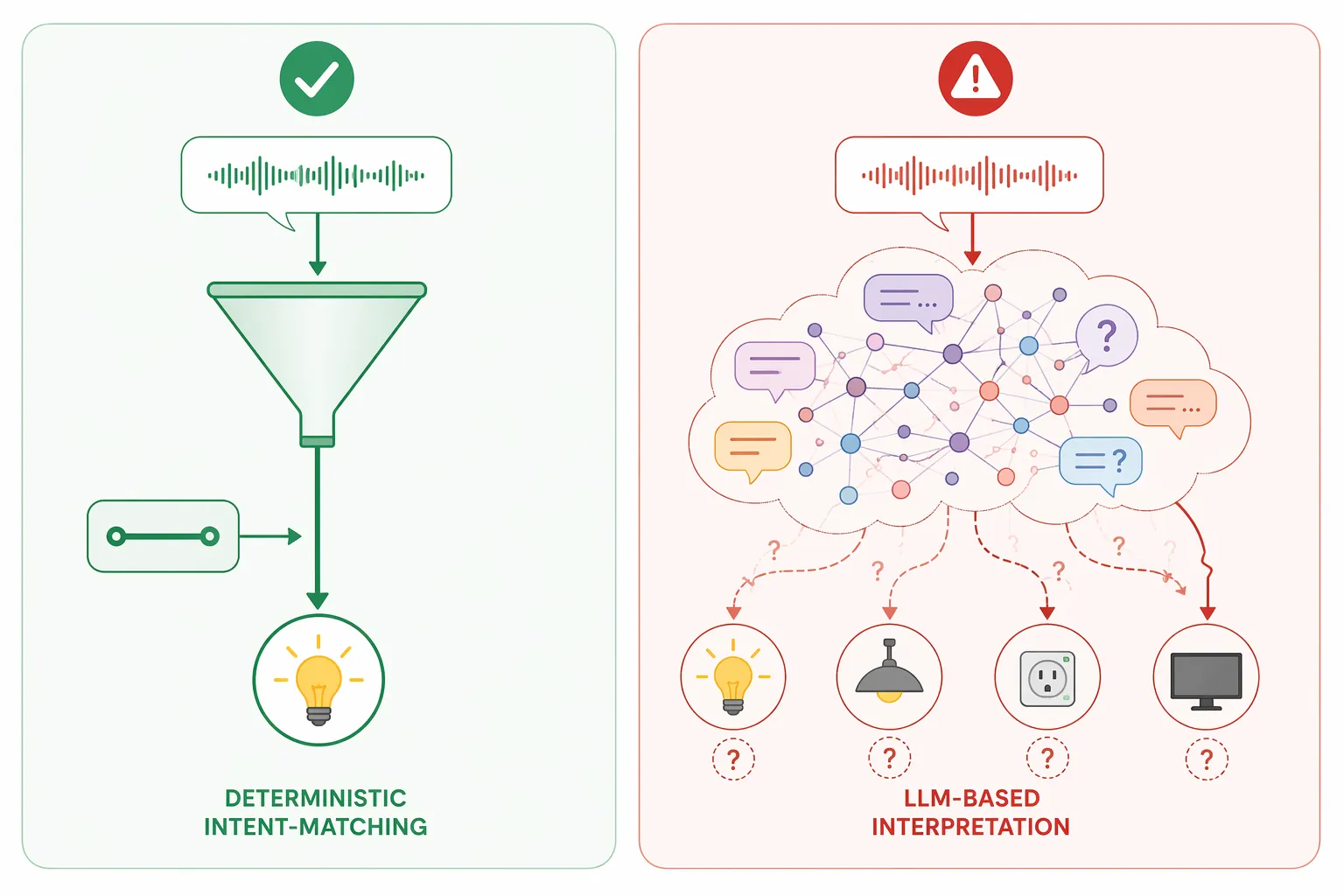
A deterministic assistant treats a smart-home command like a switchboard problem. The words come in, the system maps them to a known intent, the intent maps to a known entity, and the platform calls the service that controls that entity. If the entity does not exist, the assistant should fail plainly. If the device is offline, it should say so. The command path is dull because dull is the feature.
An LLM treats the same request as an interpretation problem. It may infer that “the hallway” means the front hall, the upstairs landing, a group with a similar name, or the lights most recently discussed. That kind of inference is useful when the user asks an ambiguous question. It is dangerous when the home already has an exact device registry. The model is being asked to be helpful in a place where the safest behavior is to be literal.
Latency is not just a benchmark number here. If a voice command waits on a cloud model, the pause changes how the home feels. People repeat commands, issue a second command before the first one finishes, or assume the assistant missed them. That can stack failures: a delayed “off” becomes two requests, a routine runs twice, or a user manually flips the wall switch while the cloud path is still deciding what to do.
Output formatting sounds like an engineer’s problem until it reaches the countertop. A home-control system needs structured, valid, boring output: entity ID, service call, parameters, confirmation. A model that returns unexpected text, adds an explanation, changes a field name, or produces a plausible but invalid action has not merely phrased something oddly. It has failed to hand the smart-home system a command it can safely execute.
Guaranteed execution is the line that separates a household control system from an assistant demo. If the system cannot guarantee that a recognized command becomes the intended device action, the smart part belongs outside the critical path. Let the model help with messy requests, room summaries, energy questions, or “what did I mean by the downstairs lamps?” But once the user gives a known command against a known device, the path should collapse back to deterministic control.
Home Assistant’s Model: Local Commands First, AI Only Where It Helps
Home Assistant is not a magic replacement for an Alexa household. It asks more of the owner: hardware choices, integrations, device cleanup, dashboards, automations, backups, and sometimes local AI configuration. A person who only wanted a speaker to turn on the kitchen lights may reasonably want no part of that.
Still, its architecture points to the repair that mass-market platforms need. Home Assistant’s Assist handles deterministic commands locally, while AI is treated as an optional layer for ambiguous requests rather than the only route between speech and device control.[3] That division respects the difference between language understanding and command execution. The model can be clever at the edge of uncertainty; the home can stay strict at the moment of action.
The project has also been attacking the part that used to make local voice feel second-class: delay. In the same architecture work, Home Assistant reported that streaming text-to-speech reduced voice response startup from 6.62 seconds to 0.51 seconds, a 13× improvement.[3] That does not make every local voice setup effortless, and it does not erase the hardware requirements for useful local LLM performance. It does show that local-first does not have to mean slow-first.
Scale matters too. GitHub’s profile describes Home Assistant as part of a “local-first rebellion” and says it is used in more than 2 million households.[4] That is not Alexa scale, and it is not the same audience. It is enough to prove that local control is not a hobbyist fantasy confined to a few workbenches. It is a working path for people who value inspectability and fallback more than a polished cloud assistant voice.
The hardware trend is moving in the same direction. Synaptics’ edge-AI discussion describes on-device NPUs delivering sub-200 millisecond response times and frames SoC and edge-AI consolidation as an accelerating smart-home connectivity trend.[5] That does not mean every $49 speaker will suddenly run a useful private model. It does mean the old excuse — that useful intelligence must always be round-tripped through the cloud — is getting weaker.
What to Watch Before You Blame the Light Bulb
When a smart home starts failing after an assistant migration, the first instinct is usually to blame the device. That is sometimes right. Bulbs drop off Wi-Fi, bridges lose tokens, Thread networks get messy, and vendor clouds go down. But the 2025–2026 assistant transition adds a new diagnostic layer: the device may be fine, the integration may be fine, and the voice interpretation layer may be the part that changed.
- If the wall switch, app, or automation still works but voice fails, suspect assistant interpretation before replacing hardware.
- If one-room commands fail more often than exact device names, look for room, group, or entity-name ambiguity.
- If routines fail only when launched by voice, test whether the routine still runs from the app.
- If multi-step commands choose strange targets, split them into single commands and watch where interpretation changes.
- If a feature disappeared entirely, check whether it was removed during the Assistant-to-Gemini or Alexa+ transition rather than assuming a device fault.
That kind of testing will not fix a cloud platform’s design decision, but it can keep a working household from being torn apart unnecessarily. A bulb that responds instantly from its own app does not need to be factory reset because a generative assistant guessed wrong. A routine that still runs manually does not need to be rebuilt from scratch until the voice path has been isolated.
The Market Wants AI Assistants; Homes Need Fallbacks
There is plenty of market pressure pushing companies toward bigger AI assistants. The exact forecasts vary and deserve cross-checking before anyone treats a single projection as settled, but the direction is obvious enough from product behavior: Amazon and Google want assistants that feel less like command parsers and more like general-purpose agents. That may be good for shopping, planning, summarizing, and open-ended questions. It is not automatically good for household control.
The practical standard should be plain. A smart-home assistant has to execute a known command against a known device repeatably, with low latency and without surprising interpretation. If it cannot do that, it is not ready to sit between people and locks, lights, thermostats, alarms, displays, and routines. Conversation can be optional. Control cannot be probabilistic.
That does not require rejecting AI in the home. It requires putting it in the right place. Let AI handle ambiguity, summarize device states, explain automations, suggest scenes, or translate messy human phrasing into a command proposal. Then let a deterministic layer verify the target, validate the action, and execute locally when possible. If the model is uncertain, the system should ask. If the cloud is slow, the local path should still work. If a routine matters, it should not depend on a model inventing the same answer every morning.
Alexa+ and Gemini may become more conversational. They may even become more useful in parts of the home that were previously rigid. But the documented regressions show the cost of treating device control as a chat problem. Until the major platforms rebuild dependable deterministic fallback layers, the more reliable smart-home future belongs to systems that keep local command execution boring on purpose.
References
- AI won’t fix your smart home anytime soon—and it might just break it, Matter Alpha
- Google Assistant ruined my smart home, but Gemini saved it, Android Authority
- AI in Home Assistant, Home Assistant, 2025-09-11
- The local-first rebellion: How Home Assistant became the most important project in your house, GitHub Blog
- Smart Home Connectivity Trends, Challenges and the Role of Next-Gen IoT Technology, Edge AI and Vision, 2026-03
Resolution
Investigating — no confirmed fix yet.
Protocol background
For general spec/firmware mechanics, see Compatibility & Protocols.
No linked protocol reference for this update yet.