The impact of the 2G network shutdown on smart home devices is much narrower than the phrase makes it sound. Your Wi-Fi bulbs, smart plugs, Wi-Fi cameras, Zigbee sensors, Z-Wave locks, Thread devices, Matter switches, and ordinary smart home hubs are not going offline because a carrier turns off 2G. They do not use 2G cellular service in the first place.
The device to check is different: an older monitored alarm panel, medical alert base station, or rare hub with a cellular communicator inside it. If that communicator is a 2G GSM module still riding on T-Mobile's network, the deadline is August 3, 2026.[1] That is close enough that this is no longer a someday maintenance item.
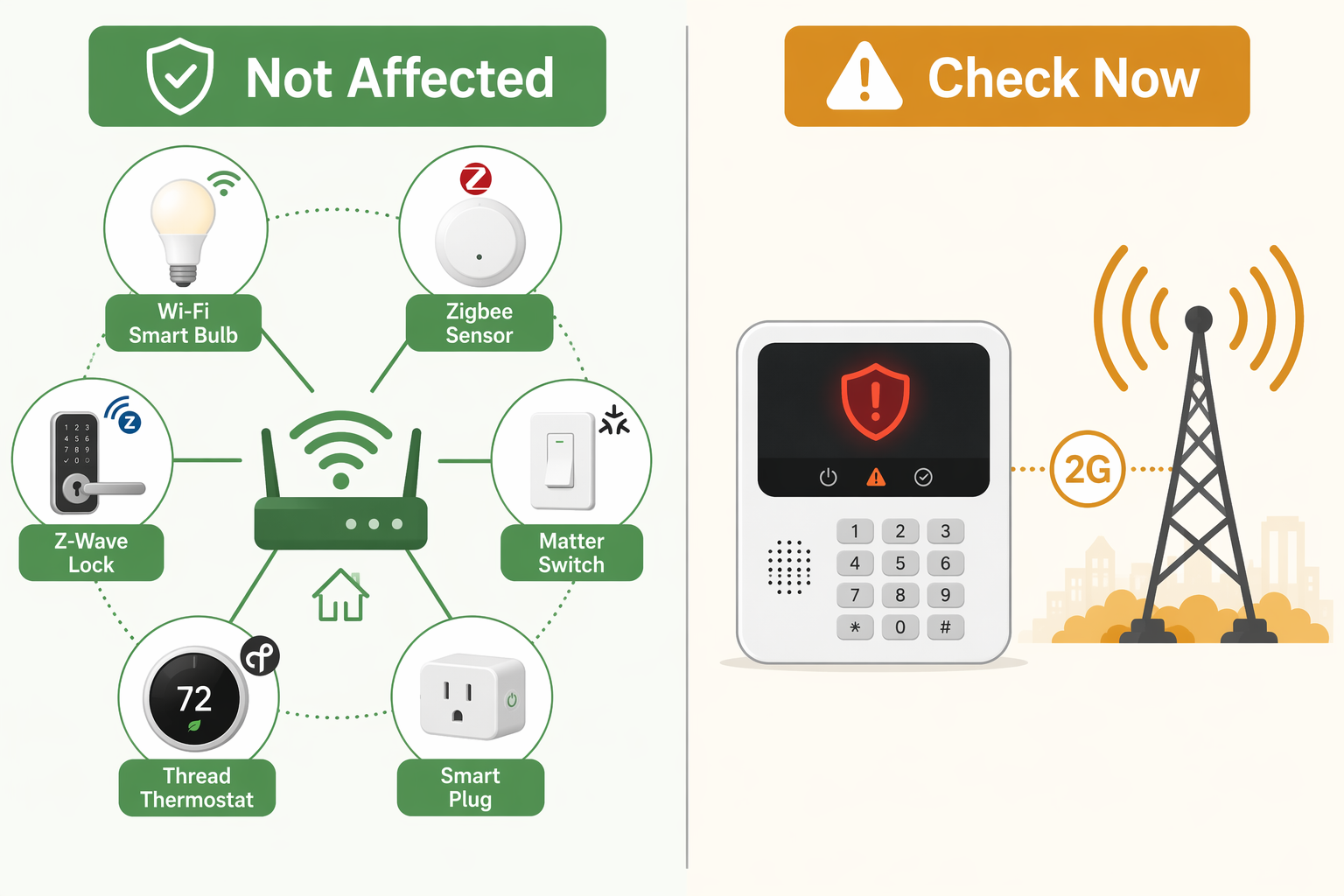
Start With the Radio, Not the Device Category
The useful question is not whether something is a smart home device. The useful question is what radio it uses to reach the outside world.
| Device or system | What it usually depends on | 2G shutdown risk |
|---|---|---|
| Wi-Fi bulbs, plugs, cameras, speakers | Home Wi-Fi and broadband | Not affected by a 2G cellular shutdown |
| Zigbee sensors and switches | A local Zigbee mesh and hub | Not affected |
| Z-Wave locks and sensors | A local Z-Wave mesh and hub | Not affected |
| Matter or Thread devices | Local network, Thread border router, Wi-Fi, or Ethernet depending on device | Not affected because of 2G specifically |
| Smart thermostats using Wi-Fi | Home Wi-Fi and broadband | Not affected by 2G |
| Monitored alarm panels with a cellular communicator | A carrier network such as 2G, 3G, 4G LTE, or 5G | Check now, especially if the communicator is old |
| Medical alert or emergency button systems with cellular backup | A cellular modem in the base station or device | Check now |
That distinction saves a lot of unnecessary work. A Zigbee leak sensor does not talk to a cell tower. A Z-Wave lock does not care whether 2G exists. A Matter switch is not secretly waiting for a GSM network. If those devices have a problem after August 3, the cause is almost certainly somewhere else: Wi-Fi, power, hub configuration, cloud service status, app changes, or the device itself.
A monitored alarm panel is different because many older installations were built to send alarm events through a cellular module. That module may sit inside or near the control panel and can be invisible to the person using the keypad every day. The alarm can still beep, chime, arm, disarm, and look perfectly normal while the communicator path is the part aging out.
Why the Deadline Points Mostly at Older T-Mobile-Based Alarm Gear
T-Mobile lists August 3, 2026 as the retirement date for its 2G GSM network.[1] Fierce Network reported the same timing and quoted T-Mobile describing the remaining 2G base as "de minimis" and consisting "almost entirely of legacy IoT devices."[2] For a normal household, that phrase should narrow the search, not widen it. Legacy cellular alarm communicators are the kind of thing to investigate; ordinary smart bulbs are not.
AT&T shut down its 2G network in 2017, and Verizon shut down 2G in 2020.[3] That does not mean every old alarm is safe. It means a device that is still functioning on 2G in the United States is very likely not depending on AT&T or Verizon 2G anymore. The remaining household concern is concentrated around T-Mobile's last 2G GSM service and devices that were never moved to LTE.
There is broader cellular IoT exposure outside the living room. 1GLOBAL says more than 50% of cellular-connected IoT deployments still rely on 2G or 3G, attributing that figure to sector analysts, though the methodology and date are not independently verifiable from the briefed material.[4] Treat that as directional context for businesses and infrastructure fleets, not as evidence that half the devices in a smart home are about to fail.
The Alarm Systems Worth Checking
The systems that deserve attention are older professionally monitored alarms, especially ones installed long enough ago that nobody in the house remembers the communicator type. Known risk categories include older 2GIG GC2 or GC3 installations with GSM modules, Honeywell Vista systems with 2G cellular communicators, older DSC panels, and legacy systems sold or serviced through ADT, Vivint, local alarm companies, or Alarm.com ecosystem dealers. That is not the same as saying every 2GIG, Honeywell, DSC, ADT, Vivint, or Alarm.com-connected system is at risk. Many have already been upgraded to LTE.
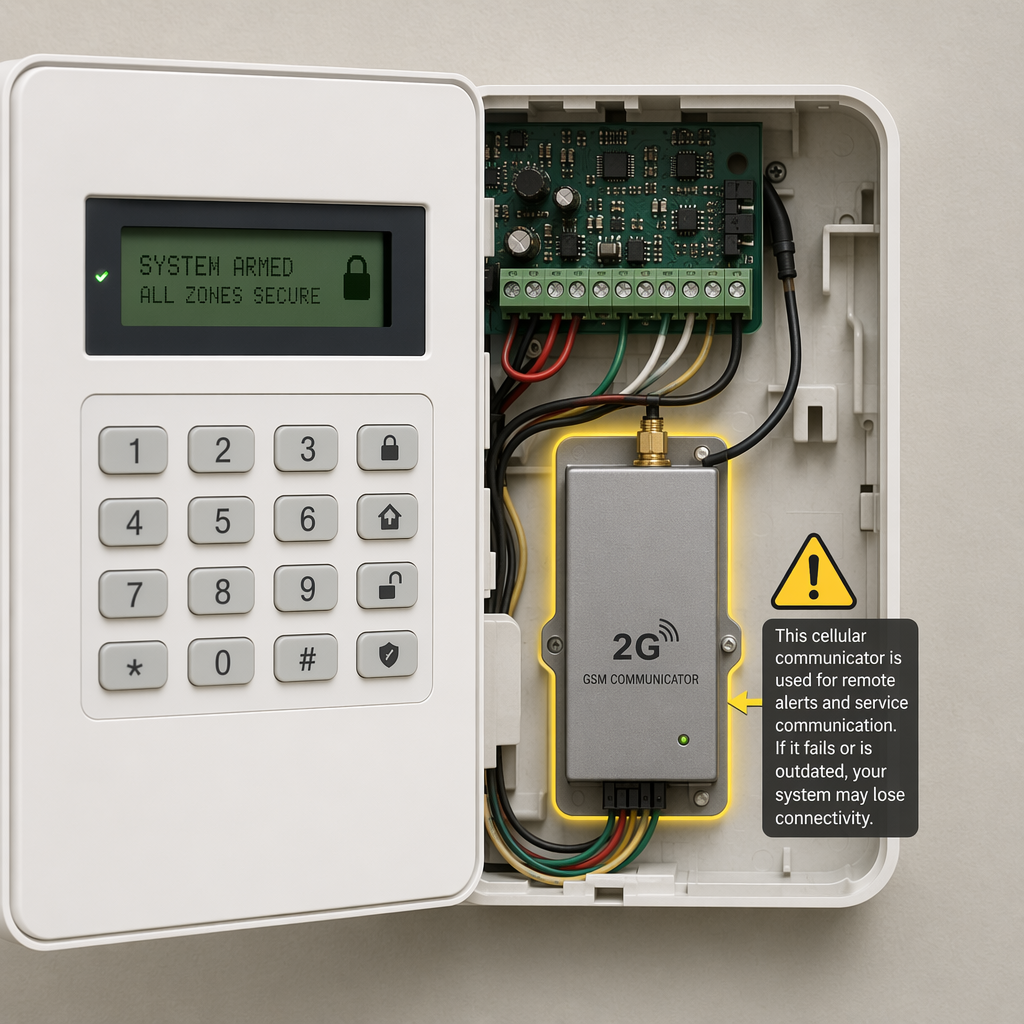
The labels to look for are usually not on the keypad screen. They may be on a communicator module inside the alarm cabinet, on a separate cellular communicator box, in the monitoring account notes, or in the installer paperwork. Terms such as GSM, GPRS, 2G, EDGE, CDMA, 3G, LTE, LTE-A, LTE-M, Cat-M, 4G, or 5G matter because they describe the path the alarm uses to reach the monitoring station.
If the panel uses only a landline, Ethernet, or broadband connection, this particular 2G deadline is not the issue. If it uses broadband plus cellular backup, the broadband path may still work while the cellular backup path fails. That is still worth fixing because backup communication is the reason many people paid for the cellular module in the first place.
How to Verify Without Guessing
- Call the monitoring provider or original installer and ask: "Does my panel use a 2G GSM cellular communicator on T-Mobile's network?"
- Ask for the communicator model number, not only the alarm panel model. The same panel family may support different radios.
- Ask whether the account has recently completed a successful cellular signal test to the monitoring station.
- If there is a separate cellular communicator box near the panel, ask the provider whether it is 2G, 3G, LTE, or something newer.
- Do not open a monitored alarm cabinet or move wiring unless your provider says it is safe; tamper switches and account procedures can create avoidable trouble.
The key is to verify the communicator, not the brand printed on the keypad. A Honeywell Vista panel, for example, can be paired with different communication modules over its life. A 2GIG GC3 could have been sold with an older GSM module and later upgraded. The panel name alone does not answer the network question.
The Failure Can Be Quiet
"My alarm still arms" is not a communication test. Local alarm functions and monitoring communication are separate enough that one can appear healthy while the other is gone. The keypad can accept a code, door sensors can chime, the siren can sound locally, and the panel can still fail to send an alarm signal to the monitoring center.
Olarm documented this silent-failure pattern in the UK context: alarm systems can appear to keep working locally while the 2G or 3G path used for remote signaling stops reaching the monitoring destination.[5] That is not a direct count of U.S. homes affected by T-Mobile's shutdown, but the mechanism is the same kind of risk: the visible part of the alarm is not always the part that proves monitoring still works.
There is also a gray period before a formal shutdown date. As networks near retirement, carriers and tower operators may reduce maintenance or capacity on older equipment. A communicator can become unreliable before the calendar says the network is officially gone, especially in places where signal was never strong to begin with. That is one reason to schedule the upgrade now rather than treating August 3 as the day to start calling.
What to Do If Your Alarm Uses 2G
Most affected alarm owners should not need a dramatic smart home rebuild. In many cases, the practical fix is replacing the old 2G cellular communicator with a 4G LTE communicator compatible with the panel and monitoring provider. Alarm Grid lists LTE communicator examples such as the Honeywell LYRICLTE-A at $138 and the 2GIG LTEA-A-GC3 at $152, but those are retail module prices and do not include installation labor or alarm-company service policies.[6]
- Confirm the current communicator type with the monitoring provider.
- If it is 2G GSM on T-Mobile, ask for an LTE communicator replacement that is supported by your panel and account.
- Ask whether the provider requires its own installer, a new monitoring agreement, or a panel upgrade as part of the service change.
- After installation, request a confirmed signal test to the monitoring station, not only a keypad demonstration.
- If the alarm also has broadband or landline communication, ask which path is primary and which path is backup after the upgrade.
The awkward part is that the technical fix and the service-provider policy are not always the same thing. A module swap may be technically enough, while a monitoring company may require a truck roll, account migration, or replacement panel because of its supported equipment list. That can change the final cost. It is still worth separating the two questions: what radio has to be replaced, and what does this provider require to keep monitoring the system?
Medical Alert Systems and Cellular Backup Devices
Medical alert systems deserve the same verification, especially older base stations or emergency button systems that use cellular service. These are not always marketed as smart home devices, but they sit in the same household risk category: a device may look idle and normal until the moment someone needs it to place an emergency call or send an alert.
Ask the provider whether the unit uses 2G, 3G, 4G LTE, LTE-M, or another cellular technology, and whether any voice path depends on older fallback behavior. WhereverSIM notes that some LTE devices can still be affected by 2G or 3G sunsets if they rely on circuit-switched fallback for voice and do not support VoLTE.[7] That is more of a device-specification issue than a typical smart plug issue, but emergency devices are exactly where that distinction matters.
What Not to Replace Because of 2G
Do not replace Wi-Fi light bulbs because of T-Mobile's 2G shutdown. Do not replace Zigbee contact sensors, Z-Wave locks, Matter switches, Thread devices, or a normal broadband-connected smart speaker because of this deadline. They may age out for other reasons, but a 2G carrier retirement is not one of them.
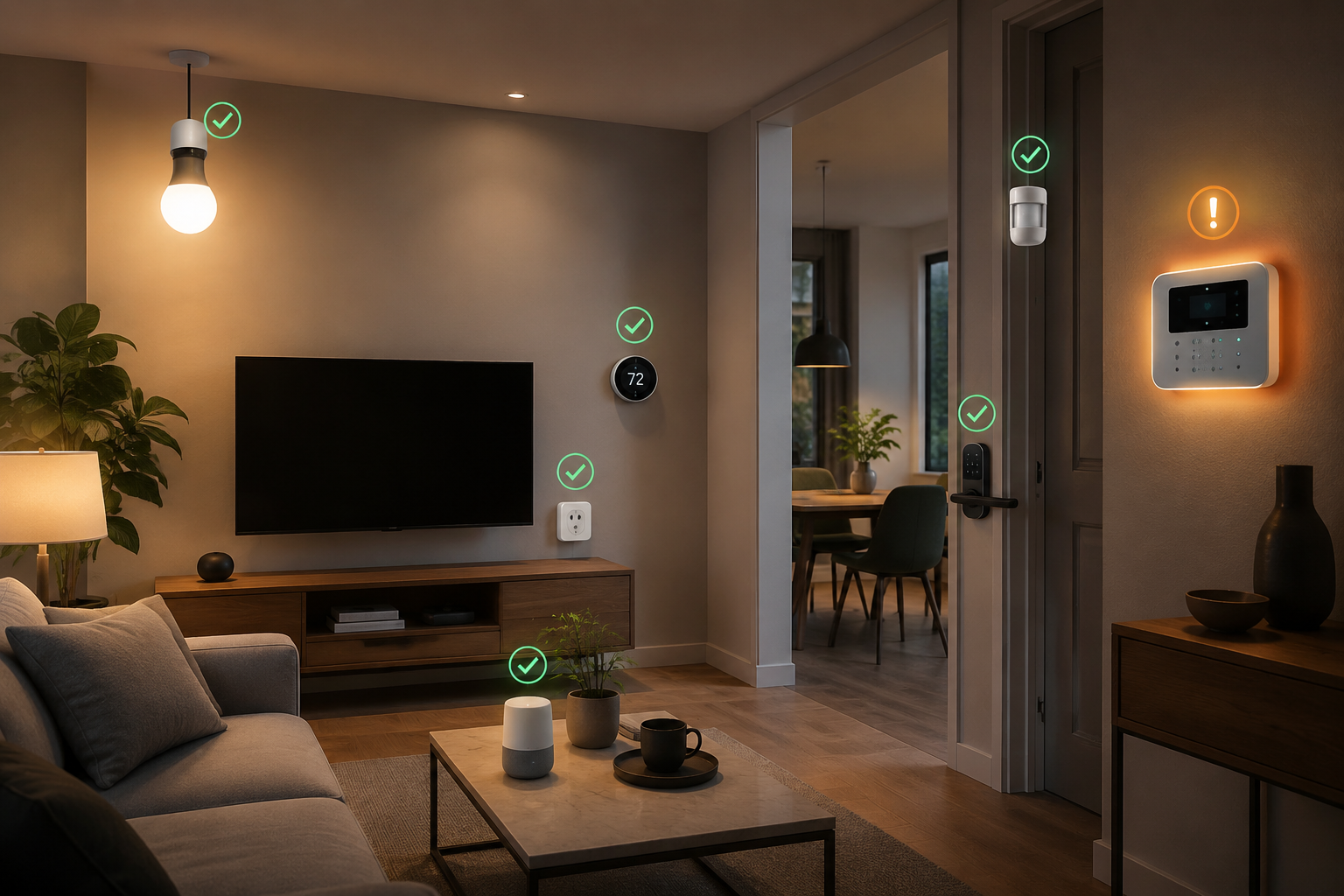
Also be careful with upgrade pitches that treat "cellular IoT" as if it covers the whole smart home. Cellular shutdowns are real infrastructure events, and they can strand equipment that was designed around old networks. But most consumer smart home devices are not cellular IoT devices. They are local-network or broadband devices.
The practical split is simple enough: leave ordinary Wi-Fi and protocol-based devices alone, verify older monitored alarms and emergency systems, and move quickly if a provider confirms a 2G GSM communicator on T-Mobile. The device most likely to hurt you is not the one that visibly stops working on August 3. It is the old alarm path that fails quietly while the keypad still looks familiar.
References
- T-Mobile Network Evolution, T-Mobile
- T-Mobile to shut down 2G GSM network this summer, Fierce Network
- 2G, 3G, 4G LTE Network Shutdown Updates, Digi
- 2G and 3G Sunsetting and What It Means for IoT, 1GLOBAL
- 2G shutdown: alarm installers upgrade guide, Olarm
- Why Should I Get an LTE Cellular Communicator?, Alarm Grid
- 3G Sunset, WhereverSIM