
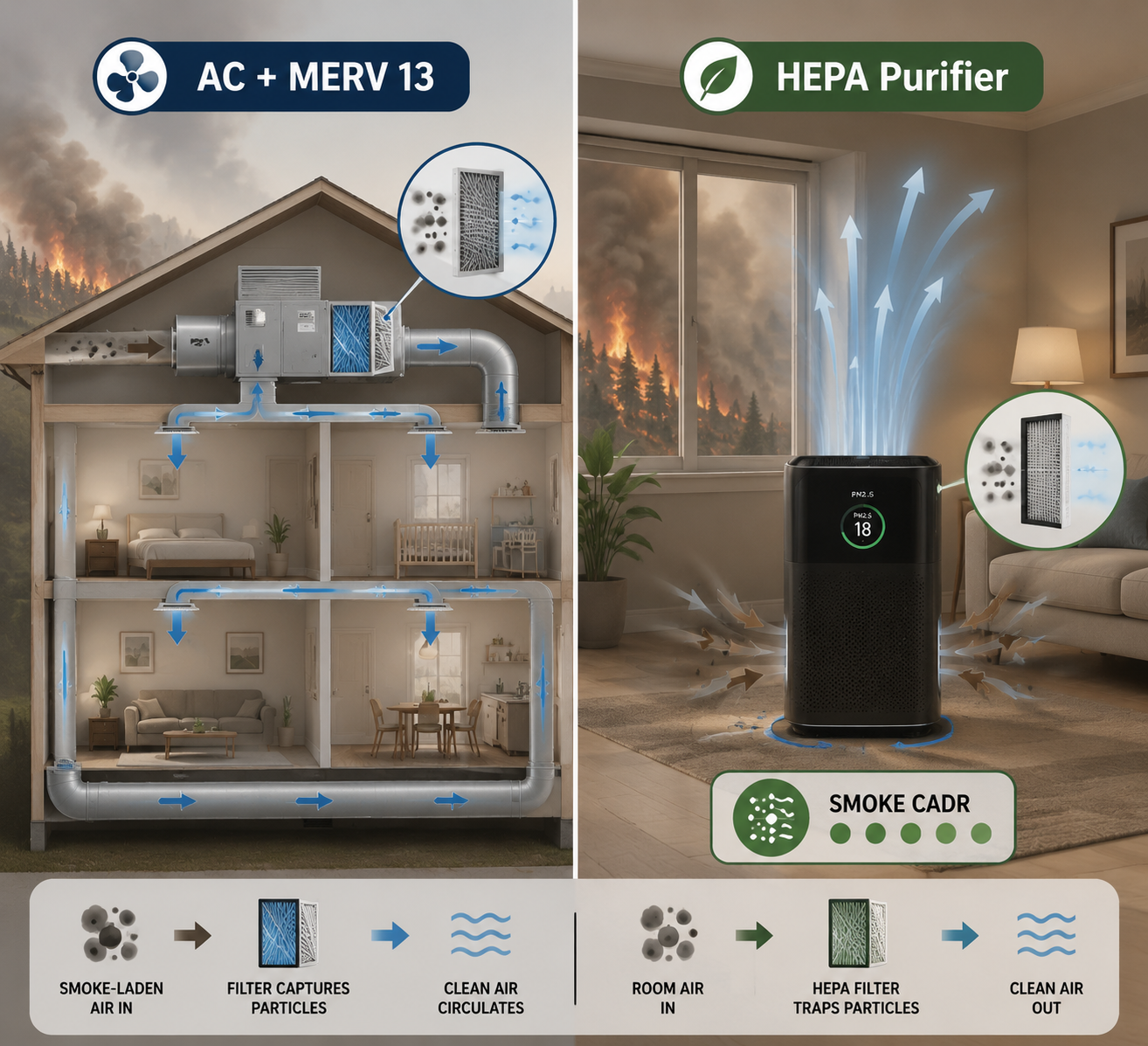
If your AC is already running during wildfire smoke, a separate smart air purifier is not automatically a waste. A 2025 LBNL/UC Berkeley study of nearly 5,000 California homes found that optimized HVAC recirculation with MERV 13 reduced indoor PM2.5 by 54 +/- 5% overall and 61 +/- 5% on peak smoke days, with about $5/month in added energy cost; the modeled result was roughly comparable to four portable air cleaners. [1]
What Central AC Can Do
That finding matters because central AC is not just a cooling system when the air outside turns smoky. In recirculate mode, it can keep pulling the same indoor air through the filter instead of importing more smoke, which gives the whole house a baseline level of protection. But that only works when the filter is actually fit for the job. EPA guidance treats MERV 13 as the useful floor for smoke, while MERV 1-4 filters mainly catch large visible particles. Older systems, especially many 15- to 20-year-old units, may not have enough fan power for that level of restriction. [2]
So AC earns its place when three things line up: a filter high enough to matter, a recirculate setting, and a blower that can keep airflow moving. In that setup, it is a whole-house baseline tool, not a room-by-room smoke scrubber.
Where AC Alone Runs Out
The failure modes are usually practical. Single-hose portable AC units can create negative pressure and pull smoky outdoor air inside, and window AC filters mostly protect the machine rather than cleaning the room air. During heavy smoke, a MERV 13 filter can also clog much faster than usual, with replacement sometimes needed in about two weeks instead of a normal three-month cycle. [4][5]
That is why one bedroom can still smell smoky even while the thermostat says the house is being cooled. The HVAC cycle is a house-wide compromise; it is not built to chase down every occupied room at the pace smoke can enter it.
What a Smart HEPA Purifier Adds
A smart HEPA purifier is built for the part of the job AC only partly covers. AHAM's smoke CADR guidance puts a medium room around 200 and a larger room around 300 or higher, which is enough to clear PM2.5 about four to six times per hour. That is the number that matters when you want a bedroom, nursery, or home office to clear quickly instead of eventually. [3]
The smart part is not decoration. A good purifier shows real-time PM2.5, ramps fan speed automatically, and can be controlled through an app or voice assistant, so you can see whether the room is actually improving. Many also add activated carbon for smoke odor and some gases. Not every smart purifier performs equally, though, which is why verified smoke CADR and room size matter more than the app badge. [6][3]
How to Deploy Both During Smoke
- Run central AC in recirculate mode with the highest filter the system can handle, ideally MERV 13, and do not assume a better filter solves the problem if the blower starts struggling. [2]
- Place a properly sized smart HEPA purifier in the room people actually occupy most, then use the PM2.5 display and auto mode to see whether the room is clearing. [3][6]
- Check the HVAC filter more often during smoke events, because a filter that normally lasts months can load up in about two weeks. [5]
- Keep outdoor air intake as low as practical and close off rooms you are trying to clean quickly.
That is the cleanest deployment model: use AC as the whole-house baseline, then use a smart HEPA purifier as the room-level cleanup and feedback loop. The savings question is not whether to buy less equipment; it is where the filtration job is actually being done.
References
- Using smart thermostats to reduce indoor exposure to wildfire fine particulate matter (PM2.5) — ScienceDirect / Lawrence Berkeley National Laboratory, 2025 [link]
- Guide to Air Cleaners in the Home — US EPA [link]
- Using an Air Cleaner to Manage Wildfire Smoke — AHAM Verifide [link]
- How to make your indoor air better when it's smoky outside — Vox [link]
- Best Air Filters for Dealing With Wildfire Smoke — Consumer Reports [link]
- Best Air Purifiers for 2026 — CNET, 2026 [link]