A smart home weather station can track a hurricane in one narrow, useful sense: it can show what the storm is doing at your property. It can record the pressure fall before the first hard gust, the peak wind hitting your roofline, the rain rate filling the ditch at the end of the street, and the conditions your phone app may smooth into a county-wide average.
It cannot track a hurricane the way the National Hurricane Center tracks one. It does not model the cone, replace official warnings, tell you whether to evacuate, or guarantee data after power, internet, or cell service fails. That distinction matters. The right station is not a private forecast office. It is a local instrument panel for the house you are trying to protect.
That is still a real job. Official weather stations and airport stations may be 10 to 20 miles apart, which leaves plenty of room for one subdivision to flood while another nearby area looks merely wet on a regional map.[1] NOAA’s May 21, 2026 Atlantic hurricane outlook called for a below-normal season with a 55% probability, but a below-normal season does not make a landfall harmless.[2] For a coastal homeowner, the question is not whether a backyard station can see the whole storm. It is whether it can give one more trustworthy local reading before conditions deteriorate.
What “hurricane tracking” means at home
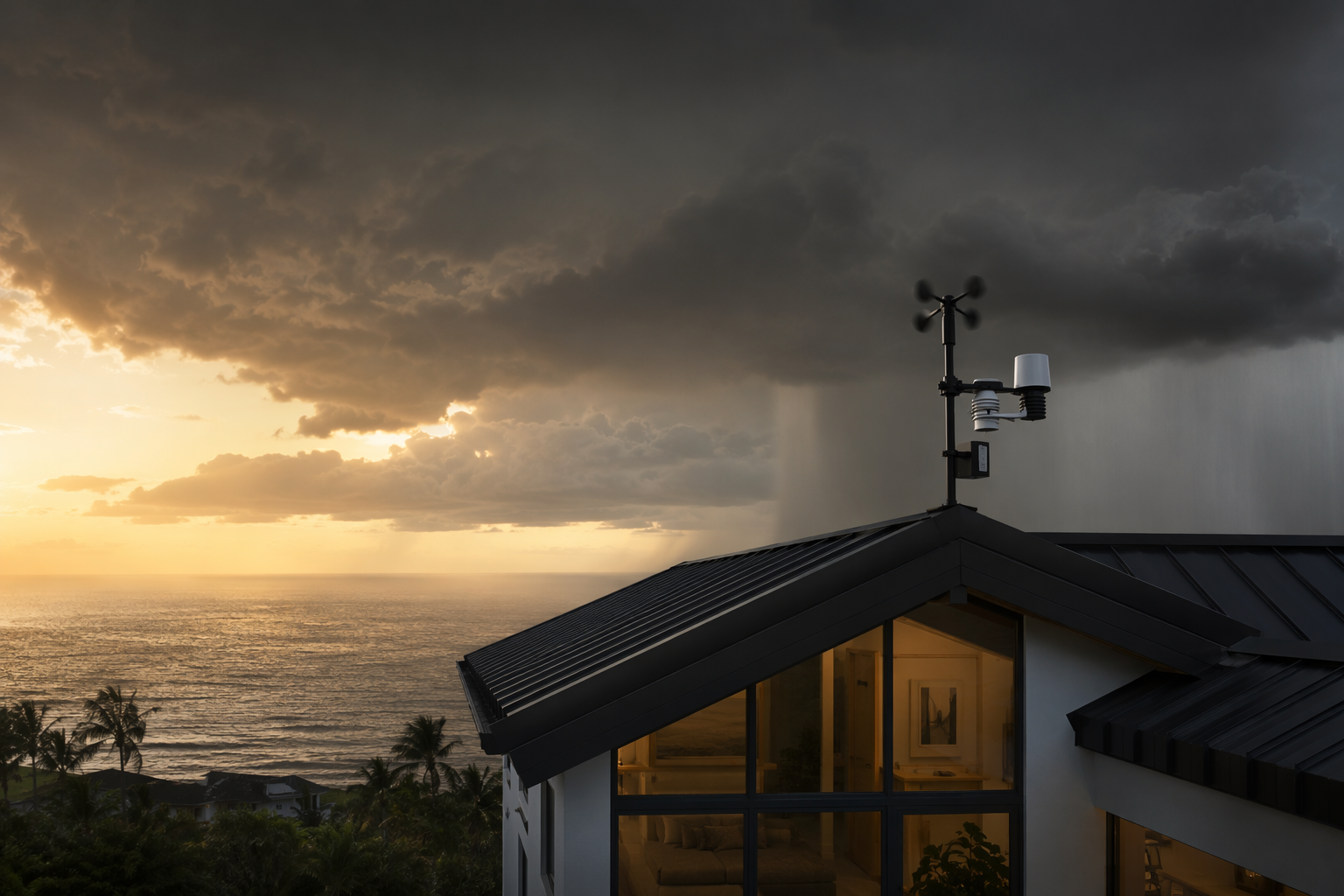
For a home station, hurricane tracking is really property-level monitoring. The useful readings are not exotic: barometric pressure, wind speed and gusts, rainfall, alert thresholds, and some way to see the data when the internet becomes unreliable. A glossy dashboard is pleasant in calm weather. During a tropical system, the value comes from sensors that keep measuring correctly while the weather gets ugly.
| Reading | What it tells you during a storm | What to watch for |
|---|---|---|
| Barometric pressure | Whether a tropical system is tightening near your location | A rapid fall, especially below 30 inHg |
| Wind gust | Whether unsecured objects, shutters, gates, or exposed fixtures are already under stress | Peak gusts, not just average wind |
| Rainfall | How much water has actually fallen at your address | Rain rate and storm total, especially if drainage is slow |
| Remote alerts | Whether a threshold has been crossed when you are away from the display | Custom pressure, wind, and rain alerts |
| Local display and backup power | Whether readings remain visible when app access drops | Console batteries and sensor battery or solar status |
Pressure is usually the first number worth watching. Brand-owned guides from AcuRite, Ambient Weather, and Davis Instruments all point to a rapid pressure drop below 30 inHg as an early measurable sign of an approaching tropical system, often before wind or rain becomes obvious at the house.[3][4][5] That does not mean a homeowner should interpret pressure like a meteorologist. It means the pressure trend can confirm that the weather at the property is moving from ordinary storminess into something more organized.
Wind is the next number that changes behavior. Average wind matters less than gusts when you are deciding whether patio chairs, grills, trash cans, shade sails, or a loose fence panel can wait until morning. A good station records peak gusts cleanly and timestamps them. A poor installation, even with an expensive sensor, may under-read badly if the anemometer sits in the wind shadow of a roof, tree line, or neighboring house.
Rainfall is where property-level data becomes most personal. A county alert may say heavy rain is occurring, but the ditch, swale, canal, driveway slope, and storm drain on your block decide what happens next. A rain total from your own gauge can also help explain the difference between two nearby neighborhoods after the storm, when one is cleaning up standing water and the other is not.
Remote alerts are useful only when they are tied to numbers you already trust. A pressure alert, a high-gust alert, or a rapid-rain alert can tell you something has crossed a line while you are checking shutters, helping a neighbor, or away from home. Smart-home integrations such as Alexa, HomeKit, or app notifications are secondary to the sensor, but they become practical when they push a threshold crossing to the person who needs to act.
The hyperlocal gap is real, but it has limits
The gap between official stations is not an argument against official data. It is the reason local instruments can sit underneath it. If the nearest airport station is inland, exposed differently, or outside the strongest rain band, it may still be accurate for its location while being less useful for your street.
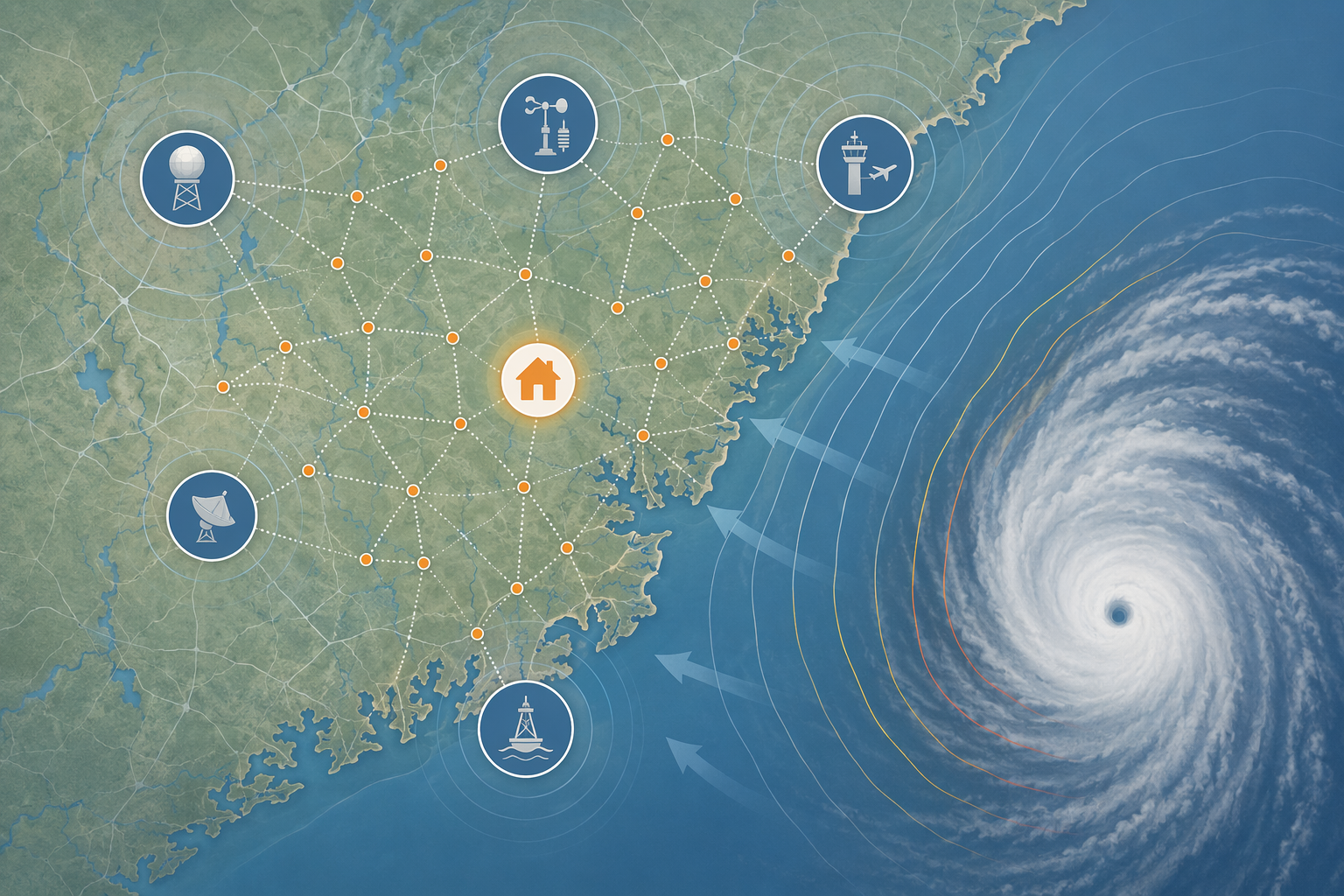
That is why personal weather stations have become part of a broader hyperlocal network. Weather Underground says its personal weather station network includes more than 250,000 stations, with data available for viewing and contribution.[6] A homeowner’s station can therefore serve two purposes at once: it gives the owner local readings, and it may add another point to a public data ecosystem.
The caution is just as important. A dense map of personal stations is not the same as a dense map of professionally sited, calibrated stations. Some backyard sensors are mounted too low, blocked by trees, baked by roof heat, or corroded by salt air. In a hurricane, the homeowner should treat personal readings as situational awareness, not authority over official forecasts, warnings, and evacuation orders.
The Irma lesson: remarkable data, then failure
The best known stress test for a consumer weather station came during Hurricane Irma in 2017. A Davis Vantage Pro2 on St. Barthelemy recorded a 199-mph gust from Irma’s eyewall, described by Davis as the highest ever recorded by a consumer weather station and the fifth-highest reliably recorded wind speed globally; the record was verified by Weather Underground and NOAA/NHC, according to Davis.[7]
The part worth remembering is not only the number. The station survived the front eyewall long enough to transmit the reading, then the back eyewall destroyed it.[7] That is exactly the right expectation to carry into a buying decision. A serious personal station can capture extraordinary hurricane data. A hurricane can still break it.
This is why the phrase “hurricane-ready” should be handled carefully. It should mean the station has the right sensors, a credible wind design, a useful rain gauge, a pressure sensor, a local display or fallback plan, and an installation that gives the instruments a fair chance. It should not mean the station is guaranteed to survive whatever comes ashore.
The sensors that matter most
Barometric pressure
For hurricane awareness, the barometer is not a background feature. It is the instrument that can start changing before the yard looks threatening. A slow, ordinary wobble in pressure is not much use by itself. A fast fall, especially as it moves below 30 inHg, is a signal to pay closer attention to official updates, local alerts, and the house-specific tasks that are still unfinished.[3][4][5]
Pressure is also the reading least dependent on perfect outdoor exposure. That makes it forgiving compared with wind. A poorly placed anemometer can lie by omission; a barometer in a decent console or sensor package can still give a homeowner a useful trend.
Wind gust recording
A hurricane decision rarely turns on “the wind is windy.” It turns on whether the latest gust says loose items are already dangerous, whether a ladder should stay in the garage, whether a gate latch is failing, or whether it is too late to be outside. The station needs to capture gusts, not just average wind, and it needs to do so from a location where the air is not being chopped up by the house itself.
Cup-and-vane designs and ultrasonic or haptic systems each have trade-offs, but siting often decides whether either one is meaningful. A 60-mph gust measured in clean exposure and a 35-mph gust measured behind a roof obstruction may describe the same storm very differently. The sensor is only as honest as the air reaching it.
Rain measurement
For hurricane rainfall, the gauge design matters. Comparative coverage cited by SmartHomeExplorer reports that the Tempest Weather System’s haptic rain gauge can undercount heavy rain by 15% to 25% above 2 inches per hour, which is a meaningful drawback when rainfall monitoring is one of the reasons to buy the station.[8] That does not make Tempest a bad system. It makes it a weaker choice if the main concern is measuring tropical downpours.
Tipping-bucket rain gauges are not perfect either, especially in windblown rain, but they remain the more reassuring choice for homeowners who care about storm totals and intense rain rates. If your property floods from overwhelmed drainage rather than storm surge, the rain gauge deserves as much attention as the wind sensor.
Display, batteries, and alerts
The app is convenient until the network path breaks. During a hurricane, a local console with battery backup can be more useful than a prettier cloud dashboard. The best setup gives you both: remote alerts while service is normal, and a local display if internet access drops.
Solar-powered sensors help reduce routine maintenance, but coastal homeowners should still check batteries before peak season. A station that fails because a coin cell, rechargeable pack, or corroded contact was ignored is not a storm instrument; it is a decoration with a login.
Which smart weather stations make sense for hurricane use?
The useful comparison is not “best smart weather station” in the abstract. It is which compromise you can live with on a coastal property. Accuracy claims in this price range should also be read with care: SmartHomeExplorer summarizes enthusiast-community comparisons and Weatherwise studies suggesting that consumer stations around $185 to $400 can deliver about 90% of the accuracy of $1,000-plus professional stations for hurricane-relevant metrics, but that does not make all models equal.[8]
| Model | Hurricane-strength reason to consider it | Main compromise |
|---|---|---|
| WeatherFlow Tempest | Easy solar setup, low maintenance, strong smart-home appeal, HomeKit compatibility | Haptic rain gauge can undercount heavy rain |
| Ambient Weather WS-5000 | Strong value, tipping-bucket rain gauge, AQI sensor, Alexa compatibility | Wind readings reported 5% to 10% high versus professional cup anemometers |
| Davis Vantage Pro2 | Research-grade reputation, separate sensor suite, 200-mph-rated anemometer | $1,000-plus cost |
| AcuRite Atlas | Mid-range option with lightning detection included | Less compelling than Davis for extreme wind durability |
| Ecowitt HP2560 | Budget-friendly station with a broad sensor suite | Best treated as value monitoring, not the toughest coastal benchmark |
WeatherFlow Tempest
Tempest is attractive for the homeowner who wants the station installed and then mostly left alone. Its solar-powered, low-maintenance design and HomeKit compatibility make it one of the easier systems to live with day to day.[8] For pre-storm pressure trends, wind awareness, and smart-home alerts, it can be a clean fit.
The rain limitation is the hard stop for some coastal buyers. If your hurricane concern is mostly wind and pressure, Tempest still belongs on the list. If your yard or street floods during high-intensity rain, the reported 15% to 25% undercount in heavy rain above 2 inches per hour is not a footnote.[8]
Ambient Weather WS-5000
The Ambient Weather WS-5000 is the value pick for many hurricane-aware homeowners because it combines a broad sensor package with a tipping-bucket rain gauge, app access, and Alexa compatibility.[8] It is the kind of station that makes sense when you want better local data without moving into Davis pricing.
Its wind compromise should be named before purchase. SmartHomeExplorer reports that the WS-5000 tends to read wind speeds 5% to 10% high compared with professional cup anemometers.[8] For household decisions, a slight high bias may be less dangerous than a sheltered low reading, but it still means the number should not be treated like an official observation.
Davis Vantage Pro2
The Davis Vantage Pro2 is the serious coastal choice when durability and wind measurement matter more than cost. Among the models compared here, it is the only consumer station with a 200-mph-rated anemometer, and the Irma case gives that rating a real-world context without making it invincible.[7][8]
The separate anemometer arm is not just a premium detail. It lets the homeowner site wind more cleanly than all-in-one packages allow, while placing other sensors where they make sense. The trade-off is price: this is a $1,000-plus path, not a casual backyard buy.[8]
AcuRite Atlas and Ecowitt HP2560
AcuRite Atlas fits the mid-range homeowner who wants a complete station and values built-in lightning detection.[8] Lightning is not the core hurricane metric the way pressure, gusts, and rain are, but in outer bands and feeder storms it is a practical alert layer.
Ecowitt HP2560 is the budget-friendly broad-sensor option.[8] It is better viewed as a way to add property-level awareness than as a station to push into the same durability conversation as the Vantage Pro2. For many homeowners, that may be enough, provided the installation is not an afterthought.
Installation decides whether the numbers are worth trusting
A weather station bought for hurricane tracking can be defeated by a lazy mount. Wind is the most sensitive. For accurate wind data, the anemometer should be mounted at 10 meters, or 33 feet, above ground, or at least 7 to 10 feet above the roof ridge when roof mounting is the practical option.[5][9] That is not always easy on a finished coastal home, but the physics do not care that the fascia board was convenient.
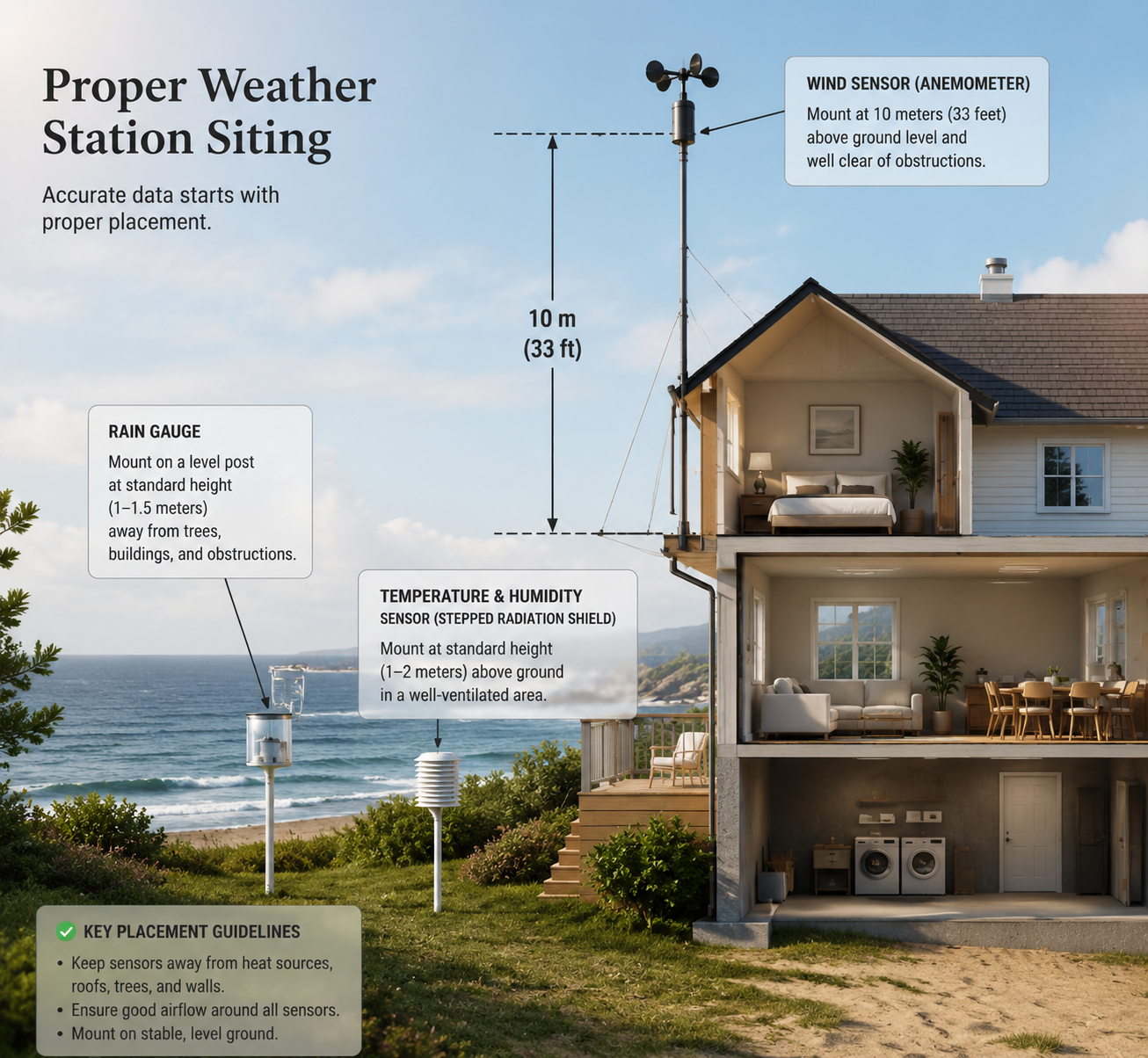
Roof mounting also needs clearance from turbulence. A mast barely peeking over the ridge may measure the roof’s disturbed airflow more than the storm. Trees, second-story walls, screened pool enclosures, chimneys, and nearby homes can all turn a wind reading into a local obstruction reading.
Rain gauges need their own honesty. They should not sit under eaves, tree limbs, roof splash, or a place where wind funnels water away from the collector. An all-in-one station forces compromises because the best location for wind is rarely the best location for rain and temperature. Separate sensor suites cost more and take more planning, but they solve a real problem.
Coastal corrosion is not cosmetic. Davis advises marine-grade 316 stainless steel or UV-stabilized housings for salt-spray environments, and notes that standard consumer stations may corrode within 1 to 2 seasons near the coast.[5] Mounting hardware, screws, clamps, and sensor contacts deserve the same attention as the station name on the box.
- Put wind exposure first if gusts are the reason you are buying the station.
- Choose tipping-bucket rain if storm rainfall totals matter more than low-maintenance elegance.
- Use corrosion-resistant coastal hardware instead of the cheapest mast kit.
- Confirm local display and battery fallback before hurricane season, not during the first warning.
- Set alerts for pressure, gusts, and rain thresholds you will actually act on.
A practical buying boundary
Buy Tempest if you want the simplest smart-home experience and can accept weaker heavy-rain measurement. Buy the Ambient Weather WS-5000 if you want the best balance of value, rain measurement, and connected features while remembering its reported wind bias. Buy the Davis Vantage Pro2 if wind durability, siting flexibility, and storm-grade instrumentation matter enough to justify the cost. Consider AcuRite Atlas for a mid-range station with lightning detection, and Ecowitt HP2560 when budget and sensor coverage are the main constraints.
The homeowner who should skip the purchase is the one who wants a device to make hurricane decisions for them. The homeowner who may benefit is the one who already follows official forecasts and warnings, but wants better local readings from the property itself: pressure falling at the house, gusts hitting the roofline, rain collecting in the gauge, and a console that still works when the app is no longer the safest assumption.
A smart home weather station is worth buying for hurricane-aware coastal homeowners who choose the right sensor suite and install it properly. It belongs below official forecasts, warnings, and evacuation orders, but above guesswork from a regional app when the question becomes what is happening at this address right now.
References
- The Best Home Weather Stations, Popular Mechanics, May 2026, link
- NOAA predicts below-normal 2026 Atlantic hurricane season, NOAA, May 21, 2026, link
- How a Home Weather Station Helps Prepare for Severe Weather, AcuRite, link
- Hurricane Season Preparation Starts with Better Weather Monitoring, Ambient Weather, link
- How to Choose a Personal Weather Station for Coastal Areas, Davis Instruments, link
- Personal Weather Station Network, Weather Underground, link
- Vantage Pro2 Registers Record-Setting High Wind Gust, Davis Instruments, link
- Best Smart Weather Stations 2026, SmartHomeExplorer, link
- Best Home Weather Stations 2026, Bob Vila, link