
When wildfire smoke moves in, the useful smart-home move is not another alert. It is getting the thermostat to put the air handler into a verified indoor-air recirculation routine, pull return air through a MERV 13 filter, and stop depending on someone at home to remember which app controls which fan setting.
That combination can be worth the setup time. In a Berkeley Lab study using about 5,000 California ecobee homes, smart-thermostat wildfire optimization with higher-efficiency filtration reduced indoor PM2.5 exposure by 54±5% overall and 61±5% on peak smoke days, with an added energy cost of about $5 per month during use.[1] Berkeley’s Center for the Built Environment describes the approach as a way to make existing HVAC controls part of wildfire resilience rather than leaving them as passive comfort devices.[2]
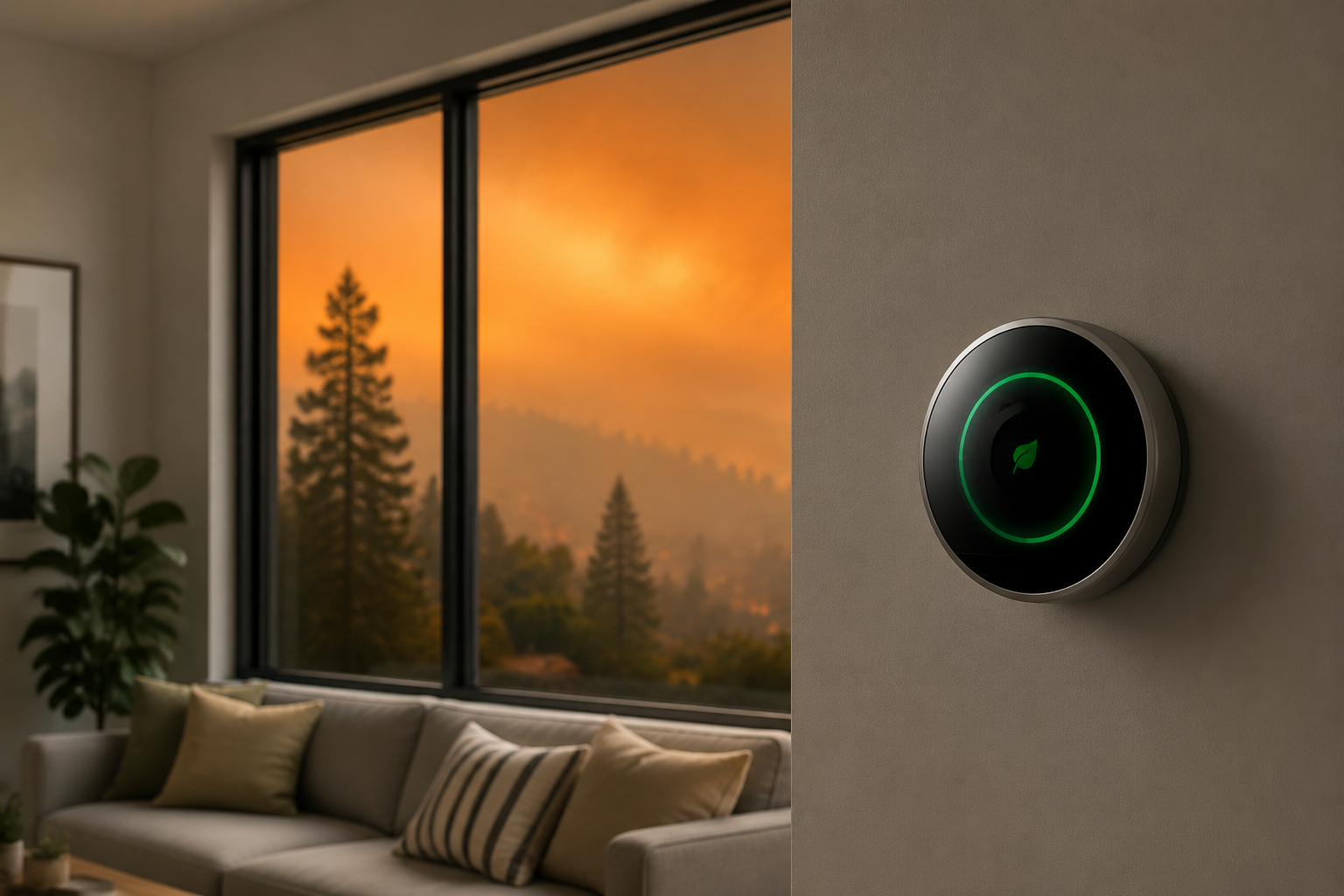
Those numbers are not a universal promise for every thermostat, duct system, filter rack, or house. They are a good reason to build the automation carefully. The protective mode only counts if the HVAC is actually recirculating indoor air through the filter. A fan-only command that leaves a fresh-air intake open, or a high-MERV filter that chokes an older blower, is not the same thing.
What the thermostat needs to do during smoke
The automation has one job: when outdoor smoke reaches the threshold you choose, the thermostat should run the air handler in a mode that keeps indoor air circulating through the HVAC filter while avoiding outdoor-air intake. On many residential systems, that means fan circulation with the system damper or ventilation setting kept closed. On some systems, especially those with energy-recovery ventilators, economizers, or dedicated fresh-air dampers, “fan on” can still move outdoor air unless the ventilation path is disabled.
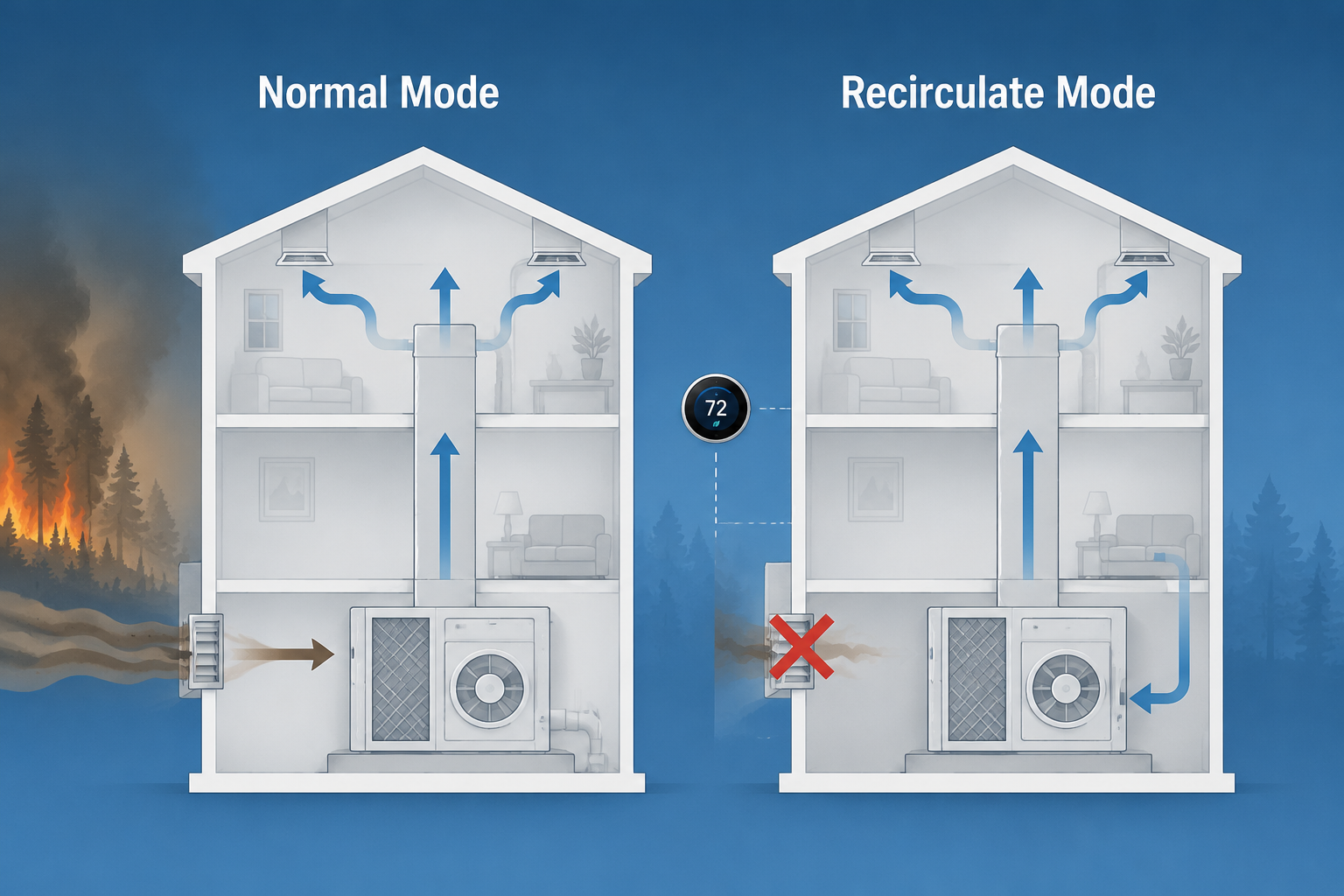
Before touching the app, name the target state in plain terms: indoor return air enters the HVAC, passes through the MERV 13 filter, and comes back through the supply registers. Outdoor intake is closed or minimized. Heating or cooling may run if the thermostat calls for it, but smoke protection should not depend on the compressor or furnace being active.
| Configuration point | What to verify |
|---|---|
| Filter | A MERV 13 filter fits correctly and does not create unsafe airflow restriction. |
| Air path | The air handler recirculates indoor air instead of pulling in outdoor air. |
| Trigger | PM2.5 or smoke detection starts the routine early enough without firing constantly. |
| Thermostat action | The platform can command fan circulation, ventilation off, or an equivalent recirculate state. |
| Exit condition | The system returns to normal after outdoor smoke improves, with a delay to prevent rapid cycling. |
Check the filter and blower before automating anything
MERV 13 is the practical target here because the study result depends on higher-efficiency HVAC filtration, and wildfire-smoke guidance commonly points homeowners toward filters in that range. But MERV 13 also has a cost: it can restrict airflow more than a lower-rated filter, especially in an older, undersized, dirty, or poorly sealed system. FilterBuy’s wildfire-smoke filter guidance flags compatibility and airflow restriction as issues to check rather than assumptions to wave away.[3]
The quick homeowner check is physical and boring, which is why it matters. Confirm the filter size is exact, the arrow points toward the blower, the rack does not let air bypass the filter, and the return grille is not whistling or pulling hard enough to bow the filter. If the system has struggled with frozen coils, weak airflow, high-limit trips, or noisy returns, have static pressure checked before asking the blower to run longer during smoke events.
Do not compensate for an uncertain filter fit by lowering the automation threshold and running the fan all afternoon. That just turns an airflow question into a runtime problem. Get the air path right first, then automate it.
Choose a smoke trigger that will not make the house hate the automation
A wildfire routine should start before the house has already absorbed hours of fine particles, but a trigger that is too sensitive will run the blower for toast, stir-fry, a steamy shower, or a foggy morning if the sensor misreads humidity as particles. The right threshold is not a moral statement about air quality. It is the point where the cost of missing early smoke becomes worse than the annoyance of extra fan runtime.
Use a PM2.5 trigger if your platform can see one. If you only have AQI, remember that AQI is an interpreted index, not the raw particle reading. If your sensor reports both, build the automation around PM2.5 and use AQI as a display layer for humans.
- Start with a threshold that reflects sustained smoke, not a single sensor spike.
- Require the reading to stay elevated for several minutes before the thermostat changes mode.
- Use a lower exit threshold than entry threshold, or add a cooldown delay, so the blower does not bounce on and off.
- Ignore or pause the routine during known indoor particle events, such as cooking, if the sensor sits near the kitchen.
- Review the first real smoke event manually instead of assuming the first setting is the final setting.
If you already run a dedicated monitor, pair this thermostat routine with Automate Your Smart Home Air Quality Monitor for Wildfire Smoke rather than making the thermostat’s weaker signal carry the whole decision.
ecobee: the cleanest path, with the same caveats as the study
ecobee deserves the first pass because the strongest evidence comes from ecobee homes and because newer ecobee hardware gives you more usable signals inside the same ecosystem. That does not mean every ecobee installation will reproduce the Berkeley result. The study used ecobee Donate Your Data homes, so the measured reductions may not transfer cleanly to older thermostat models, non-California houses, different duct layouts, or systems that cannot run a MERV 13 filter safely.[1]
The basic ecobee routine is:
- Install the MERV 13 filter and confirm normal airflow with the system running.
- Open the ecobee app and confirm the thermostat can control fan runtime independently of heating or cooling.
- Disable or close any fresh-air ventilation setting during the smoke routine if your system exposes that control.
- Use the built-in air quality signal, smoke alarm audio detection, or an external PM2.5 sensor as the trigger source.
- Create a smoke comfort setting or automation that runs the fan for extended circulation while holding normal temperature limits.
- Add a return-to-normal condition after the PM2.5 reading remains below your exit threshold.
The practical split is between air-quality detection and smoke-alarm detection. An air-quality trigger is for wildfire PM2.5. Smoke alarm audio detection is a safety signal; it can be useful as an emergency input, but it should not be treated as a normal outdoor-smoke threshold. If an alarm is sounding, the automation should not quietly keep the house in a filtration routine while people ignore the alarm.
For an ecobee Premium-style setup, put the thermostat in charge of fan circulation, not just notifications. The desired action is “run fan” plus “keep ventilation closed,” where available. If your ecobee only lets you set fan minimum runtime per hour, use that as the smoke-mode behavior and raise it only during the event. Leaving a high minimum fan runtime all season is how a good smoke setup becomes one more thing someone eventually turns off.
Watch the first event from the equipment side, not just the app side. Stand at a supply register and confirm airflow. Check the return grille for strain. Look at the thermostat state and verify it is not accidentally calling for outdoor ventilation. If the ecobee itself is misbehaving, solve that before layering in more routines; the adjacent Ecobee Thermostat Troubleshooting path is the better place for device-level faults.
Nest: use a separate PM2.5 signal, because AQI is not a native thermostat trigger
Nest can be part of a wildfire smoke routine, but the clean trigger usually has to come from outside the thermostat. The important limitation is that Nest does not give you a native AQI trigger for this job. Treat the thermostat as the actuator and a separate PM2.5 monitor or automation platform as the decision maker.
A workable Nest pattern looks like this:
- Put a PM2.5 sensor where it represents indoor living space, not directly beside a stove, humidifier, or bathroom door.
- Use the sensor or its connected platform to detect sustained elevated PM2.5.
- Use a Home/Away Assist-style workaround or connected automation layer to move Nest into the smoke-protection behavior.
- Set the behavior to fan circulation while preventing outdoor-air ventilation where your HVAC hardware allows it.
- Return to normal only after the sensor reading has stayed below the exit threshold long enough to avoid rapid toggling.
The weakness is not that Nest cannot run a fan. The weakness is that the smoke decision does not live naturally inside Nest. If you already use Nest for heat-wave behavior, keep the smoke routine separate from temperature comfort settings so one event does not overwrite the other. The platform-specific temperature side belongs in Set Your ecobee, Nest, or Honeywell for a Heat Wave; smoke mode has to care about air path first.
Honeywell: let IFTTT or Home Assistant make the smoke decision
Honeywell installations vary enough that the safest wording is blunt: the thermostat may be a capable endpoint, but the automation brain is usually IFTTT or Home Assistant. Use Honeywell to run the HVAC state you want. Use the external platform to decide when smoke conditions justify it.
With IFTTT, the rule is simple but limited: if the connected PM2.5 service reports smoke above your threshold, then set the Honeywell thermostat to the fan or circulation mode you have verified. Add a second rule to undo the change after conditions improve. The weak point is service delay and coarse control, so test the lag before trusting it for a fast-moving smoke plume.
With Home Assistant, keep the automation explicit. One sensor entity should provide PM2.5. One thermostat or fan entity should change state. One condition should prevent nuisance triggers during known indoor events. If you already maintain extreme-weather scenes, fold the smoke routine into Build a Unified Extreme Weather Mode for Heat Waves and Storms only after you have verified that smoke mode does not open fresh-air ventilation for comfort reasons.
alias: Wildfire smoke HVAC recirculation
trigger:
  - platform: numeric_state
    entity_id: sensor.living_room_pm25
    above: YOUR_PM25_ENTRY_THRESHOLD
    for: "00:10:00"
condition:
  - condition: state
    entity_id: input_boolean.cooking_mode
    state: "off"
action:
  - service: climate.set_fan_mode
    target:
      entity_id: climate.honeywell_thermostat
    data:
      fan_mode: "on"
  - service: switch.turn_off
    target:
      entity_id: switch.fresh_air_intake
mode: single
That example is intentionally generic. Entity names, fan modes, and ventilation controls differ by integration and HVAC wiring. The point is the separation of duties: PM2.5 decides, Honeywell acts, and the fresh-air path stays closed if your system exposes it.
Do not confuse this with replacing every purifier
The Berkeley result is compelling partly because the reduction was described as roughly equivalent to running four portable HEPA air cleaners, while the added energy cost was about $5 per month.[1] Wirecutter’s wildfire-smoke purifier guidance is useful as a comparison point because it shows why properly sized portable cleaners still matter in rooms where central airflow is weak or the HVAC cannot run high-MERV filtration safely.[4]
That does not turn this article into a purifier review. If you are choosing between central HVAC filtration and standalone cleaners, use Smart Air Purifier vs Central AC During Wildfire Smoke. The thermostat routine is best understood as an existing-device protection upgrade: one automation that uses the ductwork you already have, within the limits of the blower, filter rack, and air path.
Tune it against the boring false triggers
Most bad smoke automations do not fail on dramatic wildfire days. They fail on dinner. A sensor near a kitchen sees particles, the thermostat runs the fan, someone notices noise or drafts, and the household decides the whole routine is annoying. Then the next real smoke day arrives and the automation is disabled.
Put the sensor where the reading represents the air people breathe for hours. Add a short persistence requirement before triggering. If humidity or fog causes false readings in your local setup, compare the sensor trend with an outdoor PM2.5 source before lowering the threshold. If cooking is the regular offender, use a manual cooking mode, kitchen exhaust state, or time-based condition to delay the smoke routine while the source is clearly indoors.
For Code Purple days or households that need a broader device plan, keep this thermostat work connected to Protect Your Health During Code Purple with Smart Home Devices. If you are still deciding what sensors and controls belong in the house at all, start with What You Need for Smart Home Air Quality During Wildfire Smoke instead of overbuilding this one routine.
Verification routine before the next smoke day
Test the automation on a clear day with a temporary threshold or manual trigger. Do not wait for orange light in the windows to discover that the thermostat changed a screen label but left the ventilation damper open.
- Thermostat state: confirm the app and thermostat both show the intended fan or circulation mode.
- Air path: confirm supply registers are moving air and any fresh-air intake or ventilation setting is closed or minimized.
- Filter fit: confirm the MERV 13 filter is seated, facing the right direction, and not being pulled out of shape.
- Trigger behavior: confirm the routine fires only after the PM2.5 reading stays above the entry threshold for the intended delay.
- Exit behavior: confirm the system returns to normal after conditions improve without rapid cycling.
- Household override: confirm the person at home knows the one control that pauses the routine if airflow noise, comfort, or equipment behavior looks wrong.
A smart thermostat, a MERV 13 filter, and a calibrated smoke trigger can make the HVAC do real protective work. It is not a universal smoke solution, and it is not independent of duct design or blower capacity. Treat the automation, filtration, and HVAC limits as one system, and the device already bolted to the wall becomes much more than a temperature display.
References
- Smart thermostats enable smart air cleaning to reduce indoor air pollution exposure during wildfire smoke events, ScienceDirect, 2025.
- Smart Thermostats for Wildfire Resiliency, Berkeley Center for the Built Environment.
- Best MERV Filter for Wildfire Smoke, FilterBuy.
- The Best Air Purifier for Wildfire Smoke, Wirecutter.