
Devices
How a smart doorbell captured a New Jersey meteorite
A Wayne, New Jersey smart doorbell camera captured footage of a rare daytime fireball that, combined with American Meteor Society camera data, allowed astronomers to triangulate the trajectory of a meteorite that struck a Hillsborough home. The recovered meteorite was later found to contain the building blocks of life, highlighting the unexpected scientific potential of consumer doorbell cameras.
Local control & certification
Local vs. cloud control is not yet documented for this device.
The phrase “smart doorbell captures meteorite in New Jersey” is almost right, which is also why it is easy to get wrong. A home security camera in Wayne, New Jersey, captured part of a daytime fireball on July 16, 2024. That clip did not show the rock punching through a roof. It showed the meteor while it was still in flight, and it became useful because astronomers could combine it with footage from American Meteor Society camera stations in Northford, Connecticut, and Douglassville, Pennsylvania, to reconstruct the path of the object that later struck a home in Hillsborough, New Jersey.[1]
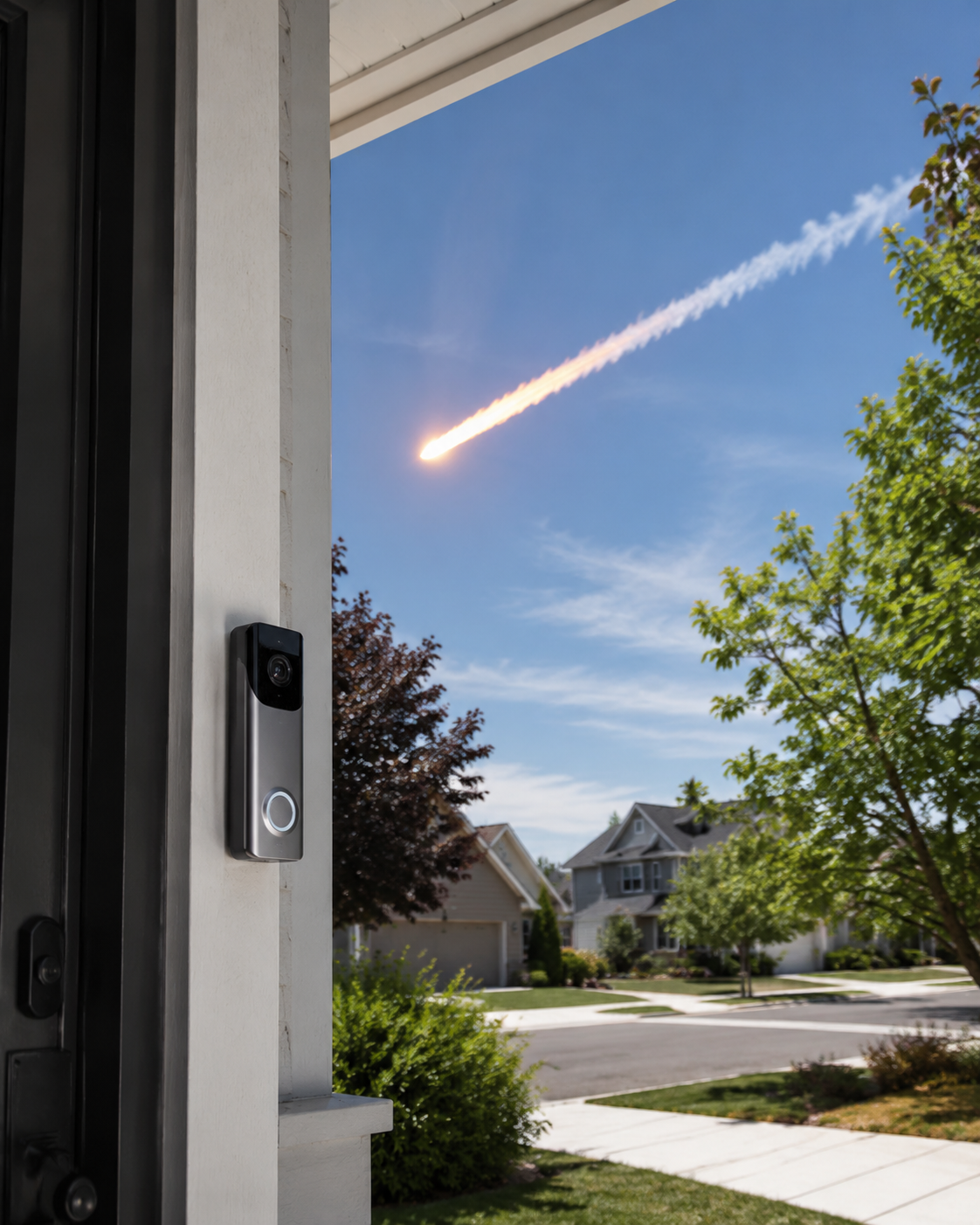
That is the small but important distinction at the center of this story. The Wayne camera was not a magic meteorite detector. It was one sensor in a lucky, messy, human-assisted chain: a porch camera happened to catch the sky, dedicated meteor cameras supplied reference observations, researchers triangulated a trajectory, a homeowner preserved recovered fragments carefully, and laboratory analysis later found chemistry that made the Hillsborough meteorite far more than a broken roof story.
The July 2024 fireball was hardly subtle. It crossed the New York and New Jersey region in daylight, entered the atmosphere at about 32,000 mph, or 14.4 kilometers per second, and broke apart roughly 22 miles above the ground. Thousands of people reported seeing it, and the event was accompanied by a sonic boom.[2] For most witnesses, that would have been the whole story: a flash, a sound, a few social posts, and then uncertainty. For meteorite recovery, though, uncertainty is the enemy. A bright fireball tells you something happened. Multiple well-located observations tell you where to look.
What the Wayne camera actually added
Consumer cameras are usually judged by mundane standards: whether the package alert fired too often, whether night vision washed out a face, whether the app kept the clip long enough to matter. In the Wayne case, the useful feature was simpler. The camera had a view of the sky at the right moment, and the original footage could be folded into a larger observational set.
Available reporting identifies the Wayne source as a home security camera, not a confirmed Ring model or a named doorbell product.[1] That matters because brand precision is not pedantry here. The New Jersey science chain depends on what the footage captured and how it was used, not on a product label. Ring belongs in this article later, in a separate Canadian impact case and in a UK fireball-monitoring partnership, not as the presumed brand behind the Wayne clip.
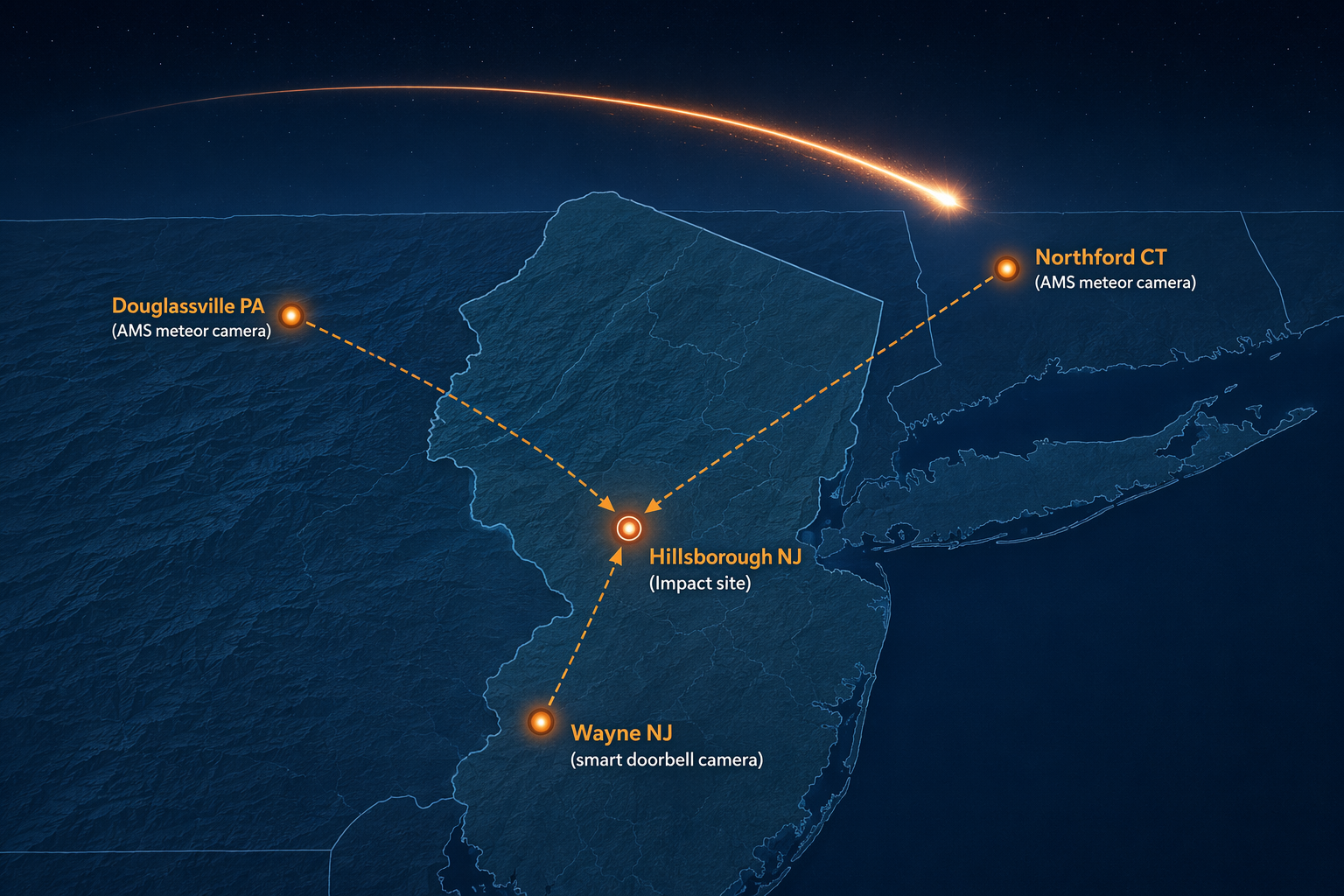
The more interesting hardware story is geometric. The Wayne footage was one of three camera sources used to triangulate the fireball, along with AMS cameras in Northford and Douglassville.[1] Those three views gave astronomers something a single viral clip cannot: perspective. A meteor crossing the sky from one camera can look dramatic while still leaving its actual height, speed, and ground track ambiguous. Add distant observations from known locations, and the same streak becomes a line that can be solved in three-dimensional space.
The object was traced back to the inner asteroid belt, according to reporting on the recovery and later study.[1] That does not mean the doorbell camera alone identified the parent region. It means the Wayne clip helped constrain a trajectory when paired with dedicated observations and subsequent analysis. The practical difference is enormous: the camera contributed evidence; it did not replace the meteor network.
Why one clip was not enough
The American Meteor Society’s work sits in the unglamorous middle of this story, which is usually where the science happens. A bright object is reported. Videos arrive from different places. The useful ones have timestamps, known locations, and enough of the sky or surroundings to place the path. Then researchers compare the apparent track from each viewpoint and solve for the meteor’s position and motion.
Distance between stations helps. In a separate discussion of meteor recovery using dashcams and security cameras, Universe Today described how combining observations from cameras roughly 100 kilometers apart can allow AMS analysts to pinpoint a fireball’s position to within about 50 meters.[3] That figure should not be treated as a guarantee for every doorbell clip. It describes what becomes possible when the observations are separated, timed, and positioned well enough for triangulation.
This is where ordinary smart-home details become scientific details. A clipped notification preview is less useful than the original video. A timestamp that can be checked is better than a memory of “around lunchtime.” A camera angled only at a doormat may miss the sky entirely, while a wider view might catch a reflection, flash, shadow, or sound that helps establish timing. Privacy zones, retention settings, and cloud storage policies are not just household preferences when an unusual event happens; they determine whether the evidence still exists by the time someone knows it matters. If you are reviewing your own setup after reading this, camera retention and privacy controls are worth understanding before the strange thing happens, not after; our guide to Ring camera privacy and data retention covers the consumer side of that tradeoff.
The Wayne camera’s value came from being available, preserved, and compatible with a larger reconstruction. That is a quieter kind of instrument than a purpose-built all-sky camera, but it is still an instrument once its data can be placed in time and space.
The Hillsborough recovery depended on careful hands
After the fireball, a fragment crashed through the roof of a home in Hillsborough, New Jersey.[1] That is the part of the story that naturally grabs attention, but the quieter scene after impact may have mattered more to the science. The homeowner, following AMS guidance, preserved fragments using gloves, foil, and glass jars, and researchers later cited that careful handling as critical to the scientific results.[1][4]
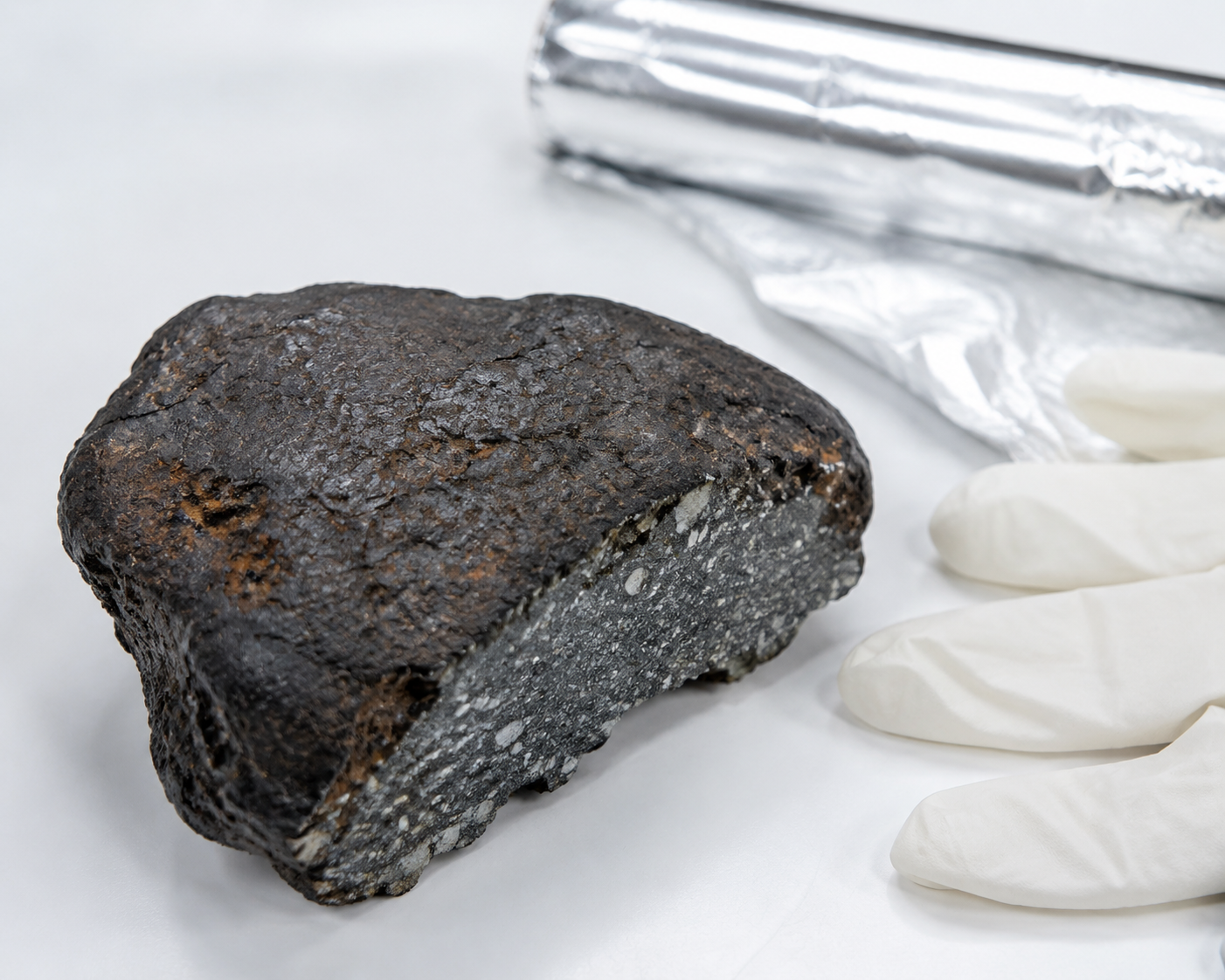
That is not a cinematic detail. Meteorites can be contaminated by skin oils, household dust, plastic bags, soil, water, and whatever else they touch after landing. A fragment that has just entered a house is already in an uncontrolled environment. Every decision after that either protects the sample or adds noise that future instruments may have to separate from the meteorite’s original chemistry.
Gloves reduce direct contamination. Foil can provide a cleaner temporary wrap than a random household container. Glass jars avoid some problems that can come with plastic storage. None of those steps require a laboratory, but they require someone to pause, ask for guidance, and resist the understandable urge to sweep everything together. In this case, that pause helped turn a damaged roof into a scientifically valuable fall.
The AMS also has to filter plenty of false alarms. Reporting on the Hillsborough case notes that the organization receives about 10 inquiries per week about possible meteorites, with fewer than 0.1% verified.[1] That context is useful for anyone imagining a future in which every doorbell alert becomes a planetary-science lead. Most odd rocks are not meteorites. Most flashes are not recoverable falls. The system works only if public observations are submitted with enough detail for experts to sort signal from noise.
Why this particular rock changed the stakes
The payoff arrived two years later. On July 15, 2026, scientists reported that the Hillsborough meteorite was a CM1/2 carbonaceous chondrite, only the second witnessed fall of this type and described by the SETI Institute as the most pristine sample known.[4] That classification is doing a lot of work. Carbonaceous chondrites are primitive, chemically rich meteorites that can preserve information from the early solar system. A witnessed fall with clean handling gives researchers a sample whose terrestrial history is unusually well constrained.
The study found amino acids, organo-metallic compounds, and evidence of brines from the parent asteroid’s subsurface, according to SETI’s release on the work.[4] Smithsonian Magazine also described the findings as showing some of the building blocks of life in the meteorite.[5] That phrase is accurate when kept in bounds. It does not mean life was found in New Jersey. It means the recovered material contains chemical ingredients and alteration signatures that matter to questions about how organic chemistry and water interacted on small bodies early in solar system history.
The brine evidence is especially important because it points to chemistry that did not happen only in empty space or during the fiery fall. It suggests interaction with salty liquid water inside the meteorite’s parent body before the fragment ever reached Earth.[4] Pair that with amino acids and organo-metallic compounds, and the Hillsborough sample becomes a record of processes that planetary scientists care about far beyond one suburban impact site.
Researchers connected the findings to returned asteroid samples from Bennu and Ryugu, the targets of NASA’s OSIRIS-REx and JAXA’s Hayabusa2 missions.[4] The comparison is not that a roof-striking meteorite replaces spacecraft sample return. It is that a clean witnessed fall can sit in the same scientific conversation as those curated extraterrestrial materials. That is a remarkable upgrade for footage that began life as a home-security clip.
| Part of the chain | What it contributed |
|---|---|
| Wayne home security camera | A consumer-camera view of the fireball in flight |
| AMS cameras in Northford and Douglassville | Dedicated reference observations for trajectory reconstruction |
| Hillsborough homeowner | Careful preservation of recovered fragments using AMS guidance |
| Laboratory analysis reported in 2026 | Classification as CM1/2 carbonaceous chondrite and detection of amino acids, organo-metallic compounds, and brine evidence |
The other doorbell meteorite story is different
There is a second doorbell-camera case that often gets pulled into the same mental folder, and it should stay separate. On July 25, 2024, in Charlottetown, Prince Edward Island, a Ring doorbell camera captured a meteorite striking a home’s front walkway, including both video and audio of the impact; the event narrowly missed homeowner Joe Velaidum.[6] Live Science described it as the first-ever video of both the sound and sight of a meteorite crash-landing.[7]
Charlottetown is the clean “doorbell catches meteorite impact” case. Wayne is the “home camera helps track a fireball that led to a recovered meteorite” case. Both matter, but they document different parts of meteor events. One captured the final strike at ground level. The other contributed to the trajectory solution for a scientifically unusual New Jersey meteorite.
For smart-home owners, the comparison is useful because it widens the idea of what a camera might record. A doorbell or exterior camera may catch a fireball crossing the sky, a flash reflected off a wall, a shadow, a sonic-boom response, or a rare ground impact. The value depends less on the brand badge than on whether the clip survives with usable timing, location, and context.
What millions of doorbells can and cannot become
There is already at least one formal experiment in treating consumer doorbells as fireball watchers. In 2024, Ring worked with the UK Fireball Alliance by distributing 50 doorbell devices in the UK for meteor shower observation during the Eta Aquariid meteor shower.[8] That partnership is UK-specific in the available reporting; it should not be inflated into a global Ring science network. Still, it is a sign that professional observers see value in cameras that were originally sold for porches, gates, and driveways.
The installed base is attractive because it is already paid for, already networked, and already spread across neighborhoods that dedicated meteor stations do not cover evenly. But the weaknesses are just as real. Doorbells are not usually pointed at the whole sky. Their lenses distort edges. Their compression can blur fast objects. Motion detection may fail to trigger on a brief overhead flash. Cloud-retention windows can delete the original before anyone files a report. Privacy zones may black out parts of the frame, which is good for neighbors and sometimes bad for reconstruction. Anyone adjusting those settings should start with privacy, not spectacle; a guide to smart camera privacy zones is more relevant to this story than a shopping list.
The New Jersey case shows the realistic version of the future. Consumer cameras can add coverage, especially when they catch an event from a useful angle. They can help confirm timing, direction, brightness changes, fragmentation, sound delays, or impact evidence. They can also waste researchers’ time if clips are stripped of metadata, uploaded without location, edited into social videos, or submitted as proof of a meteorite without a recovered sample.
A practical response is modest. If your camera records something that looks like a fireball or impact, keep the original file if possible. Note the exact location of the camera, the direction it faces, and the time shown by the system. Do not handle a suspected meteorite with bare hands if there is a plausible recovery; wait for guidance from a scientific organization such as the AMS or a local university. If the clip includes neighbors, license plates, or private spaces, think before posting it publicly. Scientific usefulness does not cancel ordinary privacy obligations.
That is the cleanest lesson from the Hillsborough meteorite. Millions of smart doorbells are not replacements for calibrated meteor networks, and most will never capture anything more exotic than a delivery driver, a raccoon, or a badly timed spider web. But when one camera sees the right patch of sky, when dedicated stations supply the geometry, when observers submit original evidence, and when recovered material is protected instead of contaminated, a porch device can become part of planetary science. In New Jersey, that chain ran from a Wayne home security camera to a Hillsborough roof to a rare carbonaceous chondrite carrying amino acids, organo-metallic compounds, and traces of ancient brines.
References
- Rare meteorite provides snapshot of early solar system, CNN, July 15, 2026
- What is known about the daytime fireball seen over the New York metropolitan area, CNN, July 17, 2024
- By Using Dashcams and Security Cameras, Astronomers Were Able to Track Down the Location of a Meteorite, Universe Today
- Alien World Chemistry Found Inside Meteorite That Struck New Jersey Home, SETI Institute
- This Meteorite Crashed Into a New Jersey Home in 2024. Now, Scientists Say It Contains Some of the Building Blocks of Life, Smithsonian Magazine
- Doorbell camera catches rare footage of meteorite striking home's front walkway, CNN, January 22, 2025
- Doorbell camera captures 1st-ever video of the sound and sight of a meteorite crash-landing, Live Science
- Video doorbell company Ring wants your meteor shower videos, BBC Sky at Night Magazine, 2024
Known issues
No known issues summary recorded for this device.
No open Troubleshooting entries are currently tracked for this device.
Spot something outdated?
Flag anything that no longer matches current firmware, app, or spec behavior. This is recorded for internal review, not published automatically.