Which Smart CO2 Monitor Works with Your Hub for Dementia Safety?
Compare four smart CO2 monitors (IKEA ALPSTUGA, SwitchBot Meter Pro CO2, Airthings View Plus, Aranet4) for dementia caregiver safety monitoring. Learn which works with your hub, the 800 ppm threshold from a case study, and how to automate ventilation when levels climb.

- Hub requirement
- Recommended SwitchBot Meter Pro CO2 requires SwitchBot Hub Mini; other models vary (Matter/Thread, WiFi, BLE)
- Protocol
- Matter over Thread, Wi-Fi, BLE
- Ecosystem support
- Apple Home, Alexa, Google Home, SmartThings, Home Assistant
- Last verified
If dementia care has made bedroom ventilation feel urgent, the first practical question is whether the monitor can measure CO2 credibly, report the reading to the hub you already use, and trigger ventilation before a caregiver is left guessing at 2 a.m.
For most homes trying to automate around 800 ppm, the SwitchBot Meter Pro CO2 is the cleanest trade-off: it uses an NDIR CO2 sensor, costs about $70, and can reach Apple Home, Alexa, and Google Home through the required SwitchBot Hub Mini, which adds roughly $40-50 to the setup.[1] IKEA's ALPSTUGA is cheaper and Matter-over-Thread friendly, but its thermal-conductivity CO2 sensor makes it better for trend alerts than for a caregiver who wants a tighter reading near 800 ppm.[2][3] Airthings View Plus is the premium air-quality dashboard. Aranet4 is the excellent portable instrument that becomes awkward unless you already run Home Assistant with Bluetooth coverage.
Hub Compatibility Comes Before Features
A CO2 monitor that cannot talk to the hub is just a screen on a shelf. That may still be useful, but it will not open a window fan, nudge a caregiver, or log what happened overnight. The bridge requirement matters as much as the product name.
| Monitor | Sensor type | Apple Home | Alexa | Google Home | SmartThings | Home Assistant | What to know before buying |
|---|---|---|---|---|---|---|---|
| IKEA ALPSTUGA | Thermal-conductivity CO2 sensor | Yes, via Matter-over-Thread | Yes, via Matter-over-Thread | Yes, via Matter-over-Thread | Yes, via Matter-over-Thread | Yes, via Matter-over-Thread | Lowest price at about $35, but ±100 ppm and calibration caveats make it a trend device, not the strongest pick near 800 ppm. |
| SwitchBot Meter Pro CO2 | NDIR, ±5% accuracy | Yes, via SwitchBot Hub Mini and Matter/HomeKit support | Yes, via SwitchBot Hub Mini | Yes, via SwitchBot Hub Mini | Not the main supported route in the supplied materials | Possible through supported integrations, but the mainstream route is the SwitchBot hub path | Best accuracy-to-price balance for most caregivers, but do not miss the required Hub Mini. |
| Airthings View Plus | NDIR | Not native Matter/Thread in the supplied materials | Yes | Yes | Not listed in the supplied materials | Possible through ecosystem workarounds, but not the simple native route described here | Strong if you want CO2 plus radon, PM2.5, TVOC, temperature, humidity, and pressure; expensive if you only need CO2 automation. |
| Aranet4 | NDIR | No native mainstream smart home route in the supplied materials | No native mainstream smart home route in the supplied materials | No native mainstream smart home route in the supplied materials | No native mainstream smart home route in the supplied materials | Yes, through Bluetooth proxy coverage | Accurate and long-lived, but BLE-only automation is a Home Assistant project, not a simple caregiver setup. |
That table is the part worth slowing down for. A product page saying it works with a voice assistant does not always mean the CO2 value can be used as a dependable automation trigger in the room you care about. Sometimes it means the app can show a reading. Sometimes it means a hub exposes a sensor. Sometimes it means a bridge has to stay powered, updated, and close enough to the device.
Where the 800 ppm Target Comes From
The 800 ppm number comes from a small but hard-to-ignore case report: in a REHVA Journal article, Cremers described an Alzheimer patient whose nocturnal restlessness stopped when bedroom CO2 was kept below 800 ppm.[4] That is the kind of detail that makes a caregiver sit up, because it connects one room, one person, and one change in ventilation.
It is also only one patient. It was not a randomized trial, and it does not prove that 800 ppm prevents dementia symptoms. In this article, 800 ppm is treated as a cautious automation target inspired by that case, not as a medical threshold.
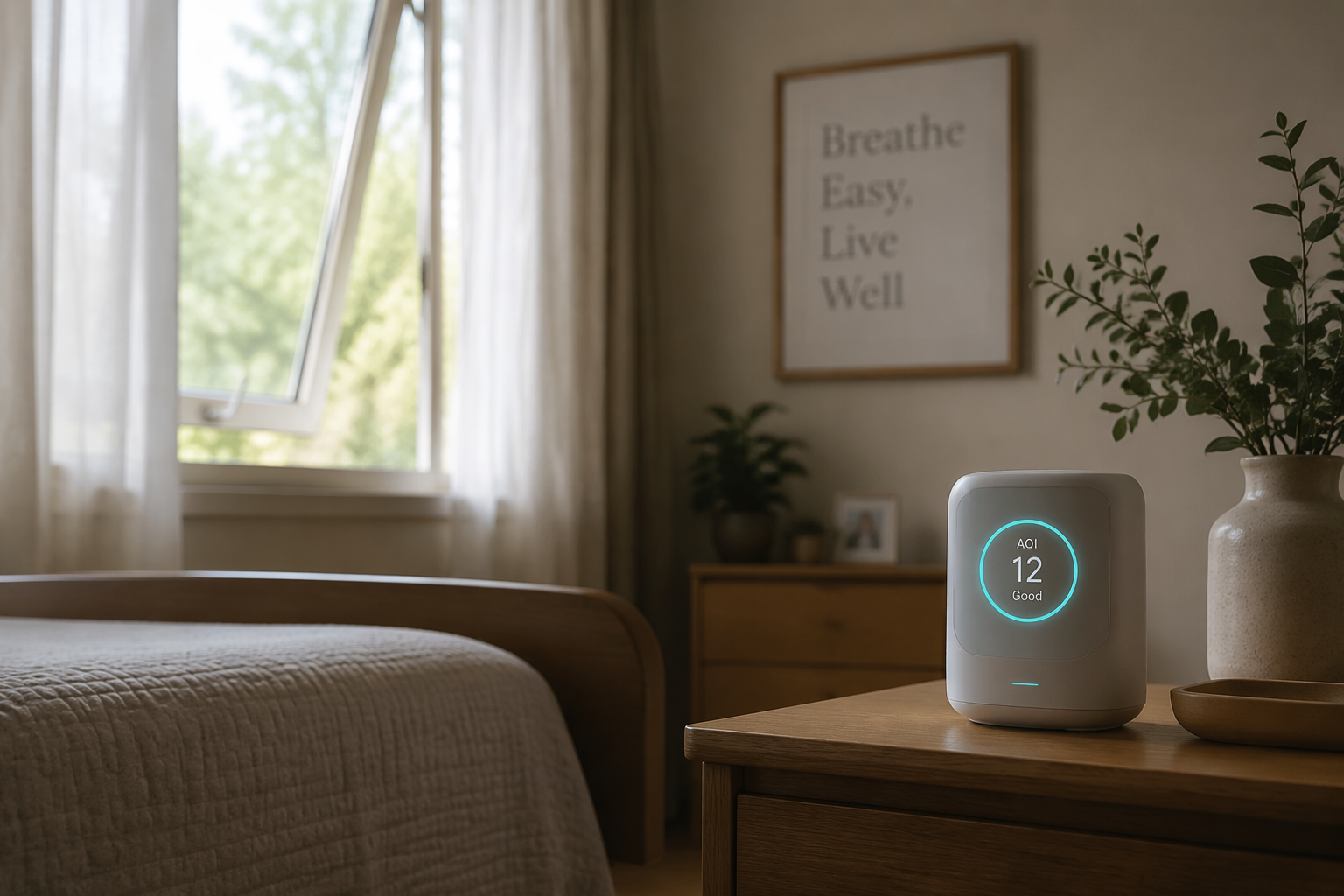
There is broader evidence that higher CO2 levels can affect short-term cognitive performance, but the populations and levels are different. In the Harvard COGfx work, cognitive scores dropped 15% at 950 ppm CO2 and 50% at 1,400 ppm in office workers, not dementia patients.[5] In the LBNL work by Satish and colleagues, 1,000 ppm was associated with significant reductions in 6 of 9 decision-making scales, and 2,500 ppm produced 'dysfunctional' scores on strategic thinking.[6]
That is enough to justify taking stale bedroom air seriously. It is not enough to turn a consumer CO2 monitor into a dementia treatment. CO2 is mainly a ventilation signal: when it rises, the room is not exchanging air well. Other pollutants may also build up, but the evidence should not be blurred. AAIC 2021 findings linked PM2.5 reductions with lower dementia risk estimates, including a 14% reduced dementia risk per 10% EPA PM2.5 reduction and 15-17% reduced risk per microgram per cubic meter PM2.5 decrease; those findings are about particulate pollution, not CO2.[7]
Sensor Type Is the First Filter
For a caregiver automation, the sensor type comes before the app design. A pretty graph cannot fix a weak measurement path. If the routine is going to turn on ventilation near 800 ppm, the monitor should not be drifting so much that the room is treated as safe or unsafe for the wrong reason.
| Monitor | Why the reading is useful | Why it may disappoint |
|---|---|---|
| SwitchBot Meter Pro CO2 | NDIR sensor with ±5% stated accuracy at a midrange price. | Needs the SwitchBot Hub Mini for the broad smart home path. |
| IKEA ALPSTUGA | Very affordable, Matter-over-Thread, and easy to place in multi-ecosystem homes. | Thermal-conductivity CO2 sensing, ±100 ppm, temperature drift, and a 7-day auto-calibration settling period make it less reassuring around 800 ppm. |
| Airthings View Plus | NDIR CO2 plus a fuller indoor-air picture, including PM2.5 and VOCs. | About $300 and WiFi-only in the supplied materials, with no native Matter or Thread route. |
| Aranet4 | NDIR, portable, and known for long battery life of 4+ years. | BLE-only automation pushes it toward Home Assistant users with Bluetooth proxy coverage. |
NDIR is the safer default for this job. SwitchBot, Airthings, and Aranet4 all use NDIR in the supplied materials. IKEA ALPSTUGA is the interesting exception: it is cheap, modern on the networking side, and still the one I would hesitate to make the main 800 ppm trigger because its CO2 sensing is described as thermal-conductivity based, with ±100 ppm accuracy and a roughly 7-day auto-calibration settling period.[2][3]
That does not make ALPSTUGA useless. For a living room where you mainly want to see whether air is getting stale, it may be good enough. For a bedroom routine tied to a vulnerable person’s sleep, a trend-level sensor is a different tool from an NDIR monitor.
How Each Monitor Gets From CO2 Rise to Ventilation
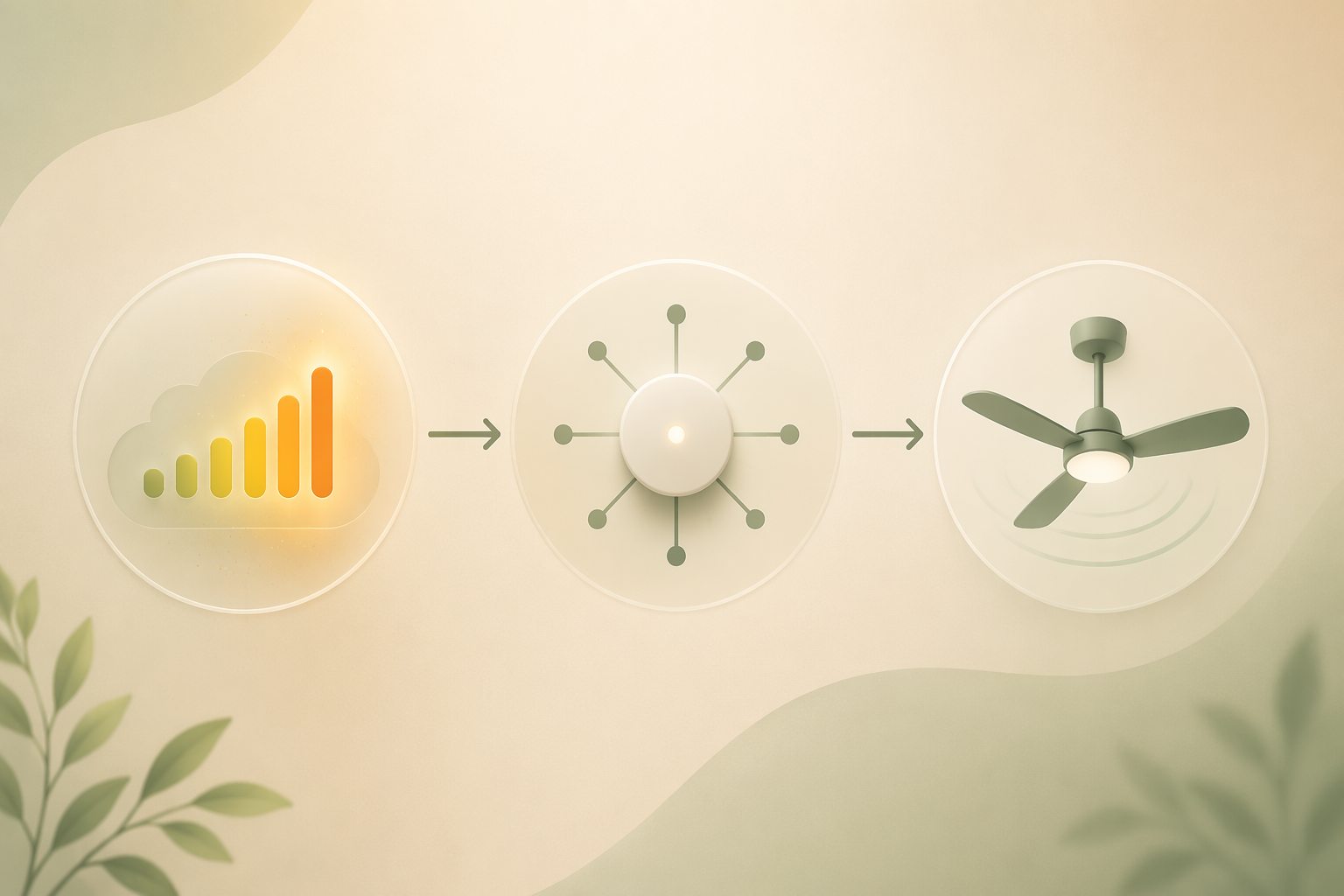
The useful chain is simple on paper: CO2 rises, the hub sees the reading, a fan or ventilation device turns on, and someone can confirm the action happened. The weak point is usually not the idea. It is the missing bridge, the unsupported trigger, or the monitor sitting just outside the wireless range that matters.
SwitchBot Meter Pro CO2: the most practical default
SwitchBot wins this particular use case by lining up three things at once: NDIR sensing, a moderate device price, and mainstream hub reach through the SwitchBot Hub Mini. The monitor itself is listed at about $70, with ±5% CO2 accuracy, and the hub adds about $40-50 when you need the Apple Home, Alexa, or Google Home path.[1]
That bridge requirement should be written on the shopping list, not discovered after the box arrives. Without the hub, a caregiver may still have a monitor, but not the automation path they thought they were buying.
- Best fit: a caregiver using Apple Home, Alexa, or Google Home who wants an NDIR CO2 trigger without paying Airthings money.
- Watch point: include the SwitchBot Hub Mini in the budget and place it where it can reliably reach both the monitor and the network.
- Automation role: use CO2 above 800 ppm as the trigger for a ventilation action, then use a higher value or long duration as the alert condition.
IKEA ALPSTUGA: Matter/Thread convenience with a measurement caveat
ALPSTUGA is attractive because it solves the networking problem cleanly. At about $35, with Matter-over-Thread and CO2, PM2.5, temperature, and humidity in one small device, it looks like the obvious low-cost answer for Apple Home, Alexa, Google Home, SmartThings, and Home Assistant households.[2][3]
The catch is not the hub path. The catch is the CO2 sensor. A thermal-conductivity sensor with ±100 ppm accuracy can be helpful for trends, but it is not the same confidence level as an NDIR monitor when the intended trigger is close to 800 ppm. A bedroom could move across that boundary without the caregiver knowing whether the change is the room or the sensor settling.
- Best fit: households that value Matter/Thread placement and want low-cost trend monitoring.
- Watch point: allow for the 7-day auto-calibration settling period and avoid treating a single reading as a clinical-grade value.
- Automation role: use it for gentle ventilation nudges, not as the only safety signal in a high-concern bedroom.
Airthings View Plus: useful when CO2 is only one part of the air-quality picture
Airthings View Plus is the monitor to consider when the household wants more than CO2. It measures seven parameters: CO2, radon, PM2.5, TVOC, temperature, humidity, and pressure. Its own CO2 bands put green below 800 ppm, yellow from 800-1,000 ppm, and red above 1,000 ppm.[8]
For a dementia caregiver focused only on ventilation triggers, that extra scope may be more dashboard than help. The supplied materials describe Airthings View Plus as WiFi-only with Alexa, Google, and IFTTT support, not as a native Matter or Thread device.[8] If the home already depends on Apple Home or SmartThings routines, that matters.
- Best fit: homes that also care about PM2.5, VOCs, radon, humidity, and longer-term air-quality review.
- Watch point: do not pay for seven sensors if the actual job is one CO2-triggered fan routine.
- Automation role: strong for Alexa, Google, or IFTTT-based alerts and actions where Airthings is already part of the household.
Aranet4: excellent readings, awkward mainstream automation
Aranet4 is the device I would trust as a portable CO2 instrument, especially for a Home Assistant household. It uses NDIR, is commonly priced around $150-200, and is described with 4+ year battery life, but it communicates over BLE rather than a mainstream smart home radio.[9]
That BLE-only design is the dividing line. In Home Assistant, an ESP32 Bluetooth proxy or Bluetooth dongle can bring the reading into automations. Outside that world, it is hard to recommend as the primary caregiver automation device. A non-technical spouse should not have to learn what a Bluetooth proxy is just to know whether the bedroom fan fired.
- Best fit: Home Assistant users who already understand Bluetooth proxy placement.
- Watch point: no native Apple Home, Alexa, Google Home, or SmartThings route is supported by the supplied materials.
- Automation role: excellent for local Home Assistant automations once BLE coverage is solved.
A Realistic 800 ppm Automation Pattern
The safest automation is boring. It should ventilate first, alert later, and avoid waking a caregiver every time someone closes a door for five minutes. The monitor’s job is to catch a sustained ventilation problem, not to turn normal room movement into alarms.
| Condition | Action | Why it helps |
|---|---|---|
| CO2 rises above 800 ppm for a sustained period | Turn on a fan, ERV/HRV boost, or smart plug connected to an approved ventilation device | Responds to the target before the room drifts far above it. |
| CO2 falls comfortably below the target | Turn ventilation back to normal | Avoids running fans all night when the room has recovered. |
| CO2 remains above the target after ventilation starts | Send a caregiver notification | Separates a temporary stale-air event from a failed automation or closed-window problem. |
| CO2 rises well above the target | Escalate the notification rather than relying only on automation | A caregiver may need to check the room, device, window, or fan. |
A simple version is enough for many homes: if bedroom CO2 stays above 800 ppm, turn on ventilation; if it remains high after the fan has had time to work, notify the caregiver. The exact delay depends on room size, fan strength, door position, and outdoor conditions, so it should be tested while someone is awake.
The ventilation device also needs its own safety check. A smart plug should not be used with equipment that the manufacturer says must not be switched that way. A window fan may be fine in one climate and wrong in another. A routine that opens a window can create security, temperature, pollen, or smoke problems. CO2 is one input, not the whole care plan.
Which Monitor to Buy for Each Hub
If you already know the hub, the choice gets narrower fast.
| Your setup | Best first look | Reason |
|---|---|---|
| Apple Home | SwitchBot Meter Pro CO2 with Hub Mini | NDIR sensing plus the supported bridge route is better suited to the 800 ppm use case than relying on ALPSTUGA’s trend-level sensor. |
| Alexa | SwitchBot Meter Pro CO2 with Hub Mini | Good accuracy-to-price balance and mainstream automation support; Airthings also fits if you want the broader air-quality dashboard. |
| Google Home | SwitchBot Meter Pro CO2 with Hub Mini | The same NDIR-plus-hub logic applies; ALPSTUGA is the lower-cost Matter option with accuracy caveats. |
| SmartThings | IKEA ALPSTUGA for simple Matter-over-Thread trend monitoring | The supplied materials support ALPSTUGA through Matter; use caution if the automation depends tightly on 800 ppm. |
| Home Assistant | Aranet4 if BLE proxy coverage is already in place; SwitchBot or ALPSTUGA if you want less BLE tinkering | Home Assistant can absorb more device oddities, but someone still has to maintain the proxies, integrations, and automations. |
The recommendation is not that Matter automatically means better care. Matter and Thread can make placement and ecosystem support easier. They do not make a thermal-conductivity CO2 reading more accurate. The useful order is sensor type first, hub compatibility second, automation path third, and price after those are solved.
The Compatibility-Based Recommendation
For most caregivers trying to keep a bedroom or living area near 800 ppm, choose an NDIR monitor and make sure the bridge path is explicit before buying. On the supplied facts, SwitchBot Meter Pro CO2 paired with the needed Hub Mini is the best accuracy-to-price trade-off for Apple Home, Alexa, and Google Home households. IKEA ALPSTUGA is the low-cost Matter/Thread pick for trend monitoring, especially where ecosystem reach matters more than tight CO2 accuracy. Airthings View Plus makes sense when CO2 is only one part of a broader indoor-air review. Aranet4 is excellent for Home Assistant homes with Bluetooth proxy coverage and awkward elsewhere.
NestGrid can help with device compatibility and automation logic, not medical decisions. The 800 ppm target is a cautious smart-home trigger inspired by a single Alzheimer case report, supported only indirectly by broader CO2 cognition studies in other populations. Treat it as a ventilation target to test and monitor, not as a dementia-prevention prescription.
References
- SwitchBot Meter Pro CO2 Monitor, SwitchBot
- IKEA ALPSTUGA Review, BreatheSafeAir
- Best Matter Compatible Air Quality Sensors, Matter Alpha
- Effect of CO2 on restlessness of an Alzheimer patient, REHVA Journal, 2015
- Associations of Cognitive Function Scores with Carbon Dioxide, Ventilation, and Volatile Organic Compound Exposures in Office Workers
- Elevated indoor carbon dioxide impairs decision-making performance, Lawrence Berkeley National Laboratory, 2012
- Improving air quality may reduce dementia risk, multiple studies suggest, Alzheimer’s Association International Conference, 2021
- Airthings View Plus, Airthings
- Recommended CO2 Levels for Optimal Building Performance, See The Air, 2024
See how this fits into the bigger picture: Ecosystem Compatibility
Report a compatibility result or correction
Tell us whether this device worked as described with your hub and ecosystem, or flag a correction if certification or firmware behavior has changed.