
Your Smart Home Hub Decides the Best CO₂ Monitor for Health
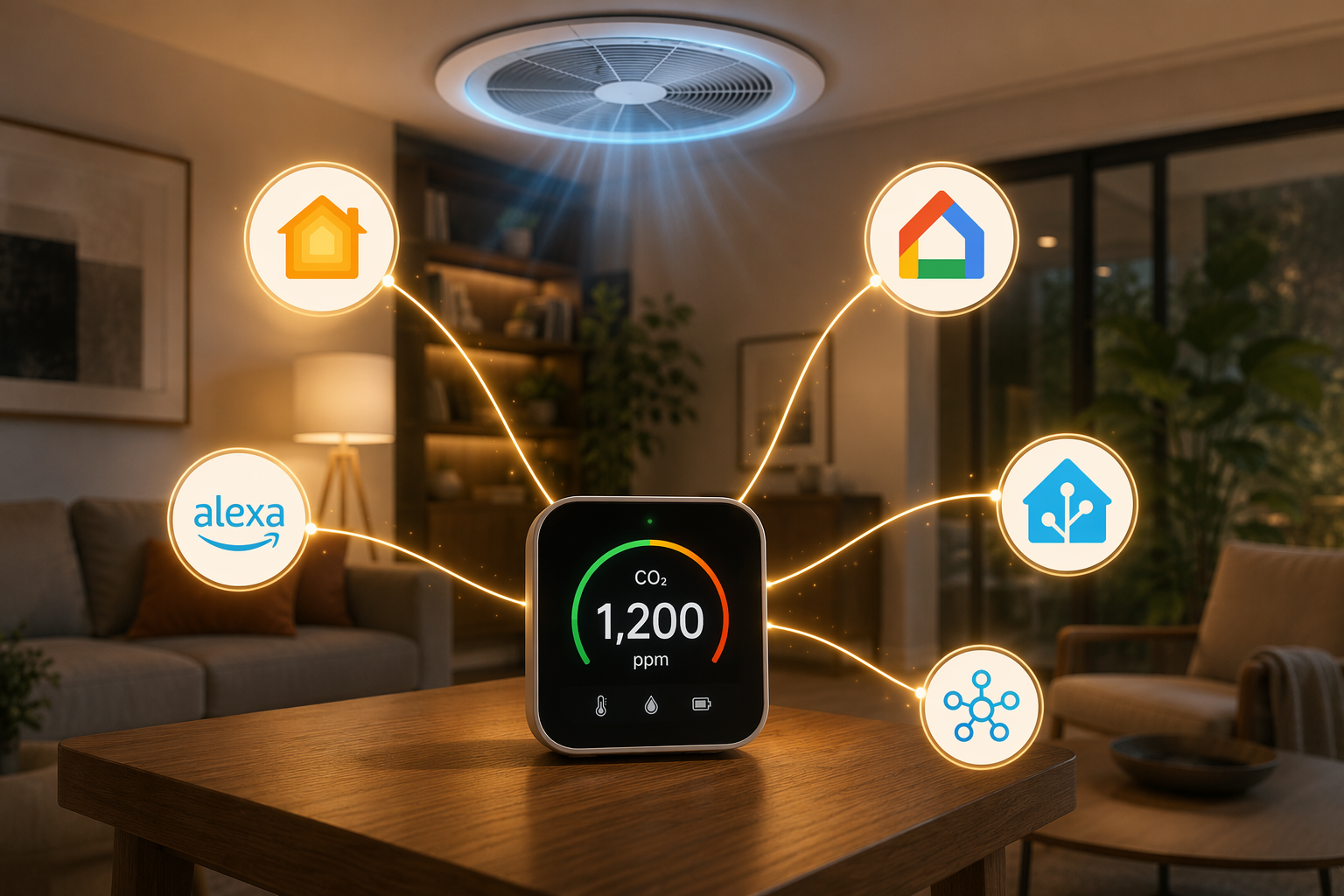
Your smart home hub determines which CO₂ monitor will automate health protections like ventilation fans and alerts. This guide ranks top models by ecosystem compatibility—HomeKit, Alexa, Google Home, Home Assistant, and Matter—so you buy a device that truly integrates with your existing setup.
- Hub requirement
- Varies by device; some require a hub or bridge
- Protocol
- Matter over Thread, Matter over Wi-Fi, BLE, Wi-Fi
- Ecosystem support
- Apple HomeKit, Home Assistant, Alexa, Google Home, SmartThings, Matter
- Certification status
- Matter certified for some; CO₂ automation requires verification
- Last verified
The easiest way to buy the wrong CO₂ monitor is to start with the prettiest dashboard. For health use, the important question is narrower: can your hub see the CO₂ number and use it to start a fan, send an alert, or tell you a room is getting stale? A monitor that accurately displays 1,200 ppm on its own screen is only halfway useful if the reading never reaches the automation layer you already live in.
This compatibility matrix is dated Q3 2026. Matter Alpha counted roughly 13 Matter air-quality sensor models in its mid-2026 guide, but that does not mean every hub exposes every pollutant as an automation trigger [1]. SwitchBot’s Meter Pro CO₂ page claims Matter compatibility and lists an NDIR CO₂ sensor, yet CO₂-over-Matter remains an investigating item because community reports say temperature and humidity may pass while CO₂ does not [2]. Aranet4 is also a special case: Home Assistant supports it through Bluetooth Low Energy, so range and proxy placement matter [3].
| Monitor | CO₂ sensor / device note | Apple HomeKit | Alexa | Google Home | Home Assistant | SmartThings | Matter | Best fit |
|---|---|---|---|---|---|---|---|---|
| Qingping Air Monitor Lite | CO₂ monitor; HomeKit path is the reason to consider it | Confirmed | Investigating | Investigating | Workaround | Investigating | Not the main path | HomeKit buyers who want native Apple visibility |
| IKEA ALPSTUGA | Matter-over-Thread air quality sensor; check whether your hub exposes the CO₂ entity before relying on automation | Confirmed via Matter/Thread border router | Investigating | Investigating | Workaround / depends on Matter implementation | Investigating | Confirmed as Matter device; CO₂ automation should be verified | Matter-first Apple homes that already have Thread |
| AirGradient ONE | Open air-quality monitor with strong Home Assistant path | Confirmed by AirGradient integrations page | Investigating | Investigating | Confirmed via ESPHome / Home Assistant | Investigating | Not the main path | Home Assistant users who want dependable local integration [4] |
| Apollo AIR-1 | Community-oriented air-quality monitor commonly considered for Home Assistant | Investigating | Investigating | Investigating | Confirmed / community path | Investigating | Investigating | Home Assistant users comfortable with maker-style hardware |
| Aranet4 | Portable CO₂ monitor; BLE integration, not Wi-Fi/Zigbee | Not Supported natively | Not Supported natively | Not Supported natively | Workaround: BLE range or ESP32 proxy required [3] | Not Supported natively | Not Supported | Home Assistant users who can place Bluetooth proxies correctly |
| SwitchBot Meter Pro CO₂ | NDIR CO₂ sensor and 5-in-1 monitoring per product page [2] | Workaround / depends on hub path | Workaround via SwitchBot ecosystem | Workaround via SwitchBot ecosystem | Workaround via BLE | Investigating | Investigating: Matter claim does not yet prove CO₂ entity exposure | SwitchBot households willing to verify CO₂ automation before buying |
| Airthings View Plus | Broad sensor suite including radon; voice and IFTTT integrations listed by Airthings | Not Supported natively | Workaround: voice integration | Workaround: voice integration | Workaround | Not Supported natively | Not Supported | People who want the Airthings app and broad IAQ tracking more than hub-native CO₂ automation [5] |
| LG Air Quality Sensor | Matter / Thread category device; verify actual CO₂ support in your hub | Investigating | Investigating | Investigating | Investigating | Investigating | Confirmed as Matter-category device | Matter testers, not set-and-forget health automation buyers |
| Sonoff AirGuard 07P | Matter Wi-Fi air-quality sensor, but not a CO₂ monitor | Not a CO₂ pick | Not a CO₂ pick | Not a CO₂ pick | Not a CO₂ pick | Not a CO₂ pick | Matter device, but no CO₂ sensor | Skip if the goal is CO₂-based health automation |
The table deliberately gives some devices a less flattering label than a store page might. “Works with Alexa” can mean voice readout. “Matter compatible” can mean the hub sees temperature and humidity but not CO₂. “Home Assistant supported” can still mean a Bluetooth monitor has to be close enough to a proxy in the room where you actually use it. Those differences are not technical trivia; they decide whether the bedroom fan turns on at night or the reading just sits in another app.
Why CO₂ belongs in a health automation
CO₂ is useful in a smart home because it is a practical signal for ventilation. CO2Meter describes classrooms reaching 4,825 ppm after lunch and a home theater reaching 2,000 ppm, both examples of occupied rooms where stale air builds up when ventilation does not keep pace [6]. The same source cites Harvard-linked cognitive-performance evidence showing a 50% drop at 1,400 ppm CO₂ [6].
For a home automation, that usually turns into a simple threshold: warn someone or increase ventilation when CO₂ rises above 1,000 ppm. The number does not need to become a lifestyle dashboard. It needs to reach the hub that can run the fan, open a smart vent where appropriate, remind someone to crack a window, or tell a renter that the bedroom is getting stale while outdoor smoke conditions make window-opening a bad idea.
Apple HomeKit: native HomeKit and Matter-over-Thread are different buys
For Apple homes, the first split is not “best sensor” versus “cheap sensor.” It is native HomeKit versus Matter-over-Thread. Qingping Air Monitor Lite belongs in the native HomeKit lane: buy it if your priority is seeing the CO₂ reading inside Apple Home and using Apple automations without building a side bridge. That is the cleaner choice for someone setting up a child’s bedroom or a small home office and who does not want to maintain Home Assistant just to move one sensor value.
IKEA ALPSTUGA is the more interesting Q3 2026 Matter path. It can make sense if your Apple home already has a Thread border router and you are comfortable confirming what Apple Home exposes before you build routines around it. The caution is simple: Matter support is not the same as a guaranteed CO₂ trigger in every ecosystem. If your intended automation is “when CO₂ exceeds 1,000 ppm, turn on the exhaust fan,” verify that Apple Home shows the CO₂ measurement as an automatable value, not just a device tile.
I would not buy Airthings View Plus as a HomeKit-first CO₂ automation device. Airthings lists Alexa, Google Assistant, and IFTTT integrations for View Plus, but not native HomeKit, SmartThings, or Matter support [5]. It may still be the right monitor if you care about its broader sensor package, including radon, and are happy living in the Airthings app. That is a different purchase than “I want Apple Home to trigger ventilation from CO₂.”
Home Assistant: the richest list, and the easiest place to fool yourself
Home Assistant is where CO₂ monitoring gets powerful, because the platform is good at turning a sensor entity into a real routine. It is also where “supported” needs a footnote. A native ESPHome device and a Bluetooth-only device can both end up in the same dashboard, but they are not equally forgiving when the monitor is two rooms away and the automation fails at midnight.
AirGradient ONE is the cleanest Home Assistant recommendation in this group. AirGradient’s integrations page lists ESPHome and Home Assistant support, along with Homey and HomeKit [4]. That makes it a good fit when the goal is local, dependable sensor access rather than app-first monitoring. If you are building a ventilation automation, the advantage is not just that Home Assistant can display the value; it is that the CO₂ entity arrives through a path Home Assistant users already know how to debug.
Apollo AIR-1 sits nearby as a community-oriented option. It is the sort of device I would consider for a Home Assistant household that is already comfortable reading release notes, checking entities after firmware updates, and treating the monitor as part of the home lab. That is a compliment, not a warning, as long as the buyer is the person who will maintain it.
Aranet4 deserves a different label: excellent portable CO₂ monitor for many people, but a workaround for Home Assistant automation. Home Assistant’s Aranet integration is BLE-based, so the monitor needs to be in Bluetooth range of the Home Assistant system or an ESP32 Bluetooth proxy [3]. That can work beautifully in a fixed room if you place the proxy correctly. It is a poor surprise if you expected a normal network device and only discover the range problem after mounting the monitor in a nursery.
SwitchBot Meter Pro CO₂ is another workable-but-verify choice. The product page lists an NDIR CO₂ sensor and 5-in-1 monitoring [2]. For Home Assistant, the safer assumption is BLE or SwitchBot ecosystem workarounds until CO₂ exposure through Matter is independently confirmed. If you already run Bluetooth proxies and like SwitchBot gear, it may be worth testing. If you want the lowest-maintenance CO₂ trigger, I would not make it the first Home Assistant pick today.
SmartHomeScene’s Home Assistant air-quality coverage is useful as a second check because it looks at devices through the same practical lens Home Assistant users use: entities, integrations, and local behavior rather than app screenshots [7]. I would still treat it as a compatibility cross-check, not a replacement for checking the current integration page and your own Bluetooth or Wi-Fi layout.
Matter: promising, but the CO₂ entity is the test
Matter is improving the air-quality sensor shelf. Matter Alpha’s mid-2026 guide lists roughly 13 Matter air-quality sensor models, which is a real change from the days when every monitor lived in its own app [1]. For CO₂ buying, though, the logo is only the beginning of the test.
The question to ask is not “does this pair with Matter?” It is “does my hub expose CO₂ as an entity I can automate?” A Matter air-quality device may report some environmental measurements while leaving out the one value you need. Sonoff AirGuard 07P is a good reminder of another trap: it may be a Matter air-quality sensor, but if it does not include a CO₂ sensor, it is not a CO₂ monitor for health automation.
For Apple users, IKEA ALPSTUGA is the Matter-over-Thread device to watch. For broader Matter households, LG’s Matter / Thread air-quality sensor is worth tracking. But in both cases, I would treat “Matter” as a setup path, not as proof that your fan routine can use CO₂. Pair first, inspect the exposed entities, then build the alert.
Alexa and Google Home: voice support is not enough
Alexa and Google Home are fine places to ask for a room condition. They are weaker buying filters when the goal is health-protective CO₂ automation. Airthings View Plus, for example, lists Alexa and Google Assistant support, but that is voice integration, not the same as native, hub-visible CO₂ automation [5]. If your plan is “ask what the air is like,” Airthings may satisfy you. If your plan is “turn on the ventilation fan above 1,000 ppm,” verify the actual trigger path before buying.
SwitchBot can also make sense in homes already using SwitchBot hubs and devices, especially if the automation stays inside that ecosystem. The unresolved part is Matter exposure of CO₂. The product page’s Matter claim and the community-reported gap can both be true in practice if only some measurements are bridged [2]. Until that is confirmed device-by-device, I would label SwitchBot for Alexa and Google homes as Workaround rather than Confirmed.
SmartThings: treat missing native support as the default warning
SmartThings buyers should be especially suspicious of generic “smart” language. Airthings View Plus does not list native SmartThings or Matter support in its tech specs, only Alexa, Google Assistant, and IFTTT [5]. Aranet4 is not a native SmartThings device. SwitchBot’s route depends on its own ecosystem and the unresolved CO₂-over-Matter question. In this category, SmartThings is less a recommendation lane than a place to stop and confirm before checkout.
That does not mean no SmartThings user can ever automate around CO₂. It means I would not buy a monitor for SmartThings unless the seller or an independent user can show the CO₂ reading inside SmartThings as a usable value. Screenshots of an app dashboard do not count. A temperature entity does not count. A vague Matter badge does not count.
Sensor quality still matters after compatibility
Once a monitor can reach your hub, sensor quality moves back up the list. BreatheSafeAir’s CO₂ monitor testing covers more than 30 devices and is useful for comparing accuracy and real-world behavior after you have narrowed the field to devices your ecosystem can actually use [8]. That order matters. A more accurate monitor trapped in its own app cannot run the fan.
Wirecutter’s 2026 home air-quality monitor guide is also a useful mainstream benchmark for polish, usability, and general buying context [9]. I would not use it as the final answer for a smart home CO₂ automation purchase, because broad air-quality rankings often reward the monitor as a standalone product. For this job, standalone excellence is only helpful after compatibility is confirmed.
The hub-specific short list
- Apple HomeKit: start with Qingping Air Monitor Lite for native HomeKit; consider IKEA ALPSTUGA if you specifically want Matter-over-Thread and can verify CO₂ automation in Apple Home.
- Home Assistant: start with AirGradient ONE; consider Apollo AIR-1 if you like community hardware; use Aranet4 only if you are comfortable solving BLE range with an ESP32 proxy.
- Alexa or Google Home: treat Airthings View Plus as a voice/app-first monitor, not automatically as an automation trigger; treat SwitchBot as a workaround until CO₂-over-Matter is confirmed.
- SmartThings: do not buy without proof that the CO₂ value appears in SmartThings as an automatable reading.
- Matter-first homes: buy only after checking that your chosen hub exposes CO₂, not merely that the device pairs.
If you already own a compatible monitor and want to build the routine, the next step is an automation around a threshold, notification, and ventilation response. I covered that setup in Automate Health Precautions with Your Smart Home Air Quality Monitor. If your health concern is also wildfire smoke or urban PM2.5, the buying logic changes; the NYC-focused guide to smart home air-quality monitors for bad smoke days is the better companion piece.
The buying rule is blunt because it prevents the expensive mistake: choose the monitor whose CO₂ value can reach your actual automation layer, then compare sensor quality and price inside that compatible set.
References
- The best Matter air quality sensors you can buy right now, Matter Alpha.
- SwitchBot Meter Pro CO₂ Monitor, SwitchBot US.
- Aranet4 integration, Home Assistant.
- Integrations, AirGradient.
- View Plus tech specs, Airthings.
- Improve Indoor Air Quality: Why Every Home Needs a CO₂ Monitor, CO2Meter.
- Best Air Quality Monitors for Home Assistant, SmartHomeScene.
- 11 Best Carbon Dioxide Monitors, BreatheSafeAir.
- The 3 Best Home Air Quality Monitors of 2026, Wirecutter.
See how this fits into the bigger picture: Ecosystem Compatibility
Report a compatibility result or correction
Tell us whether this device worked as described with your hub and ecosystem, or flag a correction if certification or firmware behavior has changed.