
Starlink versus Amazon Leo for home satellite internet
Starlink is the only commercially available LEO satellite internet with proven real-world speeds and coverage, while Amazon Leo's residential service remains pre-launch as of mid-2026. This comparison helps you decide whether to buy Starlink now or wait for Leo's promised performance and pricing.
Last updated
If you need home satellite internet in mid-2026, the comparison starts with one blunt filter: Starlink can be ordered for residential service today; Amazon Leo cannot. That does not make Leo irrelevant. It makes Leo a watchlist item rather than a purchase option, especially for households trying to keep work calls, streaming, gaming, cameras, thermostats, and smart speakers online without waiting through another vague availability window.
The current buying answer is straightforward: choose Starlink if you need satellite internet now or within the next year. Watch Amazon Leo if you can wait until late 2026 or beyond and are willing to treat its pricing, speed claims, and rollout timing as unproven until residential customers are actually using it.

| Home-buyer question | Starlink in mid-2026 | Amazon Leo in mid-2026 | What to do with that information |
|---|---|---|---|
| Can I order it for home internet? | Yes. Starlink is commercially available across more than 100 countries and claims 99.8% U.S. coverage, with more than 4 million subscribers and roughly 10,776 active satellites reported in orbit. [1] | No broad residential launch yet. Amazon Leo had 396 production satellites in orbit as of July 2026, with beta service expected later in 2026 in limited countries. [2] | If your household needs service now, this is the deciding line. |
| What does it cost? | $55/mo for 100 Mbps, $85/mo for up to 200 Mbps, and $130/mo for Residential Max up to 400 Mbps; the Standard dish is listed at $349. [3] | Monthly rates are not announced. Amazon has targeted a consumer terminal under $400, and possible Prime bundling is still a watch item rather than a confirmed residential price. [4] | Starlink prices can be budgeted. Leo pricing cannot. |
| What hardware is involved? | Standard, Mini, and High-Performance Starlink hardware are tied to an active consumer service. [3] | Amazon has described Nano, Pro, and Ultra terminals, with stated speed ceilings up to 100 Mbps, 400 Mbps, and 1 Gbps respectively. [2] | Leo’s hardware lineup is interesting, but not yet a residential buying path. |
| What performance is proven? | Starlink has real-world residential use and reported latency in the 25–60 ms range. [1] | Leo targets roughly 20–30 ms latency, but that is not yet a residential result. [4] | Use Starlink’s numbers as current-service evidence and Leo’s as targets. |
Plans and pricing: Starlink has numbers you can use; Leo has numbers to watch
Starlink’s advantage is not that every plan is cheap. It is that the prices are concrete enough to make a household decision. The current home lineup includes a $55 monthly tier for 100 Mbps, an $85 monthly tier for up to 200 Mbps, and a $130 Residential Max tier for up to 400 Mbps. The Standard dish is listed at $349. [3]
That matters more than it sounds. A rural household comparing satellite internet against weak DSL, overloaded fixed wireless, or a mobile hotspot can actually price the first year: monthly service, equipment, mounting needs, and the cost of waiting. If the current connection drops video calls or cannot carry multiple devices in the evening, the cost of doing nothing is part of the bill.
Amazon Leo’s pricing is still the opposite kind of information. A sub-$400 consumer terminal target is useful because it suggests Amazon understands hardware cost is a barrier. Possible Prime bundling is also worth watching because Amazon has a history of using Prime to make services feel cheaper or more convenient. But neither one tells a buyer what will be charged each month, what the first bill will look like, or whether the lowest price will come with speed, data, or eligibility limits. Leo’s pricing, monthly rates, and bundling are not confirmed residential offers. [4]
So the pricing comparison is asymmetrical by necessity. Starlink may or may not be the better long-term deal once Leo launches. In July 2026, it is the only one of the two with decision-grade residential prices.
Hardware: Leo’s lineup is promising, but Starlink’s dishes are already in the field
Starlink’s hardware story is familiar by now: a Standard dish for typical home use, a Mini for more portable setups, and High-Performance hardware for heavier-duty needs. The important buyer detail is not just the dish shape or size. It is that the hardware connects to a live residential network with current plans attached to it. [3]
Amazon Leo’s announced terminal lineup is more intriguing on paper. The Nano terminal is described as supporting up to 100 Mbps, the Pro up to 400 Mbps, and the Ultra up to 1 Gbps. If those categories survive into residential launch with sensible pricing, Leo could pressure Starlink at both the lower-cost and higher-speed ends of the market. [2]
For now, though, the Ultra’s 1 Gbps ceiling is not the same thing as a home customer seeing that speed on a Tuesday night. It is a terminal capability claim before broad residential service. The same caution applies to the Nano and Pro tiers: they are useful signs of how Amazon wants to segment the market, not proof of what a specific address will receive.
Performance: separate live-network evidence from launch targets
Performance is where many Starlink versus Amazon Leo comparisons get too loose. Both use low-Earth-orbit satellites, and both are aiming at lower latency than traditional geostationary satellite internet. That does not make their present-day evidence equal.
Starlink has commercially deployed residential service and reported latency in the 25–60 ms range. [1] For most home uses, that range is the difference between satellite internet that feels like an emergency fallback and satellite internet that can plausibly run normal household life: video meetings, streaming, browser work, smart-home traffic, and some gaming. It will still depend on congestion, placement, obstructions, plan, and local network conditions, but the baseline comes from an operating service.
Leo’s target of roughly 20–30 ms latency is genuinely worth attention. If Amazon reaches that range with stable throughput and competitive pricing, Starlink will face a real home-internet rival instead of another speculative constellation. But the word “target” has to stay attached to that number until residential customers can test it in ordinary conditions. [4]
The same distinction applies to speed. Starlink’s current plan ceilings can be compared against what people can buy. Leo’s Nano, Pro, and Ultra claims show the intended hardware ladder, including an Ultra ceiling up to 1 Gbps, but they do not yet establish what a household will receive after launch, during peak evening hours, behind a router, with several devices online. [2]
That is not a knock on Leo’s engineering. It is a buyer-protection line. A household replacing unreliable internet should not treat pre-launch targets as if they are the same category of evidence as a service with millions of subscribers.
Availability and coverage are the real comparison
For a home buyer, coverage is not a map screenshot. It is whether an order page accepts the address, whether the dish ships, and whether service works where the house actually sits. On that standard, Starlink is far ahead in mid-2026.
Starlink is reported as operating in more than 100 countries, claiming 99.8% U.S. coverage, serving more than 4 million subscribers, and using roughly 10,776 active satellites. [1] Satellite counts change constantly as spacecraft launch, maneuver, deorbit, or enter service, so that number should be treated as a dated snapshot rather than a permanent total. Still, the direction is clear enough for a buying decision: Starlink has a large operating constellation and a large paying customer base.
Amazon Leo is earlier in the curve. As of July 2026, it had 396 production satellites in orbit, with beta availability expected later in 2026 in a limited group of countries including the U.S., U.K., France, Germany, and Canada. [2] Wider residential availability is estimated around 2027–2029, which is a meaningful window if your current provider is merely annoying and a deal-breaker if your household needs reliable service now. [5]
This is also where a subtle regulatory caveat belongs. Leo received an FCC deadline extension that demoted its spectral priority. [6] That does not let anyone responsibly predict a specific household speed problem today. It does mean future service quality and network coordination may be affected in ways that are not yet measurable from residential use, because residential use has not broadly started.
If Leo’s beta opens near your address later in 2026, it may be worth following closely. A beta in a limited country list is not the same as broad residential availability, but it is the first point at which Amazon’s claims can begin turning into practical evidence: install experience, actual speeds, latency under load, router behavior, outage patterns, support quality, and final pricing.
Installation and equipment risk
Both services live or die at the house by the same basic reality: the terminal needs a usable view of the sky, power, and a path into the home network. Trees, rooflines, outbuildings, and bad mounting choices can matter as much as the plan name. The difference is that Starlink buyers can evaluate those constraints against actual hardware and a current app-guided setup, while Leo buyers are still waiting to see the residential kit, ordering flow, support process, and self-install details at launch. [3][4]
That gives Starlink the lower equipment-risk profile for someone buying today. You can look at the current dish price, decide whether the Standard hardware is enough, and plan the mounting work. With Leo, even a sub-$400 terminal target leaves open the practical questions: final terminal price, whether every terminal is offered to residential buyers at launch, whether the faster hardware costs much more, and whether early availability is capacity-limited by region.
Contract terms: known service beats unannounced terms
The useful contract comparison is simple because Leo’s residential terms are not public in a way a home buyer can rely on. Starlink’s current residential plans and equipment price can be checked before purchase. Leo’s monthly pricing, plan rules, equipment policies, and any bundling conditions still need to be announced for residential service. [3][4]
This is where waiting has a real cost. If Amazon launches with aggressive pricing, early buyers may benefit. If beta capacity is narrow, if rollout slips, or if the best pricing is tied to limits that do not fit your household, the wait may not pay off. None of those outcomes can be priced properly until Leo publishes residential terms.
The mid-2026 decision matrix
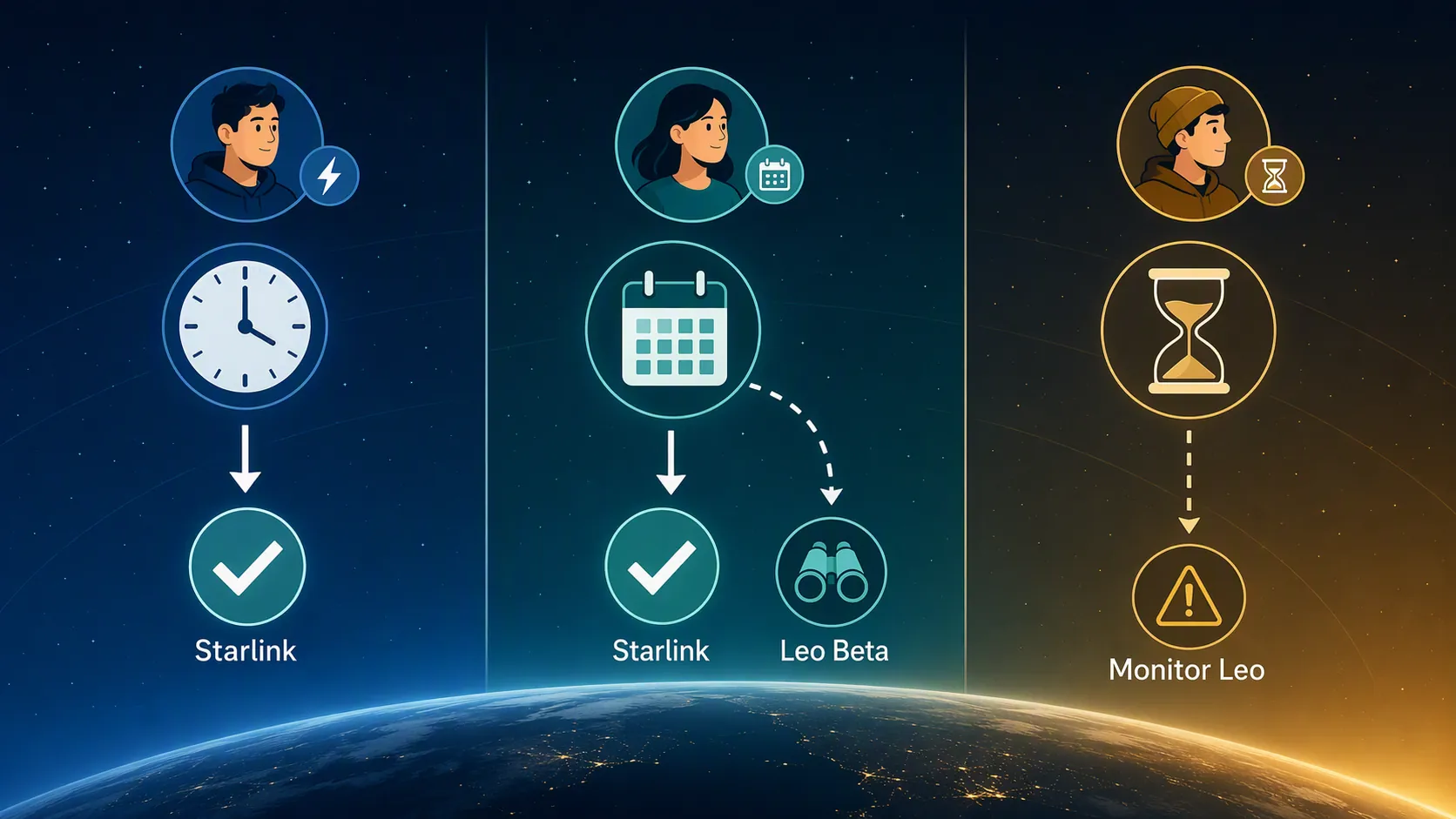
| Your situation | Best move in Q3 2026 | Why |
|---|---|---|
| You need internet this week | Buy Starlink. | It is the only one of the two with current residential availability, published home pricing, available hardware, and proven real-world use. |
| You need internet this year | Buy Starlink, but monitor Leo’s late-2026 beta. | Waiting for Leo could leave you stuck with weak service, and beta availability is expected to be limited. If Leo opens near you with good terms, you can reassess. |
| You can wait for the best deal | Watch Leo closely, but accept the risk. | Leo may create lower-cost hardware options, Prime-linked offers, or faster tiers, but its monthly pricing, residential performance, and broad availability remain unproven. |
That is the practical Starlink vs Amazon satellite internet for home comparison in mid-2026: Starlink is the buy-now answer; Amazon Leo is the potentially important future competitor. The moment Leo has residential customers, final prices, and address-level availability, the comparison gets more interesting. Until then, a household that needs reliable internet should not confuse a launch target with a service it can install.
References
- Starlink vs Kuiper — OrbitalRadar
- Amazon Leo vs Starlink comparison — Speedcast
- Starlink review — Allconnect
- Amazon Leo — SatelliteInternet.com
- When will Project Kuiper be available? — HighSpeedInternet.com
- Amazon's Project Kuiper vs. Starlink: How do they compare? — TechTarget
Known issues with this device / protocol
Spec-version history
For active regressions on this protocol, see Update Watch.
No linked Update Watch entries yet.