
Which Smart Smoke Detectors Work Best for Wildfire Season
Wildfire season brings both fire risk and hazardous smoke. This article explains when a single smart smoke detector with built-in air quality monitoring is enough, and when you need to add a dedicated PM2.5 monitor like PurpleAir to track the particle levels health agencies recommend.
Last updated
If you are shopping for the best smart smoke detectors for wildfire season, the honest answer is that one ceiling device can cover fire and carbon monoxide safety, but it usually cannot cover wildfire-smoke exposure decisions by itself. The Kidde P4010ACSCOAQ-WF is a real step forward: it combines a UL-Listed smoke alarm, carbon monoxide alarm, and indoor air quality awareness in one device. It tracks TVOCs, temperature, humidity, and mold risk. What it does not do is report PM2.5 particle levels in micrograms per cubic meter, the measurement households rely on when wildfire smoke becomes a health decision instead of a comfort complaint.[1]
That distinction matters most on the days when the sky turns orange and the house has to make choices: close up early or keep airing out, run the portable HEPA filter in the nursery or the living room, move an older parent away from a leaky front room, or decide whether the indoor air is still getting worse even after the HVAC fan has been running. A smoke alarm protects you from combustion and carbon monoxide. A PM2.5 monitor tells you whether fine particle pollution from wildfire smoke is rising, falling, or holding indoors.
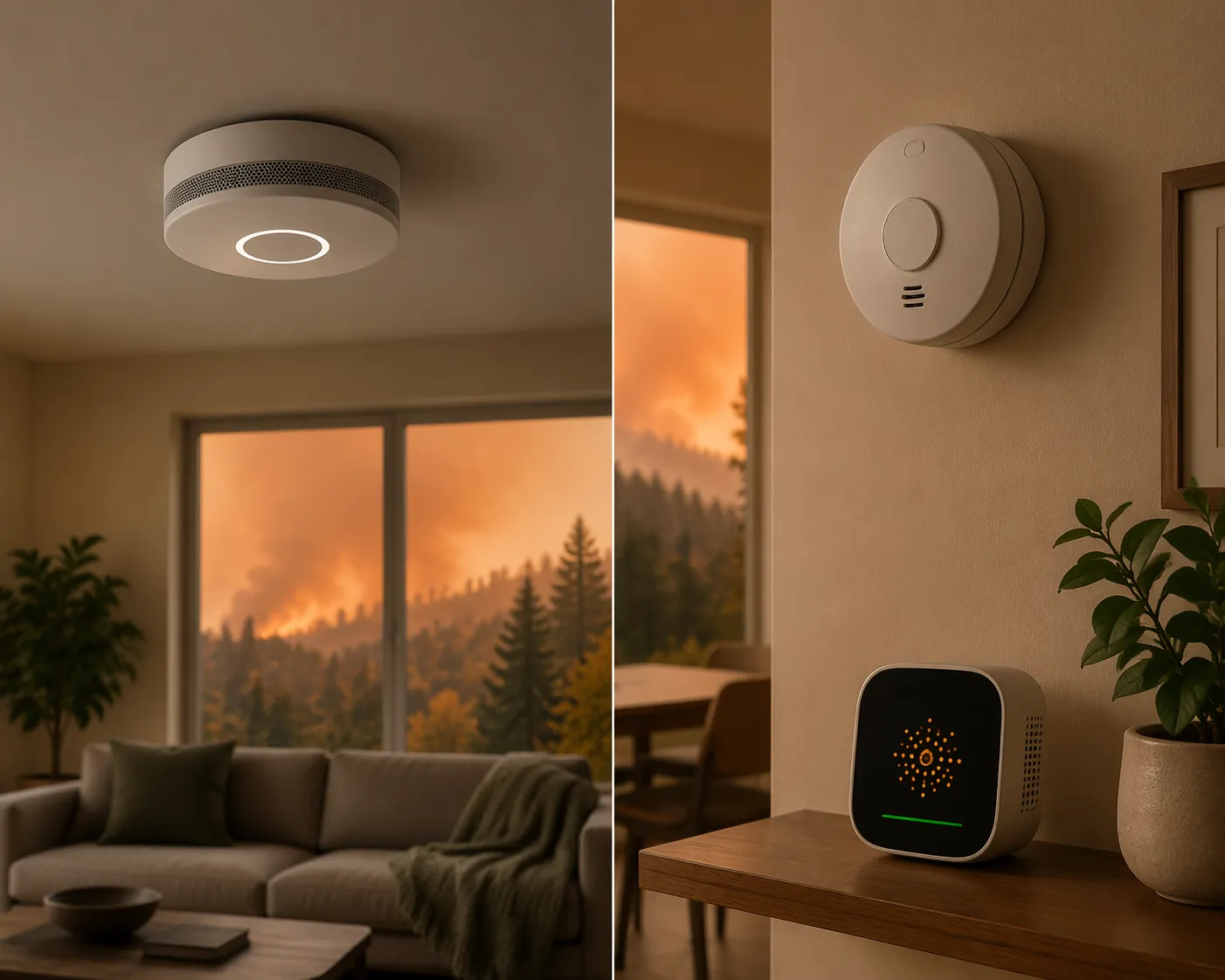
The Kidde Combo Alarm Solves a Real Problem, Just Not the Whole Wildfire Problem
The Kidde P4010ACSCOAQ-WF is the device that makes this buying decision harder in a good way. Most people do not want a ceiling full of gadgets. Renters may be allowed to install only one device. Parents already have enough battery checks, app alerts, and false alarms competing for attention. A smoke + CO alarm that also watches for indoor air quality changes is a sensible simplification, especially when the alternative is buying separate gear and hoping everyone in the household understands which app to open.
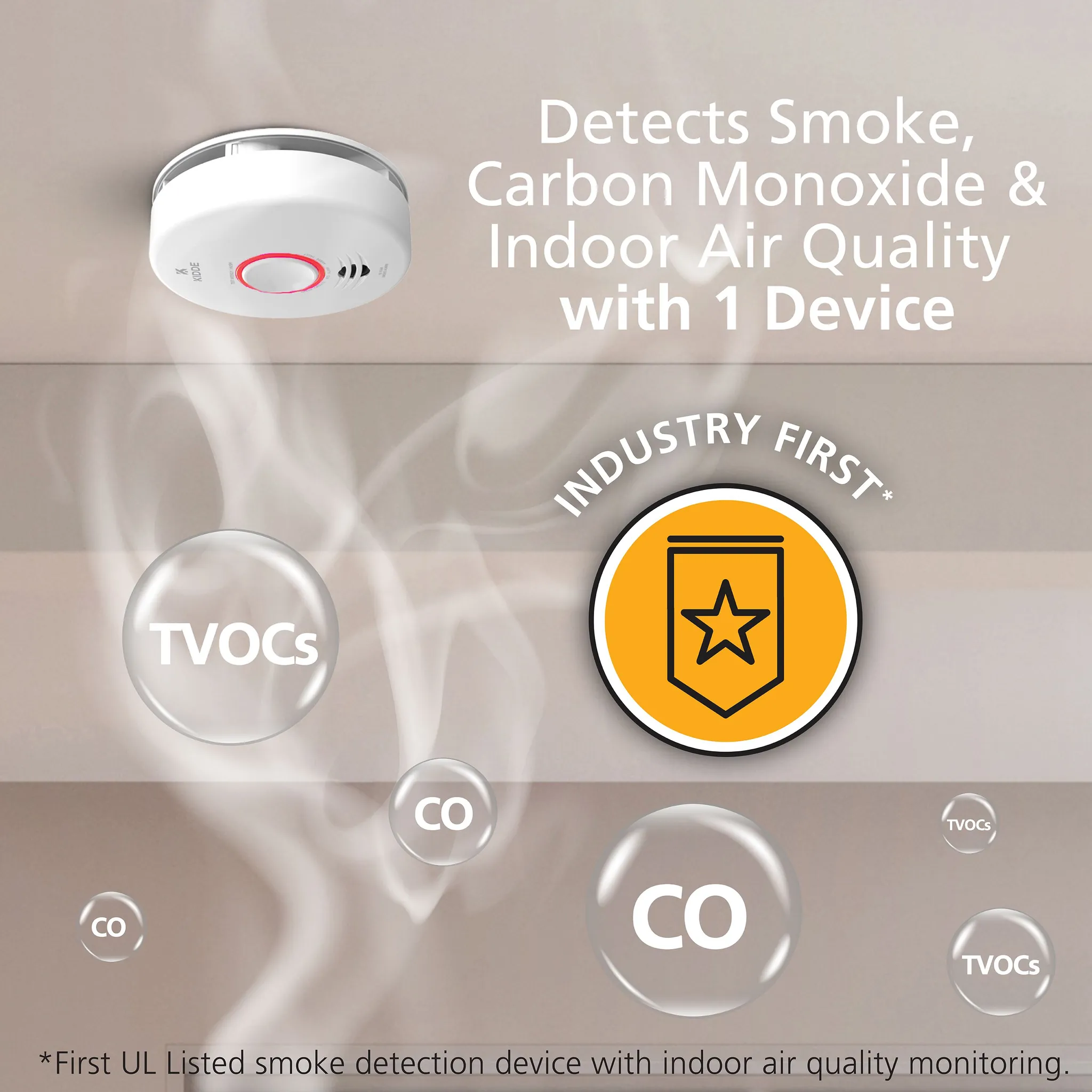
Its IAQ side watches volatile organic compounds, temperature, humidity, and mold risk.[1] Those are useful measurements. TVOCs can point to cleaning products, off-gassing, cooking byproducts, or other indoor sources. Humidity and temperature help explain comfort, condensation, and mold risk. Mold-risk alerts are especially helpful in bathrooms, basements, and older apartments where nobody is going to install a full sensor network.
But wildfire smoke is not mainly a TVOC problem inside the home. The practical question during a smoke event is fine particulate matter: PM2.5. These particles are small enough to drive health guidance, filtration decisions, and room-by-room exposure concerns. A device that says indoor air quality is worsening may be warning you about something real, but without a PM2.5 number it cannot tell you the thing most households are trying to know during wildfire season.
| Question in the house | What the Kidde combo alarm can answer | What a PM2.5 monitor can answer |
|---|---|---|
| Is there a fire or carbon monoxide emergency? | Yes, as a smoke + CO alarm | No |
| Are TVOCs, humidity, temperature, or mold-risk conditions changing? | Yes | Usually not the main job |
| Is wildfire smoke particle pollution rising indoors? | Not directly | Yes, if it reports PM2.5 |
| Which room is cleaner during a smoke event? | Not by PM2.5 | Yes, with room-by-room placement |
| Can I compare indoor readings with wildfire-smoke guidance? | Not with a PM2.5 value | Yes, with the needed particle metric |
TVOCs Are Indoor Air Quality Awareness; PM2.5 Is the Wildfire Smoke Number
The easiest way to separate the categories is to ask what decision the number changes. TVOC, temperature, humidity, and mold-risk alerts can tell you that the indoor environment deserves attention. Open a window on a clean-air day. Run a bathroom fan longer. Change a cleaning routine. Check a damp closet. Those are ordinary home-maintenance decisions, and a combined alarm makes them more likely because the sensor is already installed.
PM2.5 changes a different set of decisions. It is the number people watch when outdoor smoke enters through gaps, when a filter starts losing ground, or when one room is safer than another. It is also the number that lets you compare indoor conditions with public smoke guidance instead of guessing from smell, haze, or a generic air-quality warning.
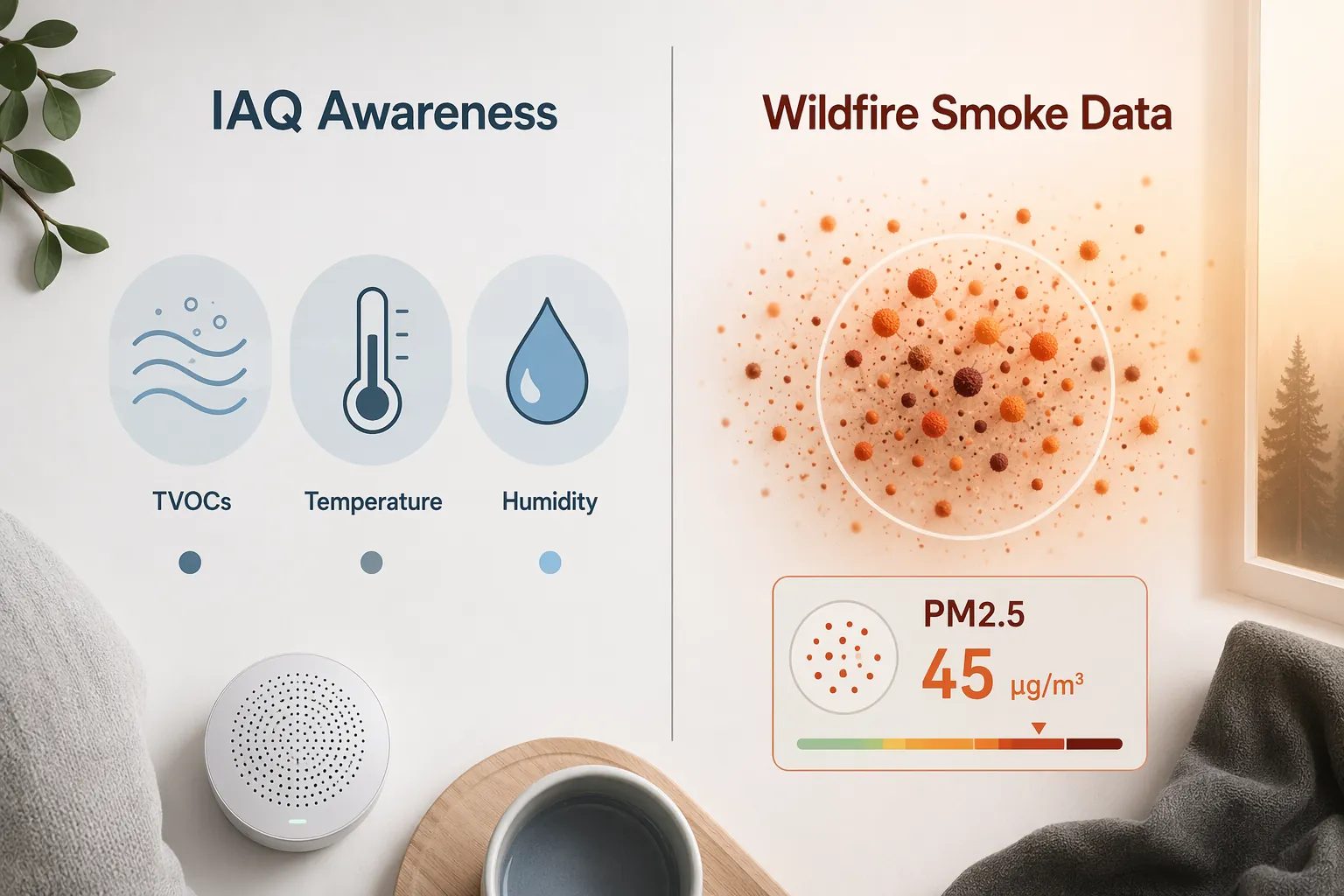
This is why the Kidde alarm should not be dismissed as a gimmick, and also should not be sold to yourself as a PurpleAir replacement. It is doing a useful indoor-air job around a certified life-safety device. It is not counting fine particles from wildfire smoke with a laser particle counter, and it cannot show a PM2.5 concentration in µg/m³.[1]
Why PurpleAir Still Has a Place Next to a Smart Smoke Alarm
Dedicated low-cost PM2.5 monitors are not perfect instruments, and that is worth saying before anyone treats a consumer sensor like a lab reference device. Berkeley Lab reported in 2020 that low-cost monitors such as PurpleAir overreported PM2.5 during wildfire events by factors of 1.6 to 2.4. The same work found that their relative changes tracked reference monitors “phenomenally well,” which is exactly the kind of imperfect-but-useful behavior that matters in a home during smoke season.[2]
That means a PurpleAir reading may need calibration or interpretation, especially if you are trying to compare it precisely with an official monitor. But for household operations, the trend is often the point. Is the bedroom improving after the air purifier turns on? Did the living room spike when someone opened the patio door? Is the indoor reading still climbing even though the outdoor map looks better? A PM2.5 monitor can answer those questions in a way a TVOC-based IAQ alert cannot.
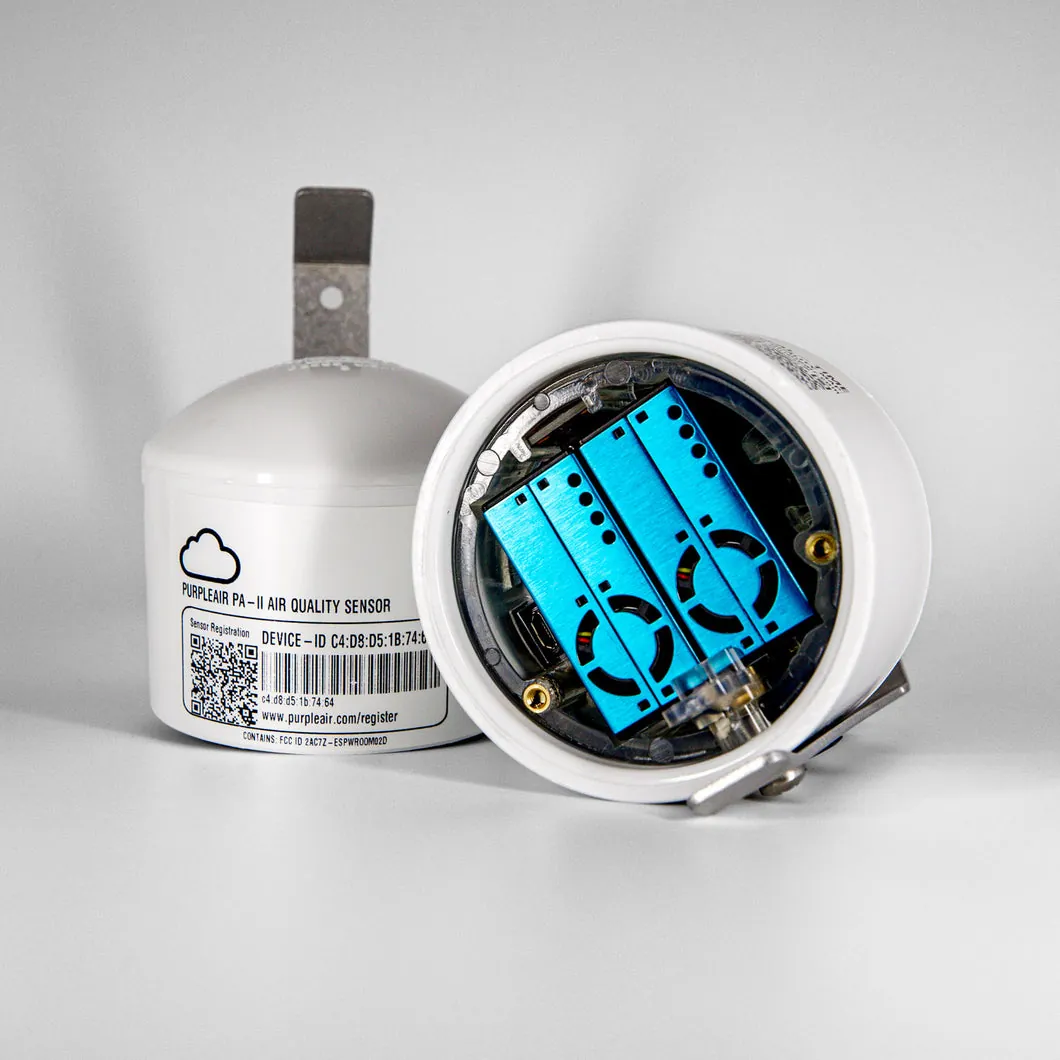
PurpleAir also matters because it is not just a standalone gadget. PurpleAir PA-II monitors are integrated into the EPA’s Fire and Smoke Map, which has made the network a familiar reference point for wildfire smoke tracking.[3] That does not make every individual home sensor official or flawless. It does make the platform unusually useful for people who already check regional smoke conditions and want their indoor decisions to line up with the same PM2.5 language.
When One Device Is Enough
A combo alarm like the Kidde P4010ACSCOAQ-WF can be enough if your wildfire-smoke risk is occasional, your household does not include anyone especially vulnerable to smoke, and your main goal is to improve basic coverage without building a sensor network. In that situation, the life-safety role comes first: smoke and carbon monoxide detection should not be compromised just to chase extra smart-home data.
- A rental or small apartment where one ceiling device is the realistic installation limit
- A household that wants smoke, CO, and general IAQ nudges in one familiar alarm form factor
- A mild-smoke region where wildfire days are infrequent and decisions are mostly based on outdoor alerts
- A budget-constrained setup where the first priority is replacing old alarms with connected, certified protection
The important expectation is modesty. The Kidde device can warn that indoor conditions are changing. It can consolidate alerts. It can make IAQ visible to someone who would never buy a separate monitor. For many homes, that is a meaningful upgrade. It just should not be asked to make particle-exposure calls it is not equipped to make.
When Two Devices Are the More Correct System
If you live in a high-smoke region, the two-device answer is cleaner: use a certified smart smoke/CO alarm for life safety, and add a dedicated PM2.5 monitor for wildfire-smoke decisions. That is not gadget excess. It is using the right sensor for the right failure mode.
- Choose two devices if anyone in the home has asthma, COPD, heart disease, pregnancy-related concerns, or other smoke sensitivity.
- Choose two devices if you need to compare rooms and decide where a child, older adult, or medically vulnerable person should sleep.
- Choose two devices if you run portable filtration and want to confirm whether it is reducing particles where people actually spend time.
- Choose two devices if you want PM2.5 readings that can be interpreted alongside wildfire-smoke maps and health-agency guidance.
- Choose two devices if wildfire smoke is a seasonal operating condition for your home, not a rare inconvenience.
The paired setup also avoids a bad smart-home habit: treating a combined dashboard as if every tile has the same safety meaning. Smoke alarm, CO alarm, TVOC trend, humidity warning, and PM2.5 concentration are not interchangeable warnings. They call for different actions, and some of those actions carry higher stakes than others.
A Few Smart Smoke Detector Side Notes That Matter in Wildfire Country
The wildfire-season question is not only about sensors. It is also about alert paths when the grid, internet, or cell network becomes unreliable. Power shutoffs and evacuation conditions expose the difference between a device that works locally and a device that depends heavily on cloud service.
Matter and Thread are worth watching, but availability is still narrow
The Heiman S1-M is notable because it supports Matter-over-Thread and UL 217 9th Edition, and can operate locally through a Thread Border Router rather than depending on a cloud path for basic smart-home communication.[4] That kind of architecture is attractive in wildfire areas because internet outages are not theoretical. The tradeoff is that Matter smoke and CO detector options are still limited compared with ordinary Wi-Fi alarms, and buyers need to check hub and ecosystem support carefully.
Professional dispatch is a different priority
Kidde’s Ring Smart Smoke + CO Alarm is the more relevant option when the priority is emergency response rather than indoor air quality detail. Kidde describes it as offering professional emergency dispatch through a Ring subscription and cellular backup when Wi-Fi is down.[5] That can matter during public safety power shutoffs or when nobody is home. It still does not turn the alarm into a PM2.5 wildfire-smoke monitor.
Modern smoke detection is improving, but product claims need care
There is good reason to value newer smoke-alarm technology. Oak Ridge National Laboratory reported smart smoke alarm algorithms, commercially licensed since 2016 and embedded in many consumer detectors, that detected smoldering fires 30 to 40 minutes faster than conventional alarms.[6] That is especially relevant when smoldering can precede visible flames. The source does not identify every current retail model using those algorithms, so this evidence supports the broader value of modern detection rather than a claim that any specific alarm on a store shelf has that exact performance.
The Practical Buying Answer
Start with certified smoke and CO coverage. That is the nonnegotiable layer. If the Kidde P4010ACSCOAQ-WF fits your home, budget, and installation limits, its indoor air quality features are a useful bonus, not marketing fluff. It is particularly sensible where the realistic alternative is an old standalone alarm plus no IAQ awareness at all.
Then ask what you need to decide during wildfire season. If you only need a general nudge that indoor conditions are changing, one smart combo alarm may be enough. If you need to decide whether a bedroom is safer than the living room, whether filtration is working, or whether indoor particle levels are still climbing during a smoke event, add a PM2.5 monitor.
For a smoke-prone household, the best system is not the neatest single device. It is a certified smart smoke/CO alarm doing life-safety work, paired with a dedicated PM2.5 monitor doing wildfire-smoke exposure work. One device can be enough for awareness. Two devices are the more correct answer when the job includes health-grade smoke decisions.
References
- Smoke + Carbon Monoxide Alarm with Indoor Air Quality Monitor, Kidde.
- Low-cost home air quality monitors prove useful for wildfire smoke, Berkeley Lab News Center, August 18, 2020.
- How to Use Air Quality Monitors During Wildfires, PurpleAir.
- Best Matter Smoke & Carbon Monoxide Detectors, Matter Alpha.
- Ring Smart Smoke Alarm, Kidde.
- Smart smoke detectors reduce false alarms and save lives, Oak Ridge National Laboratory.
Known issues with this device / protocol
Spec-version history
For active regressions on this protocol, see Update Watch.
No linked Update Watch entries yet.