
Smart Features Won't Make a Tabletop Fire Pit Safer
Pre-purchase safety review of smart tabletop fire pits, built on the CPSC's 2024–2026 warnings and recalls. It shows why fuel design and certification determine safety — not 'smart' features — so you can tell a genuinely safe model from a hazardous pour-and-ignite design.
Last updated
For a smart tabletop fire pit safety review, the first useful question is not whether the flame can be adjusted from a phone. It is what fuel is being burned, how that fuel gets into the burner, and what stops the fire when something goes wrong. The CPSC’s recent record points in one direction: the hazardous tabletop products it warned about or recalled from late 2024 through mid-2026 were pour-and-ignite liquid-fuel designs, especially alcohol or bioethanol units. In its December 2024 consumer alert, the agency said certain alcohol or other liquid-burning fire pits posed risks of flame jetting, pool fires, serious burn injury, and death, and that the products “violate the requirements in voluntary safety standard ASTM F3363-19.” [1]
That makes “smart” a weak safety word in this category. A Bluetooth fan, a remote, or a timer may change convenience. It does not change the combustion problem in a bowl that invites a user to pour alcohol into a hot or still-burning reservoir.
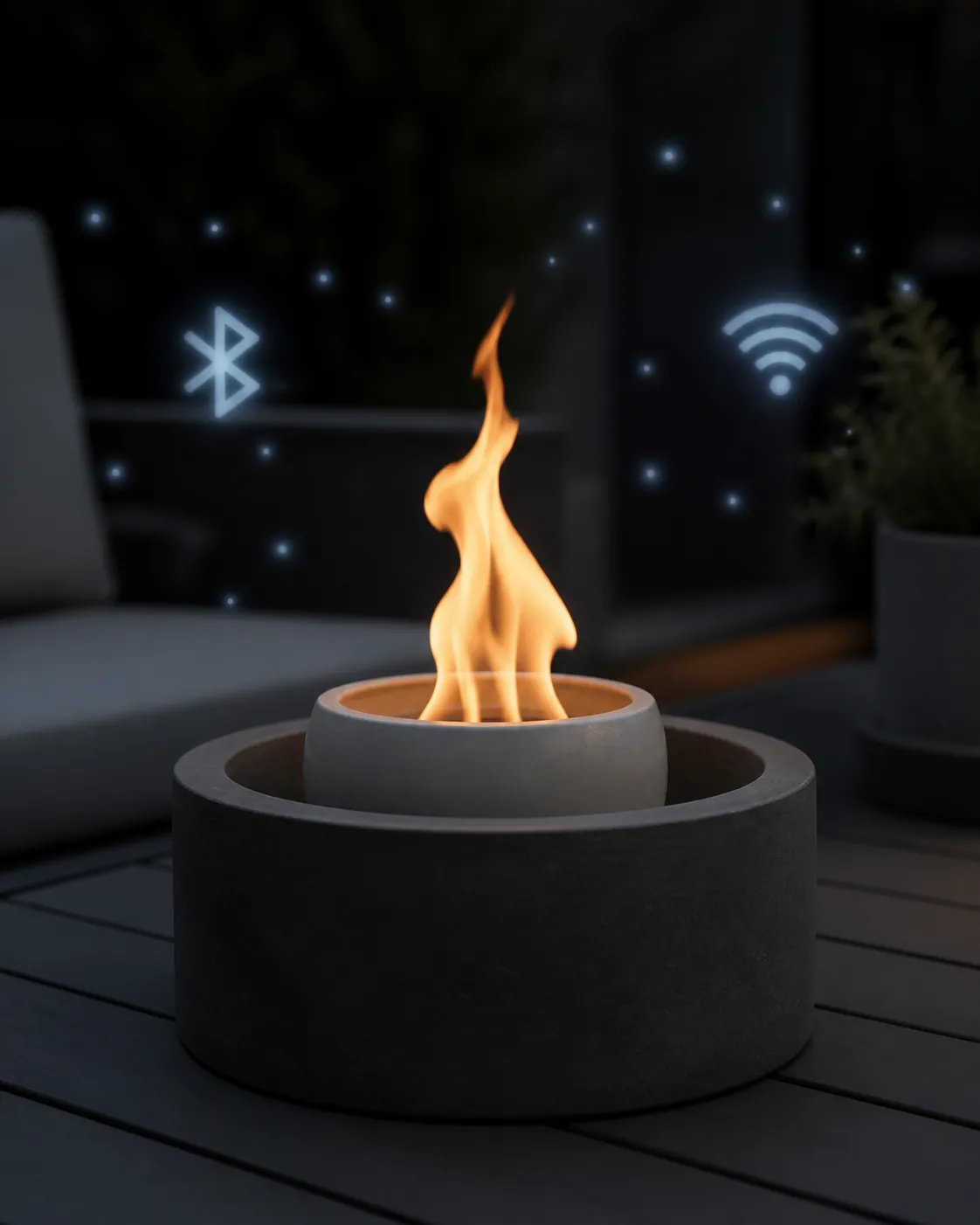
What “smart” actually means in tabletop fire pits
In the searched set available by August 2026, genuine app control was thin. BioLite’s FirePit+ is a wood-burning portable fire pit with Bluetooth airflow control through the BioLite Energy app; its official specifications list a 12,800 mAh power pack, 51 air jets, about 19.8 lb weight, and fan burn-time estimates of about 30 hours on low, 14 hours on medium, and 7 hours on high, with iOS 10.0+ and Android 12.0+ app support listed on the current product page. [2]
A May 2026 SmartHomeExplorer synthesis identified only two app-controlled fire pits in its smart-connected set: BioLite FirePit+ and HPC Fire Sedona, the latter described as a Wi-Fi and Bluetooth gas installation priced above $2,000 and requiring professional setup. The same synthesis found no native Matter, Alexa, Google Home, HomeKit, Zigbee, Z-Wave, or Thread support in the products it covered. Treat that as a searched-set finding, not as a universal certification database. [3]
If ecosystem compatibility matters, it belongs after the safety check. A buyer can read more on why Matter is the smart-home standard to start with or how Zigbee, Z-Wave, and Thread differ, but none of those radios makes a tabletop burner safer by itself. Bluetooth-only control also has ordinary range and dependency limits, which is the same general problem NestGrid flags in other connected-device categories when separating a control surface from the hardware beneath it.
The CPSC timeline is not random product noise
The official sequence matters because it keeps returning to the same design pattern. These were not warnings about app bugs. They were actions against tabletop or portable decorative fire products that use liquid alcohol or bioethanol fuel poured into a burner.
| Date | CPSC action | Product or category | What the action said |
|---|---|---|---|
| Oct. 17, 2024 | Recall 25-015 | Colsen tabletop fire pits | About 89,500 units recalled after 31 flame-jetting or flame-escape incidents and 19 burn injuries. [4] |
| Dec. 19, 2024 | Warning 25-074 | Alcohol or other liquid-burning fire pits | CPSC consumer alert tied the category to two deaths, dozens of serious burn injuries, flame jetting, pool fires, and violation of the voluntary ASTM F3363-19 requirements. [1] |
| Dec. 19, 2024 | Warning 25-073 | FLIKRFIRE tabletop fireplaces | CPSC warned consumers to stop using the products because of flame-jetting and fire hazards, with risk of serious burn injury and death. [5] |
| Sept. 18, 2025 | Recall 25-467 | Five Below tabletop fire pits | About 66,000 units recalled because of burn and fire hazards. [6] |
| May 7, 2026 | Warning 26-473 | Northlight Bio Ethanol Portable Tabletop Fireplaces | CPSC warned of risk of serious burn injury or death. [7] |
| July 16, 2026 | Warning 26-615 | Houswise tabletop fire pits | CPSC cited more than two dozen reports and seven injuries, including third-degree burns, with at least 53,500 units affected. [8] |
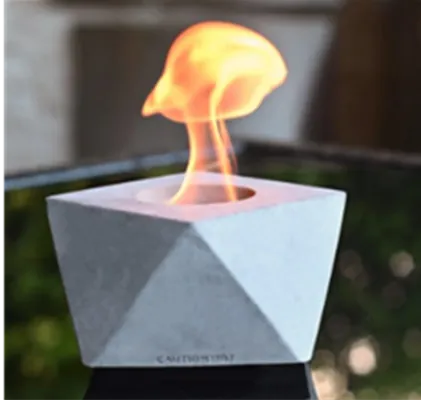
The Colsen recall is the cleanest early example because it names both scale and failure mode. Nearly 90,000 units is not a boutique anomaly, and 31 flame-jetting or flame-escape incidents are enough to show a repeatable hazard rather than a single mishandled patio accessory. The 19 burn injuries reported in that recall are also a reminder that a tabletop format does not make a flame small in consequence. [4]
Two months later, the CPSC did something broader. Its Warning 25-074 was not limited to one brand; it warned consumers about alcohol or other liquid-burning fire pits as a class when they do not meet the voluntary ASTM F3363-19 requirements. The agency connected these products to two deaths and dozens of serious burn injuries, and it named the two failure modes that matter most for a shopper: flame jetting and pool fires. [1]
On the same day, the CPSC issued Warning 25-073 for FLIKRFIRE tabletop fireplaces. The agency’s stop-use language again centered on flame jetting and fire hazards, not on styling, remote controls, or whether the product looked contained on a dining table. [5]
The pattern did not end with the 2024 holiday season. In September 2025, Five Below recalled about 66,000 tabletop fire pits because of burn and fire hazards. In May 2026, the CPSC warned consumers about Northlight Bio Ethanol Portable Tabletop Fireplaces. In July 2026, it warned about Houswise tabletop fire pits after more than two dozen reports and seven injuries, including third-degree burns, with at least 53,500 units affected. [6][7][8]
That accumulation is the review. The dangerous line in the official record is not “connected versus unconnected.” It is pour-and-ignite liquid fuel versus a design that controls fuel, flame detection, shutoff, and compliance in a way a user can verify before lighting it.
Why liquid alcohol tabletop pits fail so badly
The ugly part is the refuel moment. Alcohol and bioethanol flames can be hard to see, especially in daylight. If a user thinks the burner is out and pours more fuel into a hot unit or a unit that still holds flame, vapors can ignite and project fire outward. That is flame jetting. If burning liquid spills or spreads across a surface, the problem becomes a pool fire. ASTM F3363-19 is aimed at these kinds of hazards, and the CPSC’s consumer alert explicitly tied the warned category to flame jetting and pool fires. [1]
The temperatures leave almost no room for a useful reflex. Isopropyl alcohol and bioethanol can burn above 1,600°F, and third-degree burns can occur in less than one second; a later legal explainer summarizing the tabletop-fire-pit injury pattern used the same physics to describe why these incidents become severe so quickly. [9]
A phone app cannot see an invisible flame unless the appliance has the right sensing hardware. A timer cannot make open liquid fuel stable. A “smokeless” claim says nothing about whether a child, guest, or tired adult can safely distinguish an extinguished burner from a still-dangerous one before refueling.
The verification order that actually helps before purchase
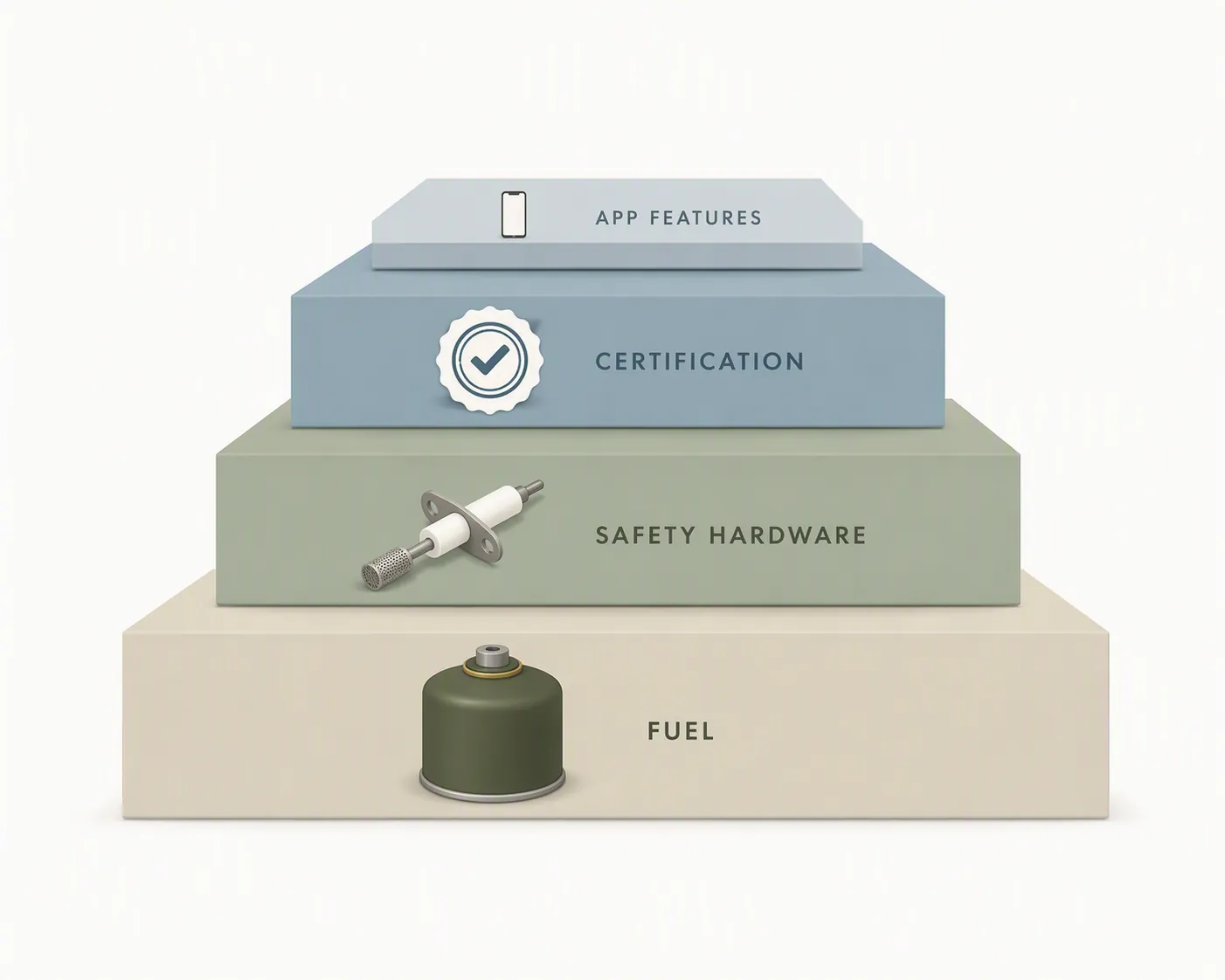
A shopper should not have to become a fire-code researcher to avoid a bad purchase. The workable order is simple: fuel class first, safety hardware second, certification third, app features last. If the first layer fails, the fourth layer is decoration.
| Check | What to look for | What to do with the answer |
|---|---|---|
| Fuel class | Pour-in alcohol, bioethanol, gel can, wood, pellet, propane, or natural gas | Avoid pour-and-ignite liquid alcohol or bioethanol tabletop designs unless credible ASTM F3363-19 relevance and safety design are clear. |
| Safety hardware | Thermocouple or flame sensor, automatic shutoff, tip-over shutoff, stable burner construction | Do not treat a remote, timer, or app as a substitute. |
| Certification | CSA, UL, or other credible label visible in the manual, rating plate, or listing documents | Verify the label and read the placement limits that come with it. |
| Connectivity | Bluetooth, Wi-Fi, remote control, app availability, ecosystem support | Use it as convenience only after the combustion design passes. |
Liquid pour-and-ignite alcohol or bioethanol
This is the strongest avoid category for pre-purchase shoppers. If you already own a model named in a CPSC recall or warning, follow the agency’s stop-use or recall instructions rather than trying to make the unit safer with different handling. The owner of a recalled unit does not need ambiance advice; they need the product off the table.
For models not named in the CPSC actions, the same design question still applies. If the product depends on the user pouring liquid fuel into an open reservoir and lighting it, the burden of proof is high. Look for explicit documentation tied to ASTM F3363-19, and remember the CPSC’s wording: voluntary safety standard, not federal regulation. A listing that says “clean-burning,” “smokeless,” “indoor/outdoor,” or “smart” does not answer the flame-jetting question.
Wood and pellet tabletop pits
Wood and pellet models sit in a different risk class from pour-and-ignite alcohol bowls because the user is not pouring volatile liquid fuel into a hot reservoir. That does not make them indoor appliances. Smoke, embers, carbon monoxide, hot metal, and surface damage still matter.
Burn-time claims are useful mainly for expectations. GearJunkie described the 1.4 lb Solo Stove Mesa as producing roughly 22 to 45 minute burns, while OutdoorGearLab measured about 10 minutes in its January 2026 review; HGTV’s June 2026 roundup described some pellet tabletop pits, including COOZOOM and YEFU examples, around one hour to one hour and fifteen minutes, and Mesa XL near one and a half hours. Those figures help you understand tending and refueling cadence, not whether the product belongs under a roof or near fabric. [10][11][12]
Propane and gas tables
Propane and natural-gas tabletop or table-style appliances can be the more controlled path when they are built as gas appliances rather than decorative open bowls. The important words are not “remote” or “Wi-Fi.” They are thermocouple, flame sensor, automatic gas shutoff, tip-over protection, regulator, hose routing, and installation requirements.
Firepits Direct’s propane fire table FAQ describes flame-sensing safety shutoff as a common feature in better gas fire pit tables, and also notes placement constraints such as substantial overhead clearance under covered spaces. The Spruce, citing NFPA guidance, reports keeping fire pits about 10 feet from structures. Use those as placement constraints to verify in the specific manual, not as permission to improvise a gas flame wherever a table fits. [13][14]
Certification labels are not lifestyle badges
A credible CSA or UL-style certification label matters because it gives the buyer something more concrete than product copy. It should appear in the manual, on the rating plate, or in listing documentation, and it should match the fuel type and installation type. A gas appliance label does not certify a separate alcohol burner. A manufacturer safety FAQ is useful, but it is not the same thing as independent verification; Outland Living’s FAQ, for example, discusses CSA-approved fire tables from the manufacturer’s own position, so its claims should be checked against the product’s actual label and manual. [15]
The same applies to clearance rules. Some gas fire table guidance refers to large overhead clearances under covered areas, such as about 80 inches in Firepits Direct and Outland Living materials, while other placement advice keeps fire pits roughly 10 feet from structures. Those numbers are not interchangeable. The manual for the exact model controls how the appliance may be used. [13][14][15]
Date-stamp every app and price claim
Connectivity claims age faster than burner hardware. BioLite’s current official FirePit+ page lists the product at $499.95 with a regular price of $599.95 and a free carry bag, while the May 2026 SmartHomeExplorer guide and retail references cited lower street-price ranges around $230 to $270. That discrepancy is not a safety issue by itself; it is a reminder to check current first-party specifications before treating a review, roundup, or marketplace tile as current. [2][3]
The same caution applies to app availability. The official BioLite page now lists Android 12.0+ and iOS 10.0+ support. Older review comments about app support should not be treated as current unless they are rechecked against the live product page and app store listing. [2]
Safe-use rules that remain non-negotiable
Once the product passes the pre-purchase screen, ordinary use still has consequences. Keep wood and propane flames outdoors unless the exact appliance is certified and documented for a specific indoor use. Put the unit on a non-combustible, stable surface. Keep it away from structures, overhangs, umbrellas, curtains, dry leaves, and table décor. Treat the roughly 10-foot clearance reported by The Spruce from NFPA guidance as a baseline to check against the model manual. [14]
- Never refuel a liquid-fuel fire pit while it is hot, smoking, or possibly still burning.
- Do not assume a small flame is safe because the burner is tabletop-sized.
- Keep children, pets, sleeves, napkins, and serving dishes outside the flame and spill zone.
- Read the manual before first use, not after the first flare-up.
- If the product has a CPSC recall or warning, stop using it and follow the official remedy.
Pre-purchase verdict
Avoid pour-and-ignite liquid-fuel tabletop fire pits, especially alcohol or bioethanol designs that do not clearly address ASTM F3363-19. If the model appears in a CPSC recall or stop-use warning, do not keep using it because it looks manageable or because the flame is small.
For the rest of the category, evaluate the burner before the app. Wood and pellet models may be simpler to understand but still need outdoor placement and hot-surface discipline. Propane or gas tables can be reasonable only when they carry meaningful safety hardware, credible certification labels, and clear installation limits. Bluetooth, Wi-Fi, a remote, or a product page calling something “smart” belongs at the end of the checklist, after the fuel and fail-safes have already earned trust.
References
- CPSC Warns Consumers to Immediately Stop Using Alcohol or Other Liquid-Burning Fire Pits Due to Risk of Serious Injury or Death — U.S. Consumer Product Safety Commission, Dec. 19, 2024
- FirePit+ Smokeless Fire Pit — BioLite
- Best Smart Connected Fire Pits 2026 — SmartHomeExplorer, updated May 16, 2026
- Colsen Recalls Tabletop Fire Pits Due to Flame Jetting and Fire Hazards; Risk of Serious Burn Injury and Death; Sold Exclusively on Amazon.com — U.S. Consumer Product Safety Commission, Oct. 17, 2024
- CPSC Warns Consumers to Immediately Stop Using FLIKRFIRE Tabletop Fireplaces Due to Flame Jetting and Fire Hazards; Risk of Serious Burn Injury and Death — U.S. Consumer Product Safety Commission, Dec. 19, 2024
- Five Below Recalls Tabletop Fire Pits Due to Burn and Fire Hazards; Risk of Serious Injury or Death — U.S. Consumer Product Safety Commission, Sept. 18, 2025
- CPSC Warns Consumers to Immediately Stop Using Northlight Bio Ethanol Portable Tabletop Fireplaces Due to Risk of Serious Burn Injury or Death — U.S. Consumer Product Safety Commission, May 7, 2026
- CPSC Warns Consumers to Immediately Stop Using Houswise Tabletop Fire Pits Due to Risk of Serious Burn Injury or Death — U.S. Consumer Product Safety Commission, July 16, 2026
- Tabletop Fire Pits: A Preventable Fire and Burn Hazard — Best Law Firms, July 31, 2026
- Solo Stove Mesa Fire Pit Review — GearJunkie
- Solo Stove Mesa Tabletop Review — OutdoorGearLab, Jan. 2026
- Best Tabletop Fire Pits — HGTV, June 26, 2026
- Propane Fire Table FAQs — Firepits Direct
- The Best Propane Fire Pits — The Spruce, June 3, 2026
- Are Fire Pit Tables Safe? We Answer Common Questions — Outland Living
Known issues with this device / protocol
Spec-version history
For active regressions on this protocol, see Update Watch.
No linked Update Watch entries yet.